



























Why Ujjain Appears Repeatedly in Ancient Hindu Texts
Discover why Ujjain appears repeatedly in ancient Hindu texts. From the Skanda Purana and Mahabharata to the Surya Siddhanta and Kalidasa, explore the scriptural, cosmic, and literary roots of this eternal city.



The Sapta Puri Status and the Garuda Purana's Guarantee of Liberation
The most fundamental and widely cited reason for Ujjain's scriptural prominence is its inclusion among the Sapta Puris, the seven sacred cities of Hinduism that are repeatedly listed in the Garuda Purana, the Skanda Purana, and the Matsya Purana. The canonical verse, known to devout Hindus across the subcontinent, declares that Ayodhya, Mathura, Maya (Haridwar), Kashi, Kanchi, Avantika (Ujjain), and Dvaravati (Dwarka) are the seven cities that grant moksha—final liberation from the cycle of birth and death—to those who die within their boundaries. This is not a minor theological footnote. The Sapta Puri classification is a cornerstone of Hindu sacred geography, a metaphysical zoning law that elevates these seven locations above all other tirthas. Ujjain, as Avantika, is not an optional stop on a pilgrim's itinerary; it is a non-negotiable node in the spiritual circuit that every devout Hindu is enjoined to visit or, at the very least, to remember at the moment of death. The Puranas embed this promise in the very soil of the city, declaring that its earth is not ordinary clay but a substance infused with the presence of Mahakal, and that the very air of Avantika carries the potency to dissolve the karmic debts of countless lifetimes. This Puranic guarantee is the bedrock upon which all of Ujjain's other scriptural appearances are built. 🔱
The Skanda Purana's Avanti Khanda and the Encyclopedic Glorification
If the Sapta Puri classification is the foundation, the Skanda Purana's Avanti Khanda is the towering edifice. The Skanda Purana, the largest of the eighteen Mahapuranas, is a sprawling, encyclopaedic text, and within its vast corpus, the Avanti Khanda stands out as a focused, almost obsessive, glorification of Ujjain. This section, running into thousands of verses, is not a casual travelogue; it is a comprehensive and systematic mapping of the sacred. It describes, in meticulous detail, the 84 Siddhas who attained perfection on Ujjain's soil, the eternal Siddhavat banyan tree that survives the cosmic dissolution, the purifying power of the Shipra River, and the specific spiritual benefits of bathing at each of her ghats. It catalogues the 84 Mahadeva temples that form a protective ring around the city, each linked to a specific Siddha and a specific planetary energy. It narrates the story of Goddess Parvati's penance on the Shipra's bank and Shiva's manifestation as Mahakaleshwar. The Avanti Khanda functions as a scriptural pilgrimage guide, a theological manifesto, and a cosmic map all at once. By devoting such an extraordinary volume of text to a single location, the compilers of the Skanda Purana signalled, with unmistakable clarity, that Ujjain was not merely a city but a complete, self-contained mandala of liberation, a place where the entire path to moksha could be walked within its sacred perimeter. 📖
Ujjain in the Mahabharata and the Shadows of the Kurukshetra War
Ujjain's scriptural presence extends beyond the Puranas into the Mahabharata, the great epic that forms the other massive pillar of ancient Indian literature. The kingdom of Avanti, with its capital at Ujjayini, appears multiple times in the epic's narrative. The Avanti kings, Vinda and Anuvinda, are mentioned as allies of the Kauravas, bringing their formidable armies to the battlefield of Kurukshetra. Bhishma, lying on his bed of arrows, speaks of the Avanti region, and the city is listed among the great kingdoms that participated in the epic war. The Mahabharata also connects Ujjain to the sacred geography of pilgrimage; the Vana Parva describes the holy tirthas of the Malwa region, and the river Shipra is mentioned among the purifying streams. While the Mahabharata does not offer the same sustained, encyclopaedic focus as the Skanda Purana, its references place Ujjain firmly within the political and spiritual landscape of the epic age. To appear in the Mahabharata is to be woven into the foundational narrative of Hindu civilization, and Ujjain's presence there confirms that its sanctity and its political importance were already well-established by the time the epic reached its final form. ⚔️
The Kumbh Mela Origin and the Puranic Churning of the Ocean
One of the most globally recognized manifestations of Hindu faith, the Kumbh Mela, has its scriptural origins directly tied to Ujjain. The Bhagavata Purana, the Vishnu Purana, and the Mahabharata all narrate the cosmic event of the Samudra Manthan, the churning of the ocean of milk by the gods and demons to obtain the nectar of immortality. As the divine physician Dhanvantari emerged with the pot of amrit, a fierce battle ensued, and in the celestial chaos, drops of the nectar fell to earth at four locations. One of those drops, the texts tell us, fell at Avantika—Ujjain. This mythological event is the very reason The Simhastha Kumbh Mela is held here every twelve years, when Jupiter enters Leo. The Shipra River, during the Kumbh, is believed to transform into a direct conduit to that original nectar, offering the bather a sip of immortality. The Puranic narrative is not a local legend tacked onto the city; it is a central, pan-Indian myth that permanently anchors Ujjain within the cosmic drama of the gods. Every time the Kumbh is celebrated, the ancient texts are being enacted, and Ujjain's riverbank becomes the stage for a ritual that the scriptures themselves ordained. 🌊
Trending Guides Now
The First Ever Kumbh Mela: Complete History, Rituals & Legacy That Continue Today

What Makes Ujjain Simhastha a Living Spiritual Tradition
How Ujjain Became a Center of Learning in Ancient India
How Ujjain Influenced Ancient Indian Astronomy

Ujjain Railway Station to Mahakaleshwar Temple Distance (2026 Guide)

Ujjain Simhastha 2028 Dates Announced: Full Shahi Snan & Event Timeline

Ujjain Travel During Shravan Month: What Changes for Visitors

Latest Simhastha 2028 Development Projects Every Pilgrim Should Know
The Astronomical Prime Meridian in the Surya Siddhanta
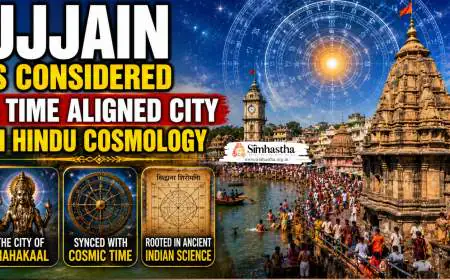
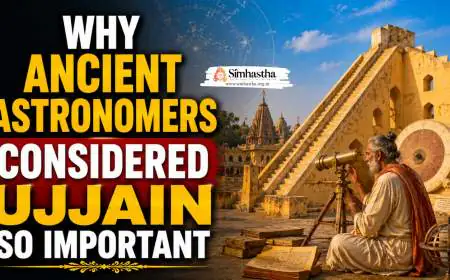
Beyond the explicitly religious Puranas and epics, Ujjain occupies a unique and prestigious position in the scientific and mathematical texts of ancient India, most notably the Surya Siddhanta. This foundational astronomical treatise, whose origins stretch back into the mists of antiquity, makes a declaration of profound geographical and cosmic significance: the line of longitude passing through Avanti—Ujjain—is the prime meridian of the earth. The text explicitly states that Ujjain lies at the intersection of the zero meridian and the Tropic of Cancer, making it the navel of the world from which all celestial calculations were to be made. The Surya Siddhanta, far from being a mere religious document, is a rigorous mathematical text that describes the earth as a sphere, calculates its diameter, and models the motions of the planets. By anchoring its entire coordinate system at Ujjain, the text permanently elevated the city to a status that transcended the purely devotional: Ujjain was the world's scientific centre, the point where the terrestrial and the celestial were measured against each other. The great astronomers who followed—Varahamihira, Brahmagupta, and Bhaskaracharya II—all worked within this Ujjain-centred framework, and their own texts continually refer back to the city's meridian. Even the Vikram Samvat, the calendar system associated with the legendary king of Ujjain, is a product of this astronomical tradition, and its pan-Indian use is a quiet, daily acknowledgment of the city's temporal sovereignty. 📐
Kalidasa's Meghaduta and the Romantic Landscape of the Malwa Capital
The scriptures are not the only ancient texts that immortalize Ujjain. The high classical literature of Sanskrit, particularly the works of Kalidasa, offers a secular yet equally potent glorification of the city. In his masterful lyric poem, the Meghaduta (The Cloud Messenger), an exiled yaksha, pining for his beloved wife, sends a message to her via a passing cloud. He describes the cloud's journey from central India northward, and the most lovingly detailed, sensuous, and ecstatic passage of the entire poem is reserved for Ujjayini. Kalidasa calls it the "jewel of the earth," describes its perfumed breezes, its beautiful women, its wealthy merchants, its great temples, and the gentle flow of the Shipra. He mentions the Mahakala Temple and the evening rituals on the river. The Meghaduta is not a Purana; it is a work of high art, and its fulsome praise of Ujjain provides independent, literary corroboration of the city's supreme importance in the cultural imagination of classical India. Kalidasa's Ujjain is not a dour, austere pilgrimage site; it is a vibrant, prosperous, and deeply romantic capital, a place where the spiritual and the sensual coexist in perfect harmony. This literary testimony, read and loved for centuries, cemented Ujjain's status not just as a sacred centre but as the very model of a civilized, beautiful, and desirable city. 🎭
The Jyotirlinga and the Shaiva Texts: Mahakal as the Lord of Time
A city does not become a recurring character in the vast library of Hindu texts without a defining, magnetic spiritual presence at its core. For Ujjain, that presence is Mahakaleshwar, the Lord of Time, enshrined in one of the twelve sacred Jyotirlingas. The Shiva Purana and the Linga Purana contain extensive sections on the origins and glories of the Jyotirlingas, and the narrative of Mahakaleshwar is among the most powerful. The story tells of a demon king, Dushana, who terrorized the city of Avanti and its pious Brahmin inhabitants. The people prayed fervently to Shiva, who manifested from the earth in a blazing, terrifying form, destroying the demon and agreeing to remain on the spot as Mahakaleshwar, the eternal lord of the city. The Puranas highlight the unique south-facing orientation of the Mahakaleshwar lingam, a feature found in no other Jyotirlinga. This direction is associated with death and the afterlife, establishing Ujjain not merely as a place of life and blessing but as a city where the mystery of time, death, and liberation is directly confronted and conquered. The daily Bhasma Aarti, the pre-dawn offering of sacred ash, is a direct enactment of the Shaiva texts' emphasis on impermanence and transcendence. The repeated appearance of Ujjain in the Shaiva Puranas is thus tied to this singular, theologically unique manifestation of the divine, a deity so central to the city's identity that his name—Mahakal—has become synonymous with Ujjain itself. 🔱
Ujjain in Jain and Buddhist Texts: A Cross-Tradition Sacred Hub
The sanctity of Ujjain is so profound that it transcends the boundaries of the Hindu fold, appearing prominently in the ancient texts of both the Jain and Buddhist traditions. In the Buddhist Jataka tales, stories of the Buddha's previous births, Ujjain (referred to as Ujjeni) is a frequent and important setting. It is depicted as the capital of the powerful Avanti kingdom, a prosperous city ruled by wise and sometimes flawed kings. The famous story of the Vessantara Jataka, one of the most popular tales in the Buddhist world, has significant episodes set in the Avanti region. The city was also an important centre for the early Buddhist monastic community.
For the Jains, Ujjain is no less significant. It is an ancient centre of Jain pilgrimage, with several temples of great antiquity. Jain texts associate the city with the lives of several Tirthankaras. The Nisitha Churni, a Jain commentary, mentions Ujjain as a place where Jain monks and nuns resided. The presence of Ujjain in these non-Hindu canons proves that the city's prestige was not a sectarian claim but a widely acknowledged reality of ancient Indian geography. It was a cultural and political superpower whose fame and importance were recognized across the spectrum of dharmic traditions. This broad, inter-textual consensus further reinforces why Ujjain appears repeatedly in ancient Hindu texts: the city was simply too significant to ignore, and every major tradition had to locate its own narrative within its powerful, sacred geography. 🛕☸️
The Eternal City in the Collective Memory of the Texts
The repeated appearance of Ujjain in the ancient texts is not the product of coincidence or regional favouritism. It is the cumulative result of a multi-millennia process of sacred canonization. The Puranas provided the theological foundation and the mythological detail, mapping every stone and every stream. The epics wove it into the grand narrative of dharma and war. The astronomical treatises fixed it as the world's scientific centre. The classical poets sang its earthly beauties. The Shaiva, Jain, and Buddhist traditions each claimed a piece of its sacred soil. Layer upon layer, text upon text, Ujjain was constructed not of brick and mortar but of verse and prose, until the physical city on the Shipra became indistinguishable from the textual city in the collective memory of the civilization. When a pilgrim today walks through the Mahakal Lok corridor or sits at the edge of the Shipra at Ram Ghat, they are not merely standing in a geographical location. They are standing inside a library of ancient texts, a living palimpsest where every stone is a page, every temple is a chapter, and the river itself is the binding that holds the entire sacred volume together. This is why Ujjain appears and reappears, from the oldest Puranas to the verses of Kalidasa—because for ancient India, Ujjain was not just a place. It was a truth. 📚🔱

Frequently Asked Questions