


















Why Ancient Trade Routes Helped Ujjain Become Famous
Discover why ancient trade routes helped Ujjain become famous. From the Dakshinapatha and Uttarapatha highways to the Silk Road, explore how this prime meridian city became a global crossroads of silk, spices, ideas, and empires.


The Crossroads of a Subcontinent and the Geography That Made Ujjain Inevitable
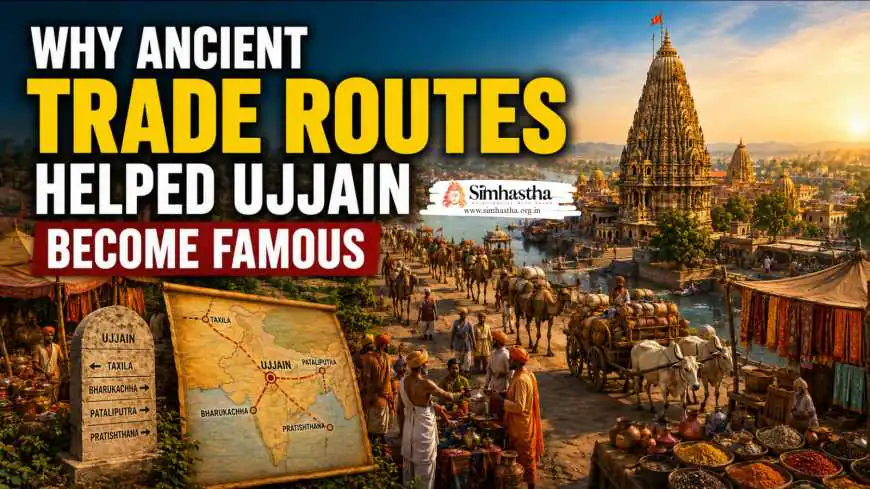
The ancient fame of Ujjain is not, at its deepest root, a product of myth or miracle, but of the hard, practical, and profoundly influential logic of geography. The city is situated on the Malwa Plateau, a high, fertile, and relatively cool tableland that rises above the dense, malarial forests of the Vindhya range to the south and the vast, arid plains of Rajasthan to the north. This plateau was, for the ancient traders who moved goods across the subcontinent on foot, on horseback, and in long, slow, dust-choked bullock caravans, a natural, welcoming, and strategically essential corridor. The Dakshinapatha, the great southern road, wound its way up from the wealthy kingdoms of the Deccan, the Satavahana territories, carrying with it the immense riches of the south—the gold from the mines of Karnataka, the clear, sparkling diamonds of Golconda, the fragrant, precious sandalwood of Mysore, and the black pepper, the "black gold" of the Roman world, from the Malabar coast. The Uttarapatha, the great northern highway, descended from the Gangetic plains, from the imperial capitals of Pataliputra and Kaushambi, and, crucially, it connected, through the great northern passes, to the fabled Silk Road that stretched all the way to China and the Roman Empire. The precise, unmissable point where these two great commercial arteries met was Ujjain. The city was not merely a convenient resting place for tired merchants; it was the unavoidable, primary transshipment hub where the goods of the south were exchanged for the goods of the north, where the spices of India began their long, transformative journey to the dining tables of Rome, and where the silk of China was sorted, repackaged, and taxed before being distributed to the eager markets of the subcontinent. The river Shipra, flowing gently through the city, provided the essential, life-giving water for the massive caravans and their animals, and the city's powerful, well-organized rulers guaranteed the safety and the fair, predictable taxation that the merchants required. Ujjain was, in the ancient world, a city that was simply, irresistibly, and profoundly inevitable. 🗺️
The Dakshinapatha and the River of South Indian Riches
The Dakshinapatha, the great southern road, was not a single, narrow, paved highway in the modern sense, but a broad, shifting, and deeply ancient corridor of movement, trade, and cultural exchange that had been in continuous use since the megalithic period. Its northern terminus, its great, wealthy, and welcoming gateway, was Ujjain. The caravans that arrived from the south were laden with the most sought-after treasures of the ancient world. There was gold, sourced from the deep, ancient mines of the Deccan, the very mineral wealth that would later fund the magnificent temples of the Gupta and the Satavahana empires. There were diamonds and other precious gems, destined for the royal courts of the north and, ultimately, for the imperial treasuries of Persia and Rome. There was the heavy, fragrant, and immensely valuable sandalwood, cut from the dense forests of the south, and the bundles of pepper, the spice that would literally change the course of global history and drive the European age of exploration. In the opposite direction, from Ujjain southwards, flowed the finished goods of the northern workshops and the imported luxuries of the Silk Road. The city's marketplaces, which the Buddhist Jataka tales describe with a palpable sense of awe and wonder, were a sensory overload of the most exotic and desirable products of the known world. It was this continuous, massive, and deeply lucrative flow of trade along the Dakshinapatha that provided the immense, foundational wealth upon which Ujjain's political power, its magnificent temple architecture, and its glorious, golden literary and scientific culture were built. The city was, first and foremost, a commercial powerhouse, a marketplace to the world, and its sacred identity was nurtured and sustained by the rivers of gold that flowed through its counting houses. 🥇
The Uttarapatha and the Gateway to the Silk Road and the World
If the Dakshinapatha was the artery that connected Ujjain to the wealth of the subcontinent, the Uttarapatha, the great northern highway, was the artery that connected Ujjain to the world. This ancient route, which followed the course of the Ganga and its tributaries, passed through the great cities of the Indo-Gangetic plain and then pushed further north and west, through the historic passes of the Hindu Kush, to link up with the vast, sprawling network of the Silk Road. Through this northern gateway, the caravans brought the legendary silk of China, a fabric so fine and so precious that it was worth its weight in gold, along with the swift, powerful horses of Central Asia, the essential, highly prized military asset for the armies of the Indian kingdoms. From the Roman Empire, through the intermediary ports of the Middle East, came wine, glassware, and gold coins, eagerly sought by the Indian elites. And from the great monastic universities of Gandhara and the Buddhist heartlands, came something even more precious and enduring than silk or gold: the ideas, the texts, and the missionaries of a new, compassionate, and intellectually rigorous faith. Ujjain, as the master of the junction, was uniquely positioned to tax, to profit from, and to be culturally fertilized by this immense, two-way flow of global commerce. The city's immense prosperity was not a local, regional phenomenon; it was a direct, tangible result of its central, commanding position on one of the most important and lucrative long-distance trade networks in the entire pre-modern world. The famous astronomer-mathematicians, the brilliant poets, and the magnificent temple builders of Ujjain were all, in a very real and direct sense, the fortunate and gifted children of the trade routes. 🐎
The Malwa Plateau as the Great Connector and the Fertile, Cool Resting Place
The Malwa Plateau itself, upon which Ujjain rests, was an essential, active, and determining factor in the city's commercial dominance. For the caravans that had laboured for weeks through the dense, malarial, and tiger-haunted forests of the Vindhyas or the arid, waterless, and bandit-ridden plains of Rajasthan, the Malwa plateau, with its fertile, black, cotton-growing soil, its pleasant, cool climate, and its abundant, year-round water supply, was a genuine, deeply welcomed paradise. It was the perfect, natural, and unavoidable rest and replenishment point. The plateau was also, and this was of immense economic significance, the primary cultivation zone for cotton, the raw material for the extraordinarily fine, translucent, and world-famous muslin textiles that were manufactured in Ujjain and exported, at immense profit, across the ancient world. The fertile soil of the plateau fed not just the city's population but the vast, hungry armies of the caravans, and the cotton it produced was the foundation of a textile industry that was the single largest manufacturing and export sector of the ancient Indian economy. The very prosperity of the land, its capacity to sustain a large, concentrated urban population and to provide the raw materials for a high-value, globally competitive manufacturing industry, was as much a reason for Ujjain's ancient fame as its strategic location. The plateau was not merely a place to pass through; it was a place of immense, inherent economic value, a green, fertile, and prosperous island in the vast, challenging landscape of central India, and Ujjain was its magnificent, undisputed capital. 🌿
Trending Guides Now

The First Ever Kumbh Mela: Complete History, Rituals & Legacy That Continue Today

What Makes Ujjain Simhastha a Living Spiritual Tradition
How Ujjain Influenced Ancient Indian Astronomy

How Ujjain Became a Center of Learning in Ancient India

Ujjain Railway Station to Mahakaleshwar Temple Distance (2026 Guide)

Ujjain Simhastha 2028 Dates Announced: Full Shahi Snan & Event Timeline

Ujjain to Mahakaleshwar Temple Distance & Taxi Fare (2026)

Ujjain Simhastha 2028: ₹91.74 Cr Harifatak-Mahakal Lok Underpass
The Merchants of Avanti and the Cosmopolitan Soul of a Trading City
The immense, continuous, and multicultural flow of trade along these ancient routes did more than just fill Ujjain's tax coffers; it forged the city's unique, cosmopolitan, and profoundly creative soul. Ujjain was not a homogeneous, inward-looking temple town; it was a bustling, polyglot, and deeply sophisticated commercial capital, a city where Greek traders from Alexandria, Scythian horsemen from the Central Asian steppes, Buddhist monks from the great Gandharan monasteries, Jain merchants from the trading communities of the west, and dark-skinned spice merchants from the Tamil lands all mingled in its crowded, colourful bazaars. The Buddhist Jataka tales, ancient stories of the Buddha's previous lives that are often set in the bustling commercial cities of the era, are filled with vivid, evocative descriptions of Ujjain's merchant princes, their immense, sprawling caravans, their dangerous, adventurous journeys, and their deeply ingrained culture of charity and religious patronage. This commercial, cosmopolitan culture was the essential, fertile soil in which the city's later, magnificent intellectual and artistic achievements took root. The mathematical genius of Brahmagupta, who gave the world the concept of zero, was not conjured in a sterile, isolated vacuum; it was developed in a city that needed precise, sophisticated mathematics for its complex accounting, its astronomical calendar-making, and its long-distance maritime and overland trade. The poetic genius of Kalidasa, whose works are filled with a deep, sensuous, and profound love of nature and a cosmopolitan understanding of the vast, varied landscape of India, was nurtured in a city that was a window to the entire, magnificent subcontinent and the world beyond. The trade routes brought gold; they also brought the invisible, priceless wealth of ideas, perspectives, and cultural cross-currents that make a civilization truly great. 🏪
The Eyes of the World and Ujjain in Ancient Global Cartography
The ancient fame of Ujjain was not confined to the borders of the subcontinent; it was literally mapped by the world's first great geographers and travel writers. The anonymous Greek sailor who composed the Periplus of the Erythraean Sea in the 1st century CE, a detailed, practical mariner's guide to the ports, goods, and trade winds of the Indian Ocean, mentions the great inland city of "Ozene" as the royal capital from which the fine cotton textiles, the onyx stones, and the other precious trade goods of the region were sourced and exported. A century later, the great Alexandrian astronomer and geographer Claudius Ptolemy, in his monumental, world-defining work, the Geographia, plotted the coordinates of "Ozene" with a precision that, while imperfect by modern standards, was remarkable for its time, placing it firmly and undeniably on the map of the global consciousness. Ujjain was not a hidden, mythical, or legendary city; it was a known, documented, and vital node in the complex, far-flung commercial networks that connected the Mediterranean world to the Bay of Bengal. The city's own, self-aware identity as the prime meridian of the Indian astronomical tradition, the zero-degree longitude from which all celestial calculations were made, was a direct, natural extension of this role as the geographical centre of the known subcontinent. The city that sits at the centre of the map is the city that measures the stars, and for the ancient world, Ujjain was, quite literally and undeniably, that very centre. 🌍
The End of the Caravans and the Living Echo of a Commercial Empire
The ancient trade routes that made Ujjain famous did not vanish overnight; they slowly, gradually, and irrevocably declined with the profound, tectonic shifts of global power and the changing technology of transport. The rise of the great, centralized Mughal Empire shifted the primary political and commercial axis of India permanently northwards, towards the Delhi-Agra corridor. The European domination of the Indian Ocean trade, the opening of direct, all-sea routes to the spice markets of the East, and the eventual arrival of the railroad in the 19th century bypassed the ancient, slow, bullock-caravan routes of the Malwa plateau. The city that had once been a glittering, cosmopolitan, world-famous commercial capital slowly receded from the global economic map and returned, profoundly and gracefully, to its other, deeper, and more ancient identity: the sacred, eternal city of the Lord of Time. But the legacy of those trade routes is still deeply, quietly, and irrevocably embedded in the very DNA of Ujjain. The city's instinctive, warm hospitality, its deep, abiding comfort with strangers, its ancient, sophisticated craft traditions, and its enduring, unshakeable sense of being, despite its modest modern size, a place of genuine, world-historical significance—all of this is the living, breathing, and quietly enduring echo of the centuries when the caravans rolled through its gates, when the marketplaces were filled with the sounds of a dozen different languages, and when the city on the Shipra was, in the truest and most complete sense of the word, the crossroads of the world. 🔱
Frequently Asked Questions