
























How Ujjain Became a Meeting Point of Faith and Astronomy
Discover how Ujjain became a meeting point of faith and astronomy. Explore the ancient observatory, Vedic clock, and cosmic significance of India's time capital.
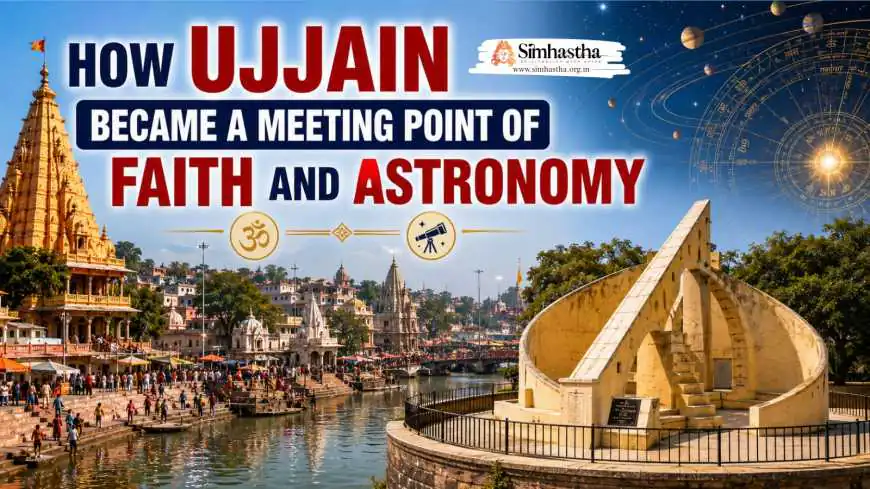

When the Heavens Meet the Earth: Ujjain's Cosmic Legacy
Let me start with a question that has fascinated humanity for millennia. 🌌 Have you ever looked up at the night sky and wondered about the cosmic forces that govern our existence? The ancient city of Ujjain didn't just wonder—it built an entire civilization around understanding those forces, merging the sacred and the scientific in a way that still astonishes us today.
Here's something that might surprise you. Before Greenwich became the world's timekeeper, there was Ujjain. 🌍 Since the 4th century BCE, this city has marked the first meridian of longitude for Hindu geographers . Indian astronomers considered Ujjain the prime meridian—the "Madhya Rekha" or middle line—from which all time and planetary positions were calculated . It was India's Greenwich, centuries before Greenwich even existed.
But here's the part that gives me chills. The Mahakaleshwar Temple—dedicated to Lord Shiva as the Lord of Time—is said to be situated at the point where the ancient Indian Prime Meridian and the Tropic of Cancer once intersected . Think about that for a moment. The temple of the god who controls time, placed at the very intersection of the earth's most significant time-measuring lines. Was it coincidence? Or did ancient architects know something we're only now rediscovering? 🕉
In this article, we'll explore how Ujjain became a meeting point of faith and astronomy—a place where mythology, science, and spirituality dance together in perfect harmony. From the Vedh Shala observatory that still measures time to the Mangalnath Temple that marks the birthplace of Mars, from the new Vedic Clock that's reclaiming India's timekeeping heritage to the ambitious plans to make Ujjain the global "Time Capital"—this is a story of a city that has always looked to the skies. 🌟
Trending Guides Now

Ujjain Simhastha
Why Ancient Astronomers Considered Ujjain So Important

The First Ever Kumbh Mela: Complete History, Rituals & Legacy That Continue Today

Why Jupiter Plays the Most Important Role in Ujjain Simhastha

Ujjain Railway Station to Mahakaleshwar Temple Distance (2026 Guide)

Ujjain Simhastha 2028 Dates Announced: Full Shahi Snan & Event Timeline
Ujjain Railway Station to Gadkalika Temple: Distance, Auto Fare and Route
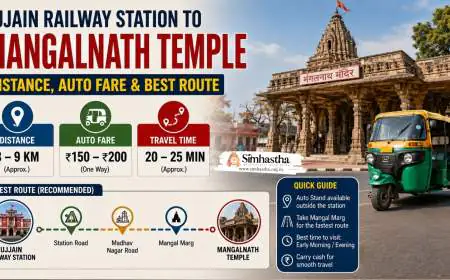
Ujjain Railway Station to Mangalnath Temple: Distance, Auto Fare and Best Route
The Prime Meridian of India: Ujjain's Ancient Timekeeping Glory
The Madhya Rekha: India's Zero Longitude
Let me tell you about the "Madhya Rekha" (मध्य रेखा), the middle line that divided the inhabited world in half according to ancient Indian geographers . This meridian passed through the city of Ujjayini—today's Ujjain—and served as the zero-degree longitude reference for all Indian astronomical texts .
The Surya Siddhanta, an astronomical treatise from the 4th to 5th centuries CE, described the prime meridian passing through Avanti (Ujjain). In the ancient Indian worldview, the day began when the sun rose in Ujjain—a fascinating concept that positioned this sacred city at the very center of time itself .
The textbook "Exploring Society: India and Beyond" now teaches our children that: "The Greenwich Meridian is not the first prime meridian. There were others in the past. In fact, many centuries before Europe, India had a prime meridian of its own! It was called Madhya rekha and passed through the city of Ujjayini" .
The Tropic of Cancer Connection
Geographically, Ujjain sits on the Tropic of Cancer, the latitude that marks the northernmost position where the sun can be seen directly overhead at noon . This alignment made it an ideal location for astronomical observations.
According to local lore, the Tropic of Cancer passes through the spire of the Mahakaleshwar Temple as well as the Mangalnath Temple . The Mahakaleshwar Temple is believed to be situated at the point where this important latitude once intersected the ancient Indian Prime Meridian . This geographical positioning is why Ujjain was called the "navel of the earth" —the cosmic center.
The Greek Connection: Ozene in Ancient Records
Ujjain's fame as an astronomical center spread far beyond India. The city was known as "Ozene" in the Periplus of the Erythraean Sea, an ancient Greek description of trade ports in the western Indian Ocean . This international recognition speaks volumes about Ujjain's reputation as a center of learning and astronomical precision. 🌍
The Observatory That Still Works: Jantar Mantar / Vedh Shala
Maharaja Jai Singh II's Masterpiece
Now, let's talk about the crown jewel of Ujjain's astronomical legacy—the Jantar Mantar, also known as the Vedh Shala. 🏛️
Built by Maharaja Sawai Jai Singh II in 1725 while he was governor of Ujjain, this observatory stands as a testament to India's enduring scientific curiosity . It's one of five observatories he constructed across India (the others being in Jaipur, Delhi, Mathura, and Varanasi), but the Ujjain observatory holds a special distinction—it's the only one that is still used for active research today .
The Story Behind Its Creation
Here's a fascinating piece of history. In 1719, Jai Singh witnessed a heated debate in the Mughal court of Emperor Muhammad Shah about how to make astronomical calculations to determine an auspicious date for the emperor to start a journey . Recognizing the importance of accurate timekeeping, Jai Singh was tasked with building an observatory modeled on the one in Samarkand built by Timur's grandson Ulugh Beg . Recognizing Ujjain's geographically significant location, Jai Singh created the first of his vedshalas here—even before the ones at Jaipur, Delhi, Mathura, and Varanasi were built .
The Instruments: Measuring the Heavens
The observatory consists of 13 architectural astronomy instruments designed to be used with the naked eye . Each "yantra" (instrument) works on the principle of casting shadows . Here's what they do:
Samrat Yantra (Sun Dial): This magnificent instrument tells the time. A long flight of steps in the middle casts a shadow on two walls on either side. The upper planes of the walls are parallel to the Earth's axis, which is tilted at 23 degrees and 27 minutes with respect to its orbital plane .
Nadi Valay Yantra: Constructed in the plane of the celestial equator, this instrument determines whether a celestial body is in the northern or southern hemisphere. It has northern and southern discs, each illuminated by the sun for six months .
Digansha Yantra: Calculates the altitude (distance from the horizon) of any celestial body and its azimuth, helping to track which planet is transiting which celestial house .
Bhitti Yantra (Transit Instrument): This is unique to Ujjain's Vedh Shala. It measures the zenith distance of any celestial body with respect to Earth .
Shanku Yantra: A vertical gnomon (part of a sundial) on a circular platform that calculates the length of the day. The Tropic of Cancer, Tropic of Capricorn, and Equator are marked by lines, and the gnomon's shadow signals the equinoxes and solstices .

A Living Observatory
After Jai Singh's time, the observatory remained uncared for about two decades. It was later renovated and funded by Maharaja Madhav Rao Scindia of Gwalior after suggestions from scholars . Since then, it has been continuously functioning.
Today, you can visit and see for yourself:
-
An automatic 8-inch diameter telescope installed During Simhastha 2004
-
A small planetarium with 20- and 30-minute shows
-
The observatory publishes an Ephemeris (Panchang) every year since 1942
-
It also conducts weather activities: rainfall measurement, temperature, humidity, air pressure, and wind speed
Zero Shadow Day: If you visit on June 21, the summer solstice, you can witness a phenomenon unique to locations on the Tropic of Cancer. For one brief minute, around noon, the sun is directly overhead, and "your own shadow will forsake you" . The guide at the observatory will tell you: "12:29 se 12:30 ke beech, ek minute ke liye aap ki khud ki parchhayi aapka saath chhod degi" (For one brief minute, your own shadow will forsake you) .
The Cosmic Temples: Where Faith Meets the Planets
Mangalnath Temple: The Birthplace of Mars
On the tranquil banks of the Shipra River stands the Mangalnath Temple, a shrine that perfectly embodies Ujjain's union of faith and astronomy . This temple holds a special distinction as an exceptional temple dedicated specifically to the planet Mangal (Mars), making it a rare confluence of cosmic belief and earthly devotion .
The Legend: According to the Matsya Purana, Mangal (Mars) is considered the son of Prithvi (Earth). Hindu mythology further narrates that Mangal emerged from a drop of perspiration that fell from Lord Shiva during an intense cosmic battle . This sacred origin sanctified the site as the birthplace of the planet Mars.
The Astronomical Connection: Historically, Ujjain held prominence in ancient Indian astronomy. It was regarded as a prime meridian for time calculations, and the Tropic of Cancer is believed to pass near the region. Due to its geographical alignment and clear skies, the site was once considered ideal for observing celestial bodies, including Mars . This astronomical association further strengthened the temple's identity as the earthly seat of the red planet. Here, mythology and scientific curiosity find an unusual harmony .
Vedic Astrology: In Vedic astrology, Mars symbolizes strength, courage, vitality, and assertiveness. Devotees from across the country visit Mangalnath Temple to perform rituals associated with the planet Mars . Tuesdays—the day dedicated to Mars—are especially auspicious and witness a significant influx of worshippers seeking planetary harmony .

Mahakaleshwar Temple: The Lord of Time
The Mahakaleshwar Temple is more than just a religious site—it's the spiritual anchor of Ujjain's relationship with time. Lord Shiva here is worshipped as Mahakal, the Lord of Time, the one who controls the cosmic cycles of creation, preservation, and destruction.
The Temple's Location: The site of Mahakaleshwar Temple is believed to be the most important of the twelve Jyotirlingas, where Shiva appeared as an endless column of light . The temple is said to be situated at the point where the ancient Indian Prime Meridian and the Tropic of Cancer once intersected . This is not a coincidence—it's a deliberate placement that connects the city's spiritual heart to its astronomical soul.
The film "Mahakaleshwar: Legends of Shiva" by HISTORY TV18 explores this fascinating connection, telling the story of "an ancient city in the heart of India—a place where history and mythology converge," and where "the temple of Shiva's most powerful manifestation—Mahakaleshwar, Lord of Time" stands at the intersection of faith and science .
The Great Minds of Ujjain: India's Astronomical Giants
Varahamihira: The Father of Indian Astrology
In the 6th century CE, Varahamihira made Ujjain his home. He was one of the first to discover many trigonometric identities and wrote extensively on astronomy and astrology . The NCERT now notes: "Varahamihira, a famous astronomer, lived and worked there some 1,500 years ago" . His work Panch Siddhantika summarized five earlier astronomical treatises and established Ujjain as a global center of astronomical scholarship.
Brahmagupta: The Number Genius
Brahmagupta was another astronomical genius who worked in Ujjain. His book, the Brahmasphutasiddhanta, was responsible for spreading the use of zero, negative numbers, and the positional number system to Arabia and Cambodia . It's no exaggeration to say that modern mathematics owes a debt to this brilliant mind who calculated the heavens from the banks of the Shipra River.
Bhaskaracharya: The Medieval Master
Bhaskaracharya, or Bhaskara II, also worked in Ujjain during the medieval period. His book Lilavati broke new ground in many areas of mathematics and astronomy . Ujjain remained a center of astronomical learning for centuries, producing some of the world's greatest scientific minds.
The Vikramaditya Legacy: The Calendar That Began in Ujjain
The Vikram Samvat
Ujjain's connection to time is also seen in the Vikram Samvat—the Hindu calendar era that is still in use today. It is named after the legendary king Vikramaditya, who is said to have ruled from Ujjain and drove away the Sakas, starting a new era around 58–56 BCE .
The city’s connection to the concept of time continues. The Hindu calendar era, Vikram Samvat is still in use. It is named after Vikramaditya—the legendary king of Ujjain . This calendar is a living reminder of Ujjain's role as the center of Indian timekeeping—a legacy that began over two thousand years ago.
The Modern Revival: Ujjain as the Global "Time Capital"
Chief Minister Mohan Yadav's Vision
The ancient astronomical glory of Ujjain is being revived in a big way. Chief Minister Mohan Yadav has announced ambitious plans to develop Ujjain as the global "Time Capital" and a modern Science City .
Addressing the International Conference "Mahakal: The Master of Time" , Chief Minister Yadav emphasized: "Ujjain is not just a city of spirituality and religion but also a historic centre of science. Ujjain will be developed as the 'Time Capital' of the world" .
Key Initiatives:
-
Science City: A ₹15 crore investment is being made to set up a modern Science City in Ujjain .
-
New Science Facility: A ₹15.5 crore science facility was inaugurated with support from the Union Government .
-
Vikramaditya Vedic Clock: The world's first Vedic clock, inaugurated by Prime Minister Narendra Modi in February 2024, displays time in traditional Indian units (muhurtas, kaalas, etc.) instead of conventional hours and minutes, blending ancient wisdom with modern technology .
The Dongla Shift: Understanding the Earth's Tilt
Due to the gradual shift in the Earth's axial tilt (obliquity), the Tropic of Cancer no longer passes exactly through Ujjain—it has shifted about 32 kilometers to Dongla village . This entire cycle spans nearly 27,500 years—a period of time that our ancient astronomers could never have imagined measuring, and yet they built their observatories to last .
Chief Minister Yadav has been promoting Dongla as a new hub for astronomical time calculation. The village now hosts an upgraded planetarium and is being transformed into a center for scientific inquiry . It offers an ideal spot for observing Zero Shadow Day on June 21, when the sun is directly overhead and objects cast no shadow at noon .
The Vedic Clock: A 21st-Century Innovation
The Vikramaditya Vedic Clock is a perfect example of Ujjain's enduring legacy. It displays time in traditional Indian units, including muhurtas and kaalas, based on astronomical formulas linked to the Dongla observatory . A similar Vedic clock has been installed at the Chief Minister's residence gate in Bhopal, and a dedicated mobile app provides Panchang information in nearly 200 languages .
The Simhastha Connection: Astronomy in Action
Why the Kumbh Happens When It Does
Simhastha, the Kumbh Mela held in Ujjain every 12 years, is itself timed according to astronomical alignments. The festival occurs when the planet Jupiter enters the zodiac sign of Leo (Simha in Sanskrit), creating a potent cosmic window for spiritual cleansing.
This is perhaps the most powerful expression of Ujjain's identity as a meeting point of faith and astronomy. The spiritual significance of Simhastha is inseparable from its astronomical timing. Millions of devotees travel to Ujjain based on the positions of the planets—a direct application of the astronomical knowledge that this city has preserved and perfected for thousands of years.
The initiatives for Simhastha 2028, including the development of Dongla as a center for time calculation, are part of extensive preparations for an event expected to attract 35–40 crore devotees .
The Bottom Line: A City That Has Always Looked to the Skies
So, how did Ujjain become a meeting point of faith and astronomy? The answer is woven into every stone of this ancient city.
From the 4th century BCE, when it became the prime meridian for Hindu geographers, to the Matsya Purana which placed the birthplace of Mars within its boundaries; from the Surya Siddhanta which used Ujjain as its reference point, to the Vedh Shala which still measures the heavens; from the Mahakaleshwar Temple standing at the intersection of the Tropic of Cancer and the Prime Meridian, to the new Vedic Clock reclaiming India's timekeeping heritage—Ujjain has always been where earth meets the heavens. 🌟
The great minds who worked here—Varahamihira, Brahmagupta, Bhaskaracharya—understood something profound: that the mysteries of the divine and the laws of the cosmos are not separate, but intertwined. In Ujjain, that understanding has been preserved in temples and observatories, in festivals and calendars, and in the enduring belief that the heavens are closer here than anywhere else. 🕉️
Frequently Asked Questions