


















Why Ujjain Was Once Considered the Center of Timekeeping
Discover why Ujjain was once considered the center of timekeeping. From its Tropic of Cancer location and Surya Siddhanta's prime meridian to the Samrat Yantra and the Ujjain school of astronomy, explore the ancient city that measured the cosmos.


The Tropic of Cancer and the Shadowless Noon
The fundamental, non-negotiable reason for Ujjain's supremacy in timekeeping is written not in a book, but in the very geography of the planet. The city lies, with an astonishing precision, directly on the Tropic of Cancer, the most northerly latitude at which the sun can appear directly overhead. This is not a mystical coincidence; it is a stark, observable, and annually verifiable astronomical event. On the day of the summer solstice, known in the Vedic calendar as Karka Sankranti, the sun climbs to the absolute zenith of the Ujjain sky, and at local noon, a vertical pillar planted in the earth casts no shadow whatsoever. This single, dramatic moment was the ultimate calibration point for the entire edifice of ancient Indian astronomy. The Surya Siddhanta, a foundational text of breathtaking mathematical rigor whose current form dates to at least the Gupta period, seized upon this geographic miracle. It declared Ujjain, the city of Avanti, to be the zero-degree longitude, the prime meridian of the earth, the point through which the line connecting the north and south poles passed and from which all terrestrial longitudes were to be measured. The city was not chosen for this role; it was recognized. The shadowless noon was the empirical, undeniable proof, the cosmic signature that marked Ujjain as the navel of the world, the fixed, terrestrial reference point without which the entire, intricate clockwork of the heavens could not be accurately mapped. 🌞
The Surya Siddhanta and the World's Longest-Running Meridian
The Surya Siddhanta is not a religious poem; it is a scientific manual of extraordinary sophistication. Its opening verses unambiguously fix the geographical coordinates of the prime meridian at Avanti (Ujjain), and it describes a spherical earth, calculates its diameter with remarkable accuracy, and models the motions of the planets. The day, according to this text, begins not at sunrise, but at midnight on the Ujjain meridian, a concept of a sidereal day that is anchored to the fixed stars and measured from a single, unchangeable terrestrial point. This made Ujjain the Greenwich of the ancient world, a role it held for over fifteen hundred years before the British established their own prime meridian in 1884. The Surya Siddhanta's calculations of the solar year, the lunar cycles, and the precession of the equinoxes were all standardized using Ujjain as the central reference. The text itself became the mother-source of a continuous, living tradition of astronomical observation and mathematical refinement that was centered on this city, a tradition that would be carried forward by a succession of brilliant minds, each of whom operated within the Ujjain-centric framework, continually refining and verifying their celestial models against the empirical evidence of the shadow and the stars. 📜
The Shanku Yantra and the Pillar That Measured the Universe
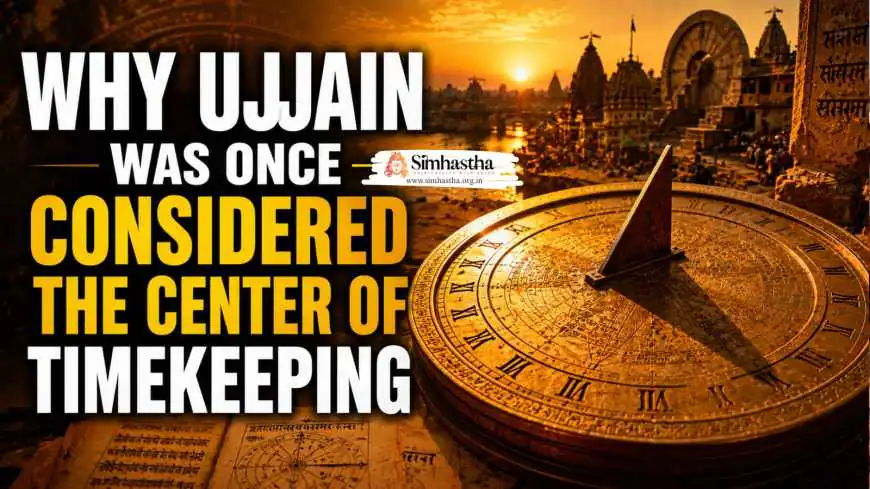
The primary instrument of this ancient timekeeping was the Shanku Yantra, the gnomon. It was a deceptively simple tool: a perfectly vertical pillar, often of stone, erected on a levelled, graduated platform. Its function was to measure the length and direction of its own shadow. At Ujjain, this instrument was the ultimate time reference. At local noon, the shadow was shortest and pointed precisely due north, defining the cardinal directions. By measuring the noon shadow's length every single day, the astronomers could trace the sun's slow journey along the ecliptic, marking the precise days of the winter solstice, when the shadow was longest, and the summer solstice, when it vanished entirely. The platform of the Shanku was essentially a year-long calendar, a physical graph of the earth's orbit. This data was the raw material for constructing the Panchangam, the Vedic almanac, which governed the timing of festivals, agricultural cycles, and sacred rituals across the subcontinent. The Shanku's observations also allowed the astronomers to calculate the ayanamsa, the subtle and continuous drift of the equinoxes caused by the earth's axial precession, a phenomenon that the Surya Siddhanta acknowledges with a precision that is startling even to modern science. The entire, complex temporal architecture of Hindu civilization—the naming of the months, the fixing of the festival dates, the determination of auspicious Muhurtas—was ultimately traceable back to the silent, daily pilgrimage of a shadow across a stone platform in Ujjain. 📏
The Unbroken Lineage of Genius and the Ujjain School of Mathematics
A prime meridian is a line on a map; it requires a continuous community of dedicated, brilliant minds to transform that line into a living, working observatory. Ujjain was blessed with such a community, an unbroken chain of mathematical and astronomical giants who, for over five centuries, constituted the most advanced scientific lineage in the ancient world. In the 6th century CE, Varahamihira made Ujjain his home, compiling the Pancha Siddhantika, a masterful synthesis of five earlier astronomical systems, and standardizing the methods for calculating eclipses and planetary positions from the Ujjain baseline. His work on the refraction of light and the nature of the monsoon winds demonstrated a scientific curiosity that ranged far beyond the merely calendrical. A generation later, in the 7th century, Brahmagupta headed the Ujjain observatory. His text, the Brahmasphutasiddhanta, is a landmark in the history of global mathematics, for it was here that the formal properties of zero were first rigorously defined. He laid out the rules for addition, subtraction, and multiplication involving zero and negative numbers, concepts that were essential for handling astronomical calculations that crossed the zero-point of the meridian. Centuries later, in the 12th century, Bhaskaracharya II added his own monumental contributions, calculating the earth's orbital period around the sun with an accuracy that differed from the modern value by only a few minutes, and laying the conceptual groundwork for what would later be known as differential calculus. These were not isolated sages; they were a community of teacher and disciple, arguing, refining, and building upon a cumulative body of knowledge, all of it anchored to the unique geographical and temporal reference point of their city. 🧮
Trending Guides Now
The First Ever Kumbh Mela: Complete History, Rituals & Legacy That Continue Today

What Makes Ujjain Simhastha a Living Spiritual Tradition
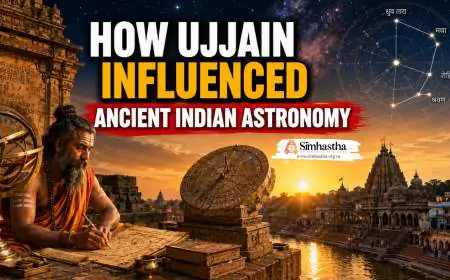
How Ujjain Influenced Ancient Indian Astronomy

How Ujjain Became a Center of Learning in Ancient India

Ujjain Railway Station to Mahakaleshwar Temple Distance (2026 Guide)

Ujjain Simhastha 2028 Dates Announced: Full Shahi Snan & Event Timeline

Ujjain Railway Station to Kal Bhairav Temple: Distance, Auto Fare and Best Route

Ujjain Simhastha Update: CM Mohan Yadav Reviews 2028 Works
Mahakaleshwar and the Temple of Eternal Time
The scientific and the sacred were never separate in Ujjain; they were the left and right eyes of a single face, gazing at the same ultimate mystery. The presiding deity of the city, Mahakaleshwar, is not just another form of Lord Shiva; he is the specific, terrifying, and liberating embodiment of Time itself. The very name translates to "the Great Lord of Time," and the south-facing orientation of his Jyotirlinga, a feature unique among the twelve, is the direction of death, the realm of the ancestors, and the ultimate, inexorable passage of all things. The daily Bhasma Aarti, the pre-dawn ritual in which the lingam is anointed with sacred ash fresh from a cremation ground, is a visceral, daily recalibration of the human soul against the immensity of cosmic time. It is a silent, ash-smeared sermon on the impermanence of the body and the eternity of the atman. The temple's own rituals are timed with a precision that flows from the astronomical calculations made in its shadow. The city's most powerful spiritual symbol is thus not a god who is above time, but a god who is time itself—the creator, the preserver, and the ultimate destroyer, in whose eternal, rhythmic dance the entire universe beats like a single, great heart. The scientific measurement of time at the observatories and the spiritual surrender to time at the temple were not parallel activities; they were a single, integrated, and profoundly beautiful worldview. 🔱
The Vikram Samvat and the Calendar of the King
The practical, lived expression of Ujjain's temporal sovereignty is the Vikram Samvat, one of the two major calendar systems of India, which is legendarily linked to the great King Vikramaditya of Ujjain and is dated from 57 BCE. The calendar is a complex lunisolar system, meticulously balancing the solar year with the lunar months through the precise insertion of intercalary months (adhika masa) to prevent the festival cycle from drifting away from the seasons. The astronomical calculations required to maintain this intricate, long-term balance were performed by the mathematicians of the Ujjain observatory, using the city's meridian as their unwavering reference. Every new year, every intercalated month, and every festival date was, in a fundamental sense, calculated from Ujjain. Even today, the Vikram Samvat is the primary calendar for millions of people across North and West India, a silent, daily, and utterly pervasive recognition of the city's ancient role as the timekeeper of a civilization. The calendar is a piece of Ujjain's time that still ticks in the homes and the festivals of the subcontinent. 📅
The Kumbh Mela and the Astrological Clock That Still Commands Millions
The most spectacular, globally recognized manifestation of Ujjain as a living, functioning center of astrological timekeeping is the Simhastha Kumbh Mela. This massive gathering of ten crore souls is not scheduled by human convenience; it is triggered by a precise, pre-calculated celestial event: the entry of the planet Jupiter (Brihaspati) into the zodiac sign of Leo (Simha). The calculation of this exact moment, down to the precise day and the sacred Muhurta for the Shahi Snan, is a direct, unbroken inheritance from the astronomical tradition of the Surya Siddhanta, and it is computed using the fundamental parameters that are referenced to the meridian of Ujjain. The great holy dip in the Shipra is thus a ritual immersion not just in the sacred water, but in a specific, cosmically defined moment of time. The entire, colossal event is a massive, participatory, and profoundly ancient act of timekeeping, a grand, dramatic proof that for the faithful, Ujjain is still where the celestial and the terrestrial clocks are synchronized, and where time itself is sanctified. 🔱
Jai Singh's Jantar Mantar and the Monumental Revival of a Sacred Science
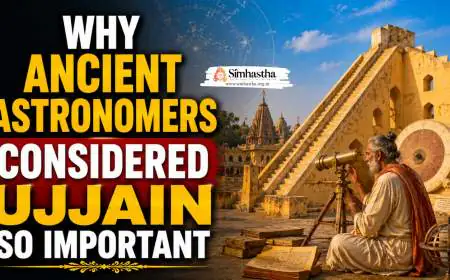
By the early 18th century, the living tradition of the Ujjain school had begun to wane, its ancient astronomical tables drifting into inaccuracy. A remarkable king-scientist, Maharaja Jai Singh II of Jaipur, staged a magnificent, last-ditch effort to restore the empirical foundations of Indian timekeeping. Dissatisfied with the small, error-prone brass instruments of his era, he returned to the ancient principles of the Shanku Yantra and built five massive, open-air masonry observatories across his realm. The one he raised in Ujjain was the most significant, a direct, physical homage to the city's ancient status as the prime meridian. Its greatest instrument, the Samrat Yantra, is a colossal, 22-foot-high triangular sundial. The shadow of its gnomon moves across a marble quadrant at the rate of one millimeter per second, measuring local time to an accuracy of two seconds. Jai Singh chose Ujjain precisely because of its ancient, scriptural authority. In doing so, he physically re-anchored the science of the heavens to its most sacred ground, creating a working monument that still functions, still whispers the time, and still connects the modern pilgrim directly to the ancient astronomers of the Surya Siddhanta. 🔭
The Living Legacy of a Cosmic Clock
Ujjain may no longer be the official prime meridian of the world, but its role as a center of timekeeping has never truly ended; it has simply transformed. The shadow of the Samrat Yantra still crawls across its marble scale, measuring the day with a precision that startles the smartphone-wielding tourist. The summer solstice still brings its shadowless noon to the Shanku Yantra's ancient ground. The Vikram Samvat still governs the calendars of millions. The great Kumbh Mela still rises and falls according to the astrological clock that was first calibrated on this riverbank. The city is a living, breathing, and continuously functioning cosmic clock, a place where the abstract, terrifying mathematics of the universe is rendered into a tangible, visible, and deeply beautiful physical reality. To stand on the Tropic of Cancer in Ujjain is to stand at the center of a sacred circle of time, a circle that has been drawn, measured, and sanctified by the greatest minds of a civilization, and that continues to tick, quietly and eternally, in the very stones of the ancient, holy city of the Lord of Time. 🔱🕰️

Frequently Asked Questions