























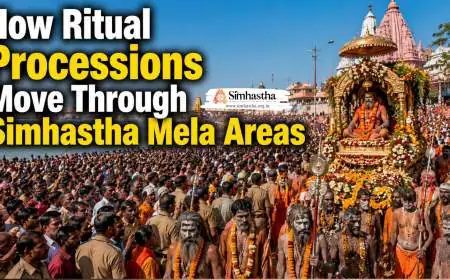



Why Ujjain Has Been a Pilgrimage Center for Centuries
Discover why Ujjain has been a pilgrimage center for centuries. Explore the ancient city's cosmic significance, Jyotirlinga, Kumbh Mela, and timeless spiritual magnetism that draws millions.


The Sapta Puri Status and the Geography of Liberation
Ujjain's preeminence as a pilgrimage center rests, at its most fundamental level, on its inclusion among the Sapta Puris—the seven sacred cities of Hinduism. The canonical list, recited in countless homes and temples across India, names Ayodhya, Mathura, Maya (Haridwar), Kashi (Varanasi), Kanchi, Avantika (Ujjain), and Dwaravati (Dwarka) as the cities that grant moksha—liberation from the cycle of birth and death—to those who die within their boundaries. This is not a minor mythological footnote. The Sapta Puri classification, found in the Garuda Purana, the Skanda Purana, and other foundational texts, elevates Ujjain to the highest tier of sacred geography in the Hindu universe. A pilgrim who visits all seven Sapta Puris is believed to accumulate immense spiritual merit, and Ujjain, as Avantika, is an essential, non-negotiable node in that circuit. The city's very earth is considered sanctified, its air charged with the presence of the divine. This status was not acquired through historical accident but through a deliberate theological process in which the Puranic sages mapped the transcendent onto the geographical, identifying specific locations on the Indian subcontinent as portals where the boundary between the material and the divine is uniquely thin. Ujjain was chosen as one of those portals, and that choice has shaped its destiny for millennia. 🛕
The Avantika of the Skanda Purana
The Skanda Purana, the largest of the eighteen Mahapuranas, devotes an entire section—the Avanti Khanda—to the glories of Ujjain. This text, composed over centuries and finalized sometime in the first millennium CE, is a staggering compendium of Ujjain's sacred geography. It describes in meticulous detail the city's 84 Siddhas, its sacred trees like the Siddhavat, its rivers and ghats, its temples and teerthas, and the specific spiritual benefits that accrue to those who visit them. The Avanti Khanda functions as both a pilgrimage guidebook and a theological manifesto, embedding Ujjain so deeply within the Puranic worldview that to be a learned Hindu is, almost inevitably, to know Ujjain as a place of profound spiritual significance. The text narrates the stories of Shiva's manifestation as Mahakaleshwar, of Parvati's penance on the Shipra's banks, of the eternal banyan that survives the cosmic dissolution. These stories have been internalized by generations of pilgrims who arrive in Ujjain not as blank-slate tourists but as devotees who already know the city through the stories they have heard since childhood. The Avanti Khanda is the script, and Ujjain is the stage upon which that script has been performed continuously for over a thousand years.
Mahakaleshwar and the Jyotirlinga of Time
If the Sapta Puri status is the broad canvas, Mahakaleshwar Jyotirlinga is the blazing, magnetic center. The twelve Jyotirlingas are the most sacred shrines of Shiva in India, and among them, Mahakaleshwar holds a unique and particularly potent position. It is the only Jyotirlinga that faces dakshina—south—a direction associated with death and the afterlife in Hindu cosmology. This south-facing orientation is not incidental; it is a direct expression of the temple's presiding deity as Mahakal—the Great Time, the Lord of Death, the ultimate reality that consumes all things. To worship Mahakaleshwar is to confront the reality of mortality and to seek the grace that transcends it. The Bhasma Aarti, the pre-dawn ritual in which the lingam is anointed with sacred ash freshly collected from a cremation ground, is one of the most visceral and profound rituals in all of Hinduism. It brings the devotee face-to-face with the impermanence of the body and the eternity of the soul. This ritual, performed daily for centuries without interruption, has drawn pilgrims to Ujjain through wars, famines, and political upheavals. The Jyotirlinga is the anchor; it is the reason a pilgrim who visits Ujjain for only a few hours will spend those hours at Mahakaleshwar, standing in the sanctum, feeling the ash, receiving the blessing, and carrying it home. 🔱
The Kumbh Mela and the Nectar of Immortality
If Mahakaleshwar is the daily, steady heartbeat of Ujjain's pilgrimage tradition, the Simhastha Kumbh Mela is its explosive, world-transforming pulse. The Kumbh Mela, rotating every twelve years among four sacred locations—Haridwar, Prayagraj, Ujjain, and Nashik—is the largest religious gathering in human history. Ujjain's association with the Kumbh is rooted in the Puranic myth of the Samudra Manthan, the churning of the cosmic ocean by the gods and demons to obtain the nectar of immortality. As the celestial bird Garuda fled with the pot of nectar, drops fell at four locations on earth, and one of those drops fell in Ujjain, sanctifying the Shipra River with the essence of the amrit. This mythological association has translated, over centuries, into a pilgrimage event of staggering scale. During the Simhastha, the population of Ujjain swells from six lakhs to over seven crores. The city becomes a temporary megalopolis of faith, with sadhus, saints, pilgrims, and seekers from every corner of India and the world converging for the royal bathing days. The Kumbh is not merely an event; it is a cyclical renewal of Ujjain's sacred identity, a periodic reminder to the entire Hindu world that this ancient city on the Shipra is one of the four cosmic nodes where the divine nectar touched the earth.
Trending Guides Now

Ujjain Simhastha
Ujjain Is Considered a Time Aligned City in Hindu Cosmology
Why Ancient Astronomers Considered Ujjain So Important
Was Ujjain the First Scindia Headquarters? Did Ranoji Start Simhastha? Full Spiritual Truth Revealed

Ujjain Railway Station to Mahakaleshwar Temple Distance (2026 Guide)

Ujjain Simhastha 2028 Dates Announced: Full Shahi Snan & Event Timeline

How ISKCON Ujjain Engages Young Devotees Through Programs

Benefits of Becoming a Simhastha Volunteer
The Prime Meridian of Ancient India
Beyond the mythological and the devotional lies a dimension of Ujjain's sacredness that is uniquely its own: its role as the prime meridian of ancient Indian astronomy. While the modern world measures longitude from Greenwich, ancient Indian astronomers measured it from Ujjain. The city was recognized as the zero-longitude point because it was believed to lie precisely on the Tropic of Cancer, the northernmost latitude at which the sun can appear directly overhead. This astronomical positioning was not merely a geographical curiosity; it was a matter of profound religious and cosmological significance. The Surya Siddhanta, one of the earliest and most authoritative texts of Indian astronomy, explicitly states that Ujjain is situated at the intersection of the zero meridian and the Tropic of Cancer, making it the navel of the earth in the Indian cosmological imagination. The Jantar Mantar built by Maharaja Jai Singh II in the 18th century, with its massive masonry instruments for measuring celestial positions, stands as a tangible monument to this astronomical heritage. For centuries, pilgrims and scholars alike understood Ujjain not just as a sacred city but as the cosmic center, the place where heaven and earth were most precisely aligned, where the movements of the planets could be observed with unique clarity, and where the human soul, properly oriented, could find its celestial bearings.
Vikramaditya and the Golden Age of Avantika
The spiritual prestige of Ujjain was amplified and consolidated by its association with one of the most celebrated figures in Indian cultural memory: King Vikramaditya. Whether Vikramaditya was a historical figure, a composite of several kings, or a purely legendary ideal, his association with Ujjain has been a powerful magnet for pilgrimage and cultural pride for well over a millennium. The Vikram Samvat, one of India's major calendar systems, is named after him and begins in 57 BCE, a date traditionally linked to his ascension to the throne of Ujjain. The Vetala Panchavimshati and Simhasana Dvatrimsika, beloved story cycles about the wise and brave king and the supernatural beings who tested him, are set in Ujjain and have embedded the city in the popular imagination of every Indian language community. Vikramaditya's legendary court was said to be graced by the Navaratnas—nine jewels—including the poet Kalidasa, whose descriptions of Ujjain in works like Meghaduta are among the most beautiful and evocative in all of Sanskrit literature. This association with a golden age of justice, wisdom, and cultural flowering has given Ujjain's pilgrimage tradition a texture that goes beyond the purely religious. To visit Ujjain is to visit the city of Vikramaditya, to walk in the footsteps of Kalidasa, to breathe the air of a place where literature, art, and governance once reached their apogee.
The Shipra River and the Ghats of Eternity
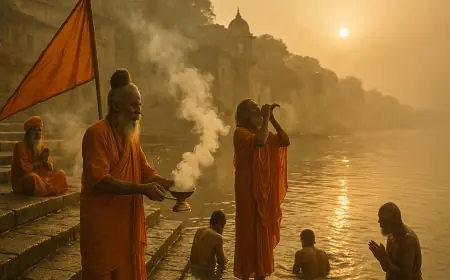
The Shipra River is the liquid soul of Ujjain's sacred geography. It is not a mighty river like the Ganga; it is modest, meandering, intimate. Yet its significance in the pilgrimage landscape is immense. The Shipra is mentioned in the Puranas as a river that purifies, that carries the blessings of the gods, that serves as a boundary between the mundane and the sacred. Its ghats—Ram Ghat, Triveni, Siddhavat, Dutt Akhara, and others—form a necklace of sacred spaces along its banks, each with its own specific rituals, its own specific legends, its own specific community of devotees. The daily Shipra aarti at Ram Ghat, where lamps are offered to the river as the sun sets, is a ritual of extraordinary beauty and emotional power. During the Kumbh Mela, the river becomes the central stage upon which the drama of the Shahi Snan unfolds. But even on an ordinary evening, with only a few dozen devotees present, the Shipra aarti transforms the riverbank into a space of deep, quiet sanctity. The river, like Ujjain itself, does not overwhelm with grandeur; it draws you in with intimacy, with the feeling that this water, this ghat, this moment of prayer, is personally meant for you.
The Accumulated Layers of Royal Patronage
Sacred cities are not sustained by mythology alone; they require the material support of powerful patrons who build temples, maintain priests, fund festivals, and protect pilgrims. Ujjain has been the beneficiary of an extraordinary chain of royal patronage stretching from ancient times to the modern era. The Maurya emperor Ashoka is recorded to have served as the governor of Ujjain before his ascension to the imperial throne, and his Buddhist leanings contributed to the city's early religious diversity. The Gupta emperors, under whom Sanskrit literature and Hindu temple architecture flourished, maintained Ujjain as a major provincial capital. The Paramara dynasty, particularly the legendary Raja Bhoja, presided over a renaissance of temple building and Sanskrit learning centered on Ujjain. The Maratha Scindias, who made Ujjain their early capital before moving to Gwalior, undertook massive renovations of the Mahakaleshwar Temple and other sacred sites. The modern Madhya Pradesh government continues this tradition, with the Mahakal Lok corridor representing the latest and most ambitious phase of royal-level patronage. Each dynasty, each ruler, added a layer to Ujjain's sacred architecture, creating the palimpsest of devotion that the pilgrim encounters today.
The Eternal City in the Hindu Consciousness
What keeps a pilgrimage center alive across centuries is not just its physical infrastructure but its place in the collective consciousness of the faithful. Ujjain occupies a permanent, luminous chamber in the Hindu imagination. Its name appears in daily prayers. Its Mahakaleshwar lingam is invoked in devotional songs. Its Kumbh Mela is marked on calendars years in advance. A grandmother in a Tamil Nadu village, a shopkeeper in a Gujarat town, a software engineer in Bangalore—all carry within them some image, some story, some association with Ujjain that has been passed down through their families. This internal, imaginative Ujjain is as real as the physical city, and it is this internal Ujjain that motivates the external pilgrimage. When pilgrims arrive, they are not discovering a new place; they are confirming a place they already know, visiting a city that has lived inside them long before their feet touched its soil. This is the genius of the Hindu pilgrimage tradition: it creates a sacred geography of the mind that is as durable, as transportable, and as powerful as the sacred geography of the earth. Ujjain, in this sense, is not just a destination; it is a permanent presence in the spiritual consciousness of millions.
The Unbroken Chain of Pilgrim Generations
Perhaps the most profound answer to why Ujjain has been a pilgrimage center for centuries is the simplest one: because parents have brought their children, and those children have grown up and brought their own children, in an unbroken chain of generational devotion. The Ujjain pilgrimage is, for countless families, an inherited tradition. A grandfather performed pind daan at the Shipra. A grandmother tied a sacred thread at the Siddhavat tree and prayed for a child. A father brought his adolescent son for his first darshan of Mahakaleshwar. These are not isolated events; they are links in a chain that stretches back further than family memory can reach. The continuity is the meaning. In a world of constant change, the Ujjain pilgrimage offers the rare and precious experience of doing exactly what one's ancestors did, in the same place, in the same way, for the same reasons. This is the pilgrimage not as tourism, not as leisure, not even as religious obligation in a narrow sense, but as identity—as the ongoing, living practice of belonging to a family, a community, and a civilization that has, for centuries, found its spiritual center in this ancient city on the Shipra.

The Timeless Embrace of Mahakal
In the end, the centuries of pilgrimage, the layers of myth and history, the astronomical calculations and royal inscriptions, the river and the ghats and the temples—all of it converges on a single, irreducible experience. A pilgrim stands before the Mahakaleshwar lingam. The air is thick with incense and the murmur of mantras. The priest offers the sacred ash. The pilgrim bows, receives the blessing, and for a moment that is both fleeting and eternal, feels held by something vast, something ancient, something that has been holding pilgrims in this exact spot for longer than any single lifetime can measure. That moment is why Ujjain has been a pilgrimage center for centuries. That moment is why it will continue to be one for centuries to come. Mahakal, the Lord of Time, presides over a city that time itself cannot erode. The pilgrims come and go, generation after generation, but the presence remains, the city endures, and the ancient, sacred, eternal Ujjain continues its quiet, majestic work of drawing souls toward the infinite. 🔱
Frequently Asked Questions