


























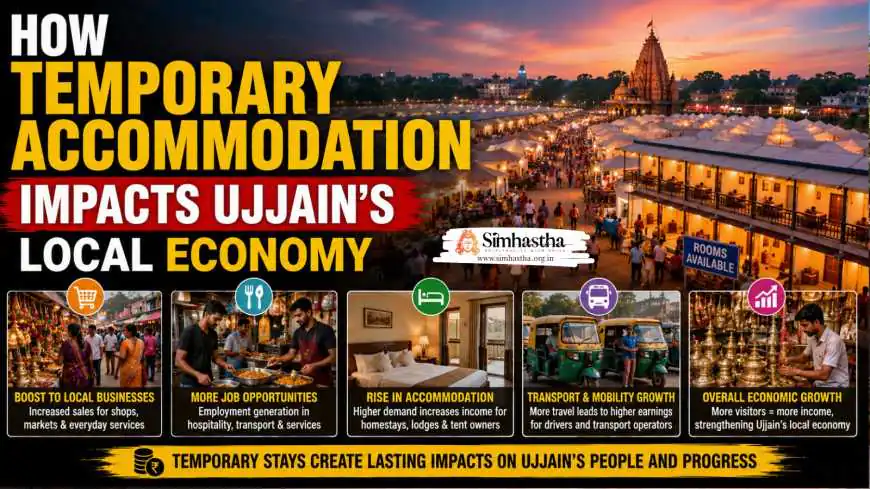
How Temporary Accommodation Impacts Ujjain's Local Economy
Discover how temporary accommodation impacts Ujjain's local economy—from ₹142 crore temple revenue to 10,000 homestays and tent cities. Explore the Simhastha 2028 economic transformation.


How Temporary Accommodation Impacts Ujjain's Local Economy
Imagine a city of six lakh people suddenly needing to shelter over two crore pilgrims on a single night. 🏠😱
That's the math problem that keeps Ujjain's administrators awake at night. And the solution? Temporary accommodation—tent cities, homestays, dormitories, and make-shift shelters that spring up overnight and disappear just as quickly.
But here's the fascinating part: these temporary structures are creating permanent economic change.
How temporary accommodation impacts Ujjain's local economy is not just about giving pilgrims a place to sleep. It's about transforming housewives into entrepreneurs, auto-rickshaw drivers into hospitality professionals, farmers into landlords, and entire villages into tourism hubs. 🏘️💪
Trending Guides Now

Best Hotels Near Mahakal Mandir 2026 Guide

Monthly Rental Rooms in Ujjain Near Mahakal Temple

Best Places to Stay in Ujjain Near Mahakal Temple

Food, Water & Facilities in Simhastha Tent City: What Pilgrims Should Know

Ujjain Railway Station to Mahakaleshwar Temple Distance (2026 Guide)

Ujjain Simhastha 2028 Dates Announced: Full Shahi Snan & Event Timeline

How ISKCON Ujjain Engages Young Devotees Through Programs

Benefits of Becoming a Simhastha Volunteer
Let me take you behind the scenes of this economic revolution unfolding in the spiritual capital of India.
📊 The Numbers That Demand Temporary Solutions
To understand the impact, you first need to grasp the scale of the challenge.
Ujjain's resident population hovers around six lakh. The city's total permanent accommodation inventory—every hotel room, guesthouse bed, dharamshala cot, and ashram dormitory—is estimated at 70,000 to 80,000 beds at the very upper limit.
On a normal day, this is more than adequate. But during the Simhastha Kumbh Mela, the projected total pilgrim footfall is a conservative 10 crore (100 million) , with the possibility of the figure climbing to 12 crore. On peak Shahi Snan days, single-day arrivals are expected to touch 1.5 to 2 crore. Even if only 20% of these day-trippers require formal accommodation, the demand on those nights will be for 30 to 40 lakh beds.
That's a demand that outstrips permanent supply by a factor of nearly forty to one.
The city's permanent infrastructure is not merely insufficient—it is, in the face of this demand, almost irrelevant. The solution must be built from scratch on the vast, open agricultural lands that surround it, in the form of a temporary, meticulously planned megacity of canvas and faith.

🏕️ The Tent City Revolution: From Barren Land to Economic Engine
Learning from Gujarat's Rann Utsav
The Madhya Pradesh government has announced plans to develop a modern tent city in Ujjain, drawing inspiration from Gujarat's highly successful Rann Utsav model in Kutch.
Chief Minister Dr Mohan Yadav noted that regions once considered barren or economically limited have witnessed significant transformation through planned tourism initiatives, creating employment and new livelihood opportunities for local communities.
What the Tent City Will Offer
The proposed facilities are expected to include modern temporary housing, medical services, food courts, security systems, and basic infrastructure aligned with international standards. According to government sources, preliminary coordination among departments has already begun for Simhastha 2028 preparations.
The Economic Ripple Effect
The tent city operators will construct and manage temporary accommodations for lakhs of pilgrims, with contracts running into hundreds of crores for the largest installations.
This isn't just about big contracts—it's about local employment generation for artisans, farmers, and small businesses.
As one report notes, "such events not only promote tourism but also help preserve and promote traditional art forms and cultural heritage". The economic benefit flows through the entire community, from the craftsman making the tents to the cook preparing the meals.
A Permanent Kumbh City on the Horizon
A Rs 2,000 crore project aims to eliminate temporary constructions for the Kumbh Mela. In 2028, a Kumbh city will be established on 2,378 hectares of land in Ujjain. This permanent infrastructure will create lasting economic benefits, though it has also faced opposition from farmers who strongly oppose the project.
🏠 The Homestay Revolution: Middle-Class Families Become Entrepreneurs
This is where temporary accommodation truly transforms Ujjain's economy—at the grassroots level.
The Government's Ambitious Target
The Madhya Pradesh government's aggressive push to register 10,000 to 15,000 homestay rooms before 2028 has ignited a quiet, entrepreneurial fire in the residential neighbourhoods of Ujjain.
Families who never imagined themselves in the hospitality business are now attending government-sponsored training workshops on guest management, basic hygiene, food safety, and the operation of the central digital booking portal.
The Domestic Transformation
The second floor, once a dusty storage space for old trunks and winter blankets, is being renovated into a clean, simple, and welcoming guest room with an attached bathroom, a ceiling fan, and a small, private sitting area.
The lady of the house is refining her grandmother's recipes for a simple, home-cooked Malwa thali that she will offer to her guests. The son is learning to manage booking requests on his smartphone.
This preparation is not just about adding a few extra beds. It is a fundamental shift in the economic self-perception of Ujjain's middle-class families. They are becoming micro-entrepreneurs, direct stakeholders in the great pilgrimage.
The Numbers Tell the Story
The scale of this transformation is already visible. Currently, there are over 60 registered homestays in Ujjain with the Madhya Pradesh Tourism Board, with new ones undergoing verification. The government aims to establish 1,000 homestays across the state. Rural communities have already earned Rs 7 crore through these homestays.
18 villages of Ujjain will be developed as tourist villages for Simhastha 2028, with construction of 180 homestays planned.
Quality Control Matters
However, not everything is smooth sailing. In February this year, MPTB revoked 79 homestay registrations in Ujjain due to unsanitary conditions and non-compliance with standard homestay norms.
The board has conducted several camps and training sessions for homestay owners and has collaborated with the Institute of Hotel Management, Bhopal, to train owners in hospitality and food preparation.
🚛 The Auto-Rickshaw Driver: The Unofficial Ambassador
If the homestay owner is the innkeeper, the auto-rickshaw driver is the city's first ambassador—and they're being prepared for the temporary accommodation boom too. 🛺
On a hot Tuesday afternoon, in a modest community hall near the Dewas Road, a group of fifty auto-rickshaw drivers sit on plastic chairs and repeat, in a hesitant, murmuring chorus: "Welcome to Ujjain, sir. Where would you like to go?"
This is a government-organized skill development and pilgrim sensitivity workshop—one of the most visible signs of how Ujjain's vast, informal transport sector is preparing for 2028.
The drivers are being trained not just in basic English, but in:
-
Soft skills of polite communication
-
Geography of new ring roads
-
Transparent operation of digital fare meters
-
UPI payment systems
-
The gentle art of dealing with a tired, lost, and often anxious pilgrim
Many drivers are investing their own savings in refurbishing their vehicles—a new seat cover, a cleaner engine, a working digital meter. They are being encouraged to form cooperatives and adopt a unified, government-approved fare card.
🏗️ The Construction and Real Estate Boom
₹800 Crore Hotel Projects
Ujjain's temple tourism has attracted ₹800 crore in hotel projects, marking a major milestone for the city's tourism-linked growth. These hospitality projects include premium developments near Mahakal Marg and Freeganj.
10% Commercial Land Price Surge
Commercial plot prices have jumped by 10% in the past quarter alone—a trend linked to rising footfall and planned hospitality infrastructure. The city's core zones—Ramghat Road, Dewas Road, and Mahakal Lok area—are witnessing rising demand for:
-
Budget and mid-range hotel plots
-
Retail and food service outlets
-
Multi-purpose commercial complexes
As one property dealer active in the Mahakal corridor noted: "With year-round tourist flow and upcoming events like Simhastha, the value of strategically located commercial plots is steadily increasing". Early investors are already positioning themselves to benefit from this cultural-economic blend.
500 New Hotels and 20,000 Rooms
The state government has set ambitious targets: 20,000 rooms will be constructed through 500 new hotels and 500 roadside amenities centres. 20 cultural and religious centres are being constructed at a cost of Rs 900 crore. The government aims to increase the contribution of tourism to the state's GDP to 10%.
🛍️ The Retail and Service Sector Boom
When Pilgrims Stay, They Spend
Temporary accommodation doesn't just house pilgrims—it keeps them in the city longer. And that means more spending on food, prasad, transportation, and shopping.
Industry representatives confirm that the current pilgrim influx has provided a greater boost to retail businesses than to the hospitality sector. Vendors dealing in food, snacks, kumkum, mehendi, and other items are seeing substantial benefits.
The Mahakaleshwar Temple Economic Engine
The Shree Mahakaleshwar Temple has recorded its highest-ever annual income, earning ₹142 crore during the 2025–26 financial year. Of this, ₹78 crore came from donations alone—the highest donation collection in six years.
The breakdown of donations reveals the economic ecosystem:
-
₹62 crore from 95 donation boxes
-
₹3.6 crore through online donations
-
₹3.38 crore contributed to the Annakshetra community kitchen
-
₹65 crore from laddu prasad sales
Devotee footfall has nearly tripled since 2022—from 40,000–50,000 daily to approximately 1.5 lakh to 2 lakh devotees every day. This explosion in visitors has directly driven the demand for temporary accommodation.
🏛️ Dharamshalas and Ashrams: The Unsung Heroes
The dharamshala and ashram sector, often overlooked in conventional economic analyses, will experience a surge in both occupancy and donations during the Simhastha.
These institutions, many of which operate on modest budgets throughout the year, will accommodate tens of thousands of pilgrims during the Mela period. The donations—both cash and in-kind—that flow into these institutions often sustain their operations and charitable activities for years afterward.
Temple trusts that manage pilgrim accommodations, such as the Mahakaleshwar Temple Trust, will see a dramatic increase in their revenue and will typically reinvest these funds into Temple Infrastructure, social services, and preparations for the next Kumbh cycle.
For the managers and trustees of these religious accommodations, the Simhastha is not merely a busy period but a critical financial juncture that determines their institutional capacity for the following decade.
🚆 The Transportation and Logistics Sector
If accommodation is the most obvious business beneficiary, transportation and logistics is arguably the most pervasive. Moving ten crore people into, around, and out of a single city is a logistical operation that rivals the mobilization of entire nations during wartime.
Indian Railways will operate over 500 special trains during the Mela period. The real transport windfall flows to the private sector—bus operators, taxi services, and the auto-rickshaw drivers who are the first and last point of contact for millions of pilgrims.
💰 The Revenue Flow: Where the Money Goes
Temple Revenue and Reinvestment
The Mahakaleshwar Temple's ₹142 crore annual income doesn't just disappear—it flows back into the local economy. The temple committee currently employs 306 staff members and incurs substantial expenditure on:
-
Salaries
-
Security
-
Sanitation
-
Maintenance
-
Construction works
-
Festival arrangements
-
Dharamshalas
-
Annakshetra community kitchen
-
Mahakaleshwar Vedic Research Institute
-
Gaushala (cow shelter)
-
Cultural programmes
Monthly expenditure now exceeds ₹5 crore.
Government Investment
The state government is investing billions in infrastructure. Key projects include:
-
Rs 100 crore for Devi Ahilya Bai Lok in Maheshwar
-
Rs 200 crore for Omkareshwar Parikrama Path
-
Rs 900 crore for 20 cultural and religious centres
-
Rs 2,000 crore for the permanent Kumbh City
The Homestay Revenue Stream
According to tourism data, homestays collectively generate substantial revenue, with income from bookings and food alone reaching approximately Rs 43 lakh in one month.
🌾 The Agricultural Connection: Farmers as Landlords
The development of temporary accommodation on agricultural land creates a direct economic link between urban pilgrims and rural farmers.
18 Ujjain villages will be developed as tourist villages for Simhastha 2028. This means farmers can:
-
Rent out land for tent cities and temporary shelters
-
Supply food and agricultural produce to the massive temporary population
-
Benefit from increased land values as villages gain tourism status
However, this has also created tension. The Rs 2,000 crore permanent Kumbh City project has faced strong opposition from farmers who believe they are being displaced. The government revoked the proposed land pooling scheme following sustained opposition from farmers' groups.
🎭 The Cultural Economy: Artisans and Performers
Temporary accommodation brings more than just bodies—it brings cultural engagement.
The Chief Minister has indicated that national artists from all over the country will present their performances during Simhastha 2028. The tent city model is expected to showcase folk performances, traditional handicrafts, and regional cuisine, attracting international visitors.
This means:
-
Local artisans selling handicrafts to pilgrims
-
Musicians and performers earning from cultural events
-
Food vendors offering regional cuisine
-
Traditional craftspersons showcasing their skills
📈 The Long-Term Economic Legacy
Beyond the Mela
The economic impact of temporary accommodation extends far beyond the weeks of the Mela itself.
The permanent infrastructure—new roads, bridges, and utilities—built to support temporary accommodation remains long after the tents are folded.
The entrepreneurial skills developed by homestay owners and auto-rickshaw drivers create lasting economic capacity.
The global visibility attracts year-round tourism, not just Mela visitors.
The property values driven by tourism development continue to appreciate.
The Simhastha Trial Run
The massive preparations for Simhastha 2028 are also serving as a trial run for permanent economic transformation. The government is developing a permanent Simhastha office that will manage both the 12-yearly Simhastha and the 6-yearly Ardh Kumbh.
⚠️ The Challenges: Not Everything Is Perfect
The Demand-Supply Gap
Despite all the preparations, accommodation shortages will occur. Schools, community halls, and public buildings will be converted into temporary dormitories. Makeshift shelters constructed from tarpaulin and bamboo will spring up on the edges of the Mela grounds.
The Pricing Problem
A room that costs ₹1,000 on a normal Tuesday can command ₹10,000 to ₹20,000 during Shahi Snan dates. This pricing creates massive revenue for some but excludes many pilgrims from formal accommodation.
The Quality Challenge
The revocation of 79 homestay registrations in Ujjain due to unsanitary conditions highlights the quality challenges in the temporary accommodation sector.
The Farmer Opposition
The permanent Kumbh City project has created significant tension with farmers, with protests and plans to intensify opposition.
💫 Final Thoughts: The Temporary That Becomes Permanent
How temporary accommodation impacts Ujjain's local economy is a story of transformation—of a city that has learned to build, unbuild, and rebuild its economic foundation with every pilgrimage cycle.
From the middle-class family turning a spare room into a homestay to the auto-rickshaw driver learning English, from the farmer renting land for a tent city to the artisan selling handicrafts to international pilgrims—temporary accommodation creates temporary structures but permanent economic change.
The ₹800 crore in hotel investments, the 10% surge in commercial land prices, the ₹142 crore temple revenue, the 10,000 homestays being registered—these aren't just numbers. They represent real families, real livelihoods, and real economic transformation driven by the simple need to give pilgrims a place to sleep.
As Chief Minister Mohan Yadav noted, the objective is to "integrate tourism development with local employment generation, benefiting artisans, farmers and small businesses".
And that integration is already happening—one tent, one homestay, one auto-rickshaw ride at a time. 🙏🏙️💪
Frequently Asked Questions