


















Who Leads an Akhara and How Leadership Is Chosen
Discover who leads an Akhara and how leadership is chosen among India's ancient monastic warrior orders. From the Mahant's absolute authority and the Mahamandaleshwar's spiritual rank to the secretive guru-shishya succession, explore the sacred hierarchy of the Kumbh Mela's spiritual armies.


The Two Faces of Authority and the Spiritual and the Administrative Leader
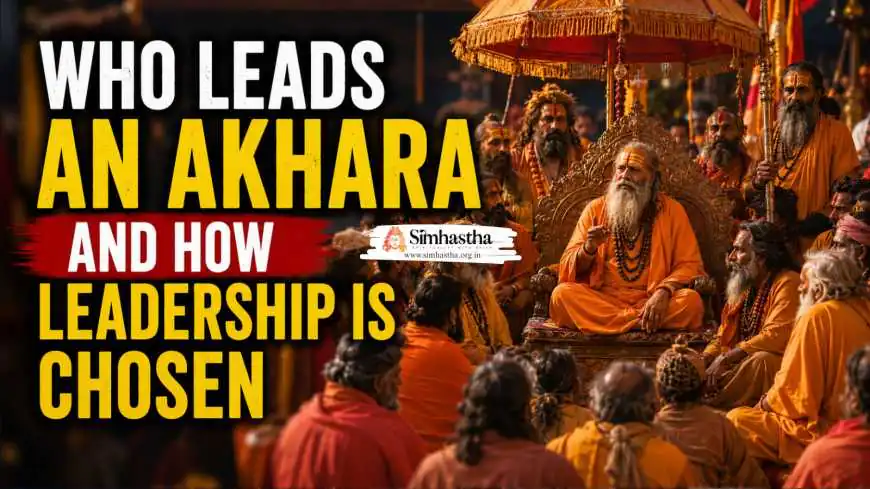
Before one can understand the selection of an Akhara's leader, one must first understand that the Akhara itself recognizes two distinct, though often overlapping, centres of supreme authority. The first, and by far the most spiritually potent, is the Mahant. The Mahant is the direct, spiritual successor of the founding saint of the Akhara, the living embodiment of the guru's grace, and the ultimate, unquestionable authority on all matters of doctrine, ritual, and the internal, spiritual discipline of the order. His word, within the sacred boundary of the Akhara's camp, is law. He is the final arbiter of disputes, the sole authority who can authorize a new Naga initiation, and the only person who can decide on the expulsion of a wayward sadhu. The second, and in many modern Akharas, the practically more powerful administrative office, is that of the Mahamandaleshwar. The Mahamandaleshwar is a senior, learned, and often politically astute sadhu who is appointed by the Mahant, with the consent of the Akhara's senior council, to manage the vast, complex, and worldly affairs of the order. He oversees the Akhara's extensive landholdings, its temples, its ashrams, and its trusts. He manages the considerable donations, the complex legal matters, and the intricate, high-stakes political relationship between the Akhara and the secular government. In some of the larger, more powerful Akharas, the role of the Mahamandaleshwar has evolved into a kind of powerful CEO-ship, with the Mahant acting as a revered, spiritual chairman of the board. However, in the smaller, more ascetic akharas, the Mahant himself may directly manage all affairs, and the title of Mahamandaleshwar is an honorary one, given to a deeply respected elder. This dual structure is the key to the Akhara's enduring strength, a beautiful, pragmatic, and deeply Indian synthesis of the saint's spiritual vision and the administrator's worldly competence. 👑
The Guru-Shishya Parampara and the Chosen Heir
The primary, foundational, and most sacred mechanism for selecting an Akhara's leader is the guru-shishya parampara, the unbroken, millennial tradition of master-to-disciple succession. The Mahant does not leave his throne to a committee vote or a popular election among the sadhus. He, and he alone, has the absolute, divinely ordained right to name his own successor during his lifetime. The process is one of the most secretive, profound, and deeply personal acts within the Akhara's inner life. For decades, the Mahant quietly observes the thousands of sadhus under his care, particularly the senior Nagas who have spent a lifetime in rigorous sadhana and selfless service. He is looking not for the most charismatic or the most politically connected, but for the soul that possesses the specific, subtle, and essential qualities required to hold the immense spiritual weight of the lineage: an unshakeable inner stillness, a profound and lived wisdom, an absolute fearlessness in the face of both worldly power and spiritual adversity, and a deep, unshakeable, and personal love for the Akhara and its sacred traditions. He may test potential candidates in ways that are invisible to the rest of the order—a sudden, harsh reprimand to test the ego, a deliberately impossible task to test the resilience, a long, unexplained period of silent, watchful waiting. The Akhara does not have a formal selection committee; it has the living, discerning, and spiritually illuminated eye of its guru. When the Mahant finally makes his choice, he summons the chosen disciple, often a man who has no idea he is being considered, to his private quarters. In a simple, sacred, and intensely emotional ceremony, he whispers the secret guru mantra of the Akhara into the disciple's ear, a sonic seed of transmission that is never spoken aloud to anyone else. He may hand over the Akhara's sacred relics—a particular trident, a manuscript, a rudraksha mala—and he formally, and irrevocably, invests the successor with the spiritual authority of the lineage. At that moment, the disciple ceases to be a follower and becomes the Mahant-elect, and the entire Akhara, upon the current Mahant's passing, is bound by its sacred maryada to serve him with the same absolute obedience. 🙏
The Succession Crisis and the Council of Elders
There are times, however, when the sacred, personal chain of the parampara is broken. A Mahant may die suddenly, in the prime of his life, without having named a successor. Or the chosen successor may die before the Mahant himself, a devastating blow that leaves the lineage without a designated heir. In these rare, painful, and often deeply fractious moments, the Akhara must fall back on its other, more collective, and more political decision-making mechanism: the council of senior sadhus. This council, typically composed of the most respected, learned, and senior Nagas and Mahamandaleshwars of the order, convenes in a closed, secret session, often conducted in the deepest, most private enclosure of the Akhara's main ashram or during the Kumbh Mela itself. The discussions can be intense, prolonged, and filled with the immense, unspoken pressure of protecting a spiritual legacy that is centuries old. The council will deliberate on the merits of the leading candidates, often the most senior and revered disciples of the deceased Mahant. Unlike a corporate election, there is no campaigning, no open nomination, and no counting of votes. The process is a blend of deep, prayerful meditation, an invocation of the grace of the founding guru, and a slow, careful, and subtle search for a consensus that is felt, intuitively and collectively, to be the will of the divine and the choice of the founder's own heart. The guiding principle is always the same: the next Mahant must be the sadhu whose spiritual radiance, wisdom, and integrity are so obvious and so universally acknowledged by his peers that his selection is seen not as a human decision, but as a divine revelation. The council's decision, once announced, is final and binding. The entire Akhara, which may have been teetering on the edge of a schism, rallies behind the new leader, and the unbroken chain of the parampara, though momentarily frayed, is reforged in the fire of collective, spiritual discernment. 🤝
The Role of the Akhil Bharatiya Akhara Parishad and External Recognition
While the internal selection of a Mahant is a purely spiritual and private affair of the Akhara, the Akhil Bharatiya Akhara Parishad (ABAP) , the umbrella organization of all the recognized Akharas, plays a crucial role in the final, formal ratification and the public acknowledgment of the new leader. The ABAP is the sole authority that maintains the official, revered register of the recognized Akharas and their legitimate Mahants. The new Mahant, after his internal selection, is presented by his Akhara to the general assembly of the Parishad, usually at the great gathering of the Kumbh Mela. The Parishad, after a review of the process to ensure that no fundamental violation of the ancient maryada has occurred, formally recognizes and publicly announces the new Mahant, granting him the official, unquestionable authority to represent the Akhara in all external, political, and inter-faith matters. This recognition is not a rubber stamp; it is a powerful, necessary validation, and the failure to secure it can lead to a prolonged, bitter, and deeply damaging public dispute over the legitimate leadership of the Akhara. The ABAP also serves as the final arbiter in a succession dispute that cannot be resolved internally, acting as a council of spiritual elders whose collective wisdom is the ultimate court of appeal. The relationship between the Akhara and the Parishad is a delicate, symbiotic dance between the absolute, internal spiritual sovereignty of the order and the practical, collective, and public governance of the greater monastic republic, a dance that is essential for the peace, unity, and strength of the entire Sanatana Dharma. 🛕
Trending Guides Now

13 Akharas of Simhastha 2028: Names, Order & Their Role Explained

How Naga Sadhus Begin Their Day: Ancient Discipline and Yogic Power
Who Are the Naga Sadhus of Simhastha 2028? Discipline, Rituals & Mystical Identity Revealed

Why Only Akharas Are Allowed to Lead Shahi Snan (Ujjain Rule Explained)

Ujjain Railway Station to Mahakaleshwar Temple Distance (2026 Guide)

Ujjain Simhastha 2028 Dates Announced: Full Shahi Snan & Event Timeline

Ujjain Simhastha Update: CM Mohan Yadav Reviews 2028 Works

Ujjain Railway Station to Kal Bhairav Temple: Distance, Auto Fare and Best Route
The Coronation and the Rajyabhishek of the Spiritual King
The formal investiture of a new Mahant is not a simple administrative handover; it is a magnificent, ancient, and deeply symbolic royal ceremony known as the Pattabhishek or Rajyabhishek, the coronation of a spiritual king. The ritual is typically conducted at the great Kumbh Mela, in the presence of the assembled masses of sadhus, the invited dignitaries of the other Akharas, and a vast, adoring crowd of lay devotees. The Mahant-elect is bathed in the sacred waters of the Triveni Sangam or the Shipra, then anointed with the sacred ash from the Akhara's eternal dhuni fire. He is dressed in the specific, traditional robes of his order and is adorned with the sacred symbols of his new office—a particular type of rudraksha mala, a silver or gold crown, and a ceremonial staff or trident that may be centuries old. He is then seated, with elaborate, Vedic ritual, on the gaddi, the sacred, throne-like seat that symbolizes the spiritual sovereignty of the lineage. The senior sadhus and the visiting Mahants of the other Akharas approach him one by one, offering flowers, garlands, and their solemn, public acknowledgment of his supreme authority. The ceremony is a powerful, public declaration that the spirit of the founding guru has passed, in an unbroken line, into the body and soul of the new Mahant. The newly consecrated leader then gives his first public blessing, his voice carrying the weight of a thousand years of tradition, and the entire congregation of sadhus and devotees prostrates before him, a sea of bodies bowing to the single, sacred embodiment of their shared, eternal faith. 👑
The Unshakable Edifice of a Thousand Years of Faith
The leadership of an Akhara is a miracle of continuity, a sacred, intricate, and deeply human edifice that has withstood the storms of history, the invasions of empires, and the constant, erosive pressures of modernity. It is a system that understands that true, lasting spiritual authority cannot be won by a vote or seized by force; it must be grown, organically, in the silent, unseen soil of a lifelong, personal relationship between a master and a disciple. The Mahant who sits on the silver throne at the head of the Shahi Snan procession is not merely a man; he is a living, breathing link in a golden chain of masters and disciples that stretches back, unbroken, to the very dawn of the Hindu monastic tradition. The process of choosing him is not a political election; it is a sacred act of love, discernment, and the profound, mysterious transmission of a grace that cannot be written into a constitution but can only be whispered, in the ultimate, private silence, from the heart of a dying father to the soul of his chosen son. And that, in the end, is the beautiful, powerful, and unshakable secret of the Akhara's eternal, undying life. 🔱
Frequently Asked Questions