































How New Members Are Initiated Into Akharas
Uncover the secret process of how new members are initiated into Akharas. From self-funeral rites and guru mantras to the ash-smeared birth of a Naga, explore the sacred death and rebirth of a Hindu ascetic.



The Long Road to the Threshold and the Years of Unseen Testing
The initiation into an Akhara is not a spontaneous act of impulse. It is the culmination of a long, often brutal, period of testing that can last for years. When a man—and, traditionally in the major Akharas, it is men, though women's orders exist—first feels the call of renunciation, he does not simply arrive at a Mela and demand a trident. He first approaches a guru, often a senior mahant of the Akhara he feels drawn to, and expresses his desire to take vairagya, the path of world-renunciation. The guru does not welcome him with open arms. Instead, the aspirant is typically assigned to the most menial tasks in the camp: chopping wood, cleaning the dhuni, serving food, and enduring the biting cold and blistering heat without complaint. This period, which can last months or years, is a continuous, unspoken examination of the aspirant's resolve. The Akhara is not looking for enthusiasm; it is looking for vairagya bhav, the genuine, bone-deep disillusionment with the world that cannot be faked. The guru watches how the aspirant handles hunger, insult, and exhaustion. Many are called; very few are kept. Only when the guru is satisfied that the desire for renunciation is authentic, and that the aspirant has the physical and mental stamina to survive the life of a naked mendicant or a wandering monk, is the initiate finally called to the inner sanctum for the great, irrevocable ritual. 🚶
The Sacred Death and the Self-Funeral of the Naga Initiate
The core of the initiation of a new member into a Shaiva Akhara, and particularly the making of a Naga sadhu, is the ritual of pind daan. In the dead of night, often during the most auspicious moments of the Kumbh Mela, the aspirant is led by the guru to a secluded area, usually on the banks of the sacred river. A small fire is lit. The aspirant, dressed in simple, unmarked white cloth, sits facing south, the direction of the dead. The guru and the senior mahants chant the mantras that a son chants for his deceased father. The aspirant makes an offering of rice balls mixed with black sesame seeds, the pind, not for an ancestor, but for himself. He performs his own shraddh ceremony. This is the moment of symbolic death. The man he was—his birth name, his caste identity, his family lineage, his professional qualifications, his debts, his relationships, his very ego—is declared dead. He is given a new name, which is often a name of Shiva or a title within the Akhara's hierarchy, and from that moment on, his former identity is never to be spoken of again. The ritual is so final that in traditional understanding, if the initiate’s biological family were to hold a funeral for him upon hearing of his renunciation, it would be entirely appropriate. He has died to them. This is the ultimate severance, the surgical removal of the self from the web of the world. 🔱
The Shaving, the Ash, and the Unclothing of the Body
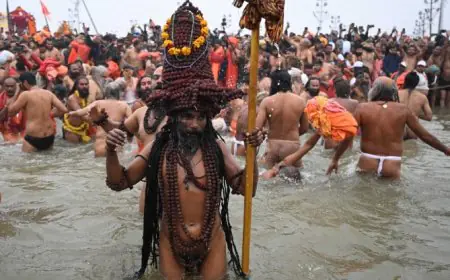
Following the pind daan, the physical transformation of the initiate begins. His head is shaved completely clean, including the scalp, eyebrows, and sometimes the beard, leaving only a small lock of hair, the shikha, which is offered to the river. This shaving is a further reinforcement of death: in Hindu tradition, the head is shaved for funerals. The initiate is then taken to the river and given a ritual bath. He emerges, and the guru, using sacred ash from the akhara's eternal dhuni fire, smears the initiate's entire body with vibhuti. This ash is not a cosmetic; it is a constant, tactile reminder of the impermanence of the physical body. It is the dust to which all things return. For the Naga initiate, the final physical act is the most radical: the removal of all clothing. The guru or a senior Naga tears away the initiate's white cloth, and the new Naga stands digambara, sky-clad, before the fire, the river, and his new brothers. This is the ultimate renunciation of all material possession, social convention, and bodily shame. The Naga's nakedness is not a display; it is an act of supreme spiritual defiance against the illusions of Maya. He is now a living representation of Shiva at the cremation ground, a being beyond the laws of the human world. ⚠️
The Guru's Whisper and the Secret Seed of the Soul
While the pind daan and the ash are the public, visible markers of the initiation, the true spiritual core of the ritual takes place in a moment of absolute, impenetrable secrecy. The guru draws the new initiate aside, away from even the other sadhus, and whispers a guru mantra into his ear. This mantra is the sonic seed of the new soul. It is never written down, never repeated aloud to anyone, and never revealed to an outsider. This mantra, chosen specifically for the initiate's spiritual temperament by the guru, is the tool with which the new sadhu will engage in his lifelong sadhana. It is the internal fire that will burn away the remaining karmic impurities. The transmission of this mantra is the moment of true spiritual rebirth. The guru is not just a teacher; in that instant, he is the divine mother and father, birthing the disciple into a new, eternal lineage. The disciple's relationship to the mantra and to the guru becomes the central, defining axis of his existence. The vow of silence, the mouna, that many new initiates observe for extended periods is designed to protect this inner seed, to allow it to germinate and grow in the undisturbed soil of the mind. The external rituals of the Akhara—the fire, the ash, the chants—are all eventually oriented toward the realization of the truth encoded in this single, whispered sound. 🙏
Trending Guides Now

13 Akharas of Simhastha 2028: Names, Order & Their Role Explained

Who Are the Naga Sadhus of Simhastha 2028? Discipline, Rituals & Mystical Identity Revealed

Why 13 Akharas Are Recognised in Simhastha

How Saints and Naga Sadhus Are Preparing for Simhastha 2028 ?

Ujjain Railway Station to Mahakaleshwar Temple Distance (2026 Guide)

Ujjain Simhastha 2028 Dates Announced: Full Shahi Snan & Event Timeline

Benefits of Becoming a Simhastha Volunteer

Ujjain Travel During Shravan Month: What Changes for Visitors
The Vaishnava Path and the Brand of the Conch
While the Naga tradition is the most visually dramatic, the initiation into the Vaishnava Akharas is no less profound, though it follows a distinctly different theological and ritual path. The Vaishnava aspirant, who seeks initiation into an order dedicated to Lord Rama or Lord Krishna, does not perform his own pind daan in the same stark, funerary manner, nor does he generally go naked. Instead, the Vaishnava initiation emphasizes saranagati, complete, loving surrender to the chosen deity. The aspirant is initiated by a guru who belongs to a specific Vaishnava sampradaya—such as the Ramanandi, Nimbarki, or Vallabhacharya traditions. The core of the initiation is the receiving of the nama mantra, the sacred name of the deity, and the gopal mantra in Krishna traditions. The guru then often applies the tapa mudra, the heated metal stamps of Vishnu's divine attributes—the conch (shankha), the discus (chakra), the lotus (padma), and the mace (gada)—onto the initiate's shoulders, arms, or chest. This is a profoundly painful but ecstatic ritual that brands the devotee forever as the property of the Lord. The initiate is then given the urdhva pundra, the distinctive white and red Vaishnava tilak, painted on his forehead in a specific style that marks his sectarian identity. He is given ochre or white robes, a mala of tulsi beads, and a new name, often suffixed with "Das" (servant) or "Sharan" (refuge). The entire ceremony is one of sacred love and master-servant relationship with the divine, a stark contrast to the Shaiva emphasis on the cremation ground and death of the ego. 🪔
The Udasin Initiation and the Sikh Connection
The Udasin Akharas, which trace their lineage to Shri Chand, the son of Guru Nanak, have an initiation process that beautifully blends the Sikh emphasis on the formless divine with the Hindu ascetic tradition. The Udasin initiate does not typically go naked, nor is he branded. The initiation, called charan pahul in some traditions, emphasizes the acceptance of the guru's teachings and a commitment to a life of celibacy, meditation, and service. The guru places his hand on the initiate's head, recites verses from the Guru Granth Sahib, and may give the initiate a small kirpan (ceremonial sword) or a seli (a woolen cord symbolic of the lineage). The Udasin akharas have their own historical camps at the Kumbh and their own distinct identity, which is reverently acknowledged within the larger Akhara system. They are a living testament to the historical fluidity between what are now known as Hinduism and Sikhism.
The Kumbh Mela and the Mass Initiation of the Warrior-Saints
While an initiation can occur at any time in the sanctity of an akhara's permanent ashram, the Kumbh Mela holds a unique and unparalleled significance in this process. The Simhastha in Ujjain, like the Kumbh at Prayagraj, Haridwar, and Nashik, is the designated time and place for the largest mass initiations. The astrological configuration of the Mela is believed to infuse the river waters with a special potency that makes the ritual death and rebirth of the initiate exceptionally powerful. During the Mela, dozens, sometimes hundreds, of aspirants are initiated simultaneously. The inner enclosures of the Juna, Niranjani, and Mahanirvani Akharas come alive with the continuous chanting of mantras as one aspirant after another undergoes the self-funeral rites. The sight, glimpsed from a distance by a privileged few, of a line of men dressed in white, moments away from their shave, their shraddh, and their emergence as naked Nagas, is one of the most powerful and unphotographed spectacles of the Kumbh. It is here, at the great cosmic conjunction, that the Akhara's army of the spirit is recruited for the next twelve-year cycle. These new Nagas will, in turn, form the protective cordon around the Akhara's mahants and deities during the great Shahi Snan processions. The Kumbh is, therefore, not just a gathering; it is the great fertility rite of the Akhara system, the moment of its spiritual reproduction. 🛕
Life After Initiation and the Severing of the Past
The morning after the initiation, the new member wakes to a completely new reality. His old identity is a ghost. He is now part of a guru-shishya parampara that stretches back, unbroken, for hundreds or thousands of years. He has an immediate new family: his guru brothers, who are his peers, and the senior sadhus and mahants, who are his guides and disciplinarians. He is at the bottom of a strict internal hierarchy, and his life will be governed by the Akhara's maryada, its internal code of conduct. This includes strict rules about diet, interaction with women, travel, and the performance of daily rituals. The new initiate is not immediately granted the prestige of a senior Naga. He spends years, sometimes decades, in rigorous spiritual practice and service to the Akhara before he earns the right to participate in the inner councils or to lead a procession. His past is entirely sealed. If his biological family were to track him down, he is expected to refuse any recognition. He has no personal property. His only possessions are his kamandalu, his mala, and the mantra in his heart. The complete severance from the world of money, relationships, and ambition is not a symbolic gesture; it is the lived, daily reality that the initiation has created. This is the ultimate meaning of the Akhara initiation: the absolute, uncompromising freedom that comes from having nothing left to lose.
The Unspoken Rule and the Protection of the Inner Circle
What you are reading here is the outer perimeter of the Akhara's secret garden. The core of the initiation ritual—the specific mantras, the exact sequence of gestures, the secret geometry of the sacred space, and the whispered instructions given by the guru to the disciple in the final, solitary moments—is never, under any circumstances, shared with the non-initiated. This secrecy is not born of arrogance but of an understanding that the spiritual power generated by these rituals is a fire that must be contained. It is a sacred technology, and its efficacy depends on its purity and its protection from the profane gaze. The Akharas, for all their spectacular public processions, are fundamentally esoteric institutions. They are the custodians of spiritual technologies that are transmitted orally, from guru to disciple, in an unbroken chain since the time of the great sages. The initiation of a new member is the most critical link in this chain. It is the moment where the lamp of one generation is passed to the next, and if the lamp is fumbled, the light of an entire lineage could be extinguished. The initiate’s vow of silence, his acceptance of the guru’s authority, and his commitment to the Akhara’s maryada are all protective seals around this sacred fire. The public may witness the ash, the fire, and the nakedness, but the true heart of the initiation remains, and will always remain, a mystery shared only between the soul and the divine. That is the rule, unspoken yet absolute.
The Eternal Flame and the Unbroken Chain
The making of an ascetic in an Akhara is, ultimately, an act of profound, cosmic hope. In a world where everything is decaying, where relationships end in death and empires crumble into dust, the Akhara initiation declares that there is an alternative. It declares that the human spirit can so thoroughly divest itself of the temporary that it touches the eternal. The man who dies his ritual death on the banks of the Shipra and rises from the river as a child of the guru is a living testament to the Hindu conviction that life is not a single, linear journey but a cycle of deaths and rebirths that can be consciously transcended. The initiation of a new member into an Akhara is the unbroken chain that connects the present, through Adi Shankaracharya and Guru Gorakhnath, back to the primordial Rishis who first sat in the Himalayan caves. Every time a guru whispers the secret mantra into a new ear, the entire lineage of a thousand years leans in to listen. The chain is forged anew in that whisper, and the eternal flame of the Akhara, the dhuni that has burned for centuries, receives another log. The ash that smears the new Naga's body is the same ash, spiritually speaking, that smeared the first sadhu. The new initiate, anonymous now, will one day be a venerable mahant, and he will, in his turn, light a funeral pyre for a young aspirant and then breathe a new soul into him. And so the eternal chain continues, unbroken, as silent and as powerful as the Shipra that flows past the ghats in the pre-dawn dark. 🔱

Frequently Asked Questions