



















How Ritual Responsibilities Are Divided Among Akharas
Discover how ritual responsibilities are divided among Akharas at the Kumbh Mela. Explore Shahi Snan order, governance roles, and the sacred hierarchy of monastic orders.

The Hidden Order Behind the Sacred Chaos
Picture this: Millions of devotees gathered on the banks of a sacred river. The air is thick with the sound of conch shells, bells, and the collective chant of millions of voices. And then, from behind a curtain of dust and devotion, they emerge—the Naga Sadhus, covered in ash, their bodies adorned with rudraksha and marigold flowers, ready to lead the most sacred ritual of all: the Amrit Snan . 🚩
But have you ever wondered how this massive spiritual spectacle is orchestrated? Who decides which Akhara goes first? How are ritual responsibilities divided among these ancient monastic orders that trace their origins back to Adi Shankaracharya himself ? 🤔
The answer lies in a meticulously structured system that has been refined over centuries—a system that blends spiritual hierarchy, historical tradition, and modern governance to ensure that the sacred rituals of the Kumbh Mela unfold in perfect harmony. In this article, we'll explore exactly how ritual responsibilities are divided among Akharas, from the grand procession order to the internal governance that keeps these organizations running. Let's dive in! 🙏
The 13 Akharas: Who's Who in the Monastic World
The Three Pillars: Sanyasi, Vaishnav, and Udasin
Before we understand how responsibilities are divided, we need to know who's doing the dividing. The 13 Akharas are broadly categorized into three groups based on their spiritual lineage and devotional focus .
Trending Guides Now

Simhastha Rituals Complete Guide to Sacred Practices in Ujjain
Why Certain Rituals Are Allowed Only at Specific Ghats During Simhastha

First Shahi Snan 2028 Date Ujjain Simhastha

What Is Shahi Snan in Ujjain Simhastha Kumbh Mela?

Ujjain Railway Station to Mahakaleshwar Temple Distance (2026 Guide)

Ujjain Simhastha 2028 Dates Announced: Full Shahi Snan & Event Timeline
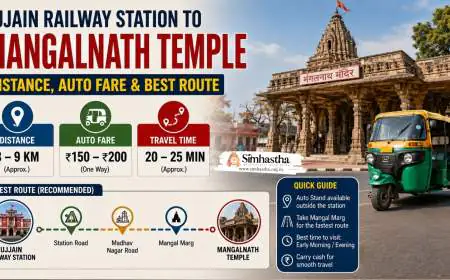
Ujjain Railway Station to Mangalnath Temple: Distance, Auto Fare and Best Route
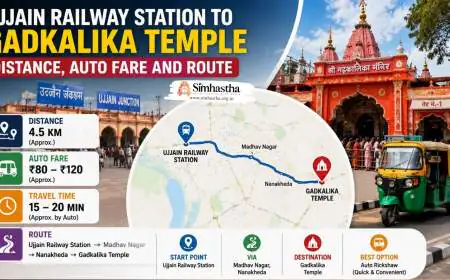
Ujjain Railway Station to Gadkalika Temple: Distance, Auto Fare and Route
The Shaivite (Sanyasi) Akharas — Seven Orders
These Akharas are dedicated to Lord Shiva and follow the Dashnami tradition established by Adi Shankaracharya . They wear the sacred tripundra—a horizontal mark on their foreheads . The seven Shaivite Akharas are:
| Akhara Name | Distinctive Feature |
|---|---|
| Juna Akhara | The largest with ~5 lakh sadhus; worships Lord Dattatreya |
| Niranjani Akhara | Second largest; has many educated members with doctorates |
| Mahanirvani Akhara | Worships Sage Kapilmuni; associated with warrior ascetics |
| Atal Akhara | One of the oldest (7th century CE); worships Lord Ganesha |
| Avahan Akhara | Oldest monastic order; worships Dattatreya |
| Anand Akhara | Second oldest; worships Dev Bhuwan Bhaskar Suryanarayan |
| Agni Akhara | Brahmachari saints who don't practice fire sacrifice |
The Vaishnav Akharas — Three Orders
These Akharas are devoted to Lord Vishnu and trace their origins to the 18th century . They feature an image of Lord Hanuman on their flags and march after the Shaivite Akharas during processions .
| Akhara Name | Distinctive Feature |
|---|---|
| Nirmohi Akhara | Preserves Vaishnava traditions; yellow-colored sign |
| Digambar Akhara | Largest Vaishnav (~2 lakh sadhus); venerates Sita, Ram, Hanuman |
| Nirvani Akhara | Notable for focus on physical fitness; silver-colored sign |
The Udasin Akharas — Three Orders
The word udāsīna means "neutral" in Sanskrit, reflecting their position between Shaivism and Vaishnavism . They follow Guru Nanak's teachings and are guided by the Guru Granth Sahib .
| Akhara Name | Distinctive Feature |
|---|---|
| Bada Udasin Akhara | Follows Sri Chand (Guru Nanak's son); founded 1825 |
| Naya Udasin Akhara | Formed after a dispute in 1846 |
| Nirmal Akhara | Also known as Sikh Akhara; reveres both Hindu scriptures and Guru Granth Sahib |
The 14th Akhara: Kinnar Akhara
An emerging presence at the Kumbh Mela since 2019, the Kinnar Akhara provides a platform for transgender individuals to express their devotion and spirituality . While it has participated in recent Kumbh celebrations, it's worth noting that the Akhara Parishad has not officially recognized it as the 14th Akhara . Regardless, its presence represents a significant step toward inclusivity in these ancient traditions.
The Grand Procession: Who Leads and Who Follows
The Peshwai: A Royal Spectacle
Before the sacred bathing begins, the Akharas make their grand entrance into the Kumbh city through a ceremonial procession known as the Peshwai . This is not just a walk—it's a royal spectacle that announces the arrival of the monastic orders .
What happens during the Peshwai:
-
Sadhus march alongside horses and elephants
-
Bands play vibrant music to accompany them
-
The Shri Mahantas (leaders) sit on ornately decorated vehicles transformed into chariots
-
Naga Sadhus captivate the crowd with acrobatic displays and martial arts performances using sticks, swords, and spears
-
Locals and pilgrims shower the sadhus with flowers and garlands
The dharma-dhvaja (flag of dharma) is then raised in each Akhara camp, marking the official beginning of the Kumbh Mela . Interestingly, the Nirmal Akhara has a unique tradition where the flag is hoisted after the sadhus enter the camp, unlike the other 12 Akharas .

The Shahi Snan Order: Who Bathes First?
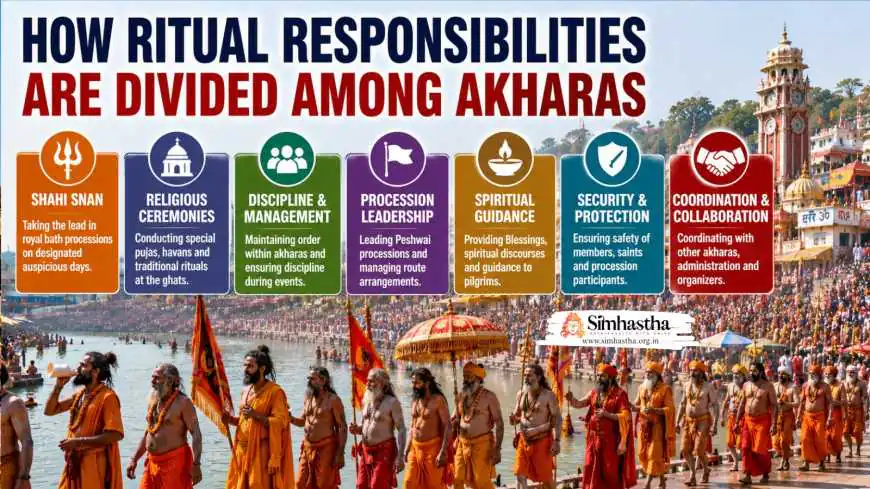
Now, this is where the division of ritual responsibilities becomes truly fascinating. The Shahi Snan (Royal Bath) is the most sacred ritual of the Kumbh Mela, and the order in which Akharas enter the water is strictly codified .
The precise order of march:
-
Mahanirvani Akhara leads, accompanied by the Atal Akhara
-
Niranjani Akhara follows, paired with the Ananda Akhara
-
Juna Akhara comes next, accompanied by Avahan and Agni Akharas
-
The Vaishnav Akharas (Nirvani, Digambar, Nirmohi) march after the Shaivite Akharas
-
The Udasin Akharas follow
-
The Nirmal Akhara (Sikh tradition) is the last to participate
Why this order matters: According to historical sources, this hierarchy was codified by the British in the late 19th century to prevent violent clashes between rival Akharas that had previously resulted in thousands of deaths . The order of precedence grants the most powerful Akharas the right to bathe first, and it's seen as a display of strength and spiritual authority.
The chariot of the Acharya Mahamandaleshwar of the Akhara is at the front of the group. Behind him, Mahamandaleshwars, Shri Mahants, Mahants, Kotwals, Thanapatis, and other officials walk in order as per their rank and position . The administration decides the route of this procession in advance, and devotees stand outside the barricades to witness this awe-inspiring spectacle.
The Internal Hierarchy: Who Does What Inside an Akhara
The Organizational Structure
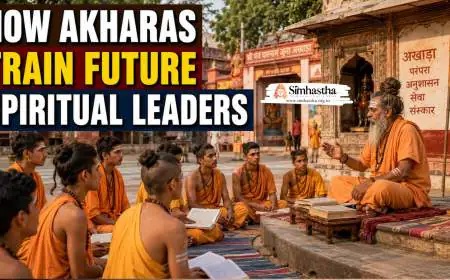
Each Akhara is a meticulously structured institution, organized into eight davas (divisions) and 52 marhis (centres), each overseen by a Mahant (head) . This structure is responsible for allocating the ritual duties within the Akhara.

Key leadership roles:
| Role | Responsibility |
|---|---|
| Acharya Mahamandaleshwar | Highest-ranking spiritual leader; leads processions and rituals |
| Mahamandaleshwar | High-ranking monks with significant influence and authority |
| Shri Mahant | Senior leader overseeing multiple centers |
| Mahant | Head of a center or division; manages day-to-day operations |
| Kotwal | Security and discipline officer |
| Thanapati | Camp manager during Kumbh Mela |
For Naga Sadhus specifically, the hierarchy includes:
-
Acharya Mahamandaleshwar (highest)
-
Mahamandaleshwar
-
Digambarshree
-
Peer Mahant
-
Thanapati Mahant
-
Jamapatiya Mahant
-
Shri Mahant
-
Mahant
-
Naga (the common ascetic)
The Panchayat System: Governance Through Consensus
Here's a fascinating detail: The word "Panchayati" appears in the names of several Akharas (like Mahanirvani, Atal, Niranjani, and Anand) because decisions in these Akharas are made by a panchayat (council) through consensus .
How the governance works:
-
Eight Mahants (the "Ashtakaushal") run the Akhara's affairs
-
Eight Deputy Mahants assist them
-
This 16-member committee selects the secretary and other officials
-
All eight Mahants maintain complete financial accounts
-
Action against any ascetic is taken only through the panchayat—no one is above the collective decision
A note on elections: During the Kumbh Mela, all executive bodies are dissolved, and a new government is elected. The term of the new government lasts for the next six years, and the elections happen before the Kumbh ends .
Ritual Responsibilities at the Amrit Snan
The Night Before: Purification of the Body and Soul
The division of ritual responsibilities begins long before the actual bath. For the Naga Sadhus—who lead the Amrit Snan—the preparation starts the night before and takes 7-8 hours .
The "17 Shringar" of Naga Sadhus:
Unlike the 16 adornments (shringar) of a married woman, Naga Sadhus perform 17—the 17th being the sacred ash (bhabhoot) with which they smear their entire body .
The ritual sequence:
-
Night-long prayers to Lord Shiva and the Akhara's deity to purify the soul
-
Cleansing rituals for the body
-
Grooming the Panchkesh (body hair) by brushing or shaving
-
Applying roli, tilak, and chandan—comparable to a married woman applying bindi and sindoor
-
Wearing garlands of Rudraksh (rosary beads)
-
Adorning an iron kada (bracelet) instead of bangles
-
Carrying a damroo, chimta, and kamandal as other adornments
Why this matters: The Naga Sadhu purifies himself inside and out before the Amrit Snan because he is aware that millions of others will bathe in the same water after him. He comes out after just one dip or two, maintaining the sanctity of the water for others .
The Ritual Bathing: Who Purifies Whom
The core responsibilities are distributed as:
-
Naga Sadhus bathe first, leading the procession
-
Mahamandaleshwars follow, with the Acharya Mahamandaleshwar at the front of his Akhara's group
-
Junior sadhus and disciples bathe after their leaders
-
Devotees bathe after all the Akharas have completed their ritual
The belief: By having darshan of the Sadhus and witnessing the ritual bathing, devotees believe they will be liberated (mukt) .
Historical Conflicts and Modern Resolution
When Ritual Responsibility Became a Battlefield
The division of ritual responsibilities hasn't always been peaceful. In earlier centuries, the Haridwar Kumbh was a battleground for economic and spiritual dominance, where sadhu Akharas fought for the right to be first to enter the sacred waters .
Notable historical clashes:
-
1760 Haridwar Kumbh: A fierce battle erupted over the right to bathe first, with as many as 18,000 sadhus killed
-
1796 Haridwar Kumbh: A clash between Shaiva and Nirmala Sikhs resulted in about 500 deaths
The British, seeking to manage these rivalries, codified the order of precedence in the late 19th century . Today, the Akhil Bharatiya Akhara Parishad (ABAP)—established in 1954—primarily exists to organize and manage the Kumbh Mela and promote coordination between different Akharas .
Unique Rituals Among Different Akharas
The Nirmal Akhara's Flag Tradition
While most Akharas install the dharma-dhvaja before the sadhus enter the camp, the Shri Panchayati Akhara Nirmal follows a different tradition—the sadhus enter first, and the flag is hoisted a day later .
The ritual sequence at Nirmal Akhara:
-
Saints, mahants, and Mahamandaleshwars enter the cantonment built in the fair area
-
The next day, the Dharmadhwaja is hoisted amid Vedic chants and rituals
-
Saints establish their Ishtadev (deity) in the temple built under the flag
-
Guru Granth Sahib is recited and other rituals are performed under the religious flag
The Udasin Tradition of Alcohol Offering
Some Udasin Akharas have a unique ritual of offering madira (alcohol) to fire—a practice that reflects their "neutral" position between Shaivism and Vaishnavism .
The Kinnar Akhara's Emerging Role
The Kinnar Akhara, representing the transgender community, has since 2019 begun participating in Kumbh rituals, establishing their own camp and performing ceremonies under their own flag . This represents a significant shift toward inclusivity in these ancient traditions.
The Bottom Line: A System of Sacred Order
So, how are ritual responsibilities divided among Akharas? Through a carefully structured system that blends:
-
Spiritual hierarchy (Acharya Mahamandaleshwar to Naga ascetic)
-
Historical tradition (the codified order of precedence established over centuries)
-
Modern governance (the Akhara Parishad, the Panchayat system, and scheduled elections)
From the grand Peshwai procession to the 7-8 hours of preparation before the Amrit Snan, from the precise order of marching to the internal governance of 52 centers, the division of ritual responsibilities among the 13 Akharas is a testament to the enduring power of Hindu monastic traditions.
The system ensures that the largest religious gathering on earth—the Kumbh Mela—unfolds with spiritual precision and social harmony. Whether it's the Juna Akhara leading the Shaivites, the Nirmohi preserving Vaishnava traditions, or the Kinnar Akhara emerging as a force for inclusivity, each Akhara plays its part in this ancient, living tradition. 🕉️
Frequently Asked Questions