



















How Ritual Calendars Are Prepared Before Simhastha Begins
Discover how ritual calendars are prepared before Simhastha begins. From ancient Surya Siddhanta calculations to the Akhara Parishad's ratification, explore the sacred astrological process that sets the Shahi Snan dates for the Ujjain Kumbh Mela.


The Celestial Trigger and Why the Stars Dictate the Sacred Baths
The Simhastha Kumbh Mela does not occur because a government declares it or because a religious organization finds a convenient date on a secular calendar. It occurs, with the absolute, unyielding precision of a cosmic law, because of a specific, rare, and profoundly potent celestial alignment. The great, benevolent planet Jupiter (Brihaspati) , the Guru of the gods, the significator of wisdom, expansion, and divine grace, enters the zodiac sign of Leo (Simha) , the royal sign of the Sun, the sign of kingship, courage, and the fierce, radiant heart. This conjunction, which happens approximately every twelve years, is the singular, non-negotiable cosmic trigger for the Ujjain Kumbh. But the calculation is far more complex than simply noting the month of Jupiter's ingress. The Kumbh astrologers must also precisely track the positions of the Sun and the Moon in relation to this primary conjunction. The most potent, spiritually charged bathing days—the Shahi Snans—are those when specific, rare combinations of these three celestial bodies create a unique, temporary, and supremely powerful doorway between the material and the spiritual realms. The waters of the Shipra, on those specific days and at those precise, astrologically calculated moments, are believed to be infused with the immortal nectar, the amrit, that was spilled during the cosmic churning of the ocean. The ritual calendar is, therefore, not a schedule; it is the precise, scientific, and sacred identification of these fleeting, cosmic windows of grace. 🌌
The Ancient Science and the Surya Siddhanta's Unbroken Legacy
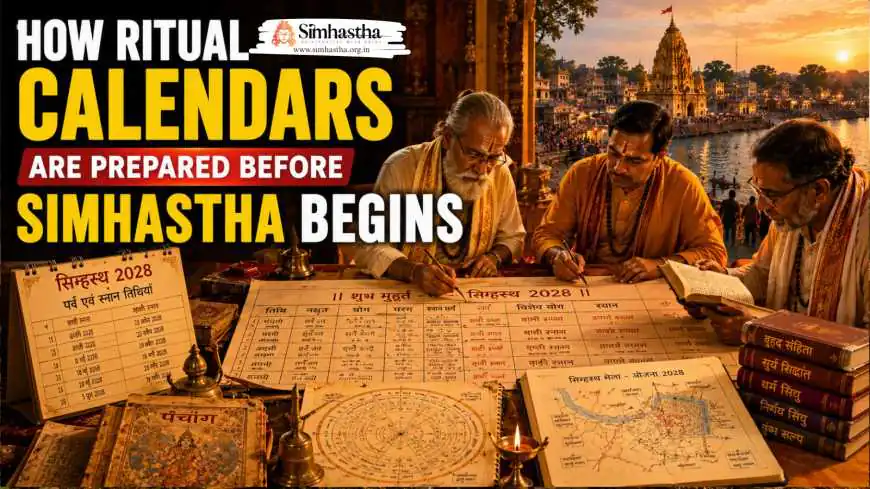
The preparation of the Simhastha ritual calendar is not based on a vague, intuitive astrology but on a rigorous, mathematically grounded, and empirically verifiable astronomical tradition that is codified in one of the world's oldest and most sophisticated scientific texts: the Surya Siddhanta. This foundational treatise, which reached its definitive form during the Gupta period and which explicitly establishes Ujjain as the zero-degree longitude, the prime meridian of the earth, is the master manual for the Kumbh astrologers. The text provides the precise mathematical formulas for calculating the orbital periods of the planets, the precession of the equinoxes, the length of the solar year, and the intricate, interlocking cycles of the lunar months. The Kumbh astrologers, who are the hereditary custodians of this ancient, sacred, and intensely demanding science, do not consult modern astronomical software or digital planetariums. They work from the ancient, hand-copied, and meticulously preserved manuscripts, using the traditional methods of the Panchangam, the Vedic almanac, to compute the precise positions of the celestial bodies at any given moment. The entire calculation is referenced to the Ujjain meridian, the sacred line that runs through the city and that was, for over a thousand years, the Greenwich of the ancient world. The preparation of the calendar is, therefore, a profound, living act of intellectual and spiritual continuity, a direct, unbroken link to the scientific and religious genius of the classical Indian civilization. 📐
The Astrologer's Silent Vigil and the Months of Solitary Calculation
The work of preparing the Simhastha ritual calendar begins, in deep, undisturbed secrecy, many months before the event. The chief Kumbh astrologer, often a man of advanced age who has inherited the sacred duty from his father and grandfather, and who has spent a lifetime mastering the complex, intricate verses of the Surya Siddhanta and the other astronomical texts, withdraws from his normal, public life. He retreats to a quiet, lamp-lit chamber, often within the precincts of an ancient temple or his ancestral home, and enters a state of intense, focused, and deeply meditative concentration. This period of solitary calculation, which can last for several weeks or even months, is itself a profound spiritual practice, a form of sadhana. The astrologer observes a strict, sattvic diet, performs his daily rituals with an extra, reverent care, and maintains a state of absolute mental and physical purity. His work is not merely an intellectual exercise; it is a sacred, ritual act, a form of worship, a direct, personal dialogue with the cosmic intelligence. He pores over the ancient, palm-leaf manuscripts, his fingers tracing the complex, mathematical verses, his mind performing the intricate calculations of planetary longitudes, conjunctions, and retrogrades. He cross-references his calculations, checks for errors, and slowly, painstakingly, pieces together the precise, celestial map of the months during which Jupiter will transit through Leo. The ritual calendar is born in this silent, solitary, and profoundly sacred vigil, a document that is the product not just of a brilliant mind but of a purified, devoted, and deeply disciplined soul. 🧘
The Dance of the Planets and the Art of Determining the Sacred Muhurta
The most critical, complex, and secretive part of the astrologer's work is the determination of the exact Muhurta for each of the great Shahi Snans. A Muhurta is not merely a date; it is a precise, sacred window of time, often lasting only a few hours, sometimes even less, during which the specific, rare, and supremely potent alignment of the Sun, Moon, and Jupiter is at its absolute, mathematical peak. The astrologer must calculate not only the broad position of Jupiter in Leo but the exact degree, minute, and second of its transit, the precise lunar day (tithi), the specific constellation (nakshatra) that the Moon is passing through, and the delicate, ever-shifting angular relationships between the planets. For the Shahi Snan to be considered supremely auspicious, specific, demanding conditions must be met. Jupiter must be in Leo, and on the day of the great bath, the Sun must be in Aries or a similarly potent, fiery, and compatible sign, creating a powerful, celestial resonance. The Moon, which governs the mind, the emotions, and the receptive, intuitive capacity of the pilgrim, must be in a particularly favourable nakshatra and must not be afflicted by any malefic planetary aspects. The astrologer's task is to identify those rare, fleeting moments when all these complex, independent celestial conditions align in a perfect, harmonious, and spiritually explosive configuration. The Muhurtas he designates are the spiritual engines of the entire Simhastha, the precise, cosmic moments when the pilgrimage's transformative power is at its absolute, most concentrated, and most accessible zenith. ⏱️
Trending Guides Now

Why Certain Rituals Are Allowed Only at Specific Ghats During Simhastha

Why Snan Dates Shift According to Planetary Positions in Simhastha

The Complete Sequence of Ritual Events During Simhastha

What Happens on the Most Important Bathing Days of Simhastha

Ujjain Railway Station to Mahakaleshwar Temple Distance (2026 Guide)

Ujjain Simhastha 2028 Dates Announced: Full Shahi Snan & Event Timeline

Ujjain to Mahakaleshwar Temple Distance & Taxi Fare (2026)

Ujjain Simhastha 2028: ₹91.74 Cr Harifatak-Mahakal Lok Underpass
The Akhara Council and the Ratification of the Divine Schedule
Once the chief Kumbh astrologer has completed his long, solitary, and sacred work, his proposed calendar, meticulously written on a traditional, hand-made scroll, is presented not to the government but to the supreme religious authority of the Kumbh Mela: the Akhil Bharatiya Akhara Parishad (ABAP) , the great council of the thirteen recognized Akharas. This is not a ceremonial, rubber-stamp presentation. The Akharas, the ancient, powerful, and fiercely independent monastic warrior orders, are the ultimate, non-negotiable authority on all matters of Kumbh ritual and protocol. The Mahants and the senior, learned Mahamandaleshwars of the great Akharas—the Juna, the Niranjani, the Mahanirvani, and the others—convene in a closed, secret session to review the proposed calendar. They are, many of them, deeply learned in the astrological sciences themselves. They will scrutinize the proposed dates, question the astrologer on his calculations, and ensure that the calendar not only satisfies the celestial requirements but also respects the ancient, fiercely guarded protocols regarding the specific, sequential bathing order of the Akharas. Only after the Parishad has thoroughly reviewed, debated, and finally, unanimously ratified the calendar is it considered to be spiritually valid and formally approved. This ratification is the essential, sacred bridge between the private, celestial calculation and the public, terrestrial enactment of the Kumbh. It is the moment when the cosmic blueprint receives the final, authoritative seal of the spiritual armies who will lead the sacred charge into the river. 🛕
The Public Proclamation and the Moment the World Learns the Dates
The formal, public announcement of the Simhastha ritual calendar is, in itself, a significant ceremonial event, a ritual of proclamation that sets the entire, vast machinery of the pilgrimage into motion. The announcement is typically made at a formal press conference, often held in Ujjain or the state capital, Bhopal, and is attended by the senior leadership of the Simhastha Central Committee, the head of the Madhya Pradesh government, the leaders of the Akhara Parishad, and, most importantly, the chief Kumbh astrologer himself, who is presented to the public with great honour and reverence. The scroll containing the sacred, ratified dates is often displayed, and the specific dates and Muhurtas for each of the Shahi Snans, the Parv Snans, and the other significant bathing days are read out, one by one, in a voice that carries the immense, ancient weight of the tradition. This moment is the starting pistol for the entire, global pilgrimage. The instant the dates are made public, an immediate, worldwide cascade of action is triggered. Millions of pilgrims, across India and the diaspora, begin to finalize their travel plans and book their train tickets. The vast, complex machinery of the government administration shifts into its highest gear. The hoteliers, the tent city operators, and the homestay owners open their booking portals. The railway and airline companies finalize their special schedules. The entire, multi-crore, multi-year infrastructure project accelerates towards its final, immovable deadline. The astrologer's quiet, solitary, months-long vigil in his lamp-lit chamber has culminated in a single, public moment that now commands the attention, the faith, and the physical movement of a hundred million souls. 📢
The Calendar as a Sacred Map and the Hierarchy of Holy Dips
The finalized Simhastha ritual calendar is not a simple list of dates; it is a detailed, sacred map that outlines the precise hierarchy of the bathing days, each with its own specific spiritual significance and its own distinct, prescribed ritual protocols. At the apex, towering above all other days, are the Shahi Snans, the "Royal Baths." These are the most spiritually potent, the most astrologically charged, and the most visually spectacular days of the entire Mela, when the great Akharas, led by their naked, ash-smeared Naga sadhus, process in their full, magnificent, medieval pageantry to the river and perform the first, most sacred plunge. The specific, sequential order in which the Akharas bathe on these days is a matter of ancient, fiercely protected protocol, and it is explicitly detailed in the calendar. Below the Shahi Snans are the Parv Snans, the "Festival Baths," which are also highly auspicious and draw immense crowds, but which do not involve the full, formal procession of the Akharas. The calendar also marks the other, significant bathing days, the daily sacred timings for the temple rituals, and the specific dates for the ancillary sacred events of the Mela. For the pilgrim, the calendar is the single most important planning document. It dictates when the crowds will be at their absolute, overwhelming peak and when the spiritual energy will be at its most concentrated, transformative zenith. The wise pilgrim studies the calendar with the same reverence and attention that a sailor studies a celestial navigation chart, using it to plot a course through the vast, chaotic, and magnificent ocean of the Kumbh, aiming for the precise, sacred moments when the divine nectar is most intensely present in the flowing, purifying waters of the Shipra. 📅
The Digital and the Physical and How the Sacred Calendar Reaches the Pilgrim
Once the ritual calendar is formally ratified and publicly proclaimed, it is disseminated through a powerful, multi-layered combination of modern, digital technology and ancient, physical tradition. The calendar is immediately published on the official, government-backed Simhastha 2028 website and mobile app, where it is available in multiple languages, complete with detailed explanations, interactive notifications, and the ability for pilgrims to set personal reminders for the specific bathing dates they plan to attend. The dates are instantly picked up and broadcast by every major news outlet, television channel, and social media platform across India. At the same time, the calendar is printed in vast quantities as a beautiful, traditional, often laminated wall poster, which is distributed, free of charge, to every temple, every dharamshala, every akhara camp, and every major public gathering point across the city and the surrounding region. These physical calendars, often adorned with the images of the sacred deities, the Akharas, and the Mahakaleshwar Jyotirlinga, become a sacred, domestic object, pinned to the walls of millions of homes, a constant, visual reminder of the approaching, sacred dates and a focus for the family's collective anticipation and spiritual preparation. The calendar also explicitly and carefully defines the specific, astrological Muhurta for each bath, often down to the precise minute, information that is absolutely critical for the Akharas, who must coordinate their massive, complex processions, and for the millions of individual pilgrims who wish to take their personal, sacred dip at the most cosmically potent, transformative moment. 📱
Practical Wisdom for the Pilgrim and Planning Around the Sacred Dates
For the pilgrim who is planning to attend the Simhastha, the ritual calendar is not just a piece of sacred information; it is the most practical, essential, and strategically important planning tool imaginable. The Shahi Snan dates are the days of the most intense, extreme, and spiritually charged crowds. The pilgrim who seeks the raw, ecstatic, and overwhelming collective energy of the greatest gathering of humanity on earth will aim, with absolute intention, for these specific dates, and they must prepare, with military precision, for the immense logistical challenges they entail. The pilgrim who seeks a quieter, more contemplative, and more personally intimate experience, or who is travelling with young children, elderly family members, or with significant physical limitations, will consciously plan their visit for the days between the great Shahi Snans, when the crowds, while still immense, are far more manageable, the queues are shorter, and the spiritual atmosphere is more gentle and receptive. The calendar also reveals the optimal arrival and departure windows. The wise pilgrim arrives a day or two before a major bathing date, to acclimatize and to settle into their accommodation, and plans to depart a day or two after, to avoid the most intense, chaotic rush of departing crowds. The ritual calendar is a gift of profound, practical wisdom, a celestial guide to the human logistics of the pilgrimage, and the pilgrim who studies it with care, respect, and strategic intelligence will be immeasurably rewarded with a safer, smoother, and infinitely more grace-filled journey. ✅
The Eternal Rhythm and a Calendar Written in the Stars
The Simhastha ritual calendar, meticulously, lovingly, and sacredly prepared by the hereditary astrologers of Ujjain, is far more than a logistical document or a schedule of events. It is a profound, living testament to the most beautiful and enduring truth of the Sanatana Dharma: that the human journey, in all its chaotic, messy, and magnificent detail, is not separate from the cosmic order but is an intimate, integral, and deeply sacred part of it. The great pilgrimage of ten crore souls is not scheduled by a committee; it is synchronized, with breathtaking precision, to the silent, majestic, and eternal dance of the planets. The calendar is the translation of a celestial rhythm into a terrestrial pilgrimage, a bridge between the vast, silent, mathematical perfection of the heavens and the passionate, tearful, and deeply human longing of the devotee for a glimpse of the divine. When the Naga sadhu raises his trident and charges into the Shipra at the precise, astrologically appointed Muhurta, he is not merely performing a ritual; he is enacting a cosmic law, a moment of perfect, harmonious alignment between the human soul and the eternal, star-written will of the universe. And the quiet, humble, and profoundly wise astrologer, who spent those long, solitary months in his lamp-lit chamber, watching the dance of the planets on his ancient, palm-leaf manuscripts, is the silent, unsung, and absolutely essential priest of this magnificent, sacred, and eternal rhythm. 🔱

Frequently Asked Questions