



















How Goddess Gadkalika Became Linked With Knowledge and Arts
Discover how Goddess Gadkalika became linked with knowledge and arts in Ujjain. From the Kalidasa legend to student rituals, explore the temple where the divine mother transforms ignorance into poetic genius and academic success.



The Dark Goddess as the Source of Light and the Paradox of Kali as Wisdom
To understand how a form of Kali, the goddess most famously associated with the cremation ground, the garland of skulls, and the fierce, uncontrollable destruction of the ego, became the supreme patroness of knowledge and the arts, one must first understand the deepest, most esoteric layer of the Shakta tradition. Kali is not a goddess of mindless violence; she is Kaal, Time itself, the ultimate, all-consuming reality that devours every illusion, every falsehood, and every comforting, self-constructed lie that the human mind creates. Her dark, naked form represents the boundless, formless void from which all creation emerges and into which it must eventually dissolve. Her garland of fifty severed heads, a terrifying image to the uninitiated, is, in the profound symbolism of the Tantras, the fifty letters of the Sanskrit alphabet, the very building blocks of all language, all thought, and all articulated knowledge. She is, therefore, not the enemy of wisdom but its ultimate, terrifying, and liberating source. The true obstacle to knowledge, the scriptures teach, is not a lack of intelligence but the massive, stubborn, and ever-chattering ego, the "I" that believes it already knows. Only when this ego is utterly decapitated by the fierce, compassionate sword of the goddess can the pure, unobstructed light of true wisdom, creativity, and artistic expression flood into the silent, receptive mind. The goddess at Gadkalika is worshipped in this specific, deeply philosophical aspect: she is the Vak Devi, the goddess of speech, the divine embodiment of the creative word, who destroys the inner darkness of ignorance and simultaneously grants the radiant, expressive power of poetry, eloquence, and intellectual brilliance. 🔱
The Unlettered Fool and the Desperate Penance of Kalidasa
The foundational narrative that forever sealed the link between Goddess Gadkalika and the arts of knowledge is the story of Kalidasa, a story that is told and retold in Ujjain with the same reverence and conviction as any passage from the Puranas. According to a tradition that is deeply and unshakably embedded in the city's collective memory, Kalidasa was not always the brilliant, erudite, and supremely confident poet-dramatist who would compose the immortal Abhijnana Shakuntalam, the Meghaduta, and the Raghuvamsa. He was, in his youth, an unlettered, simple, and intellectually dull village woodcutter, a man who could barely string a coherent sentence together, known more for his physical strength and his naive simplicity than for any spark of intelligence. Through a cruel twist of fate and the mockery of a clever princess, the young Kalidasa found himself publicly humiliated, his profound ignorance exposed to the world in the most brutal and shattering manner. In his utter, desperate, and hopeless despair, he wandered the sacred sites of Ujjain, seeking a miracle. He was directed, by a wise sage, to the temple of the fierce, dark goddess on the Shipra's bank. There, Kalidasa, with a broken heart and a completely shattered ego, prostrated himself at the feet of Gadkalika Mata. He offered her not gold or jewels, but his entire, worthless, and humiliated self. He performed a severe, unwavering penance, begging not for wealth or power, but for the simple, impossible gift of understanding. The goddess, moved by his absolute, egoless surrender and his sincere, desperate longing for knowledge, appeared before him. In some versions, she simply touched his tongue with her divine finger; in others, she whispered a secret, powerful mantra into his ear; in yet others, she simply looked at him with her fierce, compassionate eyes. In that single, transformative instant, the dense, dark clouds of ignorance that had shrouded his mind for his entire life were utterly dissolved. The man who had been a laughingstock, a symbol of utter foolishness, emerged from the temple as Kalidasa, the "servant of Kali," his mind now a blazing, crystalline fountain of the purest Sanskrit, his tongue a vehicle for the most sublime poetry the subcontinent has ever known. ✨
The Divine Touch and the Birth of a Poetic Universe
The transformation of Kalidasa is not understood in Ujjain as a mere improvement in literacy or a gradual accumulation of learning. It is revered as a complete, instantaneous, and divinely orchestrated awakening of the genius potential that lies dormant within every human soul, obscured by the thick, stubborn veil of the ego and past karmas. The goddess did not teach Kalidasa grammar or prosody; she simply removed the inner, spiritual obstruction that was blocking the flow of his innate, God-given intelligence. This is the central, enduring, and immensely hopeful promise of the Gadkalika Temple. The goddess does not grant knowledge in the way a teacher fills an empty vessel; she shatters the vessel of the limited, fearful, and ignorant self so that the boundless, universal ocean of wisdom can flood in. Kalidasa's subsequent literary output—the flawless, lyrical beauty of his verses, the profound, cosmic understanding of nature and human emotion in his plays, and the breathtaking, panoramic sweep of his epic imagination—was, in the eyes of the faithful, the direct, tangible, and irrefutable evidence of this divine grace. The temple became, and remains, the sacred, living laboratory where this alchemy of ignorance into genius was first performed, and where it is believed to be continuously available to any sincere, humble, and desperate seeker. 🎭
The Students' Temple and the Modern Rituals of Academic Faith
The profound, ancient legend of Kalidasa has, over the centuries, organically and beautifully evolved into a vibrant, living, and deeply touching modern tradition. The Gadkalika Temple is, today, overwhelmingly and unmistakably, the temple of students. As the academic calendar in India rolls relentlessly towards the season of board examinations, university finals, and the high-stakes, life-determining competitive entrance tests, the narrow, unassuming lane leading to the temple transforms. The benches fill not with the usual stream of elderly devotees and family pilgrims, but with young men and women in jeans and kurtas, their backpacks heavy with textbooks, their hands clutching pens, admit cards, and syllabi. The rituals they perform have evolved organically, passed down from one generation of Ujjain's students to the next, and they are marked by a touching, profound, and deeply personal simplicity. A student will purchase a small puja thali—a coconut, some red flowers, and incense—from one of the modest stalls outside. More importantly, they will bring with them the very tool of their academic struggle: the pen they intend to use in the examination. This pen is placed at the feet of the goddess, or handed to the priest, who touches it to the deity's dark, fierce, and compassionate image and returns it as a blessed, consecrated instrument. Some students bring their entire syllabus, a copy of their textbook, or a printed, anxiety-inducing admit card, offering the very document that is the source of their fear and receiving it back with the quiet, unshakeable faith that the goddess has seen their struggle and blessed their effort. Another deeply moving, widespread ritual is the tying of a sacred red thread or mouli to the ancient tree in the temple courtyard or the window grilles. The student ties the thread while making a silent, specific, and intensely personal prayer—for a particular percentage, a particular rank, a particular institution—and the thread remains there, a physical, fluttering testament to their petition, a quiet, hopeful flag planted in the sacred soil of faith. 🧵📖
Trending Guides Now
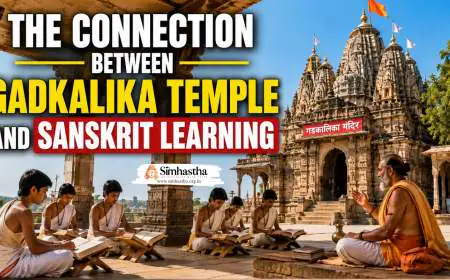
The Connection Between Gadkalika Temple and Sanskrit Learning

Ujjain Railway Station to Mahakaleshwar Temple Distance (2026 Guide)

Ujjain Simhastha 2028 Dates Announced: Full Shahi Snan & Event Timeline

Triveni Ghat Ujjain – Simhastha 2028 Complete Guide

Can You Walk From Ujjain Railway Station to Mahakaleshwar?

Mahakaleshwar Temple Entry Rules 2026: Dress Code, Mobile & Bag Policy

Bhasma Aarti at Mahakaleshwar Temple – Complete Pilgrim Guide

Why Ujjain Is One of the Four Kumbh Cities in India
Beyond the Classroom and the Goddess of All Creative Fire
While the pre-exam surge is the most visible, dramatic, and well-known manifestation of student devotion, the grace of Gadkalika Mata is not confined to the anxieties of the academic world. She is understood, by a wider, deeper, and more subtle tradition, as the patroness of all forms of intellectual and creative expression. Ujjain's lawyers, arguing a critical, life-altering case in the district court, visit the temple to seek the goddess's blessing for a sharp, incisive, and persuasive eloquence. The city's doctors, facing a complex, high-stakes surgery, come to pray for the steady, precise, and divinely guided hand that is the mark of a true healer. Musicians, seeking the perfect, soul-stirring note, dancers seeking the perfect, expressive gesture, and writers wrestling with the stubborn, unyielding blank page come to this quiet, powerful shrine to offer their instruments, their tools, and their creative struggles. The underlying, unifying belief is the same profound, ancient wisdom that transformed Kalidasa: that true, lasting, and transformative skill, in any field of human endeavour, is not merely a product of training and practice, but is, ultimately, a divine gift, a grace that flows through the purified, surrendered instrument of the human being from the infinite, creative source of the cosmos. The engineer seeking a breakthrough innovation, the entrepreneur crafting a visionary business strategy, and the scientist on the verge of a critical discovery are all, in their own way, walking the same path as the trembling student with the pen, seeking the same divine spark that ignites the human mind into brilliance. 🎨
The Temple Courtyard and the Architecture of Contemplation
The Gadkalika Temple itself, with its simple, unpretentious, and deeply peaceful architecture, plays a vital, often overlooked role in the experience of its visitors. It is not a grand, towering, and intimidating monument. It is a small, intimate, and profoundly welcoming space, a quiet, leafy sanctuary that provides a stark, healing contrast to the sensory overload and the intense, competitive pressures of the modern academic and professional world. The courtyard, shaded by ancient trees, is a place of profound, restorative quiet. It is here, after the brief, intense ritual at the inner sanctum, that the student sits with their textbook open on their lap, not in the frantic, anxious spirit of last-minute cramming, but in a new, quieter, and more deeply absorbed state of being. The calm, silent atmosphere of the temple, the gentle, rhythmic rustle of the leaves, the faint, comforting scent of incense, and the distant, steady sound of a temple bell seem to combine to create a unique, conducive environment for a kind of learning that is not merely cognitive but deeply meditative. The frantic, anxious mind that entered the temple often leaves not with a guarantee of a perfect score, but with a far more valuable and elusive gift: a quiet, steady confidence, a deep, inner calmness, and a renewed, focused clarity. The goddess's grace, experienced in this quiet, contemplative space, is not merely a promise of academic success but a direct, tangible experience of a peaceful, integrated, and powerfully receptive state of mind. 🌿
The Spiritual Technology of the Pen and the Offering of the Tool
The specific, unique ritual of offering the pen at Gadkalika Temple is a profound, elegant, and deeply meaningful piece of spiritual technology. The pen is not merely a tool; for the student, it is the primary, indispensable weapon in the high-stakes battle of the examination hall. It is the instrument through which their knowledge, their understanding, and their months of dedicated preparation will be translated into a tangible, evaluable form. To offer this pen at the feet of the goddess is to make a profound, symbolic statement of surrender: "Mother, I have done all the hard work that I can do. I have studied, I have prepared, and I have exhausted my own limited efforts. Now, I place the very instrument of my success, and the outcome of my entire labour, into your fierce, compassionate, and all-powerful hands." The return of the pen as a blessed, sanctified object completes a powerful, reassuring psychological and spiritual circuit. The student walks into the examination hall not with a mere writing instrument but with a consecrated, divine tool, a physical, tangible reminder that they are not alone in their struggle and that a force far greater than their own anxiety is now guiding their hand. This simple, elegant, and deeply moving ritual is a masterclass in the psychology of faith, a practical, time-tested method for transforming a source of paralyzing anxiety into a vessel of calm, focused, and divinely guided confidence. ✍️
The Shakti of Ujjain and the City's Ancient Tradition of Learning
The Gadkalika Temple does not exist in a spiritual vacuum. It is a vital, integral, and deeply interconnected node in Ujjain's vast, millennia-old sacred and intellectual ecosystem, a city that was, for centuries, the undisputed prime meridian of ancient Indian science, mathematics, and literature. The temple's location, a short walk from the Bhartrihari Caves—where another king-poet renounced his kingdom and composed his immortal verses of dispassion—and near the ancient Sandipani Ashram, where Lord Krishna himself received his education, places it at the very heart of a powerful, concentrated "corridor of wisdom." Ujjain was the home of the legendary Vikramaditya, whose court was famously graced by the Navaratnas, the Nine Jewels, the greatest poets, scientists, and grammarians of the age. The city's great astronomical observatories, the tradition of the Surya Siddhanta, and the mathematical genius of Varahamihira and Brahmagupta all flourished in its sacred, intellectually charged soil. Gadkalika Mata, as the specific, local embodiment of the goddess of wisdom, was the silent, divine patroness behind this entire, magnificent civilization of learning. The students who flock to her temple today are, whether they consciously know it or not, participating in a tradition that stretches back, unbroken, for over two thousand years, connecting their humble, modern anxieties to the great, golden legacy of one of the world's most profound and enduring intellectual cultures. 📚
Practical Guidance for the Seeker of Wisdom
For the pilgrim or the student planning a visit to the Gadkalika Temple, a few simple, practical insights can deepen and enrich the experience. The temple is located a short, pleasant auto-rickshaw ride from the main Ujjain temple zone, near the serene southern bank of the Shipra, and it is easily and naturally combined with visits to the Bhartrihari Caves and the Kalidasa Academy. The ideal time to visit is the early morning, when the atmosphere is at its most peaceful, the crowds are thin, and the mind is at its most receptive. The temple observes its busiest, most vibrant, and most emotionally charged season during the months of February to April, when the board exams approach, and again in May and June for the competitive entrance tests. The offerings are simple, deeply symbolic, and easily obtained: a fresh pen (the most essential item), a coconut, a garland of red flowers, and a sacred red thread. The dress code is the standard, modest Ujjain temple attire; the colour red, sacred to the goddess, is considered particularly auspicious. The most important preparation, however, is not a physical offering but an inner, spiritual one. Arrive not with a desperate, anxious, and demanding heart, but with a quiet, sincere, and humble intention. Frame your prayer clearly and simply in your mind. What specific gift do you seek? Is it the calm, focused clarity to recall what you have studied? The creative breakthrough to solve a stubborn, complex problem? The fearless, confident eloquence to present your ideas? Offer that specific, humble prayer, place your pen at the goddess's feet, tie your sacred thread, and then, most importantly, sit in the quiet, peaceful courtyard for at least twenty minutes, allowing the grace of the dark, wise mother to settle into your mind and your heart. ✅
The Eternal Promise of the Mother of Wisdom
The connection between Goddess Gadkalika and the arts of knowledge is not a dusty, academic relic of a forgotten past. It is a living, breathing, and deeply personal reality that is renewed, with a trembling pen and a whispered prayer, thousands of times every single day in a small, quiet temple on the banks of the ancient Shipra. The goddess who transformed a humiliated, illiterate woodcutter into the greatest poet of a civilization continues to sit, with her dark, fierce, and infinitely compassionate eyes, in her simple, unpretentious shrine, waiting for the next desperate, hopeful, and sincere soul to arrive. She does not promise an easy, effortless success to the lazy or the entitled. She promises, to the one who has worked to the absolute limit of their own ability and who then, in a final, complete act of humble surrender, places the fruits of their labour at her feet, the removal of that final, invisible, and mysterious inner obstacle, that sudden, miraculous, and transformative spark of grace that turns effort into achievement, knowledge into wisdom, and a skilled craftsman into a true artist. This is the eternal, beautiful, and profoundly comforting promise of Gadkalika Mata, the fierce, dark, and endlessly loving mother who holds the fifty sacred letters of the alphabet in her blood-stained hands and who waits, with infinite patience, to bestow the jewel of wisdom upon any child who asks with a sincere, humble, and desperate heart. 🔱

Frequently Asked Questions