


















Ritual Preparations That Begin Months Before Simhastha
Uncover the hidden ritual preparations that begin months before Simhastha. From astrological Muhurta calculations to Akhara marches, Naga initiation, and the city's spiritual purification, discover the sacred groundwork for the Ujjain Kumbh.


The Celestial Clockwork and the Astrological Determination of the Sacred Moment
The very first ritual preparation for the Simhastha takes place not on the banks of the Shipra, but in the silent, focused mind of the Kumbh Mela's chief astrologers. Months, sometimes a full year before the event, these hereditary scholars, heirs to the mathematical and astronomical tradition of the Surya Siddhanta, withdraw into their studies. Their task is of cosmic importance: to calculate the precise, astrologically perfect moment—the Muhurta—for each of the great Shahi Snans. The Simhastha is not scheduled by a human committee; it is triggered by a specific celestial alignment, the entry of the planet Jupiter (Brihaspati) into the zodiac sign of Leo (Simha) , combined with precise solar and lunar configurations that create a unique, potent spiritual doorway. The astrologers must compute not just the auspicious day, but the exact hour and minute when this celestial conjunction is at its most powerful, and when the waters of the Shipra are believed to transform into a direct conduit of the immortal nectar. Their calculations, once complete, are presented to the Akhil Bharatiya Akhara Parishad and the Simhastha Central Committee, and only then are the sacred bathing dates formally announced. This announcement itself is a ritual act, a public consecration of the timeline, and it sets into motion the entire, vast machinery of both the spiritual and the secular preparations. Every subsequent action—the departure of a sadhu from his cave, the sowing of the tent city's canvas, the scheduling of a special train—is synchronized to this single, astrologically determined, cosmic clock. ⏰
The Mustering of the Spiritual Armies and the Long March of the Akharas
With the sacred dates fixed, the great monastic orders, the Akharas, begin their own, ancient preparations, which often start months before their grand entry into Ujjain. The Mahant and the senior council of each Akhara issue the internal call, a spiritual summons that travels through the vast, informal network of the order, reaching the solitary Naga meditating in a Himalayan cave, the wandering sadhu walking the dusty pilgrimage routes of the south, and the community of monks residing in the order's permanent ashrams. The Akhara must then prepare for the monumental logistical and spiritual undertaking of moving its entire spiritual community—often numbering in the thousands—to Ujjain. The process of land allocation is itself a delicate, pre-Mela ritual, negotiated through the Akhara Coordination Cell, where the ancient, fiercely guarded protocol of spatial precedence is meticulously respected. The Akhara's sacred dhuni fire, which has been burning, in some cases, for centuries without being extinguished, must be ritually transferred to a sealed, portable vessel for the journey. The Akhara's presiding deity, the ishta devata, is prepared for travel, and the sacred flag, the Dhvaja, is carefully folded and consecrated. Then, the long march begins. The Akharas, particularly the Juna, Niranjani, and Mahanirvani, move towards Ujjain in a slow, ceremonial progression, their arrival, weeks later, marked by the spectacular Peshwai processions. But the march itself, the weeks of walking, chanting, and camping, is a profound, moving ritual of preparation, a collective, physical prayer that sanctifies the very earth they tread upon. 🏇
Forging the Spiritual Warriors and the Year-Long Training of the Naga Initiate
The most intense, demanding, and secretive of all the pre-Simhastha ritual preparations is the training and initiation of new members into the Akharas, particularly the making of a Naga sadhu. This is not a process that happens in a few days at the Mela; it begins months, and often years, in advance. A young man who feels the call of renunciation presents himself to a guru, and his long, arduous testing begins. He is assigned the most menial tasks in the ashram—chopping wood, cleaning, serving the senior sadhus—a process designed to systematically crush the ego, to test the absolute limits of his physical endurance, and to verify the authenticity of his vairagya (dispassion). Throughout this period, which can last for a year or more, the aspirant is under the constant, silent observation of the guru and the senior monks. He is taught the basics of the Akhara's scriptural tradition, the correct performance of the daily rituals, and the fundamentals of Hatha Yoga. He learns to tend the dhuni, to sit for long hours in meditation, and to endure hunger, cold, and insult without complaint. Only when the guru is absolutely satisfied that the aspirant's renunciation is genuine and irreversible is the date for the final initiation set, and this is deliberately timed to occur at the most potent moment of the Kumbh Mela itself, often in the dead of the pre-dawn night, in a secret ritual by the river, where the aspirant will finally die to his former self and be reborn as a naked, ash-smeared warrior of the Lord. The initiation is the culmination; the months of grueling preparation are the forging. 🔱
The Sacred Artisans and the Creation of a Million Ritual Objects
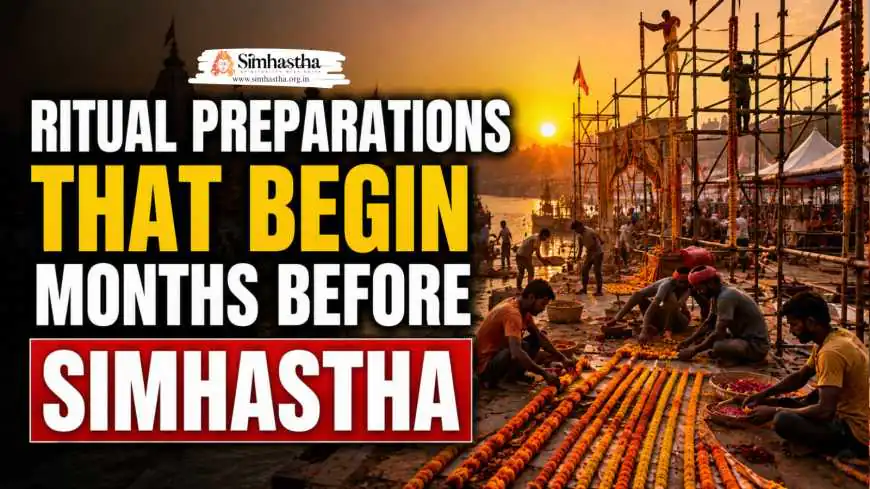
In the towns and villages surrounding Ujjain, and in the traditional artisan quarters of the city itself, another form of ritual preparation begins months in advance: the hand-crafting of the sacred objects that will be used by the millions of pilgrims. This is a vast, decentralized, and deeply spiritual cottage industry. The potters of the Malwa region begin to shape and fire the small, simple clay diyas—the oil lamps—that will be lit and floated on the Shipra by the lakh, their kilns burning through the night as the Mela draws near. The weavers of Maheshwar and Chanderi create the special, unstitched cotton cloth that will be offered to the deities. The metalworkers forge small, beautiful brass and copper vessels for the sacred water. The families who have, for generations, supplied the temples with bel patra leaves, dhatura flowers, and the fragrant, sacred grasses, tend their groves and their fields with an extra, reverent care, knowing that their harvest will be offered at the feet of Mahakal. The preparation of these objects is itself a form of worship. The potter who shapes the clay diya does so with a silent prayer on his lips. The weaver who looms the sacred cloth visualizes it draped upon the lingam. This immense, quiet, and distributed labour of love is an essential, though often unseen, ritual preparation, the slow, sacred gathering of the physical tokens of devotion that will be offered, by a hundred million hands, to the Lord of Time. 🪔
Trending Guides Now
Why Certain Rituals Are Allowed Only at Specific Ghats During Simhastha

Why Snan Dates Shift According to Planetary Positions in Simhastha

The Complete Sequence of Ritual Events During Simhastha

What Happens on the Most Important Bathing Days of Simhastha

Ujjain Railway Station to Mahakaleshwar Temple Distance (2026 Guide)

Ujjain Simhastha 2028 Dates Announced: Full Shahi Snan & Event Timeline

Ujjain Simhastha Update: CM Mohan Yadav Reviews 2028 Works

Karkateshwar Mahadev: 22/84 Mahadev of Ujjain
The Eternal Fires and the Sanctification of the Mela Grounds
Months before the first tent is pitched, a profound ritual of bhumi puja (ground sanctification) is performed on the vast, open tracts of land that have been designated as the Mela grounds. The Simhastha administration, in a rare and necessary collaboration, works with the Akharas and the temple priests to conduct these ceremonies. Vedic mantras are chanted to invoke the blessings of the earth goddess, to appease the local spirits, and to purify the soil that will temporarily host a city of ten crore souls. The land is consecrated with sacred water from the Shipra, and a small, foundational fire ritual is performed. For the Akharas, a crucial preparation is the ritual re-establishment of their dhuni, the sacred, eternal fire. The embers, carried in a sealed pot all the way from the Akhara's permanent headquarters, are placed on the designated spot within their allocated camp, and the new fire is kindled with specific mantras and offerings. This dhuni is not a cooking fire; it is the living, fiery embodiment of the Akhara's spiritual lineage, a direct, tactile link to the founder-gurus of the order. The fire will burn, without ceasing, for the entire duration of the Mela. The kindling of this fire is a powerful, symbolic act of taking spiritual possession of the sacred ground, transforming a piece of ordinary agricultural land into a sanctified, protected, and spiritually charged territory. 🔥
The Purification of the City and the Communal Spiritual Cleansing
The city of Ujjain itself undergoes a profound, communal spiritual preparation in the months leading up to the Simhastha. This is not a centrally organized event, but an organic, collective, and deeply felt need to purify the vessel that will receive the divine tide. The priests of the Mahakaleshwar Temple and the other major shrines conduct special, extended purification rituals, chanting mantras that are believed to cleanse the temple's physical and subtle fabric. The hereditary families who serve the temples undergo personal fasts and penances. The city's residents, in their thousands, participate in a wave of shramdaan (voluntary labour), cleaning the ghats, painting the temples, and repairing the ancient lanes. A palpable sense of collective, sacred anticipation builds in the air. The city, in a very real sense, is cleaning its own house, not just for the arrival of its guests, but for the arrival of the divine itself. This communal purification is a powerful, intangible ritual, a collective decision to approach the great festival with a clean body, a clean home, and a clean heart. It is the city's own, humble, and deeply moving preparation, the quiet, unglamorous work that ensures that the pilgrim who arrives is stepping onto ground that has been made ready with love, with prayer, and with the collective, devoted effort of an entire community. 🏡
The Inner Pilgrimage and the Mental Preparation of the Devotee
For the individual pilgrim, the ritual preparations often begin months before they pack a single bag. The decision to attend the Simhastha is, in itself, a sacred vow, and it is often accompanied by personal, preparatory spiritual disciplines. Many devotees undertake a specific vrat (fast) on certain days of the week, or commit to a daily, extended practice of chanting a particular mantra, such as the Mahamrityunjaya Mantra or the simple "Om Namah Shivaya." Some adopt a sattvic diet, abstaining from meat, alcohol, onion, and garlic, for the entire period leading up to the journey. Families begin to save money, setting aside a small, sacred sum each month that is dedicated solely to the pilgrimage. The reading of sacred texts, particularly the Avanti Khanda of the Skanda Purana, which describes the glories of Ujjain's sacred geography, becomes a regular household practice. This period of inner, mental, and physical purification is an essential, though deeply personal, ritual. It transforms the pilgrimage from a sudden, impulsive trip into a slow, deliberate, and deeply integrated spiritual process. The pilgrim who arrives in Ujjain after months of inner preparation arrives not as a tourist, but as a vessel that has been slowly, carefully, and lovingly prepared to receive the full, transformative impact of the Simhastha's grace. 🧘
The Final Countdown and the Night That Holds Its Breath
In the final days before the first Shahi Snan, all the parallel streams of ritual preparation—the astrological, the monastic, the artisanal, the communal, and the personal—converge into a single, focused, and intensely charged moment. The great Peshwai processions have been completed. The Akhara flags flutter in the wind. The newly initiated Nagas have been reborn from the river. The dhuni fires are burning brightly. The air in Ujjain becomes thick with a palpable, electric anticipation. On the night before the great bath, the Akhara camps are sleepless. The chanting intensifies, the meditation deepens, and the final, secret pujas are performed. The city, now swollen to bursting with millions of pilgrims, holds its collective breath. This is the final, quiet, and powerful ritual of preparation—the sacred vigil, the Jagaran—a night of prayer, silence, and intense, focused spiritual energy that is the final, necessary gathering of force before the thunderous, ecstatic, and world-transforming explosion of the Shahi Snan. The months of preparation are complete. The vessel is ready. The divine is about to descend. 🔱
Frequently Asked Questions