


































Simhastha 2028 Land Acquisition Status and Official Updates
Track the Simhastha 2028 land acquisition status and official updates. From the land pooling policy and Mela area expansion to ring roads, bypasses, and parking plazas, discover how Ujjain is gathering land for the Kumbh.



The Land Pooling Policy and the Quiet Revolution of Farmer Consent
The single most important decision that defines the land acquisition story for Simhastha 2028 is the strategic shift from compulsory acquisition under the Right to Fair Compensation Act to a voluntary land pooling scheme. The scars of the 2016 land acquisition process, where protracted legal battles and farmer protests delayed several projects, led the Madhya Pradesh government to craft a more collaborative model. Under the new policy, farmers and landowners in the notified Mela periphery are invited to voluntarily pool their land. The government then develops this land with permanent infrastructure—roads, drainage, electricity, water supply—and returns a portion, typically 30 to 40 percent, of the developed, higher-value land to the original owner. The remaining land is retained by the state for the Mela's temporary and permanent infrastructure.
This policy has been a quiet revolution. It has transformed the farmers from aggrieved sellers into project stakeholders. The returned developed plots, now with clear titles and road access, are often worth several times more than the original unirrigated agricultural land, even accounting for the reduced size. The official updates from the District Land Acquisition Committee meetings, held regularly at the Ujjain Collectorate, indicate that the land pooling scheme has been met with a significantly higher rate of voluntary participation than the 2016 process. Thousands of farmers from villages like Chintaman, Narsinghgarh, Nanakheda, and Dewas Road have signed up, accepting the long-term economic uplift of their holdings over a one-time, often disputed, cash compensation. This is not to say the process is frictionless; there are holdouts, there are grievances, and there is the constant, patient work of persuasion by the district administration. But the broad trend is one of consensus, a recognition by the Malwa farming community that the Simhastha is a twelve-yearly tide that, if harnessed, can permanently lift their economic boats. 🤝
The Mela Area Expansion and the Ring of Temporary Townships
The most visible outcome of the land acquisition process is the massive expansion of the Mela Kshetra, the sacred territory of the Kumbh. The 2016 Mela area, which stretched along the Shipra's banks, was sufficient for the 7.5 crore pilgrims of that year. For 2028, with projections touching 10 to 12 crore, the administration needed to create a significantly larger, more dispersed canvas to prevent the kind of density that leads to crowd crushes. The official master plan, updated in early 2025, carved out a new, expanded Mela zone that extends significantly to the east and west of the city, incorporating vast tracts of agricultural land that are now being transformed.
These newly acquired and pooled lands are being prepared for their temporary transformation. Some will host the sprawling camps of the 13 Akharas, each requiring designated, secure, and well-connected sectors. Others will become the sites for the official tent cities, with their tiers of premium, standard, and budget shivirs. Large parcels are being allocated for the community kitchens, the langar halls, and the temporary fire stations. The official updates from the SPV confirm that land allocation to the akharas, a sensitive and protocol-driven process, has been largely completed, with the Juna, Niranjani, and Mahanirvani Akharas receiving their traditional prime locations near the main bathing ghats. The precise demarcation of these sectors, using geo-tagged markers and drone surveys, is an ongoing task, with completion targeted for late 2026. The land is being leveled, temporary approach roads are being laid, and the first signs of the temporary city are beginning to appear on the ground. 🗺️
Trending Guides Now
Government Doubles Powers of Ujjain Mayor and Commissioner Ahead of Simhastha 2028
Ujjain Simhastha 2028: ₹700 Crore Bypass Road Plan to Manage 30 Crore Pilgrims

Simhastha Fair — Which River? Discover the Sacred Shipra (Kshipra) of Ujjain
Simhastha 2028: New Facilities for Bhatt Poojan and Darshan at Mangalnath, Angareshwar & Sandipani

Ujjain Railway Station to Mahakaleshwar Temple Distance (2026 Guide)

Ujjain Simhastha 2028 Dates Announced: Full Shahi Snan & Event Timeline

Mahakaleshwar Sandhya Aarti Online Booking 2026: Fee, Timings, Entry Gate and Step-by-Step Process

Mangalnath Temple Trip Budget: Puja, Local Transport, Food and Stay Planning
The Road Network, the Bypass, and the Land for the Arteries of Faith
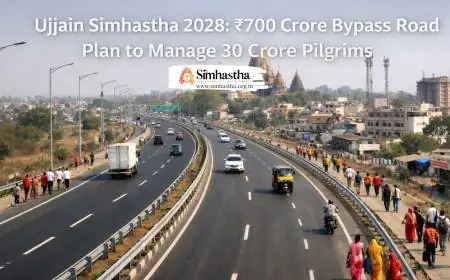
The single largest consumer of acquired land is the Simhastha Road Network Grid, a multi-ring, multi-radial system designed to funnel millions of pilgrims through the city without strangling it. The 28-kilometer, six-lane Ujjain Eastern Bypass, the crown jewel of the grid, has seen the most intense and time-bound land acquisition drive. The bypass cuts through a cross-section of agricultural land, and its construction could not begin until a continuous, unbroken chain of land parcels was secured. Official updates from the Public Works Department and the SPV confirm that the entire right-of-way for the Eastern Bypass has now been physically acquired and handed over to the construction agencies. The compensation for this corridor, which involved some of the largest individual land parcels, has been a major financial operation, with the government releasing a significant portion of the road budget for this purpose.
Beyond the bypass, the four new ring roads and the widening of the Ujjain-Indore highway to six lanes have also required extensive land acquisition. The outer ring road, in particular, has been aligned to minimize the disruption of established settlements, cutting primarily through agricultural land. The official land acquisition dashboard shows that over 90% of the required land for the ring roads is now under government possession, with the remaining patches, often small, disputed strips, being resolved through both negotiation and legal process. The land for the new satellite bus terminals at the intersections of these ring roads with the major highways has also been secured, and the civil works on these structures are well underway. The acquisition of these transport corridors has permanently altered the geographic boundaries of Ujjain, drawing vast, previously remote villages into the city's economic orbit. 🚧
The Parking Plazas and the Outer Cordons of the Pilgrim's Journey
A critical and often under-appreciated component of the land acquisition plan is the creation of massive, peripheral parking plazas. The inner Mela zone will be a strictly pedestrian-only area, and the administration's strategy to prevent the chaos of 2016 relies entirely on the availability of vast, organized parking lots on the city's edge, where pilgrims can leave their vehicles and board the free shuttle buses to the ghats. The land requirement for these plazas alone runs into several hundred hectares.
The official updates indicate that four major parking zones, corresponding to the cardinal directions, have been identified and are being developed. The largest, on the Indore side, is being built on a combination of pooled agricultural land and government-owned wasteland. These plazas are not simple fields; the land is being compacted, reinforced, and equipped with permanent lighting, security cabins, toilets, and shuttle bus stations. The land acquisition for these zones has been relatively smooth, as they are located further from the city centre and the land values were lower, making the pooling scheme more attractive to the farmers. The administration is also in the process of acquiring smaller parcels for holding areas, where pilgrims arriving on foot or by special trains can be temporarily staged before being released in a controlled flow towards the ghats. The successful, timely acquisition of these peripheral lands is the invisible, logistical backbone of the entire crowd management plan. 🅿️
The Railways, the Water Grid, and the Land for Permanent Infrastructure
Not all the acquired land is for temporary use. A significant portion of the land acquisition for Simhastha 2028 is for permanent infrastructure that will serve Ujjain for decades. The expansion of Ujjain Junction, with its eight new platforms, and the development of the two satellite terminals at Chintaman and Vikram Nagar, have required the acquisition of railway-side land and the relocation of some existing structures. The Indian Railways, in coordination with the state government, has largely completed this process, and the engineering works are in full swing. The new 200 MLD water treatment plant, the master balancing reservoirs, and the arterial water supply grid also required dedicated land parcels, which have been acquired on the city's outskirts.
The massive expansion of the sewerage network and the construction of the new sewage treatment plants (STPs) have also involved land acquisition, often near the Shipra's downstream flow. The new power substations and the solar energy farms are other permanent additions that have been carved out of the acquired land pool. These acquisitions, while less dramatic than the Mela grounds, are the most enduring legacy of the Simhastha. The land taken today for a sewage plant will treat Ujjain's waste for a century. The official updates from the SPV consistently emphasize this dual-use philosophy, reassuring citizens that the Simhastha land acquisition is not a one-time consumption of a finite resource but a catalytic investment in the city's permanent civic infrastructure. 🏗️

The Akhara Land Allocation and the Ancient Protocols of Space
The allocation of land to the 13 Akharas within the Mela zone is a process governed by a deeply traditional, unwritten but fiercely enforced protocol that predates the modern Indian state. The akharas hold immense spiritual and temporal authority, and their satisfaction with their allocated land is a non-negotiable prerequisite for a peaceful and orderly Kumbh. The official updates from the Akhil Bharatiya Akhara Parishad and the Akhara Cell of the Simhastha administration confirm that the preliminary land earmarking and allocation have been successfully concluded.
The Juna Akhara, as the largest and most senior, has been allocated its traditional prime location near the Ram Ghat and Triveni areas. The Niranjani and Mahanirvani Akharas have received their contiguous sectors, ensuring their processional integrity. A significant, progressive update is the formal allocation of designated land to the Kinnar Akhara, a move that has been widely praised as an inclusive and respectful acknowledgment of their growing spiritual footprint. The allocated land parcels have been physically demarcated, and the akharas have been given a timeline to submit their internal camp layouts by late 2026. The administration is now focused on providing the promised basic amenities—temporary road access, water and power connections, and sanitation lines—to each of these allocated akhara sectors. The land for the akharas is not merely a plot of earth; it is the territorial embodiment of their spiritual sovereignty, and the peaceful resolution of this allocation is one of the most delicate and crucial achievements of the pre-Mela process. 🛕
Compensation, Rehabilitation, and the Human Face of the Land Transfer
Behind the satellite maps and the project dashboards, the land acquisition process for Simhastha 2028 is a deeply human story of families parting with ancestral soil, of negotiations that stretch into the night, and of the government's attempt to ensure that the compensation is not just legal but just. The official compensation rates, revised in 2024, are based on a multiple of the prevailing circle rate, with a substantial solatium and additional incentives for voluntary and early participation. The district administration has set up special compensation disbursement camps where farmers and landowners are being given a single, consolidated payment directly into their bank accounts, along with a detailed statement of how the amount was calculated. This transparency is a direct response to the grievances of 2016, where delayed and opaque payments were a major source of friction.
For the land pooling scheme, the rehabilitation is not in cash but in kind. The farmer who pooled two acres of unirrigated land is promised, in return, a smaller but fully developed, road-facing, and commercially valuable plot in the same vicinity. The administration is under immense pressure to deliver on this promise, and the official updates track the progress of the infrastructure development on the "returned plots" as closely as the progress on the Mela grounds. The rehabilitation also extends to families who are displaced from their homes, though the administration has consciously minimized this by routing the new roads and projects through agricultural land rather than established settlements whenever possible. The human cost is real, and the administration's success will be measured, in the long term, by whether the families who gave up their land for the Kumbh feel, a decade later, that they received a fair bargain. 🤲
The Timeline, the Dashboard, and the Path to Completion
The official timeline for Simhastha 2028 land acquisition is aggressive but, by all accounts, on track. The critical land for the Eastern Bypass and the core road grid was secured by early 2025. The land for the Mela area expansion and the akhara camps is substantially acquired, with the final, minor parcels and legal clearances expected to be completed by the end of 2026. The land for the parking plazas and the satellite bus terminals is in the final stages of pooling and compensation. The administration has committed to completing all major land-related work by mid-2027, providing a full year's buffer before the Mela.
To ensure public accountability, the government has launched a public-facing Simhastha 2028 Project Dashboard, where citizens can track the physical and financial progress of every major project, including the land acquisition status for each road, each terminal, and each sector of the Mela grounds. This online portal, updated at least monthly, is the single most reliable source of official updates. It marks each land parcel as "Notified," "Consent Obtained," "Compensation Paid," "Physical Possession Taken," or "Developed." The dashboard is a silent, powerful answer to the rumors and misinformation that inevitably swirl around such a massive exercise. It allows the common citizen, the curious pilgrim, and the vigilant journalist to see, in real-time, where the land for the Kumbh is being gathered, and at what cost. The commitment to this radical transparency is, in itself, one of the most significant reforms of the 2028 Simhastha. 💻
The Fields That Become a City and the Eternal Cycle of the Kumbh
The vast fields of central India, which for generations have yielded wheat, soybean, and gram, are now being plowed for a different kind of harvest. They are being prepared to yield a temporary, sacred city of ten crore souls. The Simhastha 2028 land acquisition is the most tangible, physical evidence that the Kumbh is not an abstract spiritual concept but an immense material undertaking that reshapes the very earth it touches. The farmers who have pooled their land, the officers who have conducted the negotiations, and the engineers who are now laying the roads—all are, in their own way, the builders of the Kumbh. The land that is being taken today will, in a few years, be returned to silence and agriculture after the Mela, but with a permanent difference. The roads, the power lines, and the water connections will remain, having permanently elevated the value and the connectivity of this ancient, sacred landscape. The cycle of the Kumbh, which begins with the astrological conjunction in the sky, has its earthly counterpart in this cycle of land, a cycle of temporary transformation and permanent legacy that has been turning, every twelve years, for longer than memory can hold. 🔱
Frequently Asked Questions