

































Street Lighting Projects Planned Before Simhastha 2028
Discover the street lighting projects planned before Simhastha 2028. From solar LED highways and smart poles to spiritual illumination of ghats and temples, see how Ujjain will shine safely for 10 crore pilgrims.


The LED Revolution and the City-Wide Retrofit Before the Kumbh
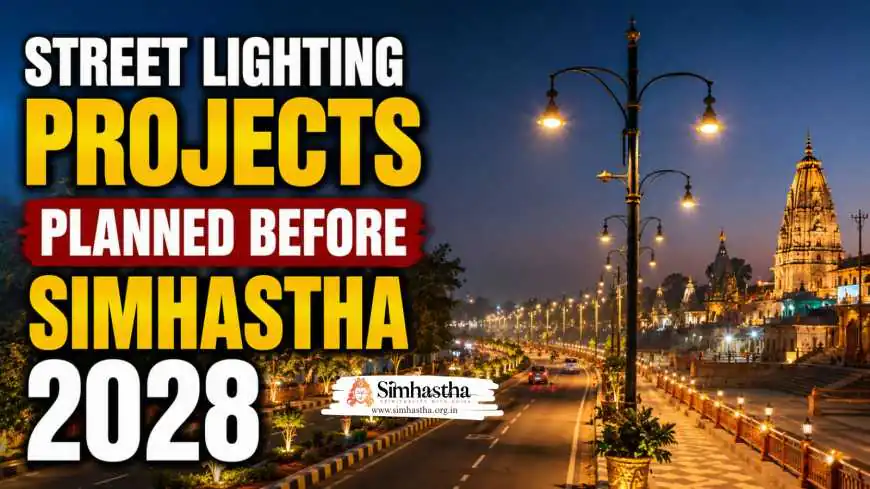
The foundation of Ujjain's lighting transformation is a massive, city-wide LED retrofitting project. The old, energy-guzzling, orange-hued sodium-vapour and fluorescent streetlights that have lit Ujjain's streets for decades are being systematically replaced with high-lumen, cool-white, and warm-white LED fixtures. This is not a simple bulb swap. It is a complete re-engineering of the city's public lighting grid, overseen by the Ujjain Municipal Corporation and the Madhya Pradesh Urban Development Company, and funded by a dedicated allocation from the Simhastha infrastructure budget. The primary corridors being targeted in the first phase are the Mahakal Path, the arterial approach roads to The Mahakaleshwar Temple, the Mahakal Lok periphery, the entire stretch of the Ram Ghat road, and the major intersections in the old city. The new LED lights offer multiple advantages: they reduce electricity consumption by up to 60%, they last many times longer, and their superior colour-rendering index (CRI) means that pilgrims can see the faces of fellow devotees, read signages, and identify potential hazards with far greater clarity. The cool-white light is being used on main arterial roads for maximum visibility, while a warmer, amber-gold light is being chosen for heritage zones, temple approach paths, and ghats, to create an atmosphere that is calming and spiritually resonant, not harsh or industrial. 💡
Smart Poles and the Digital Spine of the Illuminated City
The new street lights of Ujjain are not just lights; they are the physical nodes of the Smart City's digital nervous system. The administration is deploying thousands of smart poles along all major Mela corridors, the ring roads, the bus terminal routes, and the pedestrian zones. A single smart pole integrates a high-efficiency LED luminaire with a suite of other technologies: a high-definition CCTV camera for the ICCC's surveillance network, a public WiFi hotspot, an emergency call button that connects directly to the police and medical control rooms, and a digital display screen for public announcements and real-time crowd information. In some high-density zones, the poles also carry environmental sensors that feed air quality, temperature, and humidity data back to the central command centre. This integration dramatically reduces street clutter, as it eliminates the need for separate poles for cameras, speakers, and signs. For the pilgrim, this means that the same pole that lights your path is also the one that provides you with free internet to video-call your family, monitors your safety for the unseen eye of the security forces, and can guide you with a flashing directional alert in case of a route change or an emergency. The smart poles are being installed with underground power and fibre-optic cabling, ensuring reliability even during storms or the immense electrical load of the Mela. They are the silent, glowing sentinels of the Kumbh. 📡
Solar Lighting for the Peripheral Roads and Green Energy Commitment
The lighting plan for Simhastha 2028 incorporates a strong commitment to green energy and sustainability. A significant portion of the new lighting on the outer ring roads, the Eastern Bypass, the satellite parking plazas, and the rural approach roads is being powered by standalone solar photovoltaic (PV) street lights. These units, which require no grid connection, consist of a high-efficiency LED lamp, a solar panel mounted on top of the pole, and a battery bank that stores enough energy for up to three days of autonomy. This choice has multiple strategic advantages. First, it reduces the load on the already strained Mela power grid. Second, it eliminates the need for expensive and time-consuming trenching and cabling across long, rural stretches. Third, it guarantees that even in the event of a grid failure, the critical outer cordons and evacuation routes remain illuminated, which is a non-negotiable safety requirement. The solar lights are being deployed particularly in the parking plazas, where pilgrims will be leaving their vehicles and boarding shuttle buses. A well-lit parking lot is not just a convenience; it is a fundamental requirement for the safety of women, families, and the elderly who may be returning to their vehicles late at night. The glow of these solar lights, drawing their energy directly from the same sun that Ujjain's ancient astronomers once tracked from the Jantar Mantar, is a poetic marriage of the city's scientific past and its green future. ☀️
Illuminating the Ghats and the Spiritual Nightscape of the Shipra
The ghats of Ujjain, the sacred interface between the pilgrim and the Shipra, are receiving a unique and carefully designed architectural and spiritual lighting treatment. This is perhaps the most emotionally resonant aspect of the entire lighting project. The administration, working with heritage lighting designers, is installing a network of warm-white and softly coloured LED fixtures along the steps, the embankments, and the temple spires overlooking the river. The goal is not to flood the ghats with the harsh, flat glare of a sports stadium, but to create a layered, dramatic, and deeply peaceful nightscape. The steps themselves are being fitted with low-level, recessed bollard lights that define the edges and make the descent safe, while also creating a beautiful, rhythmic pattern of light leading down to the dark, reflective water. The ancient trees are being up-lit with a gentle, green-tinted glow. The temple shikharas that line the river are being washed with a soft, golden light that makes them appear to float above the city, ethereal and divine. The Triveni Pedestrian Bridge, the new footbridge over the Shipra, will be illuminated as a graceful ribbon of light, guiding pilgrims across the river in a state of visual and spiritual enchantment. This careful illumination ensures that the evening aarti, with its own blazing lamps, remains the primary, dramatic light source, while the surrounding architectural lighting provides a serene, supporting visual symphony. The darkness of the Shipra's waters will reflect this entire, luminous mandala, doubling its beauty and creating a night-time darshan that is as powerful as any daytime ritual. ✨
Trending Guides Now

Every Major Road Project Planned Before Simhastha 2028
Smart City Transformation for Simhastha 2028: How Ujjain Is Preparing for 5 Crore Pilgrims

New Parking Plans Being Developed for Simhastha 2028

How Ujjain Is Preparing Public Facilities for 2028

Ujjain Railway Station to Mahakaleshwar Temple Distance (2026 Guide)

Ujjain Simhastha 2028 Dates Announced: Full Shahi Snan & Event Timeline

Mahakaleshwar Sandhya Aarti Online Booking 2026: Fee, Timings, Entry Gate and Step-by-Step Process

Kal Bhairav Temple Darshan Guide: Entry, Timings and Tips
The Security Architecture of Light and the Elimination of Dark Spots
Beyond aesthetics, the street lighting project is, at its core, a security and public safety infrastructure. A comprehensive "dark spot" survey has been conducted across the entire city, identifying every underpass, narrow lane, parking area, and holding zone that is inadequately lit. The lighting plan then targets these spots with high-intensity, vandal-proof, and backup-powered fixtures. This is not a matter of mere convenience; for a solo female pilgrim walking back to her guesthouse after a late-night kirtan, or an elderly couple trying to find their shuttle bus in a sprawling parking lot, a well-lit path is the single most important safety guarantee. The new ring roads and the Eastern Bypass, which will carry a high volume of fast-moving traffic, are being lit to highway standards, with continuous, high-mast lighting at all major interchanges and roundabouts. The pedestrian corridors that lead from the outer parking lots to the Mela zone are being designed as continuous, illuminated, and CCTV-monitored safe routes. The ICCC will have the ability to remotely adjust the brightness of specific zones in real time, increasing the illumination if a crowd surge is detected, or dimming it in less populated areas to conserve energy. The strategic deployment of light is, in the modern age, one of the most effective tools of urban crowd management and crime prevention, and the Simhastha administration is deploying it with surgical precision. 🛡️
Timeline, Project Phases, and the Final Switch-On
The lighting projects are being executed in multiple, overlapping phases to ensure that all systems are in place and rigorously tested well before the first pilgrim arrives. The first phase, which involves the city-wide LED retrofitting of the core temple zone, the Mahakal Path, and the major arterial roads, is currently underway and is scheduled for completion by mid-2027. The second phase, focusing on the ring roads, the Eastern Bypass, the smart poles, and the solar lighting of the parking plazas, will be completed by late 2027. The final phase, involving the delicate architectural and ghat illumination, the integration of all smart pole networks into the ICCC, and the comprehensive testing of backup systems, will be finalized by January 2028, a full three months before the expected start of the Simhastha. This provides a comfortable buffer for any necessary adjustments, repairs, or last-minute reconfigurations. The administration has committed to a series of public "lighting trials" in the weeks leading up to the Mela, where the full night-time illumination of the city will be switched on, and citizens will be invited to provide feedback. The goal is a flawless, uninterrupted, and beautiful sea of light from the moment the first special train arrives at Ujjain Junction. 🗓️
The Common Pilgrim's Experience and a City That Never Sleeps in Darkness
The true test of these street lighting projects planned Before Simhastha 2028 will be measured in the quiet, grateful moments of a pilgrim's journey. It will be the young mother who can safely walk her child to the toilet at 3:00 AM because the path in her tent city is clearly illuminated. It will be the lost traveller who finds his way back to his dharamshala because the smart pole's digital display showed him a map. It will be the elderly woman who can confidently walk from her bus to the bathing ghat because the solar lights on the parking plaza left no shadow for fear to hide in. The often-quoted scriptural verse, "Tamaso ma jyotir gamaya" (From darkness, lead me to light), will be experienced as a tangible, engineered reality. The pilgrims of 2028, whether they arrived in the age of smartphones or the age of simple faith, will move through a Ujjain where the night has been transformed from a limitation into a luminous extension of the sacred day. The bells will ring, the chants will rise, and the lights will shine, and together, they will hold the city in a safe, beautiful, and divine embrace. 🔱
Frequently Asked Questions