

































Water Supply Planning for Simhastha 2028 Explained
Explore the massive water supply planning for Simhastha 2028. From the Narmada pipeline and 200 MLD treatment plant to 2,000 water ATMs and free refill stations, discover how Ujjain will quench the thirst of 10 crore pilgrims.


The Scale of the Thirst and the Challenge of Ten Crore Pilgrims
To understand the magnitude of the water supply planning for Simhastha 2028, one must first sit with the numbers that define the demand. Ujjain's normal daily water supply, drawn from a combination of the Narmada pipeline, the Shipra, and local groundwater, is designed for a population of approximately six lakh. During the Simhastha, on the peak Shahi Snan days, the city's effective population will swell to between 1.5 and 2 crore in a twenty-four-hour window. That is a multiplication of the base population by a factor of nearly thirty. The daily water demand, which normally hovers around 60 to 70 million litres per day (MLD), will explode to an estimated 400 to 500 MLD during the peak bathing days. This is not a demand that can be met by simply turning up the pressure on the existing system. The existing system would collapse within hours. The challenge is compounded by the fact that this demand is not evenly distributed across a fixed urban grid; it is concentrated in the sprawling, temporary Mela zone, where millions of pilgrims will be encamped in tent cities, akhara camps, and open holding areas, often far from the city's permanent water mains. The water planning, therefore, is not an augmentation of the old system but a completely independent, parallel water universe, a dedicated Simhastha Water Grid that must be built, tested, and made operational from scratch. 🚰
The Narmada Lifeline and the Dedicated 200 MLD Treatment Plant
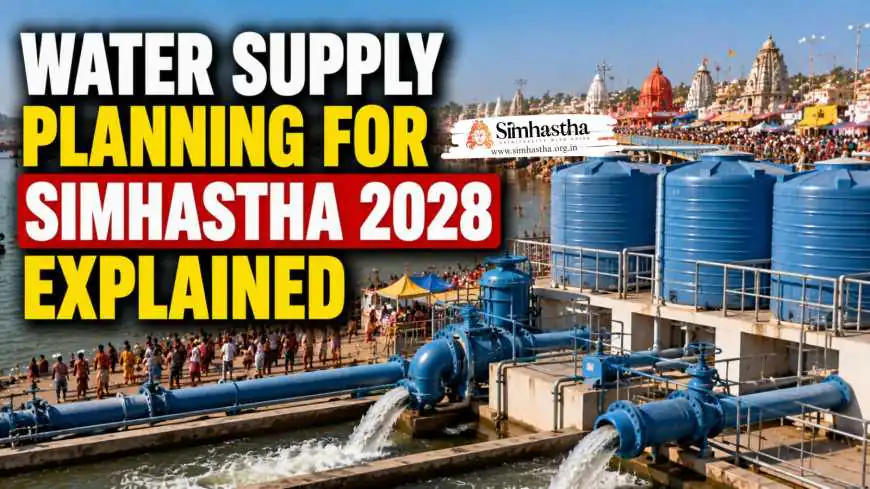
The heart of the water supply plan is the Narmada River, the great lifeline of central India, whose waters are already brought to Ujjain through the existing Narmada Pipeline Project. For the Simhastha, this pipeline connection is not merely relied upon; it is massively augmented. A dedicated, high-capacity spur of the pipeline is being constructed to feed the Simhastha Water Grid directly, ensuring that the Mela's thirst does not come at the cost of the city's permanent residents. The raw Narmada water, drawn from this pipeline, is destined for a colossal new 200 MLD Water Treatment Plant being constructed on the city's outskirts. This plant is not a temporary, modular setup; it is a permanent, state-of-the-art facility designed to international standards. The water will undergo a multi-stage treatment process: coagulation and flocculation to remove suspended particles, rapid sand filtration for fine sediment, and finally, disinfection through chlorination and ultraviolet (UV) treatment to eliminate all bacteriological and viral contaminants. The treated water will then be pumped into a series of massive, reinforced concrete Master Balancing Reservoirs, each holding millions of litres, positioned at strategic high points around the city. From these reservoirs, the water will flow by gravity and through a network of dedicated pumping stations into the distribution grid. The entire treatment and storage system is designed with multiple redundancies and backup power generators, ensuring that even a catastrophic failure at one point will not interrupt the supply to the Mela. ✅
The Distribution Network and the Democracy of the Water ATM
The treated water, held in the great reservoirs, must now reach the cupped hands of ten crore pilgrims, and this is where the most visible and revolutionary element of the plan comes into play. The distribution network is built around the concept of a ubiquitous, accessible, and free hydration point. The backbone of this network is the installation of 2,000 Water ATMs across the Mela area, the temple precincts, the railway stations, the bus terminals, and the major holding zones. These are not simple taps; they are robust, automated, self-cleaning kiosks that dispense a measured, steady stream of chilled or ambient clean water at the press of a button. Each Water ATM is connected to the main supply and is equipped with its own real-time quality sensor, displaying total dissolved solids (TDS), pH, and residual chlorine levels on a digital screen for complete transparency.
Complementing the Water ATMs are 5,000 tap points installed at lower-density areas and along the main pedestrian corridors, as well as a fleet of mobile water tankers that will continuously patrol the Mela grounds, refilling temporary storage tanks at the akhara camps, the tent cities, and the medical posts. The administration is also actively promoting a culture of reuse by setting up free water refill stations where pilgrims can fill their own reusable bottles, a simple but powerful initiative to reduce the plastic waste that has plagued previous Melas. The entire distribution network is designed to ensure that no pilgrim, whether they are a VIP in a premium tent or a wandering sadhu at the edge of the Mela, is ever more than a few minutes' walk from a source of clean, free drinking water. This is the democracy of hydration, a profound, practical expression of the spiritual truth that all souls are equal in the eyes of the divine. 🧊
Trending Guides Now
Every Major Road Project Planned Before Simhastha 2028

How Ujjain’s New Bridges & Bypasses Will Reduce Simhastha Traffic in 2028

How Smart City Projects Are Reshaping Ujjain
Farmers Win, Township Plan Falls: How Simhastha 2028’s Mega-City Scheme Was Scrapped in Ujjain

Ujjain Railway Station to Mahakaleshwar Temple Distance (2026 Guide)

Ujjain Simhastha 2028 Dates Announced: Full Shahi Snan & Event Timeline

Mahakaleshwar Sandhya Aarti Online Booking 2026: Fee, Timings, Entry Gate and Step-by-Step Process

Kal Bhairav Temple Darshan Guide: Entry, Timings and Tips
Quality Monitoring and the Public Display of Purity
In the aftermath of the 2016 Simhastha, one of the persistent concerns raised by pilgrims was the variable quality and taste of the water available at different points. The administration has taken this feedback and embedded it into the very DNA of the 2028 plan. The water quality monitoring system for Simhastha 2028 is designed not just for operational safety but for public reassurance. In addition to the sensors on every Water ATM, the entire grid will be monitored in real time from the Integrated Command and Control Centre (ICCC) . A network of remote sensors at every reservoir, major pipeline junction, and distribution node will continuously test for key parameters. The data will be streamed to the ICCC, where any anomaly will trigger an immediate alert and an automatic diversion of supply away from the contaminated segment until it is isolated and flushed.
Most importantly for the pilgrim, this data will not be hidden. Large LED public display boards at every major ghat, tent city, and congregation point will show the real-time water quality data for that zone. The display will show, in simple Hindi and English, that the water you are about to drink is clean, safe, and certified. This radical transparency is a direct response to the trust deficit that can easily develop in such a massive gathering. It is the administration saying to the pilgrim: "We are not just telling you the water is safe; we are showing you the proof, live." This public display of purity is a quiet, modern miracle, a melding of high technology and humble faith that will do as much for the pilgrim's peace of mind as for their physical health. 📊
Lessons From 2016 and the Drive for a Permanent Legacy
The water supply planning for Simhastha 2028 is built upon the hard-won lessons of the 2016 Mela. In 2016, while major water crises were averted, there were significant challenges. The water pressure in peripheral areas was often low, the quality was inconsistent, and the reliance on a patchwork of temporary tankers created logistical bottlenecks and occasional shortages. The post-Mela analysis was unequivocal: the city needed a permanent, dedicated water grid that could serve both the Mela and the growing year-round population. The 2028 plan is the direct result of this analysis. The new 200 MLD treatment plant, the master reservoirs, the arterial pipelines, and the primary distribution network are all being built as permanent legacy assets. They will remain, long after the Simhastha tents are folded, to serve the expanding residential colonies of Ujjain, to provide reliable water to areas that currently face shortages, and to support the city's growing status as a year-round pilgrimage and tourism hub. The water ATMs, while some may be repositioned, are also a permanent investment in public hydration. The Simhastha is thus being used as the catalyst to compress a generational upgrade in Ujjain's water infrastructure into a three-to-four-year window, a civic transformation that will directly improve the daily lives of every citizen. ✅
The Role of Volunteers and the Human Chain of Service
Technology and pipelines can only do so much. On the ground, during the blistering heat of a Shahi Snan day, the final, crucial link in the water supply chain will be human. The administration plans to deploy thousands of trained volunteers, organized in teams, whose sole responsibility will be to manage the hydration of the pilgrims. These volunteers, drawn from the NSS, NCC, religious organizations, and local communities, will be stationed at the Water ATMs and refill stations to assist pilgrims in operating the machines, to manage queues, and to ensure that the elderly, the children, and the physically challenged receive priority access. They will also patrol the crowded ghats and holding areas with backpack water dispensers, offering a cup of water to anyone who appears to be struggling in the heat. This is a return to the most ancient tradition of Indian pilgrimage, the offering of water to the thirsty stranger as a sacred duty. The volunteers are being trained not just in the mechanics of water distribution but in the spiritual attitude of seva, selfless service. They are the human heart of the water grid, the smiling face that hands the pilgrim a cup of cool water and, in doing so, silently enacts the divine hospitality of the Kumbh. 🙏
Common Challenges and the Resilience Built Into the System
A plan of this magnitude, executed in the chaotic, unpredictable environment of the Kumbh, must be designed not just for success but for the inevitable failures. The water supply plan for Simhastha 2028 incorporates multiple layers of resilience. The power supply, which is critical for pumping and treatment, is backed by the new dedicated Simhastha power substations and automatic failover to diesel generators at every critical node. The pipelines are divided into isolated segments with isolation valves, so that a burst or a leak in one sector will not drain the entire grid. The water ATMs are equipped with onboard storage tanks, so that a temporary loss of mains pressure will not immediately cut off the supply. Mobile tankers serve as a floating reserve, capable of being rapidly deployed to any point where a shortage develops. The entire system is designed to be gracefully degradable—it may lose some efficiency or pressure at the peak of the crisis, but it will not catastrophically fail. The ICCC, with its real-time monitoring, will function as the immune system, detecting and isolating problems before they cascade. This is the invisible engineering of resilience, the quiet, unsung science that ensures that the pilgrim, lost in their devotion, will never need to know that a crisis was averted. ⚙️
The Spiritual Meaning of a Cup of Water at the Kumbh
Ultimately, the vast, multi-crore water supply plan for Simhastha 2028 is not an end in itself. It is a means to a deeply spiritual end. The pilgrim who has travelled for days, who has braved the crushing crowds and the relentless heat, who has finally taken the sacred dip in the Shipra, will emerge from the river physically exhausted and spiritually elated. The first thing they will need, the first act of care that the city can offer them, is a simple cup of clean, cool water. In that moment, the water is not just hydration; it is a blessing. It is the welcome of the divine mother, the quenching of a physical and spiritual thirst. The water engineers, the pipeline layers, the treatment plant operators, the volunteers with their backpack dispensers—all of them are, in a real sense, the priests of a new kind of ritual, a ritual of care, of dignity, of the profound recognition that the body of the pilgrim is also a temple. The water plan is, at its core, an act of love, a city's promise to its guests that their most basic need will be met with generosity, with technology, and with grace. When the pilgrim raises that cup of clean water to their lips, they will taste not the chlorine or the Narmada's ancient minerals, but the silent, profound hospitality of Mahakal's eternal city. 🔱

Frequently Asked Questions