

























What Happens Before the First Royal Bath of Simhastha
Uncover the hidden preparations, secret rituals, and mounting spiritual energy before the first Shahi Snan of Simhastha. From the Akharas' pre-dawn assembly to the Naga charge, witness the countdown to the sacred royal bath.


The Astrological Trigger and the Announcement of the Sacred Muhurta
Long before the first tent is pitched or the first sadhu arrives, the most critical preparatory act takes place in the quiet chambers of the Kumbh Mela's astrologers. The Simhastha Shahi Snan is not a human convention scheduled for a convenient weekend. It is a celestial event. The date and the exact Muhurta, the precise window of time for the royal bath, are determined by the entry of Jupiter (Brihaspati) into the zodiac sign of Leo (Simha) , combined with specific solar and lunar configurations. The astrologers, working with the ancient calculations rooted in the Surya Siddhanta and the Ujjain Prime Meridian, compute the moment when the celestial waters align with the terrestrial river. Only when this Muhurta is formally announced by the Simhastha Central Committee in consultation with the Akhil Bharatiya Akhara Parishad does the real countdown begin. The announcement itself is a ritualized act, often made at a formal gathering in Ujjain or Bhopal, and it triggers an immediate, world-wide cascade of bookings, plans, and movements. For the Akharas, the announcement sets their own internal clocks ticking. The date is not merely a mark on a calendar; it is a cosmic appointment with the divine, and every subsequent action—from the departure of a sadhu from his Himalayan cave to the final, pre-dawn puja on the riverbank—is synchronized to this singular, astrological command. ⏰
The Grand Peshwai Processions and the Arrival of the Spiritual Armies
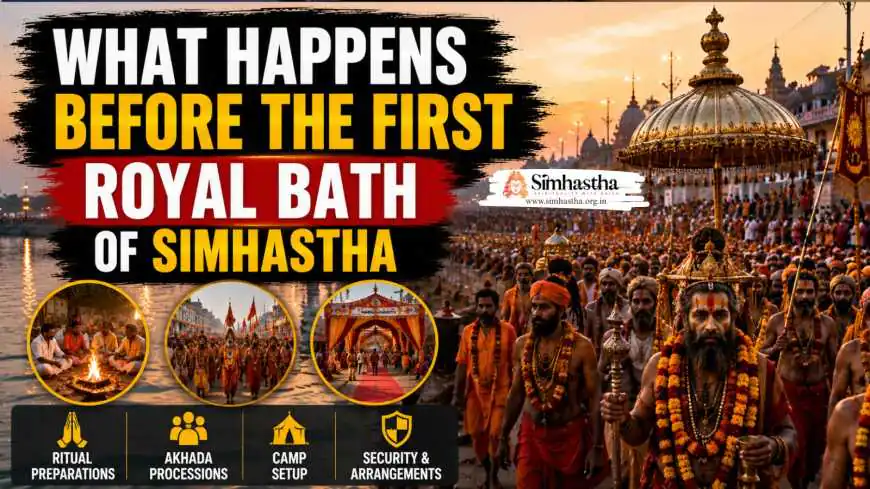
In the weeks leading up to the first Shahi Snan, the city of Ujjain witnesses a series of spectacular, medieval-style entries known as the Peshwai. Each of the thirteen recognized Akharas, the ancient monastic warrior orders, arrives at the Mela grounds with a display of pageantry that is both a spiritual statement and a demonstration of sovereignty. These are not quiet, humble entrances. A Peshwai is a full-scale royal procession. The Akhara's presiding deity, often a bejewelled image of Lord Shiva, Lord Rama, or the lineage's specific form of the divine, travels on a magnificent silver chariot or the back of a richly caparisoned elephant. The Mahant, the spiritual head of the Akhara, is carried in a palanquin, shaded by a ceremonial umbrella and flanked by his senior disciples.
The most electrifying element of the Peshwai is the presence of the Naga sadhus, the naked warrior-ascetics who are the Akhara's spiritual infantry. They move through the streets in a controlled, ecstatic fury, their bodies thickly smeared with sacred ash, their matted hair flying, and their hands brandishing tridents, swords, and spears. They shout war cries of "Har Har Mahadev," perform mock charges, and display breathtaking feats of martial and yogic skill. Drums, trumpets, and the ancient, haunting melodies of shehnai fill the air. The Peshwai is the formal, ritualized act of taking possession of the sacred ground. It announces to the city and to the cosmos that the army of the spirit has arrived and is now encamped. The order of the Peshwais is governed by a strict, historical protocol, with the Juna Akhara, the Niranjani Akhara, and the Mahanirvani Akhara traditionally leading the way. For the pilgrim, a Peshwai is the first, thrilling glimpse of the immense power that will be unleashed on the Shahi Snan day. 🏇
The Secret Initiations and the Birth of New Naga Warriors
Before an Akhara can take its place in the royal procession, its inner spiritual ranks must be renewed. One of the most profound and fiercely guarded rituals before the first Shahi Snan is the mass initiation of new members into the Akhara, particularly the making of new Naga sadhus. These initiations, conducted in the deep, impenetrable privacy of the Akhara's inner camp, often in the dead of night, are the hidden engine of the Kumbh. A candidate who has undergone years of testing and service is led to a secluded spot by the river. There, in the presence of his guru and senior mahants, he performs his own funeral rites, the pind daan for his own soul, symbolically dying to his former name, family, caste, and entire social existence. He is shaved, bathed in the Shipra, and then smeared from head to toe in the sacred ash from the Akhara's eternal dhuni fire. The guru whispers a secret, sacred mantra into his ear, and his clothing is removed. He stands naked, reborn, a living representation of Shiva at the cremation ground. This intensely private ritual, replicated in Akhara after Akhara, infuses the Mela with a constant, silent pulse of spiritual rebirth. The new Nagas, who will lead the charge into the river on the Shahi Snan day, emerge from these nocturnal rites not as the men they were yesterday, but as newborn warriors of the divine, their first public act of existence being the great, sacred plunge. 🔱
Trending Guides Now
Why Certain Rituals Are Allowed Only at Specific Ghats During Simhastha

Why Snan Dates Shift According to Planetary Positions in Simhastha
The Complete Sequence of Ritual Events During Simhastha

What Happens on the Most Important Bathing Days of Simhastha

Ujjain Railway Station to Mahakaleshwar Temple Distance (2026 Guide)

Ujjain Simhastha 2028 Dates Announced: Full Shahi Snan & Event Timeline

Ujjain Travel During Shravan Month: What Changes for Visitors

Latest Simhastha 2028 Development Projects Every Pilgrim Should Know
The Akhara Camps Awaken and the Night of the Cosmic Vigil
The night before the first royal bath is unlike any other night in the world. The entire Mela ground, now a sprawling temporary megacity of millions, crackles with a peculiar, electric stillness. Inside the fortified camps of the Akharas, there is no sleep. The dhunis, the sacred fires, are fed continuously, their flames leaping high into the pre-dawn dark. Groups of sadhus sit in circles, their eyes half-closed, engaged in deep, silent meditation or in the rhythmic, rolling chant of "Om Namah Shivaya." This is the night of the great Jagaran, the spiritual vigil. The air is thick with the scent of burning wood, incense, and the faint, earthy smell of the Shipra. In the inner sanctums of the Akhara camps, the most senior mahants perform elaborate, secret pujas to their presiding deities, invoking their blessings for the great event.
Outside the Akhara camps, the vast sea of ordinary pilgrims is also in motion. The designated bathing ghats, freshly cleaned, barricaded, and secured, are already starting to fill with devotees who have walked through the night to secure a spot. The entire city of Ujjain is a single, pulsing organism, its heartbeat quickening as the hours tick down. The police and the Mela administration are on full alert, monitoring the crowd density in real time, ensuring that the meticulously planned traffic and pedestrian flow systems are holding. There is a profound, almost tangible sense of anticipation, a feeling that something immense and transformative is about to erupt. The night is the container for the storm that is about to break. 🌙
The Flag Hoisting and the Sacred Boundaries of the Camp
A crucial but often overlooked ritual that takes place in the days before the Shahi Snan is the Akhara Dhvaja Puja, the consecration and hoisting of the Akhara's sacred flag. Each Akhara possesses a flag that is not a mere banner but a living embodiment of the order's spiritual power and lineage. The flag is woven from specific fabrics, dyed in the Akhara's traditional colors, and treated as a consecrated deity. In a formal ceremony, with the entire Akhara assembled, the flag is worshipped with Vedic or tantric rites. It is offered fire, incense, flowers, and the sacred ash, and is then raised high on a tall pole at the entrance of the Akhara's camp. The fluttering of the flag in the wind is not just a visual marker of the camp's location; it is a sacred sign that the deity is present, that the spiritual jurisdiction of the Akhara has been formally established, and that the space within its perimeter is now sanctified. The flag will not be lowered until the Simhastha concludes, and its condition throughout the Mela—how it catches the breeze, whether it remains untorn—is observed with deep, superstitious reverence. It is the Akhara's direct, visible link to the heavens, and it watches over all the activities leading up to the first royal bath. 🚩
The Pre-Dawn Assembly and the Order of the Sacred Charge
As the first faint, grey light of dawn begins to leach into the eastern sky, the Akhara camps erupt into organized, controlled chaos. This is the moment of the pre-dawn assembly. Inside each camp, the senior mahants and the heads of the various sub-sects gather to finalize the procession's formation. The order is strictly hierarchical. The Akhara's presiding deity, on its chariot or elephant, is the spiritual anchor. The Mahant and other senior, learned sadhus follow, often seated in palanquins or on decorated camels. Behind them come the musicians, the flag-bearers, and the main body of the Akhara's sadhus. But at the very front, the tip of the spiritual spear, are the Naga sadhus. They are the shock troops, the first to touch the sacred water and, by their fierce, fearless presence, to energetically sanctify the river for those who follow. The Nagas, their bodies glistening with freshly applied ash, perform their final, intense, inward-focused rituals. Some sit in a last moment of silent meditation, their tridents planted in the ground before them. Others circle their dhunis, shouting the name of Mahadev to build the internal, spiritual heat that will carry them forward. The air within the camp is a volatile mixture of extreme stillness and incipient, cataclysmic movement. 🧘
The Sudden Roar and the Charge of the Naga Warriors
And then, at the precise, astrologically determined Muhurta, a signal is given. It might be a conch shell blast, a particular rhythm of the war drums, or a shouted command from the Mahant. The discipline of the camp shatters into a magnificent, terrifying release of energy. The Naga sadhus burst from the camp entrance in a full, ecstatic sprint towards the Shipra. Their tridents are raised, their wild cries of "Har Har Mahadev" split the sky, and the ash from their bodies creates a pale, ghostly cloud around them. This is the charge of the Nagas, the single most iconic and electrifying event of the Kumbh Mela. They do not walk; they fly, their bare feet pounding the earth, their dreadlocks streaming behind them. They are not individuals anymore; they are a single, multi-limbed, divine force, a human avalanche of pure, unmediated devotion. Behind them, the great procession of the Akhara—the elephants, the chariots, the palanquins, the thousands of chanting sadhus—begins its majestic, slower march towards the river. But it is the Nagas, in those first, primal moments of their charge, who are the living, breathing embodiment of the Shahi Snan's spiritual meaning: the complete, ecstatic, and fearless surrender of the soul to the eternal. 🏃
The First Sacred Plunge and the Sanctification of the Waters
The moment the first Naga's foot touches the Shipra, the first royal bath has begun. The leaders of the charge plunge into the river with a force that sends water exploding outward. They immerse themselves completely, again and again, their bodies disappearing beneath the surface, their matted hair floating on the water like dark, tangled seaweed. This is not a hygienic dip; it is a ritual of cosmic significance. The Nagas, by their bath, are believed to sanctify the river for the millions who will follow. They are the first to receive the full, undiluted potency of the celestial amrit that the astrological Muhurta has infused into the water. After the Nagas, the senior mahants and the Akhara's deity are brought to the river's edge and given a more ceremonial bath. Finally, the thousands of other sadhus of the Akhara enter the water. The river, for those intense, chaotic moments, becomes a churning mass of ash, water, saffron, and ecstatic, liberated souls. The first Shahi Snan is complete, and the great doorway of the Simhastha is now, officially and cosmically, thrown open. 🌊

The Vast Human Mosaic and the Millions Who Wait
Beyond the immediate, dramatic events within the Akhara camps and on the main ghats, the night and pre-dawn hours before the first royal bath are defined by the vast, patient, ocean of ordinary pilgrims. They have come from every corner of India and the world, sleeping on the ground, in tents, in the open air, their only wealth the faith that has carried them here. They rise in the deep darkness and begin the long, slow walk towards the designated bathing areas, their paths illuminated by the harsh glare of temporary lights and the softer glow of small, handheld lamps. The sound of their collective chanting, a low, continuous hum of "Bam Bam Bhole," provides the deep, resonant bass note beneath the treble of the Akharas' war cries. The police and volunteer marshals work tirelessly to maintain the delicate, human hydraulics of the crowd, ensuring that the great river of people flows without stagnating into a dangerous crush. These millions of anonymous pilgrims, with their quiet, unshakeable faith, are the true foundation of the Simhastha. Their vigil, their patience, and their humble, personal prayers are the silent, powerful engine that gives the Shahi Snan its true meaning. 🚶
The Security Fortress and the Invisible Shield
Behind every ecstatic cry and every sacred plunge, an invisible, meticulously organized security apparatus is working at its peak. The night and early morning of the first Shahi Snan are the operational climax for the Simhastha security forces. The Integrated Command and Control Centre (ICCC) is a hive of silent, intense activity. Operators monitor a wall of screens fed by thousands of CCTV cameras and drone feeds, their eyes scanning for the first sign of a crowd surge or a potential choke-point. The digital predictive analytics, processing real-time data from mobile tower triangulation and ground sensors, issue silent alerts to the field commanders. Anti-terrorism units, disaster response forces, and river rescue boats are all on the highest state of alert. Plainclothes officers blend into the crowd. The entire Mela zone is ringed by a multi-layered security cordon, an invisible shield designed to protect the spiritual ecstasy from any external threat. The pilgrim, lost in their devotion, is often unaware of this immense protective shell, but it is this very shell—unseen, unsleeping, and uncompromising—that allows the surrender of the Shahi Snan to be so complete, so fearless, and so safe. 🛡️
The Eternal Meaning of the First Royal Bath
The first plunge of the Naga sadhus into the Shipra is not the beginning of the Simhastha; it is the fulfillment of the Simhastha. It is the release of a spiritual pressure that has been building since the astrologers first announced the Muhurta, through the long Peshwai processions, the secret initiations, the consecration of the flags, and the electric, sleepless night of the vigil. For the pilgrim watching from the ghats or waiting their turn downstream, understanding what has led to this moment transforms the experience. They are not just watching a spectacle; they are witnessing the climax of a sacred drama, a cosmic ritual whose script was written in the Puranas. The ash that floats on the water is the residue of the Nagas' renunciation. The chants that echo off the ghats are the accumulated mantras of a thousand years of unbroken lineage. The first royal bath is a single, radiant point in time that contains, within it, the entire, vast, ancient, and eternally renewed story of the Kumbh Mela. 🔱
Frequently Asked Questions