
























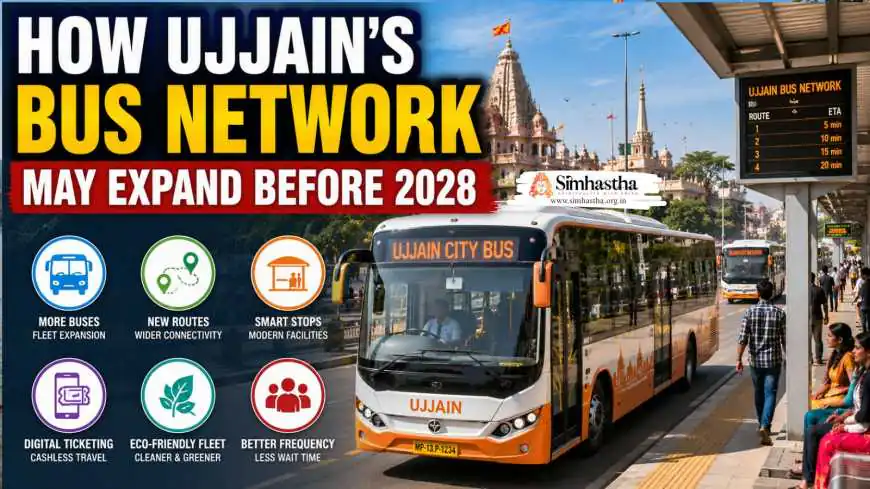
How Ujjain's Bus Network May Expand Before 2028
Discover how Ujjain's bus network may expand before 2028. Learn about new terminals, electric buses, Simhastha routes, and the transport revolution reshaping the pilgrimage city.


A Transport Spine for a City That Never Stops Growing
For most of its modern history, Ujjain's public transport has been a patchwork of private auto-rickshaws, shared tempos, and a skeletal municipal bus service that ran on a few fixed routes, primarily connecting the railway station to the Mahakaleshwar Temple area and some of the outlying colonies. The system worked, barely, under normal conditions, but the strain of even a moderately busy pilgrimage weekend would expose its limits. The Simhastha, with its projected ten to twelve crore visitors over a single month, is not a strain; it is a complete structural overload. The planners knew, from the very first transport review meeting in late 2024, that merely adding a few temporary buses during the Mela would be like trying to empty the Shipra with a teacup. What was needed was a permanent bus network upgrade that would serve the city long after the Mela tents are folded, while also being capable of handling the Mela's extreme peak loads.
Thus was born the Ujjain Bus Network Modernization and Expansion Project, a component of the larger Simhastha infrastructure package with a dedicated budget that runs into several hundred crores. The project's guiding philosophy is deceptively simple: make the bus the first choice for pilgrims and residents alike, so that private vehicles, with their associated chaos and pollution, become the exception rather than the norm. Achieving this requires not just more buses, but an entirely new ecosystem of terminals, priority lanes, real-time passenger information, and seamless integration with the railway and the proposed metro-rail feasibility study for the Indore-Ujjain corridor. 🚶
The New Inter-State and City Bus Terminals Rising on the Periphery
One of the most visible signs of the expansion that a visitor will notice even before entering Ujjain is the construction of new bus terminals on the city's outskirts. The existing bus stand, located on Dewas Road, is already congested beyond its design capacity during normal times. The Simhastha Mela area will absorb large tracts of land in the city's heart, and central bus stands simply cannot process the number of inter-city and interstate buses that will bring pilgrims from Rajasthan, Gujarat, Maharashtra, and across Madhya Pradesh. The solution is a ring of satellite bus terminals, strategically located at the intersections of the new ring roads with the major highways.
The largest of these, the Ujjain Western Inter-State Bus Terminal (ISBT) near the Indore-Ujjain highway junction, is being designed to handle up to 2,000 bus movements per day during the peak Mela period. It will be a fully air-conditioned terminal with separate arrival and departure bays, large waiting halls, food courts, clean toilet blocks, and a dedicated auto-rickshaw and taxi stand integrated with the city bus network. Two other satellite terminals, one on the Dewas Road and another on the Agar Road, will cater to traffic from the north and east. These terminals will not function in isolation; they will be the outer nodes of a hub-and-spoke model where long-distance buses terminate at the periphery, and pilgrims transfer to the city bus network, the Mela shuttle buses, or the electric auto-rickshaw fleet for their final journey into the Mela zone or the temple precincts. The terminals are being designed with a permanent legacy in mind—after 2028, they will become the backbone of Ujjain's regional connectivity, decongesting the city centre permanently. ✅
Trending Guides Now
How Ujjain’s New Parking Hubs Will Handle Millions During Simhastha 2028
How Ujjain's Transport Network Is Changing Before 2028
New Public Toilets and Sanitation Projects for Simhastha
Ujjain's New Riverfront Plans Before Simhastha 2028

Ujjain Railway Station to Mahakaleshwar Temple Distance (2026 Guide)

Ujjain Simhastha 2028 Dates Announced: Full Shahi Snan & Event Timeline

Benefits of Becoming a Simhastha Volunteer
Ujjain Travel During Shravan Month: What Changes for Visitors
Electric Buses and the Green Pilgrimage Vision
Perhaps the most striking element of the bus network expansion is the commitment to green mobility. The Madhya Pradesh government, in partnership with the central government's FAME-II scheme and its successor programs, has placed an order for 2,000 electric buses to be deployed across the state, with a significant allocation for Ujjain ahead of 2028. For the Simhastha, the plan is to operate a fleet of 500 to 700 electric low-floor buses within Ujjain city and the Mela area. These are not the noisy, fume-belching diesel buses of the past. They are silent, air-conditioned, GPS-tracked, and equipped with ramps for elderly and disabled pilgrims. The electric buses will operate on dedicated Mela routes connecting the railway stations, the satellite bus terminals, the major ghats, the tent cities, and the Mahakaleshwar Temple zone. Charging infrastructure—fast-charging stations and battery swapping points—is being installed at each terminal and at strategic depots, with the electricity supply guaranteed by the new dedicated Simhastha power substations.
For the pilgrim, the electric bus experience will be transformative. Imagine stepping off a long-distance train, weary and disoriented, and being guided by volunteer marshals to a clean, air-conditioned bus that glides silently through traffic, its route and next stop displayed on internal screens, arriving at the Mahakal Lok entrance in a predictable time, without the haggling, the smoke, or the anxiety of negotiating with an auto-rickshaw driver. This is the standard the administration wants to set for the Simhastha, and the electric bus fleet is the centrepiece of that vision. After the Mela, these buses will be absorbed into Ujjain's permanent city bus service, transforming the city's public transport into one of the greenest in central India. ✅
The Mela Shuttle Network and the Ghat-to-Ghat Connectivity
Beyond the trunk routes served by the electric buses, a finer capillary network of Mela shuttle services will operate during the Simhastha to move pilgrims between the major bathing ghats, the akhara camps, the parking lots, and the holding areas. These shuttles will be a mix of smaller electric buses, electric golf-cart-like vehicles for the pedestrianized zones, and, in some areas, cycle-rickshaws and e-rickshaws operating under a regulated permit system. The shuttle network will be designed around the concentric ring road system that the city is building for the Mela. Pilgrims parked in the outer parking lots will board shuttle buses that run on dedicated, barricaded lanes on the ring roads, bypassing much of the pedestrian traffic. The shuttles will operate at high frequency—every two to five minutes during the peak bathing hours—and will be free or nominally priced to encourage their use. A real-time shuttle tracking system integrated with the unified Mela mobile app will allow pilgrims to see exactly where the next shuttle is, how crowded it is, and when it will arrive at their stop. The goal is to eliminate the long, exhausting walks from distant parking areas to the ghats that were a significant hardship for many pilgrims, especially the elderly, during the 2016 Simhastha. 🚶
The Digital Nervous System of the New Bus Network
A network of this scale cannot be managed with whistles and hand signals. The Integrated Command and Control Centre (ICCC) that is being built for the Simhastha will house a dedicated Transport Management Cell that will function as the digital brain of the bus network. Every bus and shuttle will be GPS-tracked, and their locations will be displayed on a giant video wall in real time. The system will monitor passenger loads through onboard sensors and CCTV, and will automatically alert the control centre if a particular route or ghat is experiencing a surge in demand. Extra buses can be dynamically routed from less crowded sectors to areas of high pressure. The traffic signal system along the Mela routes will be integrated with the bus tracking system, giving priority to buses at intersections—a technique known as Transit Signal Priority—so that the shuttle fleet can maintain its schedule even when the surrounding streets are chaotic. This level of digital orchestration is unprecedented for a religious gathering in India, and if it works as planned, it will set a new benchmark for how mass pilgrimages are managed. The pilgrim, of course, will not see any of this complexity. She will simply notice that the bus arrives when the app says it will, that the journey is smooth, and that she is deposited at the ghat with a minimum of stress. ⏰
The Permanent City Bus Routes and the Post-2028 Legacy
While the Mela shuttle network is temporary, a significant portion of the bus expansion is designed to be permanent. The Ujjain City Bus Service, which currently operates a limited number of routes, will be expanded to 25 to 30 routes covering the entire municipal area, including the newly developed peripheral zones that are currently underserved. The new routes will connect the railway stations, the bus terminals, the major residential colonies, the university campus, the industrial areas, and, of course, the temple circuit. The fleet of electric buses procured for the Simhastha will form the core of this expanded city service, supplemented by CNG buses for routes with lower demand.
One of the most eagerly awaited permanent additions is the Temple Circuit Bus, a hop-on-hop-off service that will connect the major pilgrimage sites—Mahakaleshwar, Harsiddhi, Bade Ganeshji, Kal Bhairav, Mangalnath, Bhartrihari Caves, and the Shipra ghats—in a single, convenient loop. For pilgrims visiting Ujjain outside the peak Mela season, this circuit bus will be a game-changer, eliminating the need to negotiate with multiple auto-rickshaw drivers and providing a safe, comfortable, and air-conditioned way to complete the darshan circuit in a single day. The bus will have onboard audio guides explaining the significance of each temple, and a day pass will allow unlimited boarding and alighting. This kind of integrated pilgrimage transport exists in some international pilgrimage destinations, and Ujjain is poised to become one of the first cities in India to offer it at scale. ✅

The Indore-Ujjain Bus Corridor and Regional Integration
The bus network expansion cannot be confined to Ujjain's municipal limits. A large proportion of Simhastha pilgrims will stay in Indore and commute daily, and even in non-Mela times, the flow of pilgrims, students, and business travellers between the two cities is substantial. The transport master plan therefore envisions a high-frequency, high-capacity bus corridor along the newly widened six-lane Indore-Ujjain highway. This corridor will be served by a mix of air-conditioned inter-city coaches operated by the state road transport corporation and private operators under a unified fare and scheduling system. During the Simhastha, the frequency on this corridor will be increased to a bus every five to ten minutes during peak hours, with the Indore ISBT and the Ujjain Western ISBT serving as the two anchors. For pilgrims staying in Indore, the journey will be simplified to: hotel shuttle or auto to Indore ISBT, inter-city bus to Ujjain Western ISBT, transfer to Mela shuttle or city bus to the ghats. The entire chain will be covered by a single digital ticketing system, and real-time information will be available at every interchange point. This seamless integration of regional and local transport is the ultimate goal of the network design, and the Simhastha is the catalyst that is making it happen. 🚆
The Auto-Rickshaw and Feeder Service Integration
No bus network, however extensive, can serve every narrow lane and every doorstep. The auto-rickshaw and e-rickshaw sector will therefore be integrated into the expanded bus network as a formal feeder system. During the Simhastha, auto-rickshaws will be organized into designated stands at every bus terminal, railway station, and major ghat, with clearly displayed rate cards and digital payment options. The administration is also promoting the formation of auto-rickshaw cooperatives and the training of drivers as pilgrim guides, so that the auto ride is not just a transport leg but a value-added experience. The unified Mela app will allow pilgrims to book an auto-rickshaw from their bus drop-off point to their precise destination, with fare transparency and driver rating systems. This integration of the formal and informal transport sectors is crucial to the success of the overall network, and the years leading up to 2028 will see extensive efforts to bring Ujjain's auto-rickshaw drivers into the digital and regulatory fold, offering them training, licenses, and access to the technology platforms that will govern the Simhastha transport system. ✅
The Common Pilgrim's Experience in 2028
Let me draw a picture of what all this means for the pilgrim who will arrive in Ujjain during the Simhastha of 2028, or even for the ordinary devotee visiting on a quiet Tuesday in 2029. She steps off her train at the expanded Ujjain Junction, and instead of being mobbed by auto-rickshaw drivers shouting prices, she follows clear, illuminated signage to the City Bus Terminal right outside the station. She has already downloaded the Ujjain Yatra app on her phone, which has her pre-booked Bhasma Aarti pass and her hotel reservation. The app tells her that Bus Number 7, "Temple Circuit," is departing from Bay C in four minutes. She boards an air-conditioned electric bus, taps her phone on the digital validator, and takes a seat. The bus glides silently through the morning streets, its onboard display showing the next stop and the estimated arrival time. At the Mahakaleshwar stop, she alights, walks the short distance to the Mahakal Lok entrance, and is inside the temple complex within minutes. Later, she catches the same bus to Harsiddhi, then to Ram Ghat for the evening aarti. She never once haggles, gets lost, or worries about being overcharged. This is not fantasy. This is the designed outcome of the bus network expansion that is being built right now, in the dusty construction sites and the government tender documents and the planning meetings that are shaping the Ujjain of 2028 and beyond.
The Road to 2028 and the Ongoing Work
The transformation of Ujjain's bus network is not a distant future plan; it is happening in real time. The satellite bus terminals are under construction, with the Western ISBT expected to be operational by mid-2027. The first tranche of electric buses has already been ordered, with deliveries scheduled to begin in late 2026. The road widening and BRT lane markings on the major arterial routes are being executed alongside the other civil works of the Simhastha infrastructure package. The digital platform that will power the transport management system is being developed by IIT Indore in collaboration with the state IT department, with beta testing planned for early 2027. The auto-rickshaw driver training and registration drives have already commenced, with hundreds of drivers being brought into the formal system every month. The task is immense, and there will inevitably be delays, cost overruns, and unforeseen challenges. But the direction of travel is unmistakable. Ujjain is not merely preparing to host a twelve-yearly festival; it is building a public transport system that will serve as a model for pilgrimage cities across India, a system that places the pilgrim—her comfort, her dignity, her spiritual focus—at the very centre of the design. The buses are coming. The terminals are rising. The network is taking shape. And the pilgrim, whether she arrives in 2028 or 2030 or 2040, will be the beneficiary of a vision that began with the simple, profound question: how do we move millions, not as a logistical problem to be solved, but as guests to be honoured? 🔱
Frequently Asked Questions