





























How Early Should You Book Hotels for Simhastha 2028?
Learn exactly how early you should book hotels for Simhastha 2028. Discover the critical booking timeline, price surge windows, and smart strategies to secure your stay before everything sells out.



The Three-Phase Booking Timeline That Defines Simhastha Reservations
The accommodation booking landscape for the Simhastha unfolds in three distinct phases, each with its own characteristics in terms of availability, pricing, and the type of pilgrim or traveler who books during that window. Understanding these phases is the key to making a strategic, informed decision about when to commit your money and lock in your reservation.
Phase One: The Early Bird Window (Mid-2026 to Early 2027)
This is the golden window, and it is the phase that will determine whether your Simhastha accommodation experience is one of calm confidence or desperate scrambling. During this eighteen-month period before the Mela, the most organized and informed travelers—international pilgrims, large tour operators, corporate groups, and experienced Kumbh attendees—will secure the best available rooms at the most reasonable premiums. Hotels in prime locations, particularly those within walking distance of The Mahakaleshwar Temple, the Shipra ghats, and the main Mela sectors, will begin receiving block bookings and long-duration reservations. The pricing during this phase, while already elevated above normal Ujjain tariffs, represents the best value that will be available for peak-date accommodation. A room that will eventually cost ₹25,000 per night on a Shahi Snan date may be bookable for ₹8,000 to ₹12,000 during the early bird window. The hotels themselves, aware of the demand that is coming, are often willing to offer relatively moderate rates to secure confirmed, advance bookings that give them financial certainty. The pilgrim who books during Phase One is not merely reserving a room; they are purchasing peace of mind at a discount. ✅
Phase Two: The Main Booking Rush (Mid-2027 to Late 2027)
As the official Shahi Snan dates are announced by the Kumbh Mela astrologers and the Simhastha administration, and as the physical infrastructure of the Mela—the tent cities, the expanded roads, the railway upgrades—becomes visibly real, the bulk of domestic pilgrims and Indian tour operators will enter the booking market. This is the phase of maximum transaction volume. During this six to eight-month window, the remaining hotel inventory within Ujjain will be rapidly absorbed. Mid-range hotels that were holding inventory for direct bookings will release their remaining rooms. Budget hotels and lodges will begin selling out for the peak bathing dates. The homestay sector, mobilized by the government's registration and incentive programs, will open for bookings during this phase. Pricing will climb steadily but not yet astronomically. A room that was ₹8,000 during the early bird phase may now cost ₹15,000 to ₹20,000 for peak dates. By the end of Phase Two, which coincides roughly with the December 2027 holiday period, organized accommodation within Ujjain city for the Shahi Snan dates will be effectively sold out. Pilgrims who have not booked by this point will need to pivot their strategy—toward Indore, toward tent cities, toward dharamshala dormitories, or toward the informal, unorganized sector. 🚶
Phase Three: The Last-Minute Scramble (Early 2028 to Mela Start)
Phase Three is not a booking window in the conventional sense; it is a landscape of scarcity. By early 2028, three to four months before the Simhastha's expected April-May commencement, the organized accommodation sector in Ujjain will have almost no peak-date inventory remaining. What little remains will be priced at absolute premiums—₹30,000 to ₹1,00,000 per night for whatever rooms are still available in decent hotels. The overflow market in Indore will be the primary recourse for pilgrims booking during this phase. Indore, with its significantly larger hotel inventory, will still have rooms, but prices will be three to five times normal rates, and the daily commute to Ujjain on peak bathing days will involve two to three hours of travel in heavy congestion. Tent city accommodations, if not already sold out, will be available at their highest tier pricing. The dharamshalas, operating on community networks and trust-based allocations, will be overwhelmed with walk-in requests. This is the phase in which the pilgrim's spiritual equanimity is most severely tested. It is not impossible to find a place to sleep during Phase Three—the Kumbh has a way of providing, and the informal sector always absorbs a significant percentage of pilgrims—but it requires flexibility, a willingness to accept very basic conditions, and a budget that can absorb the peak pricing. ⚠️
Trending Guides Now

Affordable Hotels Near Ujjain Railway Station

Ultimate Hotel Booking Guide for Ujjain Visitors

15 Budget Hotels Near Mahakal Temple Ujjain Under ₹1500

Luxury Hotels Near Mahakaleshwar Temple Ujjain: Big Hospitality Boom Underway

Ujjain Railway Station to Mahakaleshwar Temple Distance (2026 Guide)

Ujjain Simhastha 2028 Dates Announced: Full Shahi Snan & Event Timeline

How ISKCON Ujjain Engages Young Devotees Through Programs

Benefits of Becoming a Simhastha Volunteer
The Shahi Snan Date Multiplier Effect
Not all Simhastha dates are equal in the accommodation market. The Shahi Snan—the royal bathing days when the great akharas process to the Shipra in their full, magnificent splendor—represent the absolute peak of demand. On these days, the pilgrim population of the Mela swells to its maximum, and the accommodation market experiences what economists would call a severe supply-demand discontinuity. A hotel room that might be available for ₹5,000 on a non-bathing day during the Mela period can command ₹25,000 on a Shahi Snan date. A room that costs ₹25,000 on a Shahi Snan date may be unsellable at ₹1,500 a week after the Mela concludes. This extreme date-sensitivity means that your booking strategy must be built around the specific dates you plan to attend. If you are flexible and can plan your pilgrimage for the days between the major bathing dates, you will find more availability and more moderate pricing. If your heart is set on being present for the Shahi Snan itself, you must book early, and you must book with the understanding that you are competing for a finite resource—a comfortable, private room within reasonable distance of the ghats—against millions of other pilgrims who share the same aspiration. The Shahi Snan dates for Simhastha 2028 will be officially announced by mid-2027. The moment that announcement is made, the Phase Two booking rush will begin in earnest. Being ready to book within days, not weeks, of that announcement is a significant competitive advantage. ✅
What the 2016 Simhastha and 2025 Prayagraj Kumbh Taught Us
Historical data from the two most recent and relevant mega-events provides the empirical foundation for the Simhastha 2028 booking forecast. The 2016 Ujjain Simhastha, which drew an estimated 7.5 crore pilgrims, saw hotel rooms within Ujjain sell out for the Shahi Snan dates approximately seven to eight months in advance. In 2016, the tent city infrastructure was less developed than what is planned for 2028, and the homestay sector was virtually nonexistent. The result was that pilgrims who booked late were forced into Indore or into extremely basic, unregulated accommodations. The 2025 Prayagraj Maha Kumbh, with its staggering 40-crore-plus footfall, provided an even more dramatic case study. There, formal hotel inventory in Prayagraj city was exhausted for peak dates nearly a year in advance. The vast majority of pilgrims relied on the extensive tent city installations, which themselves sold out for the Shahi Snan dates months ahead. Room tariffs in Prayagraj during the peak bathing days reached levels comparable to five-star hotels in metropolitan cities, and even dormitory beds in ashrams became a precious commodity. The lesson from both events is consistent and unambiguous: the early booker secures choice and value; the late booker secures whatever remains, at whatever price is asked. The Simhastha 2028 will follow this pattern, amplified by the improved connectivity and infrastructure that will make the pilgrimage accessible to an even larger audience than 2016.
The Accommodation Categories and Their Booking Timelines
Different accommodation types follow different booking timelines, and understanding these nuances allows you to tailor your strategy to your preferred category.
Premium Hotels and Heritage Properties: Ujjain's limited stock of premium rooms will be the first to sell out. International pilgrims, VIP visitors, and tour operators with established relationships will book these rooms during Phase One, often through direct, off-market arrangements with hotel management. If you require a premium hotel room for the Shahi Snan dates, your booking window is effectively mid-2026 to early 2027. After that, availability will be accidental—a cancellation, a release of a held block, an extraordinary stroke of luck.
Mid-Range Hotels and Business Hotels: These properties, including chain hotels in Indore and the better Ujjain hotels, will see their peak-date inventory absorbed during the Phase Two rush, roughly mid-2027 to late 2027. Booking during this window secures a comfortable, air-conditioned room at a significant but not catastrophic premium.
Budget Hotels, Lodges, and Guesthouses: These will sell out for peak dates by the end of Phase Two or the very beginning of Phase Three. They are the backbone of the domestic pilgrimage market, and demand from Indian families, small tour groups, and independent travelers will consume this inventory steadily throughout 2027.

Dharamshalas and Ashrams: These operate on a different logic. Many do not take formal advance bookings at all, or they prioritize their own community members. However, the larger, better-organized dharamshalas, particularly those run by major temple trusts, will begin accepting bookings during Phase Two. Establishing direct contact with the managing trust during Phase One, even if formal bookings are not yet open, is a wise preparatory step.
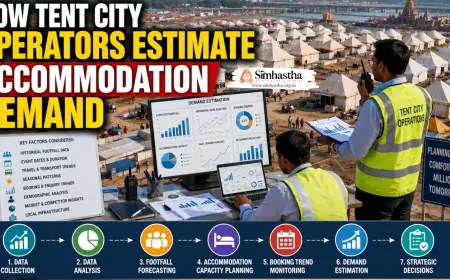
Tent Cities: The government and private operators will open tent city bookings during Phase Two, likely in the second half of 2027. Premium tents will sell out for Shahi Snan dates relatively quickly. Budget shivir tents will have more availability into Phase Three but should not be relied upon as a last-minute walk-in option.
Homestays: The government-registered homestay portal is expected to launch during Phase Two. This will be a dynamic market, with new inventory being added as homeowners complete their registration and training. Early Phase Two bookings will secure the best-located and best-prepared homestays. ✅
The Indore Factor and the Satellite Strategy
For pilgrims who are unable or unwilling to pay the extreme premiums for Ujjain accommodation on peak dates, Indore represents the most viable alternative. The city, with its significantly larger hotel inventory, its airport connectivity, and its 55-kilometer proximity to Ujjain, will function as the primary overflow accommodation hub for Simhastha 2028. However, the Indore strategy requires its own early-booking discipline. Hotels in Indore along the Ujjain corridor will see their own demand surge during the Mela, and the best-located properties—those with easy access to the highway and the planned shuttle bus routes—will sell out for peak dates during Phase Two. Pilgrims booking Indore accommodation should also factor in the commute time and its variability. On non-peak days during the Mela, the expanded six-lane highway will deliver a 45 to 60-minute commute. On Shahi Snan days, when lakhs of pilgrims are simultaneously moving toward the ghats, that same commute could stretch to two to three hours. Booking a hotel near the Indore end of the highway, pre-arranging a dedicated vehicle with a driver who knows the back routes, and planning temple visits around the peak traffic windows are essential elements of a successful Indore-based Simhastha strategy. 🚆
The Risks of Booking Too Late
The consequences of late booking during the Simhastha are not merely financial, though the financial penalty is significant. A pilgrim who books during Phase Three for a Shahi Snan date may pay five to ten times the early bird rate for a room that is inferior in location, comfort, and amenities. But beyond the financial cost, there is an experiential cost. The late-booking pilgrim spends precious pilgrimage hours searching for accommodation, negotiating with auto-rickshaw drivers, and managing the logistics of a suboptimal location, rather than being present at the ghats, in the temples, and in the spiritual atmosphere of the Mela. The stress of uncertain accommodation bleeds into the spiritual experience, making it harder to sink into the devotional mood that is the whole point of attending the Simhastha. There is also a safety and comfort risk. The unorganized accommodation sector that absorbs the late-booking overflow is variable in quality. Some informal arrangements are perfectly adequate; others involve unacceptable compromises in hygiene, security, or basic facilities. The pilgrim who books early is not just buying a room; they are buying the freedom to be fully present at one of the most spiritually significant events of their lifetime.
Your Booking Action Plan Starting Now
If you are reading this in 2026, you are in an enviable position. You have the luxury of time, information, and strategic choice that the late bookers will not have. Here is a concrete action plan. Step One: Determine your dates. Are you committed to a Shahi Snan date, or are you flexible? Your date decision drives everything else. Step Two: Set your budget. Use the realistic price forecasts for your chosen accommodation category and your chosen dates, and add a 30% buffer for unforeseen surges. Step Three: Research and shortlist. Identify specific hotels, dharamshalas, or tent city operators. Read reviews. Contact the properties directly to inquire about their Simhastha booking policies and timelines. Step Four: Register for alerts. Sign up on the official Madhya Pradesh Tourism and Simhastha portals for booking announcements. Follow the social media channels of the Ujjain administration and the major akharas that may offer pilgrim accommodation. Step Five: Be ready to book instantly. When the Phase Two booking window opens in mid-2027, the most desirable inventory will be absorbed within days, sometimes hours. Have your payment methods ready, your dates confirmed, and your decision made. Hesitation at the moment of booking is the enemy of good accommodation. Step Six: Confirm, reconfirm, and document. Once booked, obtain written confirmation, preferably with a clear cancellation and refund policy. Keep digital and physical copies of your booking confirmation. Reconfirm your reservation a month before your arrival and again a week before. 🔱
The question of how early you should book hotels for Simhastha 2028 has a clear, data-driven answer for those who want certainty, choice, and reasonable pricing: book during the early bird window of mid-2026 to early 2027 for Shahi Snan dates, and no later than mid to late 2027 for any Mela-period accommodation in Ujjain. The pilgrims who follow this timeline will arrive at the Simhastha with their accommodation secured, their minds at ease, and their hearts free to focus entirely on the spiritual magnificence of the Kumbh. The pilgrims who wait will still find a way—the Kumbh always provides—but their path will be steeper, more expensive, and more stressful. The choice of which pilgrim you wish to be is made not at the Mela itself but months before, in the quiet moment when you decide to book.
Frequently Asked Questions