




















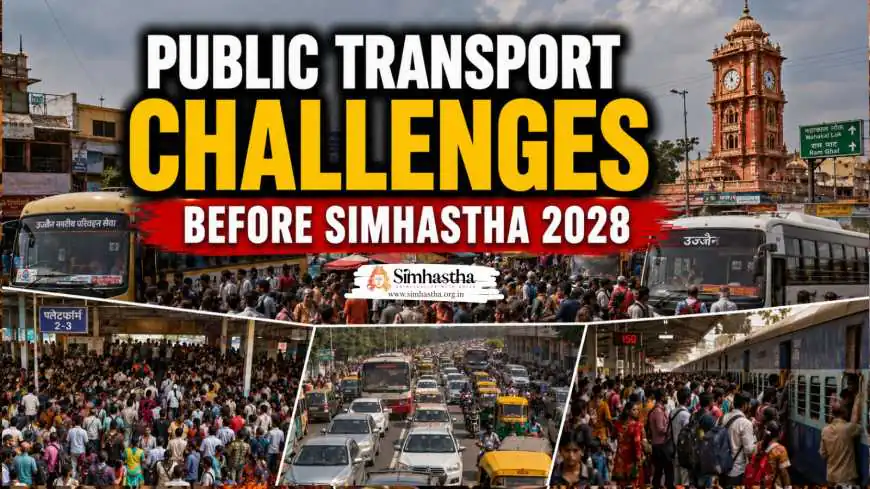
Public Transport Challenges Before Simhastha 2028
Explore the major public transport challenges Ujjain must solve before Simhastha 2028. From legacy bus gaps and congested railways to chaotic auto-rickshaws and missing last-mile links, discover the obstacles to moving 10 crore pilgrims.


The Incoming Surge and the Legacy Capacity Deficit
To understand the public transport challenges Before Simhastha 2028, one must first sit with the scale of the numbers. Ujjain’s permanent population hovers around six lakh, and its daily public transport demand is modest—a few thousand commuters relying on the skeletal remains of a city bus service, shared autos, and private two-wheelers. During the Simhastha, however, the city will experience single-day pilgrim arrivals that could touch 1.5 to 2 crore on the Shahi Snan dates. The entire monthly footfall is projected between 10 and 12 crore. That is not a fluctuation; it is a transformation into a temporary city that rivals the world’s largest metropolises for thirty intense days. The existing transport infrastructure has, at best, about five percent of the capacity required to move these numbers without catastrophic congestion. The challenge is not theoretical. It is visible now, in the congested lanes of the old city, the single narrow bridge over the Shipra that becomes a chokepoint on even a minor festival day, and the Ujjain Junction platforms that heave during the Sawan month. If the city’s public transport arteries are not radically widened and diversified, the Simhastha risks turning into a vast, stationary gridlock, with pilgrims trapped in transit and the spiritual goal of the holy dip receding behind a wall of stranded vehicles. 🚶
The Urban Bus Vacuum and the Missing Mass Transit Spine
A modern city’s answer to mass mobility is the bus, yet Ujjain’s city bus network is currently a whisper of what is needed. For most of the year, a handful of buses operate on a few fixed routes, mostly connecting the railway station to The Mahakaleshwar Temple area and a couple of outlying residential pockets. There is no dedicated Bus Rapid Transit corridor, no bus-only lanes, and no integrated ticketing system. The buses that do run are a mix of aging diesel vehicles and a few newer additions, and their frequency is so low that pilgrims routinely abandon them in favour of the more readily available, if chaotic, auto-rickshaws. For the Simhastha, the city needs a full-fledged bus rapid transit spine that can move lakhs of pilgrims per day along the major Mela corridors. This means not just procuring a fleet of electric buses—a plan that is already in motion—but also carving out dedicated right-of-way on roads that are being simultaneously widened and contested by every other form of traffic. The physical and political challenge of creating this bus spine through the heart of an ancient city, without destroying its heritage fabric or creating permanent divisions, is immense. Moreover, the bus depots, charging infrastructure for electric vehicles, and maintenance workshops that a 2,000-strong fleet demands must be built from scratch, their land acquisition often mired in the slow, painful processes of a land-pooling policy that is itself still evolving. 🚆
The Railway Junction and the Capacity Wall
Ujjain Junction, for all its historical charm, is a station built for a district headquarters, not for the largest pilgrimage on earth. On a normal day, it handles a manageable stream of passenger and express trains. During the Simhastha, it will need to process special trains in the hundreds, with passenger volumes that rival the busiest terminals in the country. The platforms are too few and too short, the waiting areas cannot accommodate the tens of thousands who will inevitably be stranded between connections, and the entrance and exit points are not designed for the unidirectional flow of massive crowds. The ongoing expansion, which includes eight new platforms and satellite terminals at Chintaman and Vikram Nagar, is a race against time. The challenge is not just construction but operational orchestration: how do you schedule so many trains on a section that also carries regular freight and passenger traffic without grinding the entire western Indian network to a halt? The railway authorities must create a temporary timetable that is almost militaristic in its precision, and the slightest delay can cascade into a nightmare of stranded pilgrims on platforms in the harsh summer heat. The challenge extends beyond the tracks to the immediate station environs, where the absence of a seamless transfer to the city’s bus network—the missing link between rail and road—will funnel lakhs of disembarking passengers into a narrow funnel of auto-rickshaws and walking paths. ⚠️
The Last-Mile Labyrinth and the Auto-Rickshaw Conundrum
In the absence of a robust city bus system, Ujjain’s auto-rickshaws have organically filled the void, becoming the de facto public transport for millions of everyday pilgrims. There are thousands of them, and during the Simhastha, their numbers will multiply as drivers from surrounding districts pour into the city seeking the economic windfall. The challenge is not their availability but their profound disorganization. There is no unified fare structure, no digital hailing or payment integration for the vast majority, and no standardized training in pilgrim management. The familiar scenes from previous Kumbhs—haggling, route refusal, overcharging, and a general sense of chaos at the railway station and bus stands—stem from this regulatory vacuum. The administration’s plan to bring auto-rickshaw drivers into a formal feeder system, with designated stands, official rate cards, digital payment options, and pilgrim-sensitivity training, is a massive administrative undertaking. It requires winning the trust of a sector that has long operated in the informal economy, and it demands a robust enforcement mechanism to prevent the inevitable touts and bad actors from eroding the pilgrim experience. The last mile between the bus stop or the parking lot and the bathing ghat is the weakest link in the entire mobility chain, and it is here, in the chaotic scrum of autos, e-rickshaws, and pedestrians, that the greatest risk of congestion and harassment lies. 🚶
Trending Guides Now
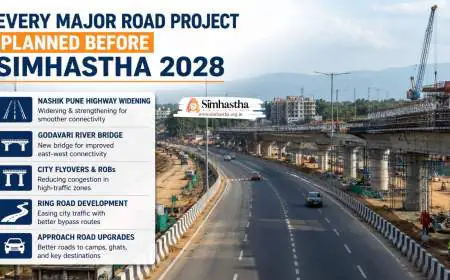
Every Major Road Project Planned Before Simhastha 2028
Smart City Transformation for Simhastha 2028: How Ujjain Is Preparing for 5 Crore Pilgrims
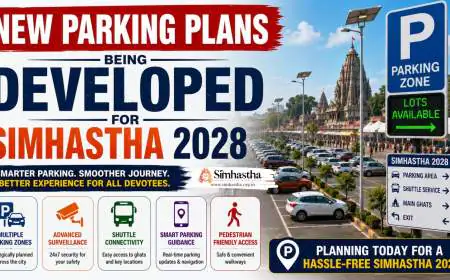
New Parking Plans Being Developed for Simhastha 2028
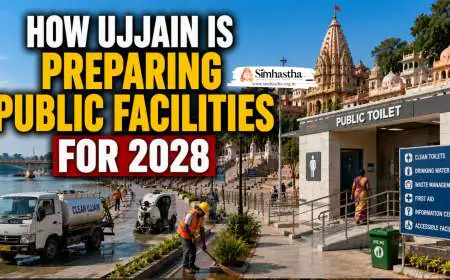
How Ujjain Is Preparing Public Facilities for 2028

Ujjain Railway Station to Mahakaleshwar Temple Distance (2026 Guide)

Ujjain Simhastha 2028 Dates Announced: Full Shahi Snan & Event Timeline
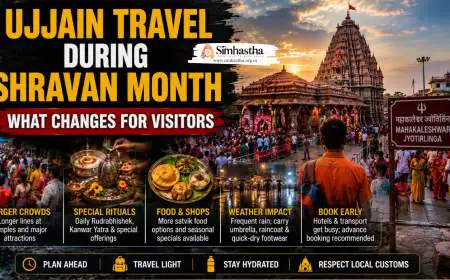
Ujjain Travel During Shravan Month: What Changes for Visitors
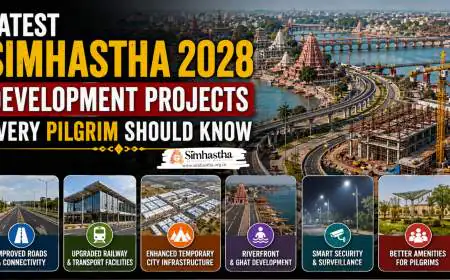
Latest Simhastha 2028 Development Projects Every Pilgrim Should Know
The Road Network Fragmentation and Congestion Hotspots
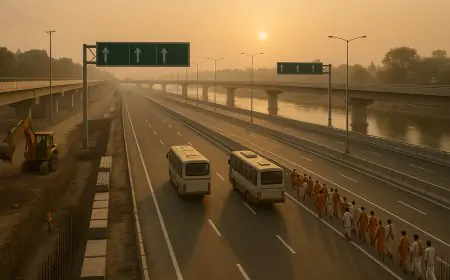
Ujjain’s old city roads were not built for vehicles; they were built for bullock carts, palanquins, and pedestrians. Over the centuries, they have been widened in piecemeal fashion, but their fundamental geometry—narrow, winding, and converging on the temple core—creates a natural traffic trap. On a regular evening, the Mahakal Marg and the roads around the Gopal Mandir can seize up for an hour. During the Simhastha, with an exponentially multiplied volume of vehicles, these streets will become impassable unless a radical road network restructuring is implemented. The planned ring roads and the Eastern Bypass are designed to divert through-traffic, but the challenge lies in the connecting tissue between these new arterials and the old city. The inner cordons, the pedestrian-only zones, and the designated parking and shuttle transfer points must be marked, barricaded, and enforced with absolute rigour. The civil engineering is perhaps the easier part; the behavioural challenge—convincing pilgrims to park their vehicles kilometres away and board a shuttle bus for the final leg—is the real test. The chaos of the 2016 Simhastha, when private vehicles were abandoned haphazardly along approach roads, turning them into kilometres-long parking lots, is a vivid memory that the administration must erase with a combination of infrastructure, communication, and firm enforcement. ✅
Parking Purgatory and the Peripheral Holding Strategy
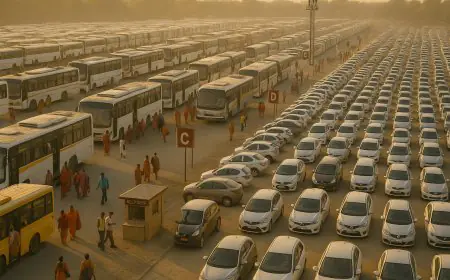
The strategy to keep the core Mela zone vehicle-free hinges entirely on the availability of massive, organized parking lots on the city’s periphery. The challenge is one of land, logistics, and psychology. Thousands of hectares of land have been earmarked and are being developed as temporary parking plazas, capable of holding tens of thousands of cars, buses, and two-wheelers. These fields, however, must be transformed from rough agricultural land into functional parking spaces with compacted surfaces, adequate lighting, security, sanitation, and, most crucially, a frequent, reliable shuttle service that takes the pilgrim from their parked vehicle to the ghats and back again. A parking lot without a guaranteed, comfortable shuttle is a detention camp. The psychological challenge is convincing a pilgrim, who has often driven hundreds of kilometres with the singular goal of reaching the temple, to voluntarily stop twenty kilometres short and surrender their onward mobility to a public bus. This requires a level of trust in the public system that has not yet been fully earned, and building that trust through visible, efficient operations in the initial days of the Mela will be critical. A failure here will see the same spillover of private vehicles into the restricted zones, quickly unravelling the entire traffic plan. 🅿️
The Digital Mobility Gap and the Information Void
In an age where a smartphone can summon a cab in seconds, the digital infrastructure for public transport in Ujjain is still nascent. Pilgrims arriving for the Simhastha will need a single, unified mobile application that provides real-time tracking of all public buses and shuttles, displays crowd density at various ghats, offers multi-modal trip planning, and integrates a common mobility card or QR-code-based payment system. Building this digital ecosystem is not merely a software development challenge; it requires the hardware backbone of GPS-installed fleets, a robust telecom network that will not buckle under the load of lakhs of simultaneous users, and a control centre that can synthesize data from thousands of cameras and sensors into actionable information. The telecom infrastructure, even now, experiences congestion during major festivals. During the Simhastha, when every pilgrim will try to use their phone simultaneously—to navigate, to pay, to connect—the network could face a catastrophic collapse, rendering the smart mobility app a useless icon on a frozen screen. The deployment of temporary mobile towers, satellite backhaul, and priority bandwidth for emergency and transport services is a parallel challenge that is as critical as the laying of any physical road. 📡
The Coordination Conundrum and the Multi-Agency Maze
Public transport for the Simhastha is not managed by a single authority. It is a complex web of agencies: the Municipal Corporation for city roads, the Public Works Department for highways, the Simhastha Special Purpose Vehicle for the Mela area, the Railways for train services, the Regional Transport Office for bus permits and auto-rickshaw regulation, the Traffic Police for enforcement, and the IT Department for the digital platform. Each of these bodies has its own hierarchy, its own procurement cycles, and its own culture. The challenge of aligning all of them into a single, coherent operational plan, with a unified command structure for the thirty days of the Mela, is a management marathon that would test any government. The decisions about which agency controls the shuttle buses, who pays for the common mobility card infrastructure, how fare revenue is shared, and who resolves inter-agency disputes in real time must be codified in advance and tested through multiple dry runs. A single breakdown in coordination—a railway delay that is not communicated to the bus dispatchers, a road closure not updated on the navigation app—can trigger a cascade of stranded pilgrims that the entire system is designed to prevent. The institutional challenge is as formidable as the physical one. 🤝
The Seasonal Overload and the Maintenance Crisis
The public transport system being built for the Simhastha is a massive surge capacity that will be utilized at its peak for a month, and then must settle into a sustainable, long-term service for Ujjain’s permanent residents. The maintenance and operational sustainability of a fleet of hundreds of electric buses, once the Mela is over and the special funding dries up, is a challenge that is often overlooked in the rush to build. The charging infrastructure must be permanent and integrated with the city’s power grid, not just a temporary generator-backed setup. The buses must be stored, cleaned, repaired, and eventually replaced, and the financial model for their post-Mela operation must be viable. The risk is that the city acquires a massive, expensive fleet that it cannot afford to maintain, leading to a slow decay of the very public transport system the Simhastha was supposed to catalyze. The challenge is to design the Mela transport system not as a temporary overlay but as the accelerated Phase One of a permanent, financially sustainable urban mobility network, with the institutional capacity and the revenue model to survive long after the last pilgrim has departed. 🔧
The Pilgrim's Perspective and the Human Face of the Challenge
Beneath all the technical and institutional layers, the public transport challenges before Simhastha 2028 have a deeply human face. They are the grandmother from a Rajasthan village who speaks no Hindi, arriving at a railway platform with no idea where the bus to the ghats is. They are the exhausted family from Maharashtra who have driven all night, only to be told they must park twenty kilometres away and wait for a shuttle that is not clearly marked. They are the solo pilgrim whose phone battery has died, and with it, his only map and payment method. The real test of Ujjain’s transport preparation will not be in the boardrooms of Bhopal but on the ground, in the first hour of the first Shahi Snan, when a bewildered pilgrim is met not with chaos but with a volunteer guide, a clear multilingual sign, and a clean, waiting bus. The challenge, ultimately, is to build a system that is not just efficient but compassionate, a system that remembers that each passenger is a soul on a sacred journey, and that the journey to the darshan is itself a part of the pilgrimage. The buses, the trains, the digital apps, and the parking lots are all, in the end, vehicles of grace, and the grace they must carry is the faith of a hundred million hearts. 🙏

Frequently Asked Questions