



















Rituals Pilgrims Commonly Witness During Simhastha
Discover the rituals pilgrims commonly witness during Simhastha Mela. From the majestic Shahi Snan and Shipra aarti to pind daan and akhara processions, explore the sacred ceremonies that define the Ujjain Kumbh.


The Shahi Snan and the Spectacle of Royal Bathing
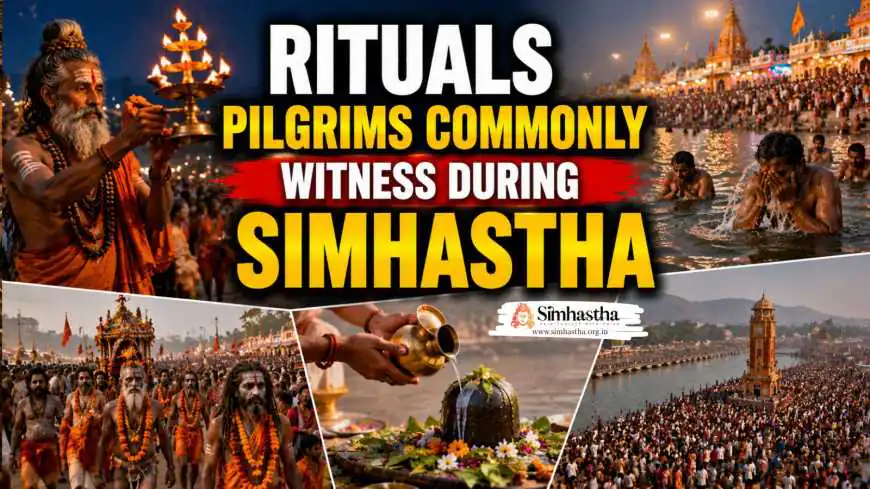
The Shahi Snan, the "royal bath," is the undisputed visual and spiritual crescendo of the Simhastha. It is the ritual that draws the world’s cameras and the pilgrim’s soul. On the appointed days, dictated by the precise astrological conjunction of Jupiter and the Sun, the great monastic orders—the Akharas—take possession of the ghats. They arrive in massive, pre-determined processions, and the order of their bathing is governed by an ancient, fiercely guarded protocol. The Juna Akhara, the Niranjani Akhara, and the Mahanirvani Akhara lead the way, followed by the other Shaiva, Vaishnava, and Udasin orders.
To witness the Shahi Snan is to see the naked, ash-covered Naga sadhus sprint towards the river with tridents raised, their matted locks flying, their shouts of "Har Har Mahadev" splitting the air. They plunge into the Shipra’s waters with a primal, ecstatic abandon that is both terrifying and deeply moving. Following them, the chariots of the akhara deities, the mahants seated on silver thrones atop elephants, and the thousands of devotees of each order take their dip. The water churns with humanity. As a pilgrim, you will likely be bathing downstream or at a slightly later hour, but to stand on the riverbank and witness this unbroken, medieval pageant is to understand the Kumbh not as a festival but as a living army of faith. The belief is that on these Shahi Snan days, the water of the Shipra is not merely water but a direct conduit to the divine, infused with the amrit of immortality. 🚶🔱
The Shipra Aarti and the Nightly Offering of Light
If the Shahi Snan is the great roar of the Mela, the Shipra Aarti is its soulful, luminous whisper. Held every evening at the main ghats, particularly Ram Ghat, the aarti is a ritual of thanksgiving and worship offered to the river itself. As dusk falls and the sky over Ujjain turns violet and orange, a group of young priests, clad in identical saffron robes, gather at the water’s edge. They carry massive, multi-tiered brass lamps, heavy with burning ghee.
To the rhythmic clang of cymbals, the sound of conch shells, and the chanting of the sacred “Om Jai Gange” or dedicated Shipra hymns, the priests raise and lower the great lamps in synchronized, sweeping arcs. The fire traces glowing patterns against the darkening sky, their reflection shimmering on the black water. The moment is breathtakingly beautiful. Pilgrims pack the ghat steps, their hands folded, their voices joining the chant. Many hold small, individual diyas—little leaf or clay boats filled with a tiny flame—and set them afloat on the river. The collective effect, a river of a thousand drifting flames beneath a symphony of sacred sound, is one of the most potent and accessible rituals a pilgrim can witness. You do not need a special pass or a priest; you simply need to be present, to find a spot on the steps, and to let the light and the sound wash over you. ✅
Trending Guides Now
Why Certain Rituals Are Allowed Only at Specific Ghats During Simhastha

Step-by-Step Guide to Shipra Snan at Ujjain Simhastha
Meditation Ritual At Ujjain Simhastha Complete Guide
What Is Shahi Snan in Ujjain Simhastha Kumbh Mela?

Ujjain Railway Station to Mahakaleshwar Temple Distance (2026 Guide)

Ujjain Simhastha 2028 Dates Announced: Full Shahi Snan & Event Timeline
Ujjain Travel During Shravan Month: What Changes for Visitors

Latest Simhastha 2028 Development Projects Every Pilgrim Should Know
Pind Daan and the Ancestral Riverbank Rituals
Amid the boisterous crowds, a quieter, more solemn ritual unfolds continuously along certain stretches of the Shipra’s banks. Pind daan, the offering of rice balls to the souls of one’s departed ancestors, is a core duty of the living according to Hindu tradition, and the Simhastha is considered an exceptionally powerful time and place to perform it. The belief, drawn from the Puranas, is that the spiritual energy of the Mela combined with the sanctified waters of the Shipra creates a unique portal through which the soul can accept the offerings of its descendants and attain peace or liberation.
Pilgrims seeking to perform this ritual, often dressed in simple white dhotis, approach the designated ghats accompanied by a family priest. They sit cross-legged facing the river, the priest chanting the specific mantras that invite the ancestors—pitrus—to partake. The devotee then forms small balls of cooked rice mixed with black sesame seeds and ghee, laying them on a bed of kusha grass. There is often a profound solemnity here, broken by tears. A man performs it for his late father, a woman for her husband, a couple for a child lost too soon. For a pilgrim, witnessing these rituals is to see the deep, familial piety of the Hindu faith in its most raw and tender form. Even if you do not perform pind daan, offering a silent prayer for your own ancestors at this time is a deeply meritorious act. 🪔
The Peshwai and the Grand Processions of the Akharas
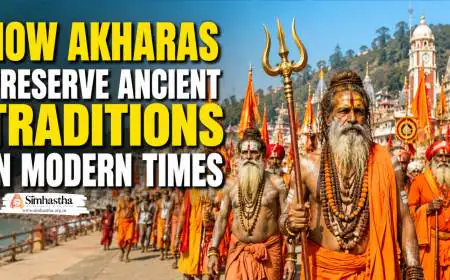
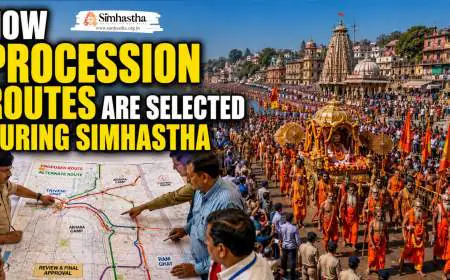
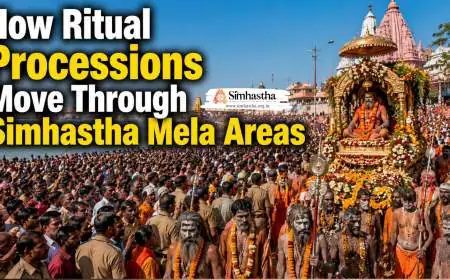
Before the Shahi Snan, there is the Peshwai, the spectacular ceremonial arrival and procession of the Akharas to the Mela grounds. These are not merely marches; they are statements of spiritual and temporal grandeur. When an akhara enters Ujjain for the Simhastha, it does so with the full pageantry of a royal court. The akhara’s presiding deity, riding on a magnificently decorated chariot or the back of an elephant, leads the procession. The mahant, the spiritual head, is often seated beneath a silver canopy, waving to devotees. Bands of musicians, often playing ancient, martial tunes on shehnais and nagaras, announce their coming.
The Naga sadhus, the fighting ascetics who are the akhara’s spiritual soldiers, perform mock charges, display their weapons—swords, spears, and tridents—and execute breathtaking physical feats. Horses, some decorated with vibrant Rajasthani or Maratha textiles, add to the cavalcade. The energy is one of proud, unapologetic spiritual chivalry. The Peshwai processions wind through the designated routes of the Mela area, and thousands of pilgrims line the streets to watch. It is a ritual that demonstrates the continued, vibrant authority of the monastic orders. To witness a Peshwai is to watch the living history of medieval India, the warrior-ascetic tradition, ride past you on horseback, its spirit undiminished after a thousand years. 🚩
Deep Daan and the Floating Lamps of Devotion
While the evening aarti on the main ghats is a communal event, the ritual of Deep Daan—the offering of a lamp—is often a deeply personal one. Throughout the evening and well into the night, you will see pilgrims, singly or in small family groups, crouching at the river’s edge, carefully lighting a small diya. This act is a prayer, and the nature of the prayer is known only to the devotee and the river. It could be a prayer for a son’s success, a thanksgiving for a healed body, or a wish for forgiveness for a personal failing.
The visual theology of this ritual is exquisite. The small flame represents the individual soul—fragile, flickering, but luminous. Placed upon the river, which represents the vast, flowing current of the divine, the soul is symbolically entrusted to God. To sit on a ghat step after the main aarti is over, in the relative quiet, and watch these small, silent flames drift slowly downstream under the stars is a meditative experience in itself. It is one of the most accessible rituals of the Simhastha; a clay lamp, some ghee, and a wick are all you need to join a tradition that links you to a million other souls who have offered their light to the Shipra over the centuries. 💡

The Parikrama and the Circumambulation of Sacred Geography
The Parikrama is the sacred circumambulation of a holy site, and during the Simhastha, pilgrims perform it on a grand scale. The most common parikramas involve walking the entire perimeter of the Mela ground or visiting specific clusters of temples in a prescribed order. Some pilgrims undertake the Panchkoshi Parikrama, an arduous walk that encompasses the entire sacred geography of Ujjain, often taking a full day or more. The act of walking is itself a ritual, a physical prayer made with the body.
You will see groups of pilgrims walking barefoot, their lips moving in constant chant. They carry small bundles on their heads, often containing offerings for the various shrines they will visit. The parikrama transforms the entire city into a temple. The route passes through ancient villages, ruined temples, and quiet stretches of the Shipra that most pilgrims never see. It is a reminder that the sacred is not confined to the crowded ghats but is diffused across the very landscape. For a pilgrim, participating in even a small part of a parikrama—perhaps walking the circuit from Ram Ghat to Mahakaleshwar-temple-entry-rules" class="contextual-link" data-post-id="470">The Mahakaleshwar Temple—is a way of inscribing the sacred geography onto your own body and memory. 🚶
The Role of Naga Sadhus and Ascetic Displays
The Naga sadhus are the living, breathing heart of the Simhastha’s most startling rituals. For the uninitiated pilgrim, their appearance can be a shock: men completely naked, their bodies thickly smeared with sacred ash, their hair in long, matted dreadlocks, and their foreheads marked with the red and yellow of their sect. Their rituals are public displays of a complete, radical renunciation of the world. They sit in circles around a dhuni, a sacred fire, even in the scorching heat, chanting mantras and smoking chillums as an offering to Shiva, not as a casual indulgence.
At specific times, they perform their yogic feats—standing on one leg for hours, raising their bodies on their hands in a levitation-like posture, or simply sitting in the padmasana with their eyes half-closed in deep meditation. To witness a Naga sadhu is to witness a man who has already undergone his own funeral rites, who has died to the world of taxes, families, and comforts, and who now lives as a representation of Bhairava, the fierce form of Shiva. Pilgrims seek their darshan, offer them fruits and cloth, and receive their blessings. The Naga’s raised hand, his muttered mantra, or simply his silent, ash-smeared presence is believed to be a direct conduit of Mahadev’s grace. 🔱
The Communal Chanting and the Soundscape of the Mela
The Simhastha is not just a visual spectacle; it is an aural immersion. The dominant ritual sound of the Mela is the massive, collective chanting of sacred mantras. At any time of the day or night, from the tent of a small village group to the massive pandal of a renowned guru, there is the unceasing, rolling thunder of the "Har Har Mahadev" chant. The call and response, often led by a charismatic sadhu, builds to a feverish pitch, a sonic wave that ripples out across the river and the camps. The chanting of the Hanuman Chalisa or the Sundara Kanda in massive groups is also a common and powerful ritual. Pilgrims gather by the thousands, sitting cross-legged on the ghats or in open fields, their combined voices creating a force field of devotion that is almost physically palpable. As a pilgrim, you do not need to know the words by heart. Simply sitting on the periphery, closing your eyes, and allowing the vibration to enter your body is a ritual of the highest order. This is sound used not as entertainment but as spiritual technology, a direct method to still the mind and awaken the heart. 🎶
The Distribution of Prasad and the Economy of Blessings
The ritual of Prasad, the offering of food that is first presented to a deity and then consumed by the devotee as a blessing, is the most universal ritual of the Simhastha. The massive community kitchens, or langars, run by various akharas, temples, and charitable organizations, are a spectacle in themselves. In vast, tented halls, volunteers ladle out a simple but delicious meal of khichdi, puri, and sabzi to a continuous, unbroken stream of pilgrims. Sitting in a long row on the ground, eating a communal meal that has been blessed by the presiding deity of that akhara, is a profound ritual of equality and surrender. The king and the beggar sit side by side, receiving the same food, for it is not charity; it is Mahaprasad, the grace of the Divine Mother. The distribution of sacred ash, vibhuti, and the holy water from the Shipra are also common. Pilgrims receive these sacred substances in their palms or on their foreheads with deep reverence, the material objects carrying an invisible, intangible blessing. ✅
The Silent Vows and Personal Moments of Grace
In the interstices of these grand, public rituals, the most personal ones take place. A woman ties a mouli, a sacred red thread, to a banyan tree on a ghat, her eyes squeezed shut in a prayer for a child. A young man offers his first paycheck at the feet of the Kal Bhairav deity. A couple lights incense at the temple of Harsiddhi Mata, their silence speaking the story of their marital bond. These are the rituals that pilgrims commonly witness but do not intrude upon. They happen at the edges of the Shahi Snan, in the quiet corners of the ghats at dawn, and in the shadows of the great temple shikharas. They are a reminder that the Simhastha is, ultimately, not just a collective event but an intimate conversation between a single soul and its Maker. As you walk through the Mela, keep your eyes open not just to the elephants and the Naga swords, but to these small, silent gestures. They are the truest expression of the pilgrim’s faith. 🙏
Frequently Asked Questions