
































Exploring the Spiritual Importance of Valmiki Ghat
Discover the spiritual importance of Valmiki Ghat in Ujjain. Walk the sacred ground where the sage meditated, the Ramayana was born, and the Shipra still whispers ancient stories.


The Sage and the River and the Birth of a Poet
To enter the spiritual landscape of Valmiki Ghat, one must first recall the life of the man who sanctified it. Valmiki was not born a sage. He began his life as Ratnakar, a feared highway robber who lived deep in the forests that once fringed the Shipra's course. According to the timeless legend, Ratnakar's encounter with the wandering sage Narada changed everything. Narada, unarmed and unafraid, confronted the robber with a single question: “For whose sake are you committing these sins? Will your family, for whom you rob and kill, share the burden of your karma?” When Ratnakar discovered that his wife and children would not, the foundation of his violent life crumbled. He fell at Narada's feet, and the sage instructed him to sit in one place and chant the name of Rama.
Ratnakar sat. He sat for years, so still that an anthill—valmika in Sanskrit—grew around him, encasing his body. From that anthill, the sage was reborn, and he took the name Valmiki. This act of complete stillness, this total dissolution of the old self and the birth of a new consciousness, is the spiritual bedrock upon which Valmiki Ghat rests. The ghat is not merely a place where Valmiki lived; it is the symbolic site of spiritual transformation itself, the place where a man's karma was not merely altered but utterly consumed, and where the first pure notes of divine poetry emerged from a heart that had known the darkest depths of human violence. 🔱
The First Verse and the Cry of Compassion
Tradition places the actual birth of the Ramayana at this very ghat. The story is deeply moving. Valmiki, now a sage, was walking along the banks of the river when he witnessed a hunter cruelly shoot down a pair of mating cranes. The surviving bird's cries of grief pierced the sage's heart. In that moment of intense empathic pain, a verse spontaneously poured from his lips, a perfect metrical couplet cursing the hunter for destroying the innocent love of the birds.
That unsought verse, born not of intellectual effort but of a heart broken open by compassion, became the first shloka of the Ramayana. Valmiki, the former robber who had caused so much suffering, had become a channel for the most profound literary and spiritual work of the age. At Valmiki Ghat, the pilgrim is invited to sit at the very edge of the Shipra where this is said to have occurred. To close one's eyes there is to try to imagine that moment: the flash of the hunter's arrow, the cry of the bird, and the sudden, unbidden rush of divine poetry that affirmed forever that karuna, compassion, is the truest source of sacred art. The spiritual importance of this ghat is thus anchored not only in penance but in the creative response to suffering, the transmutation of grief into the nectar of wisdom. 📖
Trending Guides Now

Ujjain Railway Station to Mahakaleshwar Temple Distance (2026 Guide)

Ujjain Simhastha 2028 Dates Announced: Full Shahi Snan & Event Timeline

Benefits of Becoming a Simhastha Volunteer

Ujjain Travel During Shravan Month: What Changes for Visitors

Mahakaleshwar Temple Entry Rules 2026: Dress Code, Mobile & Bag Policy

Bhasma Aarti at Mahakaleshwar Temple – Complete Pilgrim Guide

Why Ujjain Is One of the Four Kumbh Cities in India

Best Time to Visit Mahakaleshwar Temple Crowd And Weather Guide
A Sanctuary of Quietude and Inner Alchemy
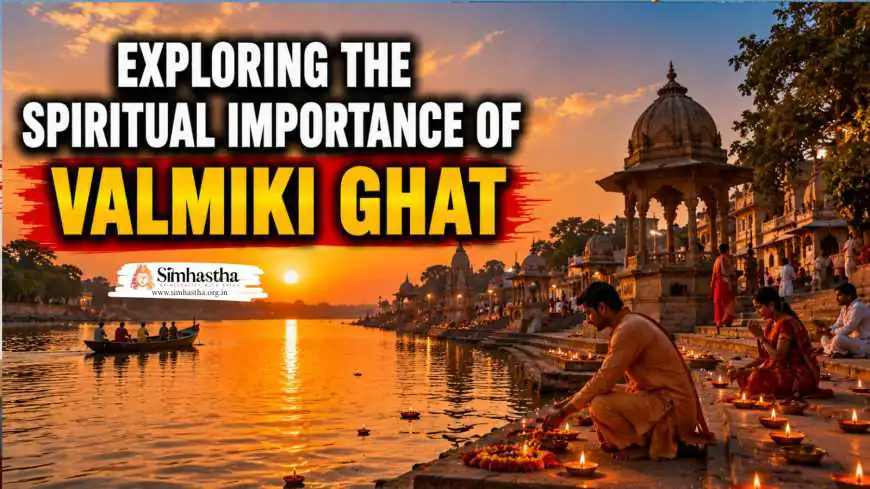
Unlike the bustling Ram Ghat where hundreds gather for the evening aarti, Valmiki Ghat remains, even today, a sanctuary of seclusion. The first thing the pilgrim notices upon arriving is the sheer, enveloping quiet. The sounds of Ujjain's traffic and temple commerce fade into a hush broken only by the soft lap of the Shipra against the stone steps, the rustle of leaves, and the occasional distant call of a temple bell. A small, simple temple dedicated to Valmiki stands a short distance from the river, its sanctum housing an image of the sage with his palm-leaf manuscript. The ghat itself is modest, the steps worn by the feet of those seekers who prefer silence to spectacle.
This atmosphere of deep quiet is not a lack; it is the ghat's primary spiritual offering. Valmiki attained his transformation through years of unmoving silence, and the place holds that archetypal energy. For the modern pilgrim—distracted, anxious, weighed down by a life that, like Ratnakar's, often feels driven by forces beyond their control—the ghat provides a literal and spiritual space to sit, to become still, and to allow the "anthill" of silence to grow around the chattering mind. The spiritual importance of Valmiki Ghat is, in a sense, its capacity to inspire inner stillness. It is a place where the devotee can taste, even for a few minutes, the profound alchemy that transformed a robber into a seer. Many come here not to perform a specific ritual, but simply to sit, to gaze at the river, and to let the quiet do its work on the soul. ✅
The Ritual of the Ramayana and the Power of the Word
While the ghat is known for silence, its most powerful "ritual" is the chanting and recitation of the Ramayana. There is no mandatory puja here, no elaborate offering list. Instead, pilgrims and sadhus often sit on the ghat steps or in the temple courtyard, reading aloud from the epic. The belief is that the verses of the Ramayana, when recited at the very site of their birth, carry a unique vibrational potency. The words, it is said, return to their source, and the merit of the recitation is magnified.
Devotees who have a specific wish or who are undergoing a difficult period in life might undertake a sankalpa to read a particular kanda of the Ramayana here. Some come to read the Sundara Kanda for courage and the overcoming of obstacles, or the Ayodhya Kanda for family harmony, or simply the Bala Kanda, which describes the birth of the epic's protagonist, to infuse a new beginning with grace. The very act of reading the Ramayana here becomes a conversation with the first poet, a way of sitting at the feet of Valmiki and receiving his transmitted wisdom. Even for those who cannot read Sanskrit or Awadhi, simply listening to the verses chanted by a priest or a sadhu in this place can be a deeply moving experience, a reminder that sound, when imbued with spiritual intention, is a vehicle of transformation.
Pind Daan and the Ancestral Connection
Like many of the sacred ghats along the Shipra, Valmiki Ghat is also a designated site for pind daan, the ritual offering to ancestors. The connection is thematically resonant. Valmiki's own life was a radical break with his past; he died to his old identity as Ratnakar and was reborn. Yet his story also embodies the profound continuity of spiritual lineage, the unbroken chain of guru and disciple that passes through Narada to Valmiki and, through the Ramayana, to all of humanity. Performing pind daan at a place so deeply associated with karmic release and transformation is considered especially auspicious. The pilgrim who offers pind here prays not only for the peace of their departed ancestors but also for the release of any lingering karmic debts that bind the family lineage, drawing on the powerful energy of the robber who was freed from the weight of his own terrible karma. 🚶
Valmiki Jayanti and the Annual Celebration of Poetry and Penance
The full moon of the Ashwin month, typically falling in October, marks Valmiki Jayanti, the birth anniversary of the sage, and the ghat comes alive with a different, yet still serene, energy. While the larger Ujjain Temples host grand festivities, the celebration at Valmiki Ghat retains a distinctly spiritual and literary flavour. Devotees gather to sing hymns in praise of the sage, to recite extended passages from the Ramayana, and to offer simple prayers. The temple is decorated with flowers, and a special abhishek of the Valmiki image is performed with milk and water.

During this time, the ghat becomes a meeting place for lovers of the Ramayana, scholars, and sadhus who spend the night in recitation and meditation. For a pilgrim who can time their visit to coincide with this festival, the experience is unforgettable. The quiet ghat, illuminated by small oil lamps, filled with the resonant chanting of the epic's verses under a full moon, becomes a living doorway into the world of Valmiki. The spiritual importance of the ghat is on full display, not as a historical abstraction, but as a living, breathing tradition that continues to inspire devotion and artistic expression. 🎭
Practical Guidance for the Seeker of Silence
Reaching Valmiki Ghat requires a small, intentional detour from Ujjain's main pilgrimage circuit, a journey that itself can be seen as a symbolic leaving-behind of the "highway" of conventional life. The ghat is located a short distance from the city center, easily accessible by auto-rickshaw. Most drivers will know the "Valmiki Mandir" or the ghat by name. The ride takes you through quieter, residential streets, and the transition from the commercial bustle to the riverside calm is palpable.
There are no entrance fees, no elaborate queue systems. The ideal time to visit is during the early morning hours, just after sunrise, when the river is bathed in golden light and the air is at its most still. Evenings are also beautiful, as the setting sun casts a peaceful glow over the water. Avoid the midday heat, as the ghat has limited shaded areas. Carry a simple offering if you wish: a garland of marigolds for the Valmiki image, a few incense sticks, and perhaps a copy of the Ramayana. Most importantly, carry the intention to be still. The ghat does not demand words; it invites presence. Sit on the steps. Close your eyes. Listen to the river. Let the story of Ratnakar and Valmiki, of the hunter and the crane, of the first poem and the second chance, wash over you. If you can, read a few verses aloud, let the sound mingle with the river's murmur. You may find, as countless pilgrims have before you, that the ghat gives you back something you did not know you had lost: a quiet mind, an open heart, and a renewed faith in the possibility of your own transformation. ✅
The Lasting Gift of the Adi Kavi
Beyond the rituals and the history, the spiritual importance of Valmiki Ghat offers a personal, timeless message. Valmiki's story is a radical testament to the truth that no human being is beyond redemption. If a feared murderer could become the adi kavi, the first poet of this civilization, if a heart hardened by cruelty could be softened into the vessel of the Ramayana's profound compassion, then what limits can the divine possibly set on our own transformation? The ghat is a place of profound hope. It whispers to the pilgrim who carries a burden of guilt, regret, or the sense of a wasted past, that the past is not destiny. The present moment of sincere turning, of genuine stillness, of an open heart, is the only reality. Valmiki's years of motionless chanting were not a punishment; they were a gestation. The ghat is a place to gestate a new self.
The next time you are in Ujjain, after you have sought the fierce protection of Kal Bhairav, offered your pen to Gadkalika, and sat in the cosmic hum of Mahakaleshwar-tatkal-bhasma-aarti-booking-guide" class="contextual-link" data-post-id="760">Mahakaleshwar, save a morning for Valmiki Ghat. Go alone. Carry nothing but your own story. Sit where the robber sat, where the poet sang, where the first tear of compassion fell into the Shipra and became a river of verse. And in that quiet, listen for the first word of your own unwritten poem, the one that begins where the old life ends. That is the gift of the Adi Kavi, and that is the spiritual importance of Valmiki Ghat. 🔱
Frequently Asked Questions