




























Why Narsingh Ghat Remains Unknown to Most Pilgrims
Discover why Narsingh Ghat remains unknown to most pilgrims in Ujjain. Explore its hidden location, quiet spirituality, and the reasons this peaceful Shipra riverbank escapes the tourist trail.


The Geography of Obscurity and a Ghat Without a Landmark
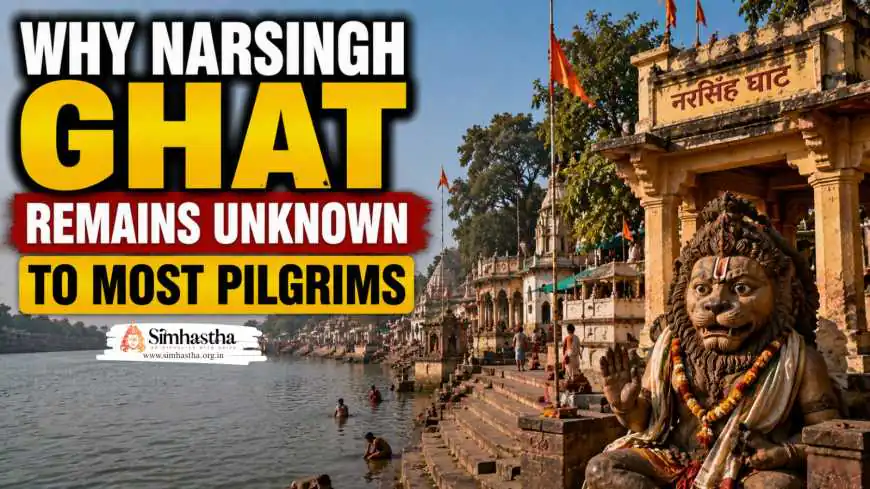
The primary reason for Narsingh Ghat's anonymity is its location. Ujjain's sacred geography is heavily clustered. The grand arc from Ram Ghat to the Mahakaleshwar Temple captures the overwhelming majority of pilgrim footfall. Narsingh Ghat lies outside this magnetic centre, tucked away in a quieter part of the city where the lanes narrow and the commercial buzz of pilgrimage fades into the rhythms of ordinary Ujjain life. It is not on the way to any major temple, nor is it a required stop in the standard one-day darshan circuit. It is a destination in itself, and in a city where pilgrims often have limited time and a long list of must-see shrines, a destination without a blockbuster attraction is easily skipped.
Furthermore, the ghat lacks a monumental visual anchor. Ram Ghat has its sweeping steps and evening lamps. Harsiddhi has its twin pillars of fire. Narsingh Ghat has a modest, ancient-feeling temple dedicated to Lord Narsingh (Narasimha), the fierce man-lion avatar of Vishnu. The temple, while deeply sacred, is architecturally humble. It does not soar above the treeline or demand to be photographed. The ghat steps are simple, often half-submerged in the river depending on the season, and there are no massive ceremonial gateways. In an age of visual culture, where pilgrim destinations are often chosen based on their Instagrammability, Narsingh Ghat’s modest beauty is its first and most effective screen. It filters out those who seek spectacle, admitting only those who seek stillness. 🚶
The Silence of the Half-Man, Half-Lion and the Missing Congregation
There is a profound irony in the obscurity of a ghat dedicated to Narasimha, one of the most dramatic and terrifying forms of the divine. The story of Narasimha—the man-lion who bursts from a pillar in a shower of splinters to destroy the demon Hiranyakashipu—is the very definition of divine intervention, a moment of cosmic violence that restores order. And yet, the ghat that bears his name is a sanctuary of peace. The small Narsingh Temple that overlooks the river is often empty, its sanctum holding a powerful image of the deity with his consort, Lakshmi. The priest, when present, is unhurried, and a devotee can sit undisturbed for long stretches, listening to the river and the distant sound of the city's bells.
The ghat's lack of a large, regular congregation also contributes to its unknown status. There are no daily aartis that draw a crowd, no prasad distribution lines, no queues. The ghat's spiritual rhythm is defined by individual, private worship rather than communal spectacle. This is not a failing of the place but its very essence. Narasimha's fierce grace is not a public performance; it is a personal, inner cataclysm, the destruction of the demons of ego. The ghat's silence, therefore, is a perfect setting for this kind of intimate encounter. But this very quality ensures that it remains hidden from the mass pilgrimage consciousness, which is trained to equate spiritual potency with visible activity and large numbers. Narsingh Ghat is the antithesis of this assumption, a place where spiritual power resides in the quiet, not in the crowd. 🔱
Trending Guides Now

Forgotten Stories and Legends Connected to Narsingh Ghat

Ujjain Railway Station to Mahakaleshwar Temple Distance (2026 Guide)

Ujjain Simhastha 2028 Dates Announced: Full Shahi Snan & Event Timeline

Benefits of Becoming a Simhastha Volunteer

Ujjain Travel During Shravan Month: What Changes for Visitors

Mahakaleshwar Temple Entry Rules 2026: Dress Code, Mobile & Bag Policy

Bhasma Aarti at Mahakaleshwar Temple – Complete Pilgrim Guide

Why Ujjain Is One of the Four Kumbh Cities in India
A History Submerged and the Myth That Whispers
The history of Narsingh Ghat is itself a quiet story, one that has not been aggressively promoted or documented in the way that the legends of the Mahakaleshwar or the Sapta Puri have been. There is a local tradition, passed down through the families that have lived in its vicinity for generations, that the ghat and its temple were once the heart of a significant settlement of Vaishnava ascetics. This community, dedicated to the worship of Vishnu in his fierce Narsingh form, maintained a rigorous routine of prayer and study, and the ghat was their secluded riverbank sanctuary. Over the centuries, as the political and spiritual centre of Ujjain shifted and the Shaiva traditions came to dominate the city's narrative, the Vaishnava presence here receded. The ghat did not fall into ruin, but it fell out of the main storyline.
This submersion of its own history is another key reason for its anonymity. Ujjain is so overwhelmingly defined by its association with Shiva—Mahakal, Omkareshwar, the 84 Mahadevas—that a shrine dedicated to Vishnu can feel almost invisible to the average pilgrim who arrives seeking the Jyotirlinga. The grand narrative of the city inadvertently overshadows this smaller, gentler story. Yet for the pilgrim who pauses, the ghat tells this story in its very stones. The architecture of the small temple shows signs of great age, with simple, weathered carvings that speak of an older time, a different aesthetic, and a spiritual tradition that once thrived in quiet strength. To sit here is to connect not just with the river, but with a forgotten lineage of devotees whose silent prayers still seem to hang in the air. 📜
The Pilgrim's Itinerary and the Cost of Time
Practical, unromantic as it may sound, time is a major factor in why Narsingh Ghat remains unknown. The standard Ujjain pilgrimage is intense, often packed into a single day. The pressure to secure darshan at Mahakaleshwar, navigate the queues at Kal Bhairav, and offer prayers at Harsiddhi consumes every available hour. Adding an out-of-the-way stop like Narsingh Ghat requires a conscious sacrifice of time and, often, a separate auto-rickshaw journey that deviates from the standard circuit. For pilgrims on a tight schedule, it becomes a question of triage, and a ghat with no major ritual attached to it is almost always the first to be cut.
The local auto-rickshaw drivers, who often double as informal tour guides, rarely suggest Narsingh Ghat. There is no commission to be earned, no shop selling expensive offerings nearby, no incentive for them to detour from the well-worn routes. The ghat exists in a kind of economic blind spot of the pilgrimage economy. It is not commercialised. There are no chai stalls hawking "Narsingh special tea," no vendors selling laminated photographs of the deity. This absence of commerce, while spiritually pure, is a significant factor in its obscurity. In a world where tourist footfall is often driven by a supporting infrastructure of shops and guides, Narsingh Ghat's purity becomes its obscurity. It is a place that does not sell itself. ✅
The Ghost of the Kumbh and Seasonal Visibility
During the Simhastha Kumbh Mela, when the entire city is transformed into a temporary megacity of faith, the famous ghats become the nodes of the largest human gathering on earth. Ram Ghat and the other central ghats are expanded, reinforced, and thronged by millions. Narsingh Ghat, despite its relative proximity, remains on the periphery. It is not designated as a major Shahi Snan site, and it does not receive the massive infrastructural upgrades that the primary ghats do. In a sense, the Kumbh, which is the ultimate advertisement for Ujjain's sacred spaces, actually deepens Narsingh Ghat's anonymity. The sheer gravitational pull of the major ghats during the Mela leaves the smaller ones like Narsingh completely eclipsed.
Yet, it is precisely during such times of hyper-activity that a ghat like Narsingh becomes a priceless refuge. A pilgrim overwhelmed by the crushing crowds and the ceaseless noise of the main Kumbh zone can slip away, find their way to this quiet bend in the river, and reclaim their sanity. The ghat serves as a spiritual decompression chamber, a place where the white-hot intensity of the Mela can be processed in silence. The irony is that this very function—being a sanctuary from the crowd—ensures that it is never part of the crowd's itinerary. It is known only to the residents of the surrounding neighbourhoods and to those rare pilgrims who have done their research or who have a serendipitous encounter with its quietude. 🌊

The Slippery Steps and the Unpolished Welcome
Let us be honest about the ghat's physical state. The steps of Narsingh Ghat are not the wide, even, freshly painted platforms of the more famous ghats. They are old, worn, and can be treacherously slippery, especially after the monsoon. There is no railing in many places, and the river's edge can be abrupt. For elderly pilgrims or those with mobility issues, navigating the ghat can be a challenge. This lack of accessibility, while not intentional, acts as a further filter. The ghat demands a certain level of physical capability and mindfulness, which, while rewarding, does not encourage mass visitation.
There is also the issue of basic amenities. There are no designated changing rooms, no filtered water stations, and no clean, well-maintained toilet blocks directly at the ghat. The absence of these conveniences, which the modern pilgrim has come to expect, keeps the casual visitor away. The ghat, in its current state, is best suited for the pilgrim who is comfortable with simplicity, who carries their own water, and who does not require a sanitized, curated experience. It is a raw, unfiltered encounter with the sacred, and this very rawness is both its greatest charm and the reason it remains on the fringes of the pilgrimage map. ⚠️
The Narsingh Connection and the Fierce Grace of Vishnu
To understand the spiritual significance of Narsingh Ghat is to understand the deity it houses. Narasimha is not a gentle god. He is the embodiment of divine rage channeled into protection, the ultimate proof that the cosmos will not tolerate the persecution of the innocent. For the devout, especially in the Vaishnava tradition, a visit to a Narsingh shrine is a powerful act of seeking protection from enemies, both inner and outer. The ghat's small temple is, therefore, a powerhouse of a very specific kind of spiritual energy—one that is not about bestowing boons of prosperity as much as it is about fiercely guarding the devotee's spiritual path.
But this fierce energy is not something that draws the casual tourist seeking a generic blessing. It is a specialized grace, sought by those who are engaged in a battle—literal or metaphorical—and who need the strength of the divine warrior. The obscurity of the ghat, in this context, is almost appropriate. Narasimha is a hidden god, one who appears only in the moment of dire need, erupting from a pillar where no one thought to look. His ghat, similarly, is a hidden place, waiting for the devotee who is desperate enough, or faithful enough, to seek it out. The privacy and silence of Narsingh Ghat are, in a way, the architectural expressions of Narasimha's own nature: concealed until invoked, powerful beyond measure, and unconcerned with public display. 🔱
The Solitary Pilgrim and the Reward of Seeking
There is a particular kind of pilgrim who finds Narsingh Ghat. They are not the ones ticking off a list of 84 Mahadevas in a single day. They are the ones who have an extra afternoon, who are travelling alone and asking questions of their hotel chowkidar, who see a narrow lane leading toward the river and follow it without a plan. The reward for this seeking is immense. At Narsingh Ghat, you will likely be alone, or in the company of a few local residents washing clothes or a sadhu sitting in meditation. The river here feels different—wider, slower, more reflective of the sky. The air is filled with the sound of water and birds, not commerce and clanging bells.
This is a place for the pilgrim to simply be. To sit without an agenda, to watch the river flow without feeling the pressure to move on to the next temple. In a city where the divine is often experienced in a state of high-intensity, communal fervour, Narsingh Ghat offers the divine as a gentle, personal presence. It is a reminder that not all of Ujjain's sacred spaces are about the roar of the crowd; some are about the whisper of the soul to itself. The ghat remains unknown not because it is unworthy, but because its worth is of a kind that the crowd does not seek. It is a hidden jewel, and like all true hidden jewels, it reveals its beauty only to those who take the time to look. ✅
The Living Silence and the Path Less Traveled
The greatest hidden symbol of Narsingh Ghat is not carved in stone; it is the living silence that pervades the place. It is a silence that has been cultivated, layer upon layer, by years of neglect and by the deep, quiet devotion of the few who come. It is a silence that speaks of Narasimha's power held in potent reserve, of a river that has seen empires rise and fall and now simply flows. It is a silence that is the rarest commodity in our modern world, and to sit in it is to be healed in ways that are difficult to articulate.
Why Narsingh Ghat remains unknown to most pilgrims is a question with many answers: geography, lack of spectacle, missing commerce, a fierce and hidden deity, and the simple, powerful allure of its silence. But perhaps the deepest answer is that it chooses to remain unknown. It is a place that protects its own peace. It is a sanctuary not for the masses, but for the one. And for that single pilgrim who arrives, weary and seeking, the ghat opens its quiet heart and offers a gift that the crowded temples cannot: the sacred, unbroken stillness of a riverbank where the man-lion sleeps with one eye open, guarding all who sit at his feet. 🛕🔱
Frequently Asked Questions