


























Forgotten Stories and Legends Connected to Narsingh Ghat
Discover forgotten stories and legends connected to Narsingh Ghat—from Lord Narasimha's fierce protection to martyrs' temples and ancient Shipra River mysteries. Explore Ujjain's hidden ghat.



Forgotten Stories and Legends Connected to Narsingh Ghat
Have you ever walked past a place so quiet, so unassuming, that you almost missed it entirely—only to discover later that it holds some of the most powerful stories in all of Hindu mythology? 🦁
Welcome to Narsingh Ghat in Ujjain—the forgotten ghat that hides in plain sight along the sacred Shipra River. While millions of pilgrims flock to the grand Ram Ghat and the towering Mahakaleshwar Temple, this modest stretch of stone steps remains largely unknown to most visitors.
But here's the paradox: Narsingh Ghat is named after one of the most terrifying and awe-inspiring forms of the divine—Lord Narasimha, the half-man, half-lion avatar of Vishnu who burst from a pillar to destroy a demon king. The ghat carries an energy of fierce protection, courage, and the destruction of evil forces. And yet, it is a sanctuary of peace.
The forgotten stories and legends connected to Narsingh Ghat weave together mythology, history, patriotism, and mystery. From the cosmic battle between good and evil to a temple dedicated to martyred soldiers, from a 2,500-kilogram mercury Shivalinga to the quiet whispers of Prahlada's devotion—this ghat holds layers of meaning that most pilgrims never discover.
Trending Guides Now
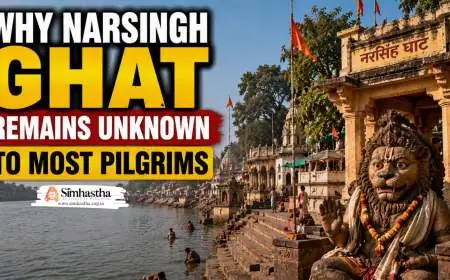
Why Narsingh Ghat Remains Unknown to Most Pilgrims

Ujjain Railway Station to Mahakaleshwar Temple Distance (2026 Guide)

Ujjain Simhastha 2028 Dates Announced: Full Shahi Snan & Event Timeline

How ISKCON Ujjain Engages Young Devotees Through Programs

Benefits of Becoming a Simhastha Volunteer

Mahakaleshwar Temple Entry Rules 2026: Dress Code, Mobile & Bag Policy

Bhasma Aarti at Mahakaleshwar Temple – Complete Pilgrim Guide

Why Ujjain Is One of the Four Kumbh Cities in India
Let me take you on a journey through the hidden stories of Narsingh Ghat—the legends that time forgot, the heroes it honors, and the mysteries it still guards. 🌊🔱
🦁 The Cosmic Legend: When the Man-Lion Emerged from a Pillar
The Boon That Shook the Universe
To understand Narsingh Ghat, you must first understand the legend of Narasimha—one of the most dramatic and terrifying stories in Hindu mythology.
According to the Bhagavata Purana, the demon king Hiranyakashipu had obtained a boon that made him nearly indestructible. He could not be killed:

Armed with this invincibility, Hiranyakashipu terrorized the three worlds. He forbade the worship of Lord Vishnu and demanded that everyone worship him instead.
The Devotee Who Would Not Bow
But Hiranyakashipu had a problem: his own son, Prahlada. Despite being born to a demon king, Prahlada was a devoted worshipper of Lord Vishnu. No amount of torture, threats, or cajoling could shake his faith.
Prahlada's devotion was unshakable. He argued with his father. He endured brutal punishments. He refused to bow. And he kept chanting the name of Vishnu.
The Moment of Divine Fury
Finally, Hiranyakashipu's patience ran out. In a fit of rage, he pointed to a pillar in his courtyard and demanded: "If your Vishnu is everywhere, is he in this pillar?"
Prahlada calmly replied: "Yes, my Lord is everywhere."
Enraged, Hiranyakashipu smashed the pillar with his mace.
And then—it happened.
From the shattered pillar emerged Lord Narasimha—neither fully man nor fully animal, with the body of a man and the head of a lion. His eyes were blazing. His fangs were sharp. His roar shook the universe.
The Twilight Execution
At twilight—neither day nor night—on the threshold of the courtyard—neither indoors nor outdoors—Lord Narasimha grabbed Hiranyakashipu and tore him apart with his lion claws.
No weapon was used. No rule was broken.
The demon king was dead. Dharma was restored. And Prahlada was saved.
The Fierce Energy That Remains
The fierce energy of that divine protection is believed to reside at Narsingh Ghat. This is not a ghat of gentle blessings or serene meditation—it is a place of fierce protection, where devotees come seeking:
-
Freedom from fear and phobias
-
Relief from enemies and obstacles
-
Protection from persecution and oppression
Devotees who visit this ghat come seeking the powerful protective blessings of the man-lion god.
The Washing of Divine Hands
One of the most cherished local legends is that Lord Narasimha washed his hands here after killing the demon Hiranyakashipu. The sacred waters of the Shipra River are believed to have cleansed the divine hands that had just destroyed evil.
This is why pilgrims stop at Narsingh Ghat for a holy bath before offering prayers at the nearby Narsingh Temple. The holy dip at this ghat is believed to wash away fears, phobias, and the karmic seeds of past wrongdoings that may have manifested as enemies or obstacles in one's life.
🏛️ The Temple That Time Forgot: Narsingh Mandir
The Humble Sanctuary
Unlike the towering spires of Mahakaleshwar or the dramatic pillars of Harsiddhi, the Narsingh Temple that overlooks the ghat is architecturally humble. It does not soar above the treeline. It does not demand to be photographed.
But what it lacks in grandeur, it makes up for in spiritual intensity.
The temple houses a striking idol of Lord Narasimha in his Ugra (fierce) form. The idol typically shows Narasimha with:
-
Lion face with wide eyes
-
Sharp fangs and blazing expression
-
Multiple arms holding various divine weapons
The Quiet Devotion
The small Narsingh Temple that overlooks the river is often empty. The priest, when present, is unhurried. A devotee can sit undisturbed for long stretches, listening to the river and the distant sound of the city's bells.
There are no daily aartis that draw a crowd. No prasad distribution lines. No queues. The ghat's spiritual rhythm is defined by individual, private worship rather than communal spectacle.
This is not a failing of the place but its very essence. Narasimha's fierce grace is not a public performance; it is a personal, inner cataclysm—the destruction of the demons of ego.
The Auspicious Days
The most auspicious day to visit Narsingh Ghat is Narasimha Chaturdashi, which falls on the fourteenth day of the bright fortnight in the month of Vaishakha (April-May). This day celebrates the appearance of Lord Narasimha and sees thousands of devotees gathering at the ghat for special pujas, abhishekams, and night-long prayers.
Thursdays, dedicated to Lord Vishnu and his incarnations, are also considered highly favorable for worship at this ghat.
🇮🇳 The Temple of Martyrs: Bharat Sevak Mandir
An Unprecedented Tribute
One of the most extraordinary and forgotten stories connected to Narsingh Ghat is the presence of the Bharat Sevak Temple—a temple dedicated not to gods or goddesses, but to martyrs and national heroes.
Located near Narsingh Ghat, this unique temple has idols of around 50 martyrs, and beneath these idols are written their tales of courage.
The Vision of Dan Singh Chaudhary
The temple was established in 2008 by Dan Singh Chaudhary, a retired district court judge who used his retirement funds to build it. He was inspired by Guru Narsinghanand Maharaj.
The temple honors 21 Param Vir Chakra awardees, along with freedom fighters, sports personalities, artists, educators, and politicians who have made exceptional contributions to the nation.
A Living Memorial
The Bharat Sevak Temple is not just a religious site, but a vibrant symbol of patriotism, respect, and inspiration. It reminds visitors that heroism and sacrifice are forms of worship too.
The temple conducts daily aarti—not once, but twice a day—honoring those who laid down their lives for the nation. This is perhaps one of the only temples in India where martyrs are worshipped alongside deities.
A Story That Deserves to Be Told
While millions visit Ujjain for Mahakal Darshan, very few know about this extraordinary tribute to India's heroes. The Bharat Sevak Temple at Narsingh Ghat stands as a quiet reminder that the spirit of sacrifice and service is as sacred as any divine power.
🔱 The Pardeshwar Mahadev Temple: A Modern Marvel
The Largest Mercury Shivalinga in the World
Another fascinating story connected to Narsingh Ghat is the Pardeshwar Mahadev Temple, located on the ghat itself.
This temple houses a dazzling mercury (parad) Shivalinga that weighs 2,500 kilograms—the largest of its kind in the world. Some sources mention a 1,500 kg Shivalinga brought from China, while others confirm the 2,500 kg figure for the mercury linga.
The Siddha Ashram Connection
The Pardeshwar Mahadev Temple is part of the Siddha Ashram, located on the banks of the Shipra River between Ram Ghat and Narsingh Ghat. The ashram was established in 2004 and has become a significant spiritual center in Ujjain.
A Unique Spiritual Experience
Visiting the Pardeshwar Mahadev Temple offers a unique spiritual experience—the massive mercury Shivalinga is believed to have powerful healing and spiritual properties. Devotees come here to perform Rudrabhishek and seek blessings for peace and prosperity.
🌊 The Shipra River: The Sacred Witness
The River That Washes Away Sins
The Shipra River—also known as the Kshipra—is considered the "Ganga of Malwa" and occupies a prominent place in Hindu religion. It is one of the four rivers believed to possess the "nectar of immortality" .
A holy dip in the Shipra during the Simhastha Kumbh Mela is believed to free a soul from the cycle of rebirth and death and help humans attain salvation.
The Legend of the River's Origin
According to ancient texts, the Shipra River originated from the heart of Varaha—Lord Vishnu's incarnation as a boar. Another legend says that Lord Shiva cut Lord Vishnu's finger with his trident, and the flow of blood became the Shipra River.
These stories connect the Shipra River to the very essence of divine energy—making Narsingh Ghat, which sits on its banks, a doubly sacred location.
A River in Distress
The Shipra River also carries a sadder story. Despite its sacred status, the river faces severe pollution from sewage and industrial waste. During the Kumbh Mela, the ghats—including Narsingh Ghat—are bursting with pilgrims, but the river's health remains a growing concern.
🏕️ The Simhastha Connection
A Gathering of Millions
Every 12 years, the Simhastha Kumbh Mela takes place on the banks of the Shipra River. During this massive religious gathering, Narsingh Ghat becomes a special gathering point for Vaishnava sadhus and pilgrims who prefer Vishnu-aligned bathing spots over the more Shaiva-dominated ghats of Ujjain.
The Fresh Mural
During the 2016 Kumbh Mela, Narsingh Ghat sported a fresh mural—a visual reminder that even the forgotten ghat comes alive during the festival.
A Quieter Alternative
While Ram Ghat becomes overwhelmingly crowded during Simhastha, Narsingh Ghat remains relatively quieter than the bustling main ghats, allowing for more focused and uninterrupted prayer. For those seeking a spiritual experience away from the chaos, Narsingh Ghat offers a peaceful alternative.
🌌 The Mystery of the Underground Passage
A Forgotten Tunnel
One of the most intriguing forgotten stories connected to Narsingh Ghat involves a subterranean passage.
According to certain historical accounts, there is a well or underground passage near the ghat that was dug by Hanuman himself. Some say this is not a well but a subterranean passage that leads under the sea to the city of Ujjain.
The King Who Ruled from Below
This underground passage is said to lead to the kingdom of a ruler named Bikrami—a legendary figure associated with Ujjain's ancient history.
While historical evidence for this tunnel remains scant, the story persists in local lore—a reminder that Narsingh Ghat holds secrets that have not yet been fully uncovered.
🕊️ The Quiet Wisdom of the Ghat
Why Narsingh Ghat Remains Unknown
The primary reason for Narsingh Ghat's anonymity is its location. Ujjain's sacred geography is heavily clustered around Ram Ghat and Mahakaleshwar Temple. Narsingh Ghat lies outside this magnetic centre, tucked away in a quieter part of the city where the lanes narrow and the commercial buzz of pilgrimage fades into the rhythms of ordinary Ujjain life.
It is not on the way to any major temple. It is not a required stop in the standard one-day darshan circuit. It is a destination in itself—and in a city where pilgrims often have limited time and a long list of must-see shrines, a destination without a blockbuster attraction is easily skipped.
The Silence of the Half-Man, Half-Lion
There is a profound irony in the obscurity of a ghat dedicated to Narasimha—one of the most dramatic and terrifying forms of the divine. The story of Narasimha is the very definition of divine intervention, a moment of cosmic violence that restores order.
And yet, the ghat that bears his name is a sanctuary of peace.
A Perfect Setting for Intimate Encounter
The ghat's silence is not a failing but its very essence. Narasimha's fierce grace is not a public performance; it is a personal, inner cataclysm—the destruction of the demons of ego.
Narsingh Ghat is the antithesis of the assumption that spiritual potency requires visible activity and large numbers. It admits only those who seek stillness.
🙏 Final Thoughts: The Ghat That Guards Its Secrets
Forgotten stories and legends connected to Narsingh Ghat are not just tales from a distant past—they are living truths that continue to shape the spiritual landscape of Ujjain.
From the cosmic battle between Narasimha and Hiranyakashipu to the quiet devotion of Prahlada, from the heroic martyrs honored at Bharat Sevak Temple to the massive mercury Shivalinga at Pardeshwar Mahadev, from the mysterious underground passage to the sacred waters of the Shipra—every stone, every step, every ripple at Narsingh Ghat tells a story.
And yet, most pilgrims never hear these stories. They walk past the ghat's modest steps, unaware that they are passing by a place where divine protection, national sacrifice, and cosmic mystery converge.
Narsingh Ghat does not demand attention. It does not seek fame. It simply waits—patiently, quietly—for those who are ready to discover its secrets.
So the next time you visit Ujjain, take a detour from the crowded Ram Ghat and the majestic Mahakaleshwar Temple. Walk the quiet lanes to Narsingh Ghat. Sit on its humble steps. Listen to the river. And let the forgotten stories find you. 🦁🌊🙏
Frequently Asked Questions