































Ancient Teaching Methods Used at Sandipani Ashram Explained
Ancient teaching methods used at Sandipani Ashram explained—from the 64 arts in 64 days to Gurukul system, Ankpat stone, and Vidyarambh rituals. Discover Krishna's school.
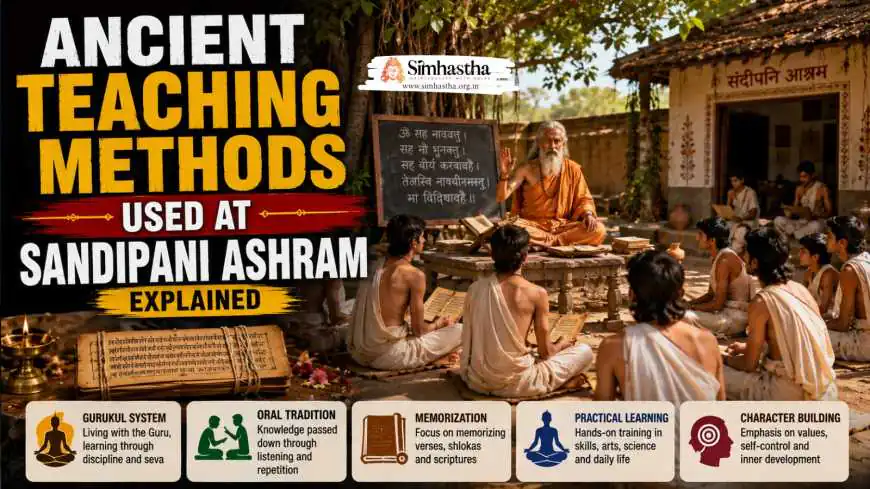


Ancient Teaching Methods Used at Sandipani Ashram Explained
Imagine a school where students master 64 different arts in just 64 days. Where the teacher carves numbers into stone to teach mathematics. Where divine beings sit alongside humble mortals, learning the same scriptures under the same ancient tree. 🌳📚
Welcome to Sandipani Ashram in Ujjain—the world's first Gurukul and the sacred school where Lord Krishna, his brother Balram, and his dearest friend Sudama received their education under the guidance of the enlightened sage Maharishi Sandipani.
Nestled on the banks of the sacred Kshipra River, just 6 kilometers from Ujjain Junction, this ancient ashram represents one of the most sophisticated educational systems ever devised by humanity. The ancient teaching methods used at Sandipani Ashram were not merely about transferring information from teacher to student. They were about transforming the whole person—body, mind, and spirit—through a holistic system that has inspired educators for over 5,000 years.
Let me take you inside this living laboratory of ancient wisdom and explain exactly how education happened at one of India's most legendary centers of learning. 🕉️✨
Trending Guides Now
What Students Can Learn From Sandipani Ashram Today
Life Lessons Modern Students Can Learn From Sandipani Ashram
How Gurukul Education Worked at Sandipani Ashram

Fascinating Facts About Lord Krishna's Education in Ujjain

Ujjain Railway Station to Mahakaleshwar Temple Distance (2026 Guide)

Ujjain Simhastha 2028 Dates Announced: Full Shahi Snan & Event Timeline

How ISKCON Ujjain Engages Young Devotees Through Programs

Benefits of Becoming a Simhastha Volunteer
🏛️ The Gurukul System: The World's First Residential University
A School Like No Other
Before we dive into the specific methods, you need to understand the big picture. Sandipani Ashram was a Gurukul—a residential school where students lived with their teacher, absorbing knowledge not just through lessons but through every moment of daily life.
Sandipani Ashram is known as the world's first Gurukul. Students didn't just attend classes and go home. They lived in the ashram, ate food prepared in the community kitchen, slept under the same roof, and participated in daily rituals alongside their guru.
The Divine Student Body
What makes this Gurukul truly extraordinary is its student body. According to Hindu scriptures, Lord Krishna, Balram, and Sudama all studied here together. The ashram finds mention in the Mahabharata and is considered an important center of learning at the beginning of the Mahabharata period.
Krishna and Balram traveled from Mathura to Ujjain specifically to begin their formal education under Rishi Sandipani. This was not a casual decision—it reflects the extraordinary reputation of Sandipani Ashram as a center of excellence.
The Ashram Complex
The ashram complex is huge with vast stretches of land. It includes:
-
The main shrine of Guru Sandipani

-
Idols of Lord Krishna, Balram, and Sudama reminding visitors of the deep bond between teacher and disciple
-
Sarveshwar Mahadev Temple housing a 6,000-year-old Shivlinga with a natural depiction of Sheshnaag
-
The sacred Gomti Kund (water tank)
-
The Ankpat area where Krishna washed his writings

📚 The Curriculum: 14 Vidyas and 64 Arts in 64 Days
The 64-Day Miracle
The most extraordinary aspect of the teaching methods at Sandipani Ashram is the legend of the 64 days.
According to ancient scriptures, Lord Krishna mastered 14 Vidyas (sciences) and 64 Kalās (arts) in just 64 days—one art per day. This feat is considered a divine miracle, demonstrating both Krishna's omniscience and the extraordinary effectiveness of Guru Sandipani's teaching methods.
The 64 Arts (Kalās) in Detail
The 64 arts Krishna mastered included:
| Category | Examples |
|---|---|
| Spiritual Sciences | Vedas, Upanishads, Dharmaśāstra |
| Warfare | Archery, swordsmanship, military strategy |
| Creative Arts | Music, dance, painting, sculpture |
| Intellectual Arts | Logic, grammar, astronomy, mathematics |
| Practical Skills | Medicine (Ayurveda), elephant training, horse training |
| Fine Arts | Poetry, drama, story-telling |
According to the Srimad Bhagavatam, the curriculum included all the Vedas, the art of drawing, astronomy (Jyotiṣa), Gandharva Veda (music and arts), medicine (Ayurveda), training elephants and horses, and archery
The 14 Sciences (Vidyas)
The 14 Vidyas included:
-
Four Vedas: Rig, Yajur, Sama, Atharva
-
Six Vedangas: Śikṣā (phonetics), Kalpa (rituals), Vyākaraṇa (grammar), Nirukta (etymology), Chandas (prosody), Jyotiṣa (astronomy)
-
Dharmaśāstra: Law and ethics
-
Mīmāṃsā: Interpretation
-
Nyāya: Logic
-
Purāṇas: Ancient histories
Some traditions specify that Krishna learned 4 Vedas in 4 days, 6 Shastras in 6 days, and 16 Puranas in 16 days
🪨 The Teaching Tools: From Stone to Story
The Numbered Stone: Ancient Mathematics
One of the most fascinating artifacts at Sandipani Ashram is a stone on which numbers from 1 to 100 are engraved.
This stone is believed to have been marked by Guru Sandipani himself, showcasing the ancient methods of teaching practised here.
What does this tell us about ancient teaching methods?
-
Visual learning: Numbers were carved into stone so students could see and touch mathematical concepts
-
Permanent reference: The stone served as a textbook that all students could refer to
-
Hands-on practice: Students could trace the numbers with their fingers, engaging multiple senses in the learning process
This stone is a physical testament to the practical, experiential nature of education at Sandipani Ashram.
Ankpat: Where Krishna Washed His Writings
The area near the ashram is known as Ankpat—a place believed to have been used by Lord Krishna to wash his writings.
Ankpat literally translates to "where numbers (ank) fall (pat)" . This sacred spot reveals several aspects of ancient teaching methods:
-
Writing practice: Students were actively engaged in writing and practicing their lessons
-
Purity rituals: The washing of writings may have been a ritual purification of knowledge
-
Discipline: Students were expected to care for their learning materials
The Ancient Peepal Tree
Every visitor to Sandipani Ashram bows first at the ancient Peepal tree, honoring the unseen lineage of teachers who have kept knowledge alive since time immemorial. This tree is a living symbol of the continuity of the Guru-Shishya tradition.
🙏 The Guru-Shishya Relationship: The Heart of Ancient Education
Beyond Information Transfer
The Guru-Shishya relationship was the cornerstone of education at Sandipani Ashram. Guru Sandipani was not just a teacher—he was a spiritual guide who shaped Krishna's human experience
What Krishna Said About His Guru
According to legend, Krishna once said: "The Guru is greater than even the parents, for he gives the knowledge that leads to liberation."
This profound respect for the teacher was not just lip service. It was the foundation of the entire educational system.
The Ideal Student
Balram and Krishna were ideal students, always eager to learn and please their guru. With all humility, they completed their studies quickly. Despite being the incarnation of Vishnu, Krishna lived like any other disciple—obedient, humble, and devoted to his guru
The Guru-Dakshina Tradition
When Krishna and Balram completed their education, they asked Sandipani what he would like as Guru-Dakshina (teacher's fee). This tradition—where students offer something of value to their teacher as a sign of gratitude—was an essential part of the Gurukul system.
According to one legend, Guru Sandipani's only son was lost to the sea. Krishna and Balram, as their Guru-Dakshina, went to find and return him—demonstrating that the highest form of gratitude is service.
🌊 Gomti Kund: Sacred Waters for Sacred Learning
The Miracle of the Water Tank
The Gomti Kund is a sacred stepped tank located within the ashram. According to legend, Lord Krishna summoned waters from all the holy rivers of India into this tank to make it convenient for his guru to perform rituals.
The Practical Purpose
Beyond the miracle, the Gomti Kund served a practical educational purpose:
-
Source of water supply for the ashram in ancient times
-
Ritual purification before and after studies
-
Community gathering space for teaching and discussion
The Shunga Period Nandi
An image of Nandi near the pond dates back to the Shunga period (185-73 BCE) , confirming the ashram's ancient lineage
🕯️ The Living Tradition: Vidyarambh Sanskar
The Initiation into Learning
One of the most beautiful legacies of Sandipani Ashram's teaching methods is the Vidyarambh Sanskar—the ritual initiation into learning.
Vidyarambh is among the 16 major Hindu rituals (Samskaras), marking the child's first step into learning.
The Basant Panchami Ceremony
On the auspicious occasion of Basant Panchami, a traditional Vidyarambh Sanskar is conducted at Sandipani Ashram. Devotees from across the country gather to initiate their children into learning through this sacred ritual.
As part of the ritual, young children are guided to write the sacred mantras "Shri Ganeshaya Namah" and "Shri Saraswatyai Namah" .
The Guru Purnima Tradition
Similar rituals are also performed during Guru Purnima, where children receive their first lesson in culture and education
A special puja is performed at the ashram, followed by the consecration of Lord Krishna, Balarama, and Sudama's idols
The Educational Symbolism
The fact that Vidyarambh continues to be performed at Sandipani Ashram today is a testament to the enduring power of its ancient teaching methods. The ashram is not just a museum—it is a living educational tradition.
🏛️ The Architectural Evidence: What the Stones Tell Us
The Shrine of Guru Sandipani
At the heart of the ashram, you will find the shrine of Guru Sandipani, alongside idols of Lord Krishna, Balarama, and Sudama. This arrangement—with the guru at the center and students flanking him—reflects the hierarchical respect that defined the Gurukul system.
The Sarveshwar Mahadev Temple
The Sarveshwar Mahadev Temple houses a 6,000-year-old Shivlinga with a natural depiction of Sheshnaag. According to belief, this Shivlinga was worshipped by Guru Sandipani and his disciples—confirming that spiritual practice was an integral part of daily life.
The Vallabh Sect Connection
Followers of the Vallabh sect consider this place as the 73rd seat out of the 84 seats of Vallabhacharya where he gave his discourses across India. This confirms the ashram's importance as a center of learning across multiple traditions.
🧠 The Educational Philosophy: What Made It Work
Holistic Development
The ancient teaching methods used at Sandipani Ashram were designed for holistic development:
-
Physical: Warfare training, archery, horse riding
-
Intellectual: Vedas, logic, astronomy, mathematics
-
Creative: Music, dance, painting, poetry
-
Spiritual: Meditation, rituals, ethical living
-
Social: Community living, service, friendship
Experiential Learning
Unlike modern education that often emphasizes memorization, the Gurukul system emphasized experiential learning:
-
Students lived what they learned
-
They practiced skills daily
-
They observed their guru's example
-
They participated in community rituals
Individualized Attention
With a small student-to-teacher ratio, Sandipani could provide individualized attention to each student. The fact that Krishna mastered 64 arts in 64 days—one art per day—suggests a highly structured, personalized curriculum.
Moral and Ethical Foundation
Education was not just about acquiring skills—it was about building character. The stories of Sudama's friendship, Krishna's humility, and the Guru-Dakshina tradition all emphasize moral and ethical values.
🌟 The Legacy: Why These Methods Still Matter
The World's First Gurukul
Sandipani Ashram is known as the world's first Gurukul—and its methods have influenced educational systems across the globe for millennia.
A Model for Modern Education
The ancient teaching methods used at Sandipani Ashram offer lessons that are remarkably relevant today:
-
Holistic education over narrow specialization
-
Experiential learning over passive listening
-
Teacher-student relationships over impersonal instruction
-
Moral and ethical foundation over pure technical training
-
Community living over isolated learning
A Living Tradition
Today, Sandipani Ashram stands as a symbol of traditional education and spiritual learning It continues to attract visitors seeking divine inspiration and a profound connection to India's incredible spiritual heritage
💫 Final Thoughts: The Eternal School
Ancient teaching methods used at Sandipani Ashram were not merely pedagogical techniques—they were a complete way of life. From the numbered stone that taught mathematics through touch to the Gomti Kund that provided water for ritual purification, from the 64 arts in 64 days to the Guru-Dakshina tradition of service—every aspect of education at Sandipani Ashram was designed to create complete human beings.
When you visit Sandipani Ashram, you are not just visiting a historical site. You are walking through a living classroom—a place where the divine and the human studied together, where friendship and learning were inseparable, and where wisdom was not just taught but lived.
The stones still bear the numbers Guru Sandipani carved. The Gomti Kund still holds sacred waters. The ancient Peepal tree still stands as a silent witness to millennia of teaching and learning.
And somewhere, in the quiet of the morning, you can still hear the echoes of Krishna's laughter, Sudama's devotion, and the guru's timeless teachings. 🕉️📚✨
Frequently Asked Questions