


















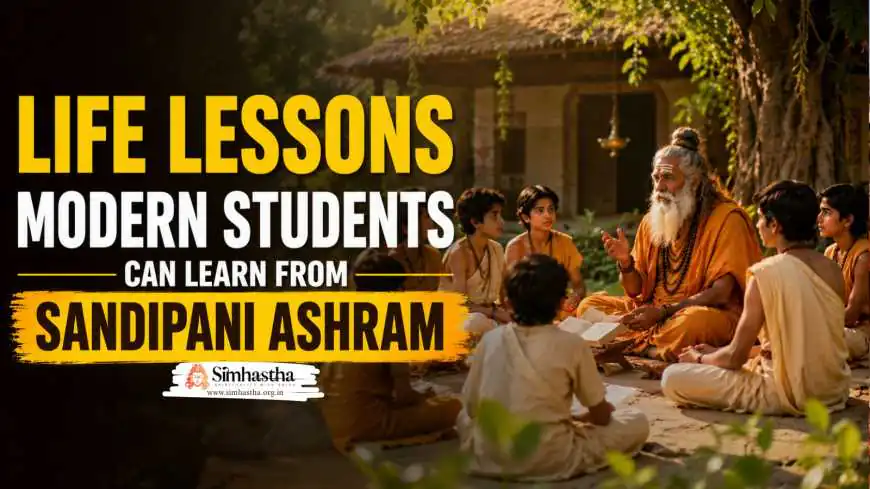
Life Lessons Modern Students Can Learn From Sandipani Ashram
Discover timeless life lessons modern students can learn from Sandipani Ashram. From the guru-shishya bond and the value of simplicity to holistic learning and true friendship, explore the ancient wisdom of Ujjain's sacred gurukul.


The Lesson of the Embodied Teacher and the Sacred Guru-Shishya Bond
The first and most profound lesson of Sandipani Ashram is that education is not a transaction; it is a sacred, transformative relationship. In the modern world, a teacher is often reduced to a service provider, a content-delivery mechanism whose success is measured by the marks their students achieve in a standardized test. At Sandipani's gurukul, the guru was the very heart of the learning process, a living, breathing embodiment of the wisdom he taught. The students, Krishna and Sudama among them, did not just listen to lectures; they lived with their teacher. They observed him in the quiet, unguarded moments of daily life. They saw how he woke before dawn, how he performed his ablutions with a mindful, sacred precision, how he tended the sacred fire with a reverence that was both ancient and deeply personal, and how he spoke to every creature, from the youngest child to the oldest cow, with a gentle, unwavering respect. This constant, immersive exposure to a fully realized human being was the core curriculum. The lesson for the modern student is clear: seek mentors, not just tutors. Find the teacher whose life you would want to emulate, not just the one with the best crash-course notes. The quality of the teacher's own inner stillness, their own integrity, and their own lived wisdom is the invisible, powerful curriculum that shapes the soul far more deeply than any textbook ever can. The bond of trust, reverence, and personal connection between the guru and the shishya is not a sentimental relic of a bygone era; it is the most powerful and efficient educational technology ever devised, and its loss in the modern, transactional classroom is a quiet, unacknowledged tragedy. 🙏
Service as the Foundation of Learning and the Humility of Chores
At Sandipani Ashram, no student, not even the Lord of the Universe himself, was exempt from the daily, humble chores that were an integral part of the curriculum. Krishna, the supreme avatar who held the entire cosmos within his divine form, was sent into the forest by his guru to collect firewood. He and Sudama, barefoot, their simple dhotis tied at their waists, would walk the ancient paths, gathering the dry, fallen branches that would feed the sacred dhuni. This was not a punishment or a menial task; it was a profound, embodied lesson in seva, in selfless service, and in the radical, spiritual equality of all honest labour. The modern educational system, with its relentless focus on individual achievement, on being "the best," "the topper," and "the winner," often breeds a subtle, unspoken arrogance and a deep disdain for physical, manual work. The young student who is shielded from all household chores, who has never washed a plate or cleaned a floor, is being denied a fundamental human education. They are being raised to believe that their intellectual work is somehow superior to the labour that sustains their very life. The lesson from Sandipani is clear and humbling: there is no knowledge without humility, and there is no genuine humility without the willingness to serve. The simple, rhythmic acts of sweeping the ashram floor, fetching water from the river, and caring for the guru's cows were not distractions from learning; they were the very soil in which the seeds of wisdom could take root. They taught the student to ground their lofty thoughts in the tangible, physical reality of the world, to respect the dignity of all work, and to understand that true leadership is, first and always, a form of humble, loving service. 🧹
The Curriculum of the Complete Human and Education Beyond the Textbook
The syllabus that Sandipani Muni taught was breathtakingly holistic. It was a curriculum designed not to produce a narrow specialist but a complete, integrated, and fully realized human being. The modern world, with its pressure to specialize early and to view education solely as a pipeline to a career, has lost this magnificent, civilizational vision. At the gurukul, Krishna and Sudama studied the Vedas and the Upanishads, the foundational scriptures of spiritual and philosophical wisdom, with a depth and a rigour that would challenge any modern doctoral student. But their education did not stop there. They mastered the Dhanurveda, the ancient science of warfare and weaponry, training their bodies to be as strong, disciplined, and responsive as their minds. They studied the Gandharva Veda, the sacred arts of music, dance, and aesthetics, learning to cultivate the heart's capacity for beauty, subtle emotional expression, and the transcendent power of sound. They delved into the Ayurveda, the science of life and longevity, understanding the intricate, sacred workings of the human body and the natural world. The lesson for the modern student, who is often forced to choose between "science" and "arts," between the intellectual and the physical, is a radical, liberating one: a complete education cultivates every dimension of the human being—the logical mind, the sensitive heart, the disciplined body, and the intuitive spirit. The pursuit of a single, narrow expertise, at the cost of a deep, broad, and integrated understanding of life, produces a fragmented, unbalanced, and ultimately unhappy human being. The genius of the Sandipani model was its insistence that the study of the cosmos and the study of the self were not separate disciplines; they were a single, unified, and magnificent journey. 🎓
The Friendship of Krishna and Sudama and the Sacred Bond Beyond Circumstance
The story of Krishna and Sudama is not just a charming tale from the Bhagavata Purana; it is a profound, lifelong lecture on the true nature of friendship, a lecture that the modern student, navigating the often transactional, social-media-driven world of peer relationships, desperately needs to hear. Krishna was a prince of immense power, destined to be the king of Dwaraka. Sudama was a poor Brahmin boy, so impoverished that he and his wife often went without food. Their external circumstances could not have been more different, yet the bond they forged in the simple, egalitarian environment of Sandipani's ashram was one of absolute, unconditional, and sacred love. The most powerful lesson lies in the story of their reunion, many years after their student days. Sudama, driven by the desperate poverty of his family, reluctantly journeys to Dwaraka to seek the help of his old friend. He carries the only gift he can afford: a small, humble pouch of beaten, parched rice. Krishna, the Lord of the Universe, seated on a golden throne, sees his friend approaching and does something extraordinary. He does not wait for Sudama to bow or to make his request. He rushes down from his throne, his eyes filled with tears of love, and washes the tired, dusty feet of his poor friend with his own divine hands. He then eagerly snatches the humble gift of parched rice and eats it with a joy and a relish that surpasses any royal feast. The lesson for the modern student is this: true friendship is not a function of social status, shared interests, or mutual utility. It is a sacred, eternal bond of the heart, forged in the simple, authentic moments of shared life, that is completely indifferent to the external circumstances of wealth, power, or prestige. The friend who is with you when you have nothing to offer but a handful of parched rice, and who receives that offering as the greatest treasure, is the only kind of friend worth having. 🤝
Trending Guides Now
What Students Can Learn From Sandipani Ashram Today
Ancient Teaching Methods Used at Sandipani Ashram Explained

Fascinating Facts About Lord Krishna's Education in Ujjain
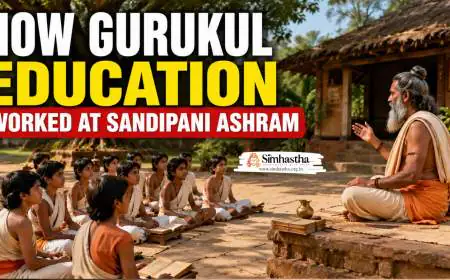
How Gurukul Education Worked at Sandipani Ashram

Ujjain Railway Station to Mahakaleshwar Temple Distance (2026 Guide)

Ujjain Simhastha 2028 Dates Announced: Full Shahi Snan & Event Timeline

Ujjain Railway Station to Kal Bhairav Temple: Distance, Auto Fare and Best Route

Ujjain Simhastha Update: CM Mohan Yadav Reviews 2028 Works
Learning Through Living and the Guru's Unspoken Curriculum
The deepest, most transformative lessons at Sandipani's ashram were not taught through formal, verbal instruction. They were absorbed, through a process of silent, continuous osmosis, from the very atmosphere of the place and the being of the guru. The modern classroom is a space of constant, explicit verbal communication—lectures, presentations, and instructions. The gurukul was a space of profound, intentional silence, where the student learned to still their own chattering mind long enough to observe, to absorb, and to intuitively grasp the subtle, unspoken truths that are invisible to the restless, distracted intellect. Sandipani Muni did not need to give a lecture on the value of discipline; the students saw it in the unwavering, daily precision of his pre-dawn rituals. He did not need to explain the importance of compassion; they felt it in the gentle, unhurried way he tended to a wounded animal. He did not need to speak about the nature of the divine; they sensed it in the quiet, luminous stillness that filled the ashram during the evening meditation, as the soft, silver smoke of the dhuni rose into the twilight sky. The modern student, who is constantly bombarded with information but rarely given the space to truly observe, reflect, and intuit, can learn a profound lesson here. The capacity to sit in silence, to watch the world with a patient, non-judgmental attention, and to learn from the unspoken, lived example of a wise elder is a mode of education that has been almost entirely lost, and its absence is a deep, invisible wound in the modern soul. 🧘
The Sacred Offering and the Daksina of the Heart
A unique and profoundly significant tradition of the ancient gurukul was the Guru Daksina, the offering made by the student to the teacher at the completion of their studies. This was not a fixed fee or a contractual payment; it was a sacred, voluntary, and deeply personal expression of the student's gratitude, and it was the final, culminating lesson of the entire educational journey. The story goes that Sandipani Muni, as his Guru Daksina, asked Krishna to rescue his son, who had been lost in the ocean and was being held by a powerful demon. Krishna, the supreme Lord, without a moment's hesitation, undertook this perilous task, descended into the demon's lair, and restored the guru's son to him. This extraordinary act teaches the modern student a vital, transformative lesson: education is a gift, not a commodity. It is an unbroken chain of grace that has been passed down from teacher to student, generation after generation, for millennia. The modern student often views their education as a personal entitlement, something they have paid for and are owed. The spirit of the Guru Daksina is the radical, humbling opposite of this. It is the recognition that what has been received is of such immeasurable value, touching the very core of one's being, that it can never be repaid. A debt of money can be discharged; a debt of gratitude for genuine, soul-shaping knowledge can only be honoured through a life lived with the integrity, wisdom, and compassion that the guru has imparted. The true Daksina of a student is not a cheque; it is the quality of their character and the light they bring into the world. 🎁
The Simplicity of a Life Well-Lived and the Poverty of Riches
The entire physical environment of Sandipani Ashram was a silent, continuous lesson in the profound value of simplicity. The students, regardless of their royal or humble origins, lived in simple, thatched huts. They slept on the floor, on mats woven from sacred kusha grass. They ate the same simple, sattvic food, prepared with the ashram's own produce. They wore simple, unstitched cotton dhotis. In a modern world that relentlessly equates happiness with the accumulation of material possessions, the branded labels on one's clothes, and the latest model of one's smartphone, the Sandipani model offers a radical, counter-cultural truth. The constant, anxious pursuit of "more"—more marks, more money, more likes, more stuff—is not the path to happiness; it is the very definition of a restless, unfulfilled life. The gurukul taught, through its very design, that a life of focused, intentional simplicity is not a life of deprivation. It is a life of profound, liberated abundance. By consciously eliminating the endless, exhausting noise of material desire, the student could direct the full, undivided power of their attention to the only pursuits that genuinely matter: the pursuit of wisdom, the cultivation of inner stillness, and the deep, nourishing joy of authentic human connection. The lesson for the modern student, who is drowning in a sea of consumerist desire, is a lifeline: the less you need to be happy, the happier you will be. The simplicity that was not a punishment but the very architecture of a focused, meaningful, and deeply joyful life. 🌿
The Ancient Ashram and the Modern Quest for Meaning
The dusty, sun-dappled courtyard of Sandipani Ashram, silent now but for the murmur of the Shipra and the distant echo of temple bells, stands as a gentle, powerful rebuke to the frenetic, anxious, and often soulless machinery of modern education. It whispers a quiet, ancient truth that the modern student, racing on the treadmill of tuitions, exams, and career anxiety, has almost forgotten: that the goal of a true education is not merely to make a living, but to learn how to make a life. The lessons it offers—the sacred bond with a mentor who embodies wisdom, not just information; the profound, humbling grace found in selfless service; the nourishment of a complete, holistic curriculum that honours the body, the heart, and the spirit as much as the intellect; the unshakeable, unconditional love of a true friend; and the liberating, joyful simplicity of a life that is focused on the eternal rather than the transient—are not archaic, sentimental ideas from a forgotten past. They are the precise, urgently needed, and deeply healing medicine for the ailments of the modern, weary, and meaning-hungry soul. The boy who would become the Lord of the Universe once walked barefoot through these very grounds, gathering firewood for his teacher, and in that simple, humble act, he taught a lesson that every modern student, in the quiet, desperate depths of their own heart, is longing to learn: that the greatest life is not the one that accumulates the most, but the one that serves the most, loves the most, and seeks, with a sincere and humble heart, the eternal light that shines within. 🔱
Frequently Asked Questions