


















Why Certain Rituals Are Allowed Only at Specific Ghats During Simhastha
During Simhastha in Ujjain, every ritual is performed only at designated ghats. This complete guide explains the spiritual, scriptural, astrological, and administrative logic behind ghat-specific rituals.


Simhastha Is Open, but Not Unstructured
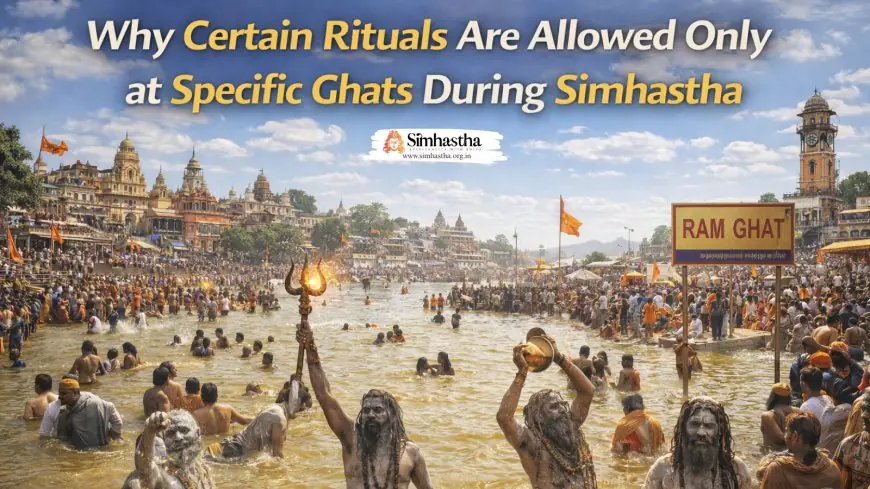
At first glance, Simhastha appears to be a vast spiritual gathering where millions arrive at the Shipra River to bathe, pray, and participate freely. Yet anyone who observes closely soon notices something unusual. Not every ritual is allowed at every ghat. Certain acts are restricted, redirected, or entirely prohibited outside designated locations.
This raises a common question among pilgrims and researchers alike: why are certain rituals allowed only at specific ghats during Simhastha?
The answer lies at the very heart of Simhastha itself. Simhastha is not an unregulated religious gathering. It is a precision-based spiritual system, where place, time, ritual, and authority are inseparably linked.
Also Read | What Is Simhastha? Complete Explanation of Ujjain’s Sacred Kumbh
Trending Guides Now

Step-by-Step Guide to Shipra Snan at Ujjain Simhastha

What Is Shahi Snan in Ujjain Simhastha Kumbh Mela?

How Ritual Responsibilities Are Divided Among Akharas

Why the First Shahi Snan Holds Supreme Spiritual Authority

Ujjain Railway Station to Mahakaleshwar Temple Distance (2026 Guide)

Ujjain Simhastha 2028 Dates Announced: Full Shahi Snan & Event Timeline

Ujjain Simhastha Update: CM Mohan Yadav Reviews 2028 Works

Karkateshwar Mahadev: 22/84 Mahadev of Ujjain
The Concept of Ritual Geography in Sanatan Dharma
In Sanatan tradition, rituals are never detached from geography. Rivers, forests, mountains, and cities each possess specific ritual capacities. A ritual that is spiritually effective in one place may be inappropriate or ineffective in another.
Simhastha represents the most refined expression of this principle. The ghats of the Shipra are not treated as interchangeable riverbanks. Each ghat functions as a spiritual zone, activated for specific purposes during the Simhastha cycle.
This system is often described as ghat-wise ritual discipline, and it explains why Simhastha operates with far greater regulation than other pilgrimages.
Every sacred act performed during Simhastha carries centuries of Sanatan tradition, from the timing of holy baths to the disciplined order of Akharas and temple rituals. To truly understand how these ancient practices unfold on the ghats of Ujjain, our detailed guide on Simhastha rituals explains each ceremony, its spiritual meaning, and its role in the larger flow of Ujjain Simhastha and the Simhastha Kumbh Mela, helping pilgrims experience the festival with clarity, devotion, and cultural authenticity.
Why All Rituals Cannot Be Performed Everywhere
Different rituals serve different spiritual objectives.
Some rituals are purificatory, meant for mass participation.
Some are initiatory, reserved for ascetics and akharas.
Some are ancestral, requiring emotional stillness and continuity.
Some involve renunciation and require strict isolation.

Allowing all rituals at all ghats would collapse these distinctions. During Simhastha, such collapse would result not only in chaos but in ritual dilution.
This is why simhastha ritual rules exist. They protect meaning, not privilege.
Also Read | Simhastha 2028 Dates Officially Announced: Full Event & Shahi Snan Timeline
Scriptural Foundations of Ghat-Specific Rituals
Ancient texts describing Simhastha and sacred rivers repeatedly distinguish between:
-
Snan ghats
-
Shraddha ghats
-
Tapasya zones
-
Akhara ritual spaces
These distinctions are not symbolic. They are functional.
The Shipra River is described as having varying ritual energy along its course. Certain stretches are considered suitable for liberation-oriented acts, while others are meant for continuity-oriented rituals such as pind daan.
This is the unseen scriptural logic behind shipra river ghats simhastha restrictions.
Shahi Snan and Its Exclusive Ghats
Shahi Snan is the most regulated ritual of Simhastha. It is not merely a ceremonial bath. It is the public assertion of spiritual sovereignty by akharas.
During Shahi Snan:
-
Akharas enter in a fixed sequence
-
Lineage hierarchy is strictly followed
-
Silence, discipline, and isolation are maintained
Such conditions cannot exist at every ghat. This is why shahi snan ghat simhastha locations are strictly designated.
Allowing Shahi Snan rituals at public ghats would disrupt both ascetic discipline and pilgrim safety. Therefore, Shahi Snan ghats remain protected ritual zones.
Also Read | The Untold Reason Naga Sadhus Lead the First Shahi Snan at Simhastha 2028
Akharas and Their Ghat Privileges
Akhara rituals are lineage-based, not crowd-based. Initiations, vows, and symbolic acts performed by akharas carry consequences that extend beyond the Simhastha period itself.
For this reason, simhastha akhara rituals are confined to specific ghats where:
-
Access is controlled
-
Timing is astrologically sanctioned
-
Ritual purity can be maintained
These ghats are not chosen arbitrarily. They are identified through a combination of scripture, historical continuity, and akhara consensus.
Also Read | Inside the 13 Akharas: Roles, Rituals & Hidden Traditions for Simhastha 2028
Public Snan Ghats and Mass Participation
Simhastha is open to all pilgrims, but access is structured.
Public snan ghats allow millions of devotees to take Simhastha snan without interfering with ascetic rites. These ghats are designed for flow, accessibility, and collective purification.
This separation ensures that Simhastha remains inclusive while preserving spiritual order. It is a model of disciplined openness, rarely seen at this scale.
Ancestral Rituals and Their Designated Locations
Rituals such as pind daan, tarpan, and pitru offerings require a calm and emotionally grounded environment. These acts are deeply personal and cannot coexist with high-intensity processions or mass bathing.
For this reason, ghat wise rituals simhastha assigns ancestral rites to quieter stretches of the river.
Performing such rituals at Shahi Snan ghats would not only disrupt the atmosphere but also diminish the spiritual focus required for ancestral remembrance.
Ascetic Practices and Restricted Zones
Certain ascetics undertake intense vows during Simhastha, including prolonged immersion, silence, or isolation. These practices require protection from interruption.
Specific ghats and river stretches are reserved for such acts, forming part of simhastha spiritual zones. These zones are respected by both pilgrims and administrators.
This mutual respect maintains harmony between diverse spiritual paths operating simultaneously within Simhastha.
Also Read | Kshipra Riverfront Zones: What Pilgrims Must Know for Simhastha 2028
Administrative Enforcement Rooted in Spiritual Logic
Modern regulations at Simhastha often appear administrative in nature, but they are built upon ancient ritual logic.
Barricades, time slots, access corridors, and crowd diversions are designed to support ghat discipline, not override it. Authorities enforce restrictions because tradition demands them, not because of convenience.
This is why simhastha religious restrictions should be understood as protective, not prohibitive.
What Happens When Ghat Discipline Is Ignored
Occasionally, pilgrims attempt to perform rituals at non-designated ghats due to lack of awareness. Such acts are typically redirected rather than penalized.
This gentle correction reflects Simhastha’s guiding principle: discipline with compassion.
The system is designed to educate, not punish.
Also Read | How Sector-Based Crowd Flow Works in Simhastha: A Simple Guide for First-Time Visitors
Why Pilgrims Sense Different Energies at Different Ghats
Many devotees report feeling distinct emotional or spiritual states at different ghats. This is not imagination.
Centuries of ritual repetition leave energetic imprints. Over time, these imprints shape how a place is experienced.
This phenomenon reinforces why ujjain simhastha ghats are treated as unique ritual entities rather than neutral locations.
The Balance Between Freedom and Order
Simhastha welcomes millions, yet functions without collapse because freedom operates within boundaries.
These boundaries are not arbitrary. They are inherited, tested, and preserved across generations. This balance is the reason Simhastha remains spiritually coherent despite its scale.
Sacred Discipline Is the Soul of Simhastha
Certain rituals are allowed only at specific ghats during Simhastha because Simhastha itself is a discipline, not a spectacle.
Every restriction protects meaning.
Every boundary preserves lineage.
Every ghat assignment safeguards spiritual intent.
When pilgrims respect this structure, Simhastha unfolds as it has for centuries: not as chaos, but as cosmic order expressed through humanity.
Related Simhastha 2028 Guides :
- What Are the Official Dates and Major Events of Simhastha 2028?
- Why Simhastha Happens Only When Jupiter Enters Leo ?
- Why Ujjain Was Chosen for Simhastha: Ancient Scriptures & Astral Logic
- Does Taking a Holy Bath in the Shipra River During Simhastha Remove Karmic Sins?
- Best Time To Visit Simhastha 2028
- Top 10 Routes to Enter Ujjain During Simhastha 2028 Without Traffic Hassles
- The Cosmic Importance of Jupiter in Leo: Why It Creates Simhastha in Ujjain
- How Akhara Sector Allocation Works in Simhastha 2028: Complete Breakdown for Pilgrims
- Who Are the Naga Sadhus of Simhastha 2028? Discipline, Rituals & Mystical Identity Revealed
- The Arrival Procession of Akharas in Simhastha 2028: A Complete Explainer
- How to Travel Inside Ujjain During Simhastha 2028: Routes, Maps and Movement Plans
Frequently Asked Questions