



















Why Bathing Timings Change from Day to Day During Simhastha
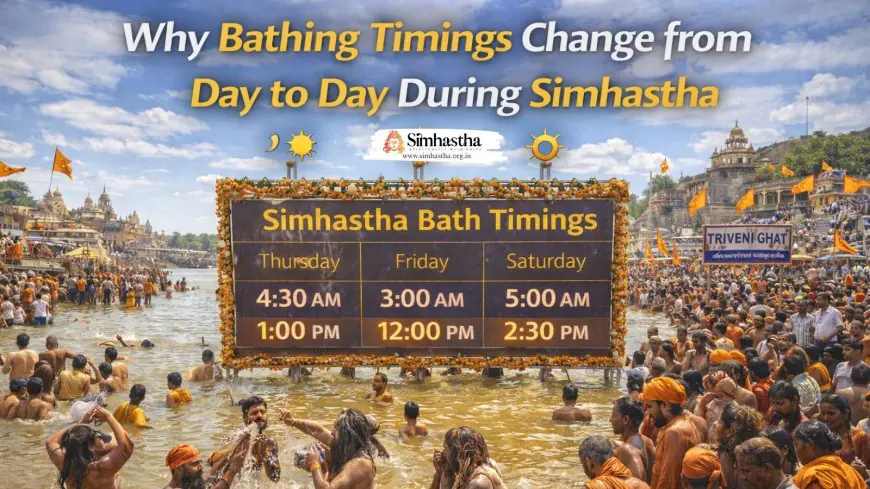
Bathing timings during Simhastha are not fixed. This in-depth guide explains the astrological, ritual, akhara, and administrative reasons why Simhastha snan timings change every day.


Why There Is No Single Bathing Time in Simhastha
One of the most searched and most misunderstood questions during Simhastha is simple on the surface but complex in reality: Why do bathing timings change from day to day during Simhastha?
Pilgrims often expect a fixed bathing schedule, similar to daily temple aarti timings. Simhastha does not function that way. There is no permanent Simhastha bathing time, no universal Simhastha snan timing, and no single answer to Simhastha snan time today that applies across all ghats and all days.
This is because Simhastha bathing is governed not by convenience, but by cosmic time, ritual hierarchy, and spiritual discipline.
Also Read | Ujjain Simhastha - Meaning, History & Why It Matters
Trending Guides Now

Why Certain Rituals Are Allowed Only at Specific Ghats During Simhastha

Why Snan Dates Shift According to Planetary Positions in Simhastha

The Complete Sequence of Ritual Events During Simhastha

What Happens on the Most Important Bathing Days of Simhastha

Ujjain Railway Station to Mahakaleshwar Temple Distance (2026 Guide)

Ujjain Simhastha 2028 Dates Announced: Full Shahi Snan & Event Timeline

Ujjain Simhastha Update: CM Mohan Yadav Reviews 2028 Works

Karkateshwar Mahadev: 22/84 Mahadev of Ujjain
The Core Principle: Simhastha Bathing Is Time-Dependent, Not Clock-Dependent
In Simhastha, time is not measured only in hours. It is measured in muhurats, planetary positions, ritual precedence, and lineage authority.
That is why Simhastha snan timing changes every day.
Bathing windows are determined by:
-
Daily astrological calculations
-
Presence or absence of Shahi Snan
-
Akhara movement schedules

-
Ghat-specific ritual zoning
-
Crowd pressure and safety windows

Together, these factors shape the Simhastha bathing schedule, which is recalculated continuously rather than announced once.
Also Read | Simhastha 2028 Official Dates
Astrology: The Primary Reason Bathing Timings Shift Daily
The most important factor behind changing Simhastha bathing timings is astrology.
Simhastha is governed by Jupiter, but daily bathing windows are influenced by:
-
Tithi
-
Nakshatra
-
Yoga
-
Karana
-
Sunrise and sunset transitions
A snan performed during one muhurat may carry high spiritual merit, while the same act at another time may be neutral.
This is why Simhastha snan muhurat is recalculated every morning by priests and akhara astrologers.
On certain days, the auspicious window may be short. On others, it may extend for hours. This directly affects Shipra snan timing for pilgrims.
Also Read | Why Simhastha Can Only Happen in Ujjain: Scriptural & Astronomical Proof
Shahi Snan Days: When Bathing Timings Change Drastically
On Shahi Snan days, the bathing schedule changes completely.
During Simhastha Shahi Snan time:
-
Akharas receive first access
-
Public bathing is restricted or delayed
-
Ghats are cleared and purified before and after procession
-
Snan windows open only after akhara completion
This is why pilgrims often notice that Simhastha snan time today on a Shahi Snan day looks entirely different from the previous day.
Shahi Snan days are not flexible. They override all routine Simhastha bathing rules.
Also Read | Simhastha 2028 Ujjain Visiting Guide: Best Dates, Shahi Snan Meaning & Pilgrim Planning
Akhara Movement and Its Impact on Bathing Timings
Akhara processions are not symbolic walks. They are ritual events tied to astrological clocks.
When an akhara is scheduled to move:
-
Certain ghats are closed
-
Bathing is paused upstream and downstream
-
Snan resumes only after ritual completion
This is why Ujjain Simhastha snan timings often shift unexpectedly for pilgrims who are unaware of akhara schedules.
The bathing system prioritizes ritual authority over personal planning.
Also Read | Who Are the Naga Sadhus of Simhastha 2028? Discipline, Rituals & Mystical Identity Revealed
Ghat-Specific Snan Timings
Another major reason bathing timings change is that not all ghats open at the same time.
Each ghat has:
-
A different ritual role
-
Different crowd thresholds
-
Different purification cycles
As a result, Simhastha ghat snan time can vary even on the same day.
One ghat may allow bathing at dawn, while another opens only after sunrise. On Shahi Snan days, some ghats may remain closed entirely for the public.
This explains why Simhastha bathing day wise planning is essential for pilgrims.
Every sacred act performed during Simhastha carries centuries of Sanatan tradition, from the timing of holy baths to the disciplined order of Akharas and temple rituals. To truly understand how these ancient practices unfold on the ghats of Ujjain, our detailed guide on Simhastha rituals explains each ceremony, its spiritual meaning, and its role in the larger flow of Ujjain Simhastha and the Simhastha Kumbh Mela, helping pilgrims experience the festival with clarity, devotion, and cultural authenticity.
River Flow and Environmental Factors
Shipra River is not a large perennial river. Its flow, depth, and cleanliness vary daily.
Environmental factors affecting Shipra snan timing include:
-
Water release schedules
-
Flow regulation for ritual purity
-
Overnight sediment changes
-
Safety assessments
If river conditions are not ritually or physically suitable, bathing windows are delayed or shortened.
This is why Simhastha bathing restrictions are sometimes announced at short notice.
Also Read | Kshipra Riverfront Zones: What Pilgrims Must Know for Simhastha 2028
Crowd Density and Safety Overrides
While spiritual logic comes first, safety is not ignored.
If crowd density exceeds thresholds:
-
Bathing windows are staggered
-
Ghats are rotated
-
Entry and exit flows are separated
This results in visible changes in Simhastha bathing schedule, especially on weekends and auspicious dates.
However, these changes are always layered on top of ritual timing, not the other way around.
Why There Is No “Permanent Simhastha Snan Time”
Pilgrims often search for a fixed Simhastha kumbh snan time expecting a daily routine.
Such a routine does not exist.
Simhastha operates on responsive sacred time, where:
-
Every day is recalculated
-
Every ritual reshapes the schedule
-
Every planetary shift matters
This is why asking “What is the Simhastha bathing time?” without mentioning the date has no accurate answer.
How Pilgrims Should Plan Bathing During Simhastha
Understanding why timings change helps pilgrims adapt intelligently.
Recommended approach:
-
Check daily snan announcements
-
Avoid assuming yesterday’s timing applies today
-
Respect Shahi Snan restrictions
-
Choose public snan ghats unless guided otherwise
This approach aligns personal devotion with Simhastha ritual timing.
Spiritual Meaning Behind Changing Timings
Beyond logistics, changing bathing timings serve a deeper purpose.
They remind pilgrims that:
-
Spiritual merit is not mechanical
-
Time must be respected, not controlled
-
Discipline is part of devotion
In Simhastha, waiting is also a form of worship.
Also Read | Why Shahi Snan Is the Most Important Ritual of Simhastha 2028 ?
Changing Bathing Timings Are the Discipline of Simhastha
Bathing timings change from day to day during Simhastha because Simhastha itself is alive to time.
Astrology decides the window.
Akhara authority defines the order.
Ghats preserve ritual integrity.
Administration protects safety.
Together, they ensure that Simhastha snan remains a sacred act, not a routine activity.
Understanding this transforms confusion into clarity and participation into alignment.
Related Simhastha 2028 Guides For You :
- How to Travel in Ujjain During Peak Snan Days: Do’s & Don’ts for Simhastha 2028
- Why Millions Take the First Shahi Snan: Spiritual Benefits, Science & Dharma Explained
- Top 10 Routes to Enter Ujjain During Simhastha 2028 Without Traffic Hassles
- Simhastha 2028 Ujjain Visiting Guide: Best Dates, Shahi Snan Meaning & Pilgrim Planning
- Ujjain Simhastha 2028: Devotees Won’t Have to Walk Miles — ₹20,000 Crore Mega Plan Unveiled for the Grand Festival!
Frequently Asked Questions