


































Why Millions Take the First Shahi Snan: Spiritual Benefits, Science & Dharma Explained
The first Shahi Snan is the most sacred bath of the Kumbh Mela. This detailed guide explains why millions wait for it, its spiritual meaning, dharmic logic, scientific aspects, and why it holds unmatched importance at Ujjain Kumbh 2028.


Why Millions Take the First Shahi Snan: Spiritual Benefits, Science & Dharma Explained
At every Kumbh Mela, millions of pilgrims willingly wait for hours, sometimes days, just to witness or participate in one moment: the first Shahi Snan. For first-time visitors, this raises a natural question. Why does this single bath carry such immense importance? Why do saints bathe first? And why do millions believe that missing the first Shahi Snan means missing the very heart of the Kumbh?
The answer lies not in spectacle, but in dharma, discipline, and deep spiritual science that has guided Sanatan tradition for thousands of years.
For Every pilgrims, understanding Simhastha 2028 dates and the official Shahi Snan timeline is essential before booking flights or accommodation, as these sacred dates are completely non-negotiable.
What Is the First Shahi Snan?
The term Shahi Snan literally means Royal Bath. It refers to the most auspicious bathing ritual during the Kumbh Mela, performed on dates determined strictly by planetary alignments. Among all Shahi Snans, the first Shahi Snan is considered the most powerful.
Trending Guides Now
Why Simhastha Happens Only When Jupiter Enters Leo ?

Simhastha Kumbh Mela Explained for First-Time Visitors

How Simhastha 2028 Traffic Control Relies on Ring Roads and Bypass Corridors

Why Simhastha 2028 Planning Focuses on Movement Flow Over Monument Building

Ujjain Railway Station to Mahakaleshwar Temple Distance (2026 Guide)

Ujjain Simhastha 2028 Dates Announced: Full Shahi Snan & Event Timeline

Mangalnath Temple Trip Budget: Puja, Local Transport, Food and Stay Planning

Omkareshwar Trip Budget Guide: Transport, Stay, Food and Local Travel Costs
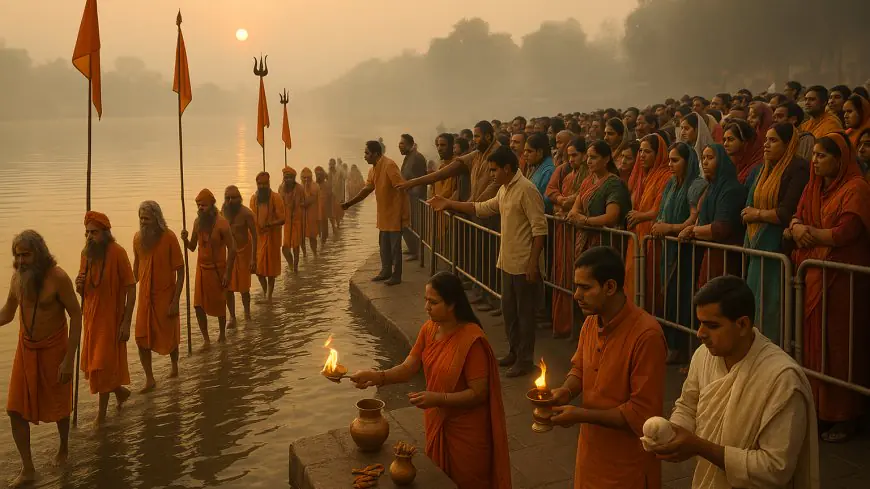
During this ritual:
-
Ascetic orders (Akharas) enter the river in a fixed, ancient order
-
Saints and renunciates bathe first
-
The general public follows only after the ascetics complete their snan
This sequence is not ceremonial privilege. It is a dharmic protocol rooted in spiritual logic.
Why the First Shahi Snan Is Spiritually Supreme
In Sanatan Dharma, energy moves before matter. Ascetics who renounce worldly life are believed to carry heightened spiritual charge due to years of tapasya, celibacy, meditation, and discipline.

When they enter the sacred river during the most potent astrological window:
-
Their collective spiritual energy is believed to activate the river
-
The water becomes charged with higher vibrational purity
-
Lay pilgrims bathing afterward receive amplified spiritual benefit
This is why the first Shahi Snan is not about priority, but preparation of the sacred space.
Astrological Timing Behind the First Shahi Snan
The first Shahi Snan always coincides with the strongest planetary alignment of the Kumbh cycle. At Ujjain Simhastha, this alignment involves:
-
The Sun’s position in Leo
-
Jupiter’s transit into Aquarius
-
Specific lunar tithis and nakshatras
Astrology in Kumbh tradition is not predictive; it is participatory. The timing determines when cosmic forces are most receptive to human spiritual action.
Bathing during this window is believed to:
-
Cleanse accumulated karmic impressions
-
Reset spiritual intent
-
Open a path toward moksha
Role of Akharas in the First Shahi Snan
Akharas are not mere groups of saints. They are living institutions of dharma, each preserving a spiritual lineage.
During the first Shahi Snan:
-
Akharas follow a precise order established centuries ago
-
Shaivite, Vaishnavite, and other orders maintain ritual discipline
-
Any deviation is considered adharmic
This strict order ensures that ego never replaces discipline, even in the world’s largest gathering.
Dharmic Logic: Why Saints Bathe First
Dharma operates on responsibility, not entitlement. Saints bathe first because:
-
They bear the responsibility of maintaining spiritual balance
-
Their lives are dedicated entirely to renunciation
-
They symbolically absorb collective impurities before the masses enter
This concept mirrors ancient yajna traditions, where priests prepared the fire before offerings were made.
Scientific Perspective on the First Shahi Snan
Modern science is beginning to observe patterns that ancient traditions intuitively understood.
Large water bodies show changes in:
-
Microbial composition
-
Ionic balance
-
Temperature and flow behavior
When millions gather in synchronized calm, prayer, and ritual movement:
-
Stress hormones reduce
-
Collective psychological coherence increases
-
The human nervous system enters a meditative rhythm
The first Shahi Snan sets this rhythm. Chaos never begins the Kumbh. Order does.
Why Millions Wait Only for the First Shahi Snan
Many pilgrims travel long distances only to attend the first Shahi Snan and then return. This is because:
-
Scriptures assign the highest punya to the first bath
-
The karmic benefit is believed to equal years of austerity
-
Even witnessing the first Shahi Snan is considered meritorious
For elderly devotees and first-time pilgrims, this single moment is seen as spiritually complete.
Shahi Snan at Ujjain Simhastha 2028
At Ujjain, the Shahi Snan carries additional weight because:
-
The Shipra River is activated only during Simhastha
-
Mahakaleshwar’s presence aligns time and liberation
-
The Simhastha cycle itself is rare
The first Shahi Snan of Simhastha Mahakumbh 2028 will therefore be one of the most spiritually significant events of the decade.
Common Misconceptions About Shahi Snan
-
It is not a VIP bath
-
It is not a political event
-
It is not about crowd dominance
It is a ritual of responsibility, discipline, and spiritual sequencing.
What the First Shahi Snan Teaches Modern Society
In a world driven by speed and shortcuts, the Shahi Snan teaches:
-
Wait your turn
-
Respect spiritual hierarchy
-
Understand that preparation precedes participation
This is why the tradition has survived thousands of years without losing relevance.
Frequently Asked Questions