

























What Is Simhastha? Complete Explanation of Ujjain’s Sacred Kumbh
A complete, factual explanation of Simhastha in Ujjain covering its meaning, history, rituals, astrology, and why it is one of India’s four sacred Kumbh Melas.


What Is Simhastha?
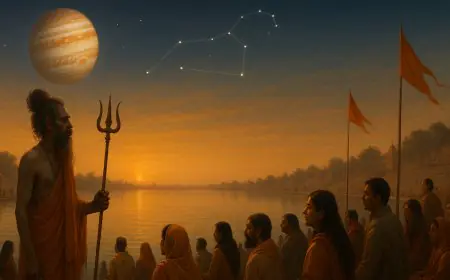
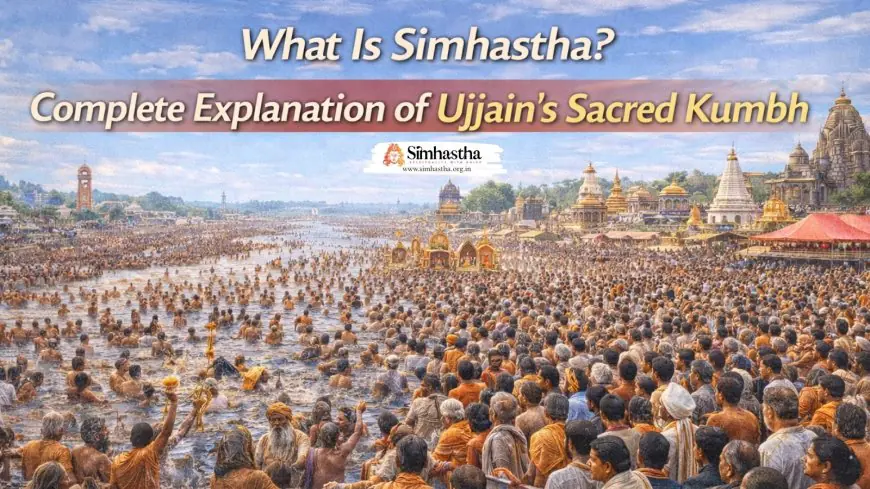
Simhastha meaning refers to a rare Hindu Kumbh Mela held in Ujjain, Madhya Pradesh, when Jupiter (Guru) enters the Leo zodiac sign (Simha Rashi), creating a precise cosmic alignment defined by Hindu astrology. The term comes from Sanskrit, where “Simha” means lion and “Stha” means positioned, meaning “when Jupiter is established in Leo.” Simhastha occurs approximately every 12 years, based on planetary movement, and is supported by specific solar alignments. It is one of the four sacred Kumbh Melas in India, alongside Prayagraj, Haridwar, and Nashik, and is uniquely associated with Ujjain and the sacred Shipra River, making it a time-governed spiritual phenomenon rooted in Sanatan Dharma, astrology, and ritual authority.
This article is part of our main Ujjain Simhastha guide, which covers meaning, history, dates, rituals, and pilgrimage planning.
A Complete Explanation of Simhastha in Ujjain
While the definition explains what Simhastha is, it does not explain why Simhastha exists or why only Ujjain hosts it. Simhastha is not merely a recurring fair or gathering. It is a cosmically regulated spiritual event, governed by astrology, scripture, and ritual authority rooted in Sanatan Dharma.
Simhastha occurs only when a non-negotiable planetary alignment takes place. Unlike other religious festivals fixed by calendar dates, Simhastha is fixed by celestial movement, which is why its dates shift and why it cannot be replicated elsewhere.
Trending Guides Now

How Simhastha 2028 Planning Uses Temporary Infrastructure Over Permanent Construction
Why Simhastha 2028 Is Expected to Be the Largest Ever?

What to Wear Carry Avoid at Ujjain Simhastha

How Simhastha 2028 Traffic Control Relies on Ring Roads and Bypass Corridors

Ujjain Railway Station to Mahakaleshwar Temple Distance (2026 Guide)

Ujjain Simhastha 2028 Dates Announced: Full Shahi Snan & Event Timeline

Mangalnath Temple Trip Budget: Puja, Local Transport, Food and Stay Planning

Omkareshwar Trip Budget Guide: Transport, Stay, Food and Local Travel Costs
Meaning of the Word “Simhastha”
The word Simhastha comes from Sanskrit:
-
Simha means Lion (Leo zodiac sign)
-
Stha means established or positioned
Simhastha literally means “the time when Jupiter is established in Leo.”
This astrological condition is the spiritual trigger that activates the Kumbh cycle at Ujjain.
Without this alignment, Simhastha cannot occur, regardless of planning, government decisions, or human intent.
Also Read | Why Simhastha Happens Only When Jupiter Enters Leo ?

What a First-Time Pilgrim Actually Sees, Hears, and Feels During Simhastha
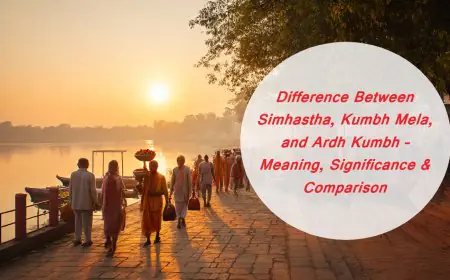
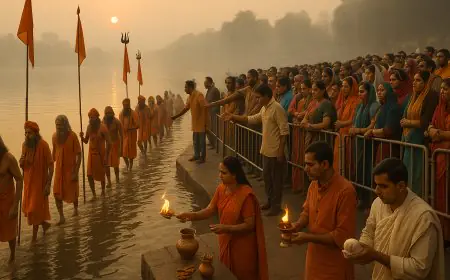
Beyond definitions and dates, Simhastha is a full sensory immersion. A first-time pilgrim waking up at 3 AM on a Shahi Snan day will hear the distant chants of Har Har Mahadev before seeing any sadhu. The air smells of camphor, marigold, and the distinct earthiness of the Shipra River banks at low flow. What you feel is not chaos but a strange, organized urgency — families rushing toward designated Simhastha snan ghats while Naga Sadhus move in slow, deliberate formation on the opposite side. Unlike a stadium crowd, Ujjain Kumbh has zones of silence and zones of roaring devotion. At Ram Ghat, you will see a grandmother bathing her grandson in water that locals swear tastes different during Jupiter in Leo transit. By 6 AM, the sun reveals thousands of saffron flags, temporary ashrams in Ujjain made of bamboo and tarpaulin, and the quiet dignity of Kalpavasis who have slept on the riverbank for a month. This sensory reality — the cold Shipra water at dawn, the weight of a wet cotton sari, the unexpected courtesy of strangers sharing soap — is what no article on Simhastha pilgrimage ever captures. Yet it is the very reason pilgrims return every 12 year spiritual cycle.
Simhastha Is Not Just a “Mela”
Calling Simhastha a “fair” is technically incorrect.
A fair is organized by people.
Simhastha is revealed by time.
The Akharas, rituals, bathing dates, and procession orders are not flexible. They follow a hierarchy preserved through centuries of tradition. Even modern administration operates around Simhastha, not over it.
Why Simhastha Is Held Only in Ujjain
A very common search query is simhastha ujjain or why Simhastha is held in Ujjain. The answer lies in sacred geography, not administration.
Ujjain is not one of many locations chosen for Simhastha. It is the only possible location.
Ancient texts refer to Ujjain as Avantika, one of the seven Moksha Puris of Sanatan Dharma. It is the city where liberation is considered accessible through time alignment rather than lifelong renunciation alone.
At the spiritual center of Ujjain stands Mahakaleshwar Jyotirlinga, where Shiva is worshipped as Mahakal, the Lord of Time.
This distinction is critical.
In most pilgrimage cities, deities govern space or devotion.
In Ujjain, the presiding deity governs time itself.
Simhastha can only occur where time is ritually acknowledged and controlled. That is why no other city, no matter how sacred, can host Simhastha.
The second reason is the presence of the Shipra River.
Shipra is not a large river, nor a perennial one in the modern sense. Its importance is ritual, not physical. Scriptures describe Shipra as a tirtha-nadi that becomes spiritually potent only during specific cosmic periods.
Simhastha is one such period.
During Simhastha, bathing in Shipra is believed to activate dormant spiritual merit, which is why Simhastha snan holds a unique place in Hindu practice.
This combination of:
-
Mahakal as the Lord of Time
-
Shipra as a time-activated sacred river
exists only in Ujjain.
That is why Simhastha cannot rotate like other Kumbh Melas.
That is why Simhastha in Ujjain is not a choice, but a rule.
Also Read | How Astrology Determines Simhastha’s Location: Why Ujjain Becomes the Anchor
The Astrology Behind Simhastha (Guru, Simha Rashi, and the 12-Year Cycle)
Many users search simhastha meaning, simhastha guru, or why Simhastha happens every 12 years. This section answers all of them clearly.
Simhastha is governed by Jupiter (Guru), the planet associated with wisdom, dharma, and spiritual expansion.
Jupiter takes approximately 12 years to complete one full orbit around the zodiac. Simhastha occurs when Jupiter enters Simha Rashi (Leo).
However, not every Jupiter-Leo transit qualifies automatically.
For Simhastha to be valid:
-
Jupiter must be firmly established in Leo
-
The Sun must occupy a supportive zodiac position
-
Astrological calculations must align across traditional Panchang systems
This precision is why Simhastha dates cannot be adjusted casually.
If the alignment is delayed, Simhastha is delayed.
If the alignment is early, Simhastha occurs earlier.
Human calendars follow planetary movement, not the other way around.
This is also why people searching when is Simhastha in Ujjain often see long gaps between events.
Simhastha does not occur “around” 12 years.
It occurs exactly when Guru allows it.
This is also why Simhastha is sometimes confused with:
-
Ardh Kumbh
-
Other regional Kumbh cycles
But those events allow multiple astrological combinations.
Simhastha allows only one.
That is why scholars often describe Simhastha as the purest form of Kumbh, governed by astrology alone.
Also Read | Why Simhastha Can Only Happen in Ujjain: Scriptural & Astronomical Proof
Simhastha vs Kumbh Mela vs Ardh Kumbh (Clear Difference Explained)
One of the biggest sources of confusion online is the difference between:
-
Simhastha
-
Kumbh Mela
-
Ardh Kumbh
This confusion is visible in queries like simhastha kumbh, simhastha kumbh mela ujjain, and simhastha fair.
Let us clarify this definitively.
Kumbh Mela
Kumbh Mela is a broad term derived from the Samudra Manthan legend, where drops of nectar fell at four locations. Kumbh Melas rotate among these locations based on multiple acceptable astrological conditions.
Kumbh Melas are:
-
Vishnu-centric
-
River-centric
-
Flexible in astrological combinations
Ardh Kumbh
Ardh Kumbh is held midway between two full Kumbhs at select locations. It is significant, but it does not carry the same astrological rigidity as Simhastha.
Simhastha Kumbh
Simhastha is:
-
Shiva-centric, not Vishnu-centric
-
Governed strictly by Jupiter in Leo
-
Held only in Ujjain
-
Anchored to Mahakal and Shipra
-
Highly regulated in rituals and ghats
Calling Simhastha a “fair” or treating it like a generic mela strips it of its philosophical foundation.
Simhastha is not about scale.
It is about alignment.
This is why Simhastha continues to retain stricter discipline, stronger akhara authority, and deeper ritual zoning compared to other Kumbh gatherings.
Also Read | Detailed Difference Between Kumbh, Ardh Kumbh And Simhastha
History of Simhastha – Ancient Origins to Modern Continuity
Search queries like simhastha history, last Simhastha in Ujjain, and simhastha 2016 indicate that users are not only curious about belief, but about continuity. Google values this strongly.
Simhastha is not a revived tradition. It is an unbroken one.
Ancient Scriptural Period
The earliest references to Simhastha appear in the Skanda Purana, Matsya Purana, and Shaiva texts that describe Avantika (ancient Ujjain) as a city where cosmic time becomes ritually accessible.
These texts do not describe Simhastha as optional or celebratory. They describe it as inevitable when planetary conditions arise. This is a critical distinction.
Simhastha is presented as a cosmic obligation, not a human invention.
Classical and Early Medieval Period
During the Gupta and post-Gupta eras, Ujjain was a major center of astronomy and calendrical science. It is not a coincidence that Simhastha’s astrological precision matured here.
Royal inscriptions and temple records show that Simhastha gatherings were already large, disciplined, and ghat-regulated. There is no evidence of Simhastha ever being cancelled or replaced.
Paramara Dynasty and Institutionalization
Under the Paramara rulers, Ujjain became a Shaiva stronghold. Akhara systems gained clearer hierarchy during Simhastha, and ritual zoning became more formal.
This period shaped Simhastha as a spiritual governance event, where akharas, scholars, and ascetics collectively upheld dharma.
Mughal and Maratha Periods
Contrary to popular belief, Simhastha did not disappear during non-Hindu rule. Historical records confirm that Simhastha continued, sometimes quietly, sometimes openly, but never interrupted.
By the Maratha period, Simhastha was again openly patronized, with administrative support aligned to akhara authority rather than political dominance.
Colonial Documentation
British records refer to Simhastha as “the Ujjain Kumbh” but note its strict astrological scheduling and exceptional ritual discipline compared to other large Hindu gatherings.
Importantly, colonial administration did not redefine Simhastha. It merely adapted to it.
This confirms one thing clearly:
Simhastha survives regimes, empires, and ideologies because it is governed by time, not power.
Simhastha 2016 – The Last Complete Simhastha in Ujjain
Why Simhastha 2016 Was Significant
Simhastha 2016 marked a transition point between traditional execution and modern scale.
Key characteristics:
-
Over 7 crore pilgrims participated over the cycle
-
Ritual zoning was preserved despite massive crowds
-
Akhara processions followed classical precedence
-
Shipra River purification and flow management became central planning concerns
Unlike many modern religious events, Simhastha 2016 did not dilute rituals for convenience. Instead, infrastructure adapted to tradition.
Shahi Snan Discipline
Shahi Snan days in 2016 were conducted with strict access control. Public bathing was paused during akhara movements, reinforcing that Simhastha is not equal-access at all times, but ritual-priority based.
This reinforces Simhastha’s identity as a spiritually governed event rather than a crowd-driven one.
Lessons from Simhastha 2016
-
Ritual authority remained supreme
-
Administrative systems followed akhara timelines
-
Ghats were not treated as interchangeable
-
Shipra was treated as sacred infrastructure, not just water management
These lessons directly influence how Simhastha 2028 is being planned.
Also Read | What Happened at Simhastha 2016 in Ujjain? Complete Overview
Simhastha 2028 – Official Dates, Importance, and Why This Cycle Matters
Official Simhastha 2028 Dates
Simhastha 2028 will be held from 27 March 2028 to 27 May 2028 in Ujjain.
These dates are not administrative announcements. They are derived from planetary calculations, specifically Jupiter’s transit into Simha Rashi (Leo).
This answers directly:
-
When is Simhastha in Ujjain? → 2028
-
Next Simhastha in Ujjain → 2028
-
Simhastha 2028 date → 27 March to 27 May 2028
Why Simhastha 2028 Is Astronomically Fixed
Unlike festivals that allow “auspicious windows,” Simhastha operates on exact celestial positioning.
If Jupiter’s entry into Leo shifts by weeks or months, Simhastha shifts with it. There is no symbolic adjustment.
This is why Simhastha cannot be preponed or postponed for political or logistical reasons.
Why Simhastha 2028 Is Strategically Important
Simhastha 2028 is expected to be one of the most closely observed Simhasthas in history due to:
-
Increased global attention on Kumbh-scale events
-
Advanced infrastructure and digital coordination
-
Higher first-time pilgrim participation
-
Environmental focus on Shipra River sustainability
Yet, despite modernization, ritual authority remains unchanged.
Expected Structure of Simhastha 2028
Simhastha 2028 will follow the same spiritual framework:
-
Shahi Snan days governed by akhara councils
-
Ghat-specific ritual permissions
-
Shipra snan regulated by time windows
-
Mahakal-centric ritual calendar
Technology will assist.
Tradition will decide.
Why People Search Simhastha 2028 So Early
Search data shows rising interest years in advance. This is because:
-
Simhastha occurs only once in 12 years
-
Many pilgrims plan attendance once in a lifetime
-
Scholars, akharas, and administrators prepare years ahead
Also Read | Simhastha 2028 Dates Officially Announced: Full Event & Shahi Snan Timeline
Akharas and the Spiritual Governance of Simhastha
One of the most misunderstood aspects of Simhastha is who actually governs it. Many assume Simhastha is administered entirely by the state. In reality, Simhastha is spiritually governed first, administratively supported second.
At the core of this governance system are the akharas.
Akharas are not temporary groups formed for Simhastha. They are centuries-old monastic institutions that preserve ascetic lineages, ritual authority, and doctrinal continuity within Sanatan Dharma. During Simhastha, akharas function as the highest ritual authority.
This is why searches such as simhastha akhara, simhastha guru, and simhastha kumbh mela ujjain repeatedly surface. Users sense that Simhastha is not just a gathering of devotees but a congregation of spiritual power centers.
Role of Akharas During Simhastha
During Simhastha, akharas are responsible for:
-
Deciding Shahi Snan order
-
Approving ritual calendars
-
Assigning ascetic camps
-
Maintaining lineage discipline
-
Upholding ritual purity
Administrative agencies coordinate logistics, but they do not override akhara decisions.
Each akhara arrives with its own Mahamandaleshwars, saints, and disciples. Initiations, renunciations, debates, and doctrinal affirmations occur quietly within akhara camps, away from public spectacle.
This is why Simhastha is often described by scholars as a spiritual parliament, where authority flows from tradition, not popularity.
Simhastha Guru and Lineage Authority
Searches for simhastha guru are not accidental. During Simhastha, lineage transmission peaks. Disciples formally accept renunciation, titles are conferred, and spiritual authority is renewed for the next cycle.
These acts do not happen randomly. They occur only under astrologically sanctioned periods within Simhastha, reinforcing that time governs authority, not ambition.
Also Read | Who Are the Naga Sadhus of Simhastha 2028? Discipline, Rituals & Mystical Identity Revealed
Ghats, Shipra River, and the Ritual Zoning System
A defining feature of Simhastha, and a major search intent driver, is its ghat-based ritual system. Queries such as simhastha snan, shipra river simhastha, and simhastha ghat system reflect this curiosity.
Simhastha does not treat all riverbanks equally.
The Shipra River is divided into ritual zones, each with a specific spiritual function. This zoning is not for crowd control alone. It is rooted in scriptural instruction and centuries of practice.
Why Simhastha Snan Is Not the Same Everywhere
Bathing during Simhastha is called Simhastha snan, but not all snans are equal in purpose.
Different ghats are designated for:
-
Shahi Snan by akharas
-
Public purification snan
-
Ancestral rituals
-
Ascetic practices
Allowing all rituals at all ghats would collapse spiritual order. This is why simhastha ghat rules are strictly enforced.
Shahi Snan Ghats
Shahi Snan is the most sacred ritual of Simhastha. It represents spiritual sovereignty, not royal privilege.
During Shahi Snan:
-
Akharas move in fixed sequence
-
Public access is restricted
-
Ritual silence and discipline are enforced
This controlled environment preserves the sanctity of the act and prevents ritual dilution.
Public Snan Ghats
Public snan is equally important but serves a different spiritual function. These ghats allow millions of pilgrims to participate in Simhastha without interfering with ascetic rites.
This separation ensures that Simhastha remains inclusive without becoming chaotic.
Shipra River’s Unique Role
Unlike perennial rivers, Shipra’s spiritual potency is believed to activate during Simhastha due to planetary alignment. This belief explains why shipra river simhastha searches spike sharply as dates approach.
Shipra is treated as a living sacred entity during Simhastha. Its flow, cleanliness, and access are managed with ritual sensitivity, not just environmental policy.
Also Read | Does Taking a Holy Bath in the Shipra River During Simhastha Remove Karmic Sins?
Also Read | The Magic of the Shipra River – Ujjain’s Sacred Lifeline of Faith and Flow
Who Should Attend Simhastha and Why
Another high-intent search pattern revolves around simhastha religious importance and simhastha hindu festival. People want to know whether Simhastha is meant for saints alone or for ordinary devotees.
The answer is clear. Simhastha is open to everyone, but it speaks differently to different seekers.
Household Devotees
For householders, Simhastha represents:
-
Purification through Simhastha snan
-
Renewal of dharmic commitment
-
Participation in a once-in-12-years spiritual cycle
Many families plan a single Simhastha visit across generations, treating it as a lifetime milestone.
Ascetics and Renunciates
For ascetics, Simhastha is not optional. It is a disciplinary obligation. It is where lineage is reaffirmed, vows are tested, and authority is transmitted.
This is why akharas treat Simhastha as a turning point rather than a celebration.
First-Time Pilgrims
For first-time pilgrims, Simhastha often becomes a transformational experience. The scale may appear overwhelming, but the underlying order provides a sense of stability and purpose.
This balance between magnitude and meaning is what separates Simhastha from ordinary religious gatherings.
Also Read | What Is Ujjain Kumbh 2028? Full Guide for First-Time Visitors
Myths, Misconceptions, and How Simhastha Is Commonly Misunderstood
Despite growing search interest, Simhastha is frequently misunderstood. Queries like simhastha fair, simhastha mela meaning, and simhastha kumbh reflect this confusion.
Let us correct the most common misconceptions.
Myth 1: Simhastha Is Just a Religious Fair
Simhastha is not a fair. There is no entertainment core, no commercial purpose, and no flexible scheduling. Labeling it as a fair reduces a cosmic system to a social event.
Myth 2: Simhastha Is the Same as Other Kumbh Melas
While Simhastha is a form of Kumbh, it is not interchangeable. Its astrology, location, and Shiva-centric philosophy make it fundamentally different.
Myth 3: Dates Can Change Based on Convenience
Searches like ujjain simhastha date and when is simhastha in ujjain often assume flexibility. In reality, Simhastha dates are locked by planetary movement. No authority can alter them.
Myth 4: Administration Controls Simhastha
Administration supports Simhastha. It does not define it. Spiritual authority rests with akharas and tradition, not with event planners.
Also Read | Mythological and Historical Significance of The Simhastha Kumbh Mela
Five Practical Realities No Guidebook Warns You About Simhastha
Even the most devout pilgrim benefits from ground-level preparation for Ujjain’s sacred Kumbh. These are the unspoken truths of attending Simhastha 2028.
1. Your mobile network will collapse on peak snan days.
Do not rely on Google Maps or UPI payments during Shahi Snan. Download offline maps of Ujjain and carry physical cash. The Simhastha administration prioritizes emergency communication, not social media.
2. The walk from your hotel to the ghat may take three hours.
Vehicles are blocked miles away during Simhastha snan. What looks like a 15-minute walk on a normal day becomes a slow-moving pilgrimage through controlled ritual zoning corridors.
3. Not every ghat is for public bathing.
Searching for Shipra River snan locations is not enough. Some ghats are reserved exclusively for akharas and ascetics. Entering a restricted ghat can lead to delay or denial of access. Always ask before stepping into the water.
4. The best time for solitude is between 2 AM and 4 AM.
Most guides highlight sunrise bathing. But kalpavasis and serious seekers know that the deepest spiritual experience of Simhastha happens in the pre-dawn darkness, when only the sound of water and distant bells remain.
5. You will be asked for proof of accommodation.
Post-2016 security reforms mean that entering Ujjain during Simhastha without a confirmed booking can result in being redirected to outlying camps. Do not arrive as a walk-in pilgrim without a plan.
Frequently Asked Questions