

























How to Travel Inside Ujjain During Simhastha 2028: Routes, Maps and Movement Plans
Learn how to move smoothly inside Ujjain during Simhastha 2028 with city routes, shuttle maps, walking corridors, parking plans and safe movement strategies for pilgrims.


How to Travel Inside Ujjain During Simhastha 2028: Routes, Maps & Movement Plans






For Every pilgrims, understanding Simhastha 2028 dates and the official Shahi Snan timeline is essential before booking flights or accommodation, as these sacred dates are completely non-negotiable.
Understanding the Basic Simhastha Layout of Ujjain
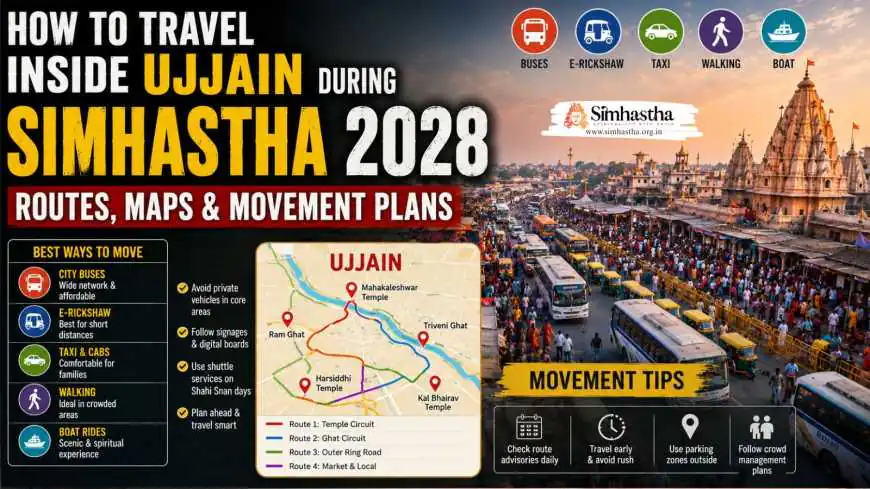
For Simhastha 2028, Ujjain will be divided into multiple functional zones – ghats, Mahakal Corridor area, Akhara sectors, tent cities, parking hubs and service corridors. Each zone is connected through a planned mobility network of shuttles, walkways and controlled-traffic roads. Knowing which zone you are staying in and which ghat or temple you want to visit is the first step to planning your movement.
Main Movement Zones for Pilgrims
- Ghat Zone: Areas along the Kshipra River where bathing ghats are located.
- Mahakal Zone: Mahakaleshwar Temple, Mahakal Corridor and nearby streets.
- Tent City Zones: Large residential clusters for pilgrims.
- Parking & Shuttle Zones: Peripheral areas where private vehicles stop.
- Akhara Corridors: Routes reserved for saints and processions.
Once you know which two zones you are travelling between, choosing the right route and mode becomes easy.
Shuttle Routes: The Backbone of Pilgrim Movement
Shuttle buses are the fastest and safest way to travel between parking areas, tent cities, ghats and the Mahakal Corridor during Simhastha 2028. Instead of allowing all private vehicles into the core, the city will rely heavily on high-frequency shuttle loops.

To deepen your understanding of the spiritual customs and sacred rituals practiced during Ujjain Simhastha, read our complete Simhastha rituals and sacred practices guide that explains their meaning, timing, and significance.
How Shuttle Loops Typically Work
- Shuttles run between parking hubs ↔ ghats.
- Separate shuttle loops connect tent cities ↔ Mahakal Zone.
- Clear signboards show shuttle numbers and destinations.
- Shuttles stop at fixed drop points to avoid roadside crowding.
- Most loops are one-way to prevent traffic clogging at junctions.
For most pilgrims, the simplest rule is: park or stay at your zone, then use shuttles to enter the core pilgrimage areas.
Walking Corridors: Best Choice Near Ghats & Mahakal
Inside the densest spiritual zones, walking is often faster and safer than attempting to use vehicles. Dedicated pedestrian corridors help pilgrims move steadily without coming into conflict with buses or cars.
Benefits of Using Walking Routes
- Reduced risk of pushing or crowd crush near junctions.
- Predictable movement with clear direction signboards.
- Better experience of bhajans, aartis and spiritual ambience.
- Easier communication with volunteers and help desks on the way.
Senior citizens and families with children should choose routes with wider footpaths and handrails whenever available, even if they seem slightly longer.
Key Internal Routes Pilgrims Will Frequently Use
Though exact street names may vary in official maps, movement will mostly follow a few main flows that connect accommodation, ghats and Mahakal Corridor.
Example Movement Flows
- Tent City → Shuttle Stop → Ghat Zone: For early morning snan.
- Tent City → Shuttle → Mahakal Corridor: For darshan and aarti.
- Parking Hub → Shuttle → Ghat Zone: For one-day pilgrims.
- Ghat Zone → Walking Corridors → Akhara Areas: For darshan of saints.
Pilgrims should avoid trying to “explore short-cuts” through internal streets on Shahi Snan or peak days, as many routes will be temporarily restricted for safety.
first time Simhastha guide is essential because without contextual understanding, pilgrims arrive prepared for devotion but unprepared for logistics, stamina, patience, and adaptability.
Traffic Restrictions & Vehicle Movement During Simhastha
For safety reasons and to prevent gridlock, many core roads inside Ujjain will either be one-way, shuttle-only or pedestrian-only, especially on big bathing days. Private cars, buses and autos will have limited access to central areas.
Typical Traffic Restrictions to Expect
- No private vehicles allowed near major ghats during peak hours.
- Outer-ring parking compulsory for large groups and tourist buses.
- Temporary closure of internal roads during Akhara processions.
- Night-time restrictions on non-essential movement near core zones.
Instead of resisting these restrictions, planning within them will make your journey more peaceful and efficient.
Also Read | Best Time to Visit Ujjain Simhastha 2028
Using Maps, Signboards & Help Desks Effectively
Simhastha 2028 will rely heavily on visual systems — color-coded maps, zone boards, shuttle route diagrams and wayfinding signs in multiple languages. Understanding them saves time and reduces anxiety in crowded situations.
Smart Ways to Use On-Ground Guidance
- Identify your zone name and nearest shuttle route first.
- Follow arrows and color-coded signs instead of asking multiple people.
- Use official help desks for clarity rather than road-side guesses.
- Click photos of key maps at entry gates for quick reference later.
Digital apps, if provided, will supplement but not replace physical signboards — especially when networks fluctuate.
Also Read | Step-by-Step Guide to Shipra Snan at Ujjain Kumbh Mela
Best Practices for Safe & Smooth Movement Inside Ujjain
Authorities can design routes, but each pilgrim’s choices decide how comfortable their experience becomes. A few simple movement habits make a huge difference during Simhastha.
Movement Tips for Pilgrims
- Start early for snan and darshan instead of waiting for peak time.
- Travel light; carry only essential items in a small bag.
- Walk in single file in narrow lanes; avoid sudden stops.
- Keep children and older family members ahead of you, not behind.
- Drink water, rest occasionally and avoid rushing in heat.
- Never cross barricades or closed routes even if they look empty.
By aligning with the movement plan instead of fighting it, you help protect both yourself and others.
Travelling With Seniors, Children & Large Groups
Special care is needed when travelling with vulnerable family members. Choosing the right combination of shuttle, walking distance and timing is crucial.
Extra Care Tips for Sensitive Groups
- Use closest shuttle stops to reduce walking distance.
- Avoid hottest mid-day hours for long walks.
- Keep a meeting point fixed in case of separation.
- Write important phone numbers and zone name on a small card.
- Use wheelchairs or support services if available for those in need.
Planning movement with compassion, not speed, ensures that everyone in your group benefits from Simhastha’s spiritual power.
Also Read | Common Simhastha Mistakes Visitors Must Avoid
Movement as a Part of the Pilgrimage
Travelling inside Ujjain during Simhastha 2028 is not just logistics — it is part of the pilgrimage itself. Walking through sacred corridors, waiting in calm lines, sharing space with unknown devotees and following disciplined routes are all forms of inner tapasya. When done consciously, every step becomes a mantra, every movement a part of your offering to the divine.
If you move with patience, awareness and respect for the shared flow, Ujjain will carry you gently from your tent to the ghat, from the ghat to Mahakal, and from the outer city to the inner stillness of your own heart.
Frequently Asked Questions