



























Why Gau Ghat Holds Special Significance for Devotees
Discover why Gau Ghat holds special significance for devotees in Ujjain. From Krishna's pastoral past to pind daan rituals and the daily blessing of feeding cows, explore this serene Shipra ghat's profound spiritual power.



The Sacred Intersection of the Cow, the River, and the Ancestors
The profound spiritual power of Gau Ghat does not stem from a single mythology or a monumental temple; it arises from a potent, threefold convergence of sacred elements that are each, individually, pillars of Hindu faith. The first is the Shipra River, the liquid goddess of Ujjain, whose waters are infused with the amrit of the Kumbh and the grace of Mahakal, flowing as a constant stream of purification and liberation. The second is the cow (Gau Mata) , who, in the theology of the Sanatana Dharma, is not merely an animal but a living, breathing abode of thirty-three crore deities. Every part of her body is a sacred tirtha. To serve, feed, and protect a cow is, in essence, to perform a simultaneous puja to all the gods at once. The third is the ancestral realm (Pitru Loka) , which is most accessible at specific, powerful tirthas where the veil between the living and the dead is at its thinnest.
At Gau Ghat, these three forces merge into a single, spiritually charged field. The Puranas and the local oral traditions hold that performing ancestral rituals, especially pind daan, in the presence of cows on the bank of a sacred river creates an unparalleled conduit for the departed souls. The cows, with their innate sattvic purity and their cosmic significance, are believed to act as divine intermediaries. The offerings of rice, sesame, and water, made by the pilgrim while a cow breathes gently nearby, are said to be carried directly and unimpeded to the waiting hands of the pitrus. This is why Gau Ghat, along with Siddhavat and Ram Ghat, is considered one of the most important sites in Ujjain for the shraddh ceremony, especially during the solemn fortnight of Pitru Paksha. The very atmosphere—the soft lowing of the cattle, the lap of the river, and the chanting of the priests—seems engineered for the tender, tearful work of honouring the dead. 🌾
The Krishna Connection and the Pastoral Roots of Gau Ghat
While Ujjain is a city defined by the Lord of Time, a beautiful thread of Vaishnava lore is intricately woven into the sanctity of Gau Ghat. The local tradition, passed down through generations of priests and cowherd families who have served at the ghat for centuries, whispers that this very stretch of the Shipra was once a favourite resting spot of the young Lord Krishna himself. During his earthly pastimes as the divine cowherd of Vrindavan, it is said that he would bring his beloved cows to this gentle riverbank to drink, to rest in the shade of the ancient trees, and to fill the air with the enchanting melody of his flute. This pastoral connection transforms the ghat from a simple bathing spot into a living echo of Gokul and Govardhan, a piece of Vrindavan nestled within the Shaivite heart of central India.
For the devotee, this legend adds a layer of deeply personal, emotional sweetness to the pilgrimage. Every cow that ambles down to the water's edge becomes a potential gopi, a silent witness to the divine play. The act of feeding a cow here is thus not just a generic act of charity; it is a conscious participation in Krishna’s own lila. It is a way of stepping into the role of the gopas and gopis, of serving the Lord by serving his most cherished creatures. Many Vaishnava pilgrims, particularly those from the ISKCON Ujjain temple, make it a point to include Gau Ghat in their spiritual circuit, coming here to sing the Hare Krishna mahamantra softly, to offer fresh grass to the cows, and to meditate on the pastoral beauty that the Supreme Personality of Godhead himself so loved. The ghat thus becomes an ecumenical bridge, a place where the Shaiva and Vaishnava streams of Ujjain's faith flow together in a shared reverence for the sacred cow. 🐚
Trending Guides Now
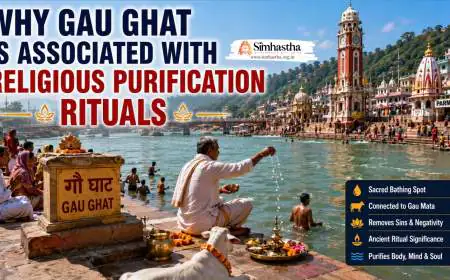
Why Gau Ghat Is Associated With Religious Purification Rituals

Ujjain Railway Station to Mahakaleshwar Temple Distance (2026 Guide)

Ujjain Simhastha 2028 Dates Announced: Full Shahi Snan & Event Timeline

Mahakaleshwar Sandhya Aarti Online Booking 2026: Fee, Timings, Entry Gate and Step-by-Step Process

Latest Simhastha 2028 Development Projects Every Pilgrim Should Know

Mahakaleshwar Temple Entry Rules 2026: Dress Code, Mobile & Bag Policy

Bhasma Aarti at Mahakaleshwar Temple – Complete Pilgrim Guide

Why Ujjain Is One of the Four Kumbh Cities in India
Pind Daan at Gau Ghat and the Liberation of the Ancestors
On the wide, worn stone steps of Gau Ghat, a ritual of profound, heart-breaking beauty unfolds daily, but with particular intensity during the Pitru Paksha period. Families arrive, often dressed in simple white garments, carrying brass plates laden with cooked rice, black sesame seeds, kusha grass, and small vessels of Ganga jal. They are met by a family priest, a panda, who has guided their lineage's ancestral rites for decades. The family sits cross-legged on the ghat, facing the sacred southern direction and the flowing Shipra. The priest begins the chanting of the ancient mantras, the sacred sounds that invite the souls of the departed fathers, mothers, and forefathers to the riverbank.
The presence of the cows at this moment is the unique, powerful catalyst of Gau Ghat. Before the pind (rice balls) are offered into the river, a portion is often set aside and fed to a cow. The belief is that the cow's sacred consumption of the offering validates it, purifies it, and carries its essence directly to the pitrus. A devotee will hold out a flat palm with a bit of rice and jaggery, and a gentle, warm muzzle will brush against their skin, receiving the offering. It is an act of profound, tactile grace. The tears that fall on the stone steps are not just tears of grief but of a strange, unexpected consolation. The devotee feels, in that moment of feeding the silent, liquid-eyed cow, that they have truly touched the soul of their lost parent. The ritual concludes with the formal offering of the pind into the Shipra, but it is the brief, sacred exchange with the cow that often lingers longest in the pilgrim's memory, a quiet, physical proof that their love has been received. 🕯️
The Living Deities and the Daily Ritual of Feeding the Cows
Beyond the solemn, calendar-bound ritual of pind daan, the everyday, beating heart of Gau Ghat is the simple, continuous act of feeding the resident cows. From the first light of dawn, pilgrims arrive carrying bundles of fresh, green grass, stacks of thin wheat rotis, lumps of golden jaggery, or packets of specially formulated cattle feed purchased from small stalls nearby. The ghat is home to a permanent, gentle herd of cows, bulls, and calves, looked after by a dedicated family of caretakers who have known each animal by name for generations. There is a democracy of devotion here. The wealthy merchant in his silk kurta, the humble farmer's wife in her cotton saree, the young student with a backpack—all stand side-by-side, their hands extended, their faces lit with a quiet, simple joy as a cow eats from their palm.
This daily ritual is believed to confer an immense spiritual merit (punya) . The scriptures state that feeding a cow can mitigate the malefic effects of certain planetary positions, particularly Ketu and Rahu, and can bring prosperity, peace, and the healing of chronic ailments. But for most devotees, the act is its own immediate reward. The touch of a cow's rough, warm tongue on the palm, the soft, deep gaze of her eyes, and the sheer, grounding physicality of her presence have a profoundly therapeutic effect. The stress, the anxiety, and the noise of the world seem to dissolve. A woman who has been struggling with infertility will come to feed the cows daily for a month, whispering her prayer into the ear of a gentle calf. A man burdened by a failing business will sit on the steps, simply watching the herd, and find a strange, unexpected clarity. Gau Ghat is, in this sense, a living sanctuary of emotional and spiritual healing, where the divine mother offers her grace not through a stone idol, but through the warm, breathing body of Gau Mata. 🐮
The Architecture of Simplicity and the Serene Riverfront
Gau Ghat does not announce itself with a towering shikhara or a grand, ceremonial gateway. Its architecture is one of deep, deliberate simplicity, and in that simplicity lies its profound charm. A wide, gently sloping expanse of stone steps, worn smooth by the bare feet of centuries, leads down to the serene, unruffled waters of the Shipra. A few old, sprawling banyan and peepal trees provide a generous, dappled shade, their aerial roots hanging like natural curtains of meditation. There are no loudspeakers blaring chants, no row of shops haggling over the price of a puja thali. The dominant soundscape is not the cacophony of commerce, but the gentle lowing of cows, the soft splash of a hoof in the shallows, the rustle of leaves, and the quiet murmur of prayers. A small, ancient temple dedicated to Gau Mata stands quietly at the edge of the ghat, its sanctum holding a beautiful, maternal image of the cow goddess, often garlanded with marigolds and fresh grass.
This serene riverfront offers a stark, welcome contrast to the intense, crowded energy of Ujjain's more famous central ghats. It is a haven for the pilgrim who seeks solitude, for the weary soul that needs to be held by the quiet, nurturing energy of the mother. The open sky, the flowing water, and the presence of the placid, unhurried cattle create a space that feels both expansive and deeply sheltered. It is a place where one can sit for an hour, unbothered, simply watching the river and the herd, feeling the sun on one's skin, and allowing the city's ancient, spiritual vibrations to seep into the bones without any intermediary. Gau Ghat is the silent, breathing, gentle heart of Ujjain's sacred geography. 🌿

Common Mistakes and How to Approach a Sacred Cow
The sanctity of Gau Ghat requires a specific, gentle etiquette. The cows here are not circus animals or pets; they are living, breathing deities. The first and most important rule is to approach with calmness and respect. Sudden movements, loud shouts, or aggressive attempts to grab a cow's horns or tail are not only disrespectful but can frighten the animal and provoke a defensive kick. Stand or sit quietly, let the cow come to you if she wishes, and always be mindful of the massive, gentle power of a bull. Do not run or create a commotion near the herd. If you are bringing food, ensure it is fresh, clean, and appropriate. Roti, grass, jaggery, and proper cattle feed are welcome. Avoid feeding processed, spicy, or stale human food, and never, ever feed a cow anything containing onion, garlic, or meat, even by accident. Plastic bags and wrappers are a grave danger; ensure any packaging is securely stowed in a bin far from the animals. If you are with children, hold their hands and teach them to extend a flat palm, not to poke, and to speak in a soft, loving tone. The cows are known to be calm, but their massive size demands awareness. If a cow is resting, chewing cud, or nursing a calf, let her be. A silent, folded-hand "Gau Mata ki Jai" from a respectful distance is as powerful an offering as a handful of grass. The caretakers are your best guide; they know each animal's temperament and can help you approach safely. The key is to see the cow not as an object for a selfie, but as a maternal presence to be served with love. 🐄
The Emotional and Spiritual Rewards of a Visit
The pilgrims who are drawn to Gau Ghat are often those carrying a heavy, unspoken burden. It is a ghat for the grieving, the weary, and the hopeful. A woman who has lost her husband will come here, not to the thunderous power of a Jyotirlinga, but to this quiet, bovine mother, to sit and stroke a cow's forehead and cry without shame. A young couple, unable to conceive, will come to feed the calves, their prayer a silent, desperate plea whispered into a velvet ear. A man weighed down by the constant, crushing anxiety of his life will find himself sitting on the steps, doing nothing but watching the river and the cattle, and feel a loosening in his chest, a quieting of the mental storm.
The reward of a visit to Gau Ghat is not a dramatic, lightning-bolt miracle. It is a slow, gentle, permeating grace. It is the feeling of being unconditionally accepted, not judged, by the liquid, compassionate eyes of the cow. It is the therapeutic, grounding pressure of a warm muzzle in your palm. It is the release of grief into the flow of the Shipra, knowing that your offering has been carried to the ancestors by a sacred messenger. The ghat is a profound teacher of the feminine divine, not in her warrior aspect as Durga, but in her most primal, nourishing form as the eternal mother, the giver of milk, the patient, enduring, and all-forgiving source of life. The healing here is often invisible, working its way into the soul long after you have left the riverbank, a quiet seed of peace planted in the deepest soil of the heart. 🙏
The Motherly Embrace of Gau Mata and the Whisper of the Shipra
In the end, the significance of Gau Ghat is a lesson in the simplest and most profound truth of the spiritual life: that the divine is not only in the burning flame and the towering spire, but in the soft, steaming breath of a calf on a cold winter morning, in the patient, rhythmic chewing of cud by a mother cow, and in the silent, knowing gaze of an old bull standing knee-deep in the sacred river. To leave the thunder of Mahakal's court and enter the quiet, pastoral embrace of Gau Ghat is to complete a spiritual circuit, to understand that the Lord of Time and the Mother of Nourishment are two faces of the same ultimate reality.
As you walk away from the ghat, the scent of fresh hay and river water clinging to your clothes, you carry with you the memory of a gentle, warm touch on your hand. The cows remain by the river, as they have for centuries, timeless witnesses to the endless flow of grief and hope that brings pilgrims to their side. The Shipra whispers her ancient song of liberation, and the bells of the distant temples ring on. But in the quiet of your own heart, a new space has opened, a space filled with the quiet, healing, and utterly unconditional love of Gau Mata. And that, perhaps, is the most profound liberation of all. 🔱🐄
Frequently Asked Questions