































Kukuteshwar Mahadev Ujjain21/84: Pitra Dosh Nivaran Mandir
Worship Kukateshwar Mahadev, the 21st of 84 Ujjain temples. Lord Shiva of the cuckoo's cry – bestowing inner peace amid life's chaos. Darshan guide.
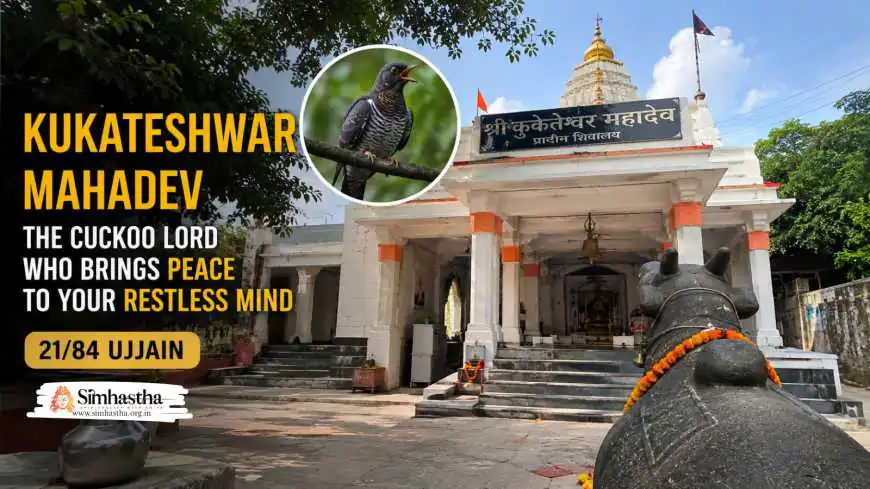


Kukateshwar Mahadev: The Cuckoo Lord Who Brings Peace to Your Restless Mind – 21/84 Ujjain
There Is a Sound That Can Heal a Screaming Mind – And Shiva Made It Sacred 🕊️
Your mind is never quiet, is it? Even now, as you read these words, there is a background hum of thoughts – what you need to do tomorrow, what someone said yesterday, what you should have said instead, the endless to-do list, the worry that has no name. Some days it feels like a radio playing ten stations at once. Other days it is a single, piercing scream of anxiety. You have tried meditation – but your mind only got louder. You have tried distraction – but the noise follows you into sleep. You have tried alcohol, Netflix, exercise – temporary relief, then the static returns.
Now imagine a sound that is not noise but medicine. The call of the cuckoo bird – soft, clear, rhythmic, unhurried. In the early morning, deep in the sacred Mahakal forest of Ujjain, that call still echoes. And at the 21st shrine of the legendary 84 Mahadev Yatra, Lord Shiva has taken that sound as his signature. His name is Kukateshwar Mahadev – also spelled Kukkuteshwar – the Lord of the Cuckoo's Cry .
He does not promise to silence your mind. He promises to tune it – like a musician tuning an instrument – until the noise becomes music and the music becomes peace. The Skanda Purana's Avanti Khanda mentions this sacred shrine, and it is believed that mere darshan here can liberate ancestors from animal rebirths – such is the power of this divine sound .
If you have ever felt exhausted by your own thoughts, overwhelmed by emotional chaos, or simply hungry for a quiet that is not just the absence of sound but the presence of harmony – this Mahadev is waiting for you. Let me take you into his temple and show you how a bird's song and a Shiva Linga can become the antidote to the screaming of the modern mind.
Trending Guides Now
Guheshwar Mahadev Temple, Ujjain: The Sacred Cave of Lord Shiva
Shri Kapaleshwar Mahadev Ujjain – The Sacred Site Where Shiva’s Kapal Vrat Was Completed
Lokpaleshwar Mahadev: 12/84 Ujjain's Cosmic Protector

Kalakaleshwar Mahadev: 18/84 Ujjain's Time Pacifier

Ujjain Railway Station to Mahakaleshwar Temple Distance (2026 Guide)

Ujjain Simhastha 2028 Dates Announced: Full Shahi Snan & Event Timeline

Mahakaleshwar Sandhya Aarti Online Booking 2026: Fee, Timings, Entry Gate and Step-by-Step Process

Mangalnath Temple Trip Budget: Puja, Local Transport, Food and Stay Planning
The 21st Mahadev: Where the Yatra Finds Its First True Silence 🌿
By the time a pilgrim reaches the 21st temple of the Chaurasi Mahadev circuit in Ujjain, they have been through protection, energy balance, boundaries, and vigilance. Now, at number 21, they meet Kukateshwar – the Mahadev of inner peace and mental harmony.
The number 21 in Hindu tradition is associated with completion and transition. There are 21 chakras in some tantric texts (beyond the usual seven). There are 21 levels of mind in certain Shaiva classifications. And 21 is the number of days often recommended to break a habit – including the habit of mental noise. Kukateshwar as the 21st Mahadev represents the threshold where the seeker stops fighting the mind and starts listening to it – not as an enemy, but as a cuckoo that can be trained to sing a sweet song.
I once met a corporate executive who had come to this temple after a panic attack that landed him in the hospital. He told me, "My mind never stopped. Meetings, deadlines, emails, performance reviews – the noise was continuous. I thought I was going crazy." The priest at Kukateshwar gave him a simple practice: "Every morning, before you check your phone, go to your window and listen for the first bird that sings. Do not name it. Do not analyze it. Just listen. Then chant this Mahadev's verse once. Then go about your day." The executive did this for 21 days. He told me later, "The noise didn't disappear. But it moved. It became background, not foreground. I could hear my own breath again."
That is the gift of the 21st Mahadev. Not the absence of sound. But the presence of peace within sound. The cuckoo does not live in a silent forest. It lives in a forest full of sounds – but its own voice is clear, pure, and calming. Kukateshwar teaches you to become that cuckoo – not by escaping the world, but by finding your own note within the chaos.
Kuka: The Sacred Cuckoo Whose Call Is a Mantra 🎵
Let me explain the name Kukateshwar because it holds the entire teaching of this temple. Kuka (or kokila) is the cuckoo bird – specifically the Indian cuckoo (Cuculus micropterus) whose call is a clear, two-note sound often rendered as "kuh-oo". In Sanskrit poetry, the cuckoo is associated with spring, love, yearning, and sweetness. But in Shaiva spirituality, the cuckoo represents something deeper: pure awareness that calls out from within the dense forest of thoughts.
The cuckoo is famous for its persistence. It calls and calls, not for an audience, but because calling is its nature. It does not try to silence the other birds. It simply adds its voice to the symphony. And somehow, that single, clear note can cut through the cacophony and bring a moment of peace to the listener.

Kukateshwar Mahadev is Shiva as that cuckoo. He does not shout to be heard. He sings – softly, persistently, sweetly – and those who listen find their minds settling like dust after a storm.
The temple is located on Gandharva Ghat below the Udasin Akhara at Ram Ghat, and it houses an ancient black stone idol of Shiva along with idols of Ganesha, Kartikeya, Parvati, and Nandi . The presence of two conch shells, along with sun and moon idols, makes this shrine architecturally unique .
The Devotional Sanskrit Verse captures this beautifully:
कुकुटितनादसंयुक्तं महाकालवने स्थितम्।
शान्तिदं देवं तं कुकाटेश्वरं भजे॥
Let me translate this into the language of a tired mind.
Kukutitanadasamyuktam – "Associated with the sound of the cuckoo." Not just any sound. A specific, soothing sound that has been sacred for millennia.
Mahakalavane sthitam – "Established in the Mahakal forest." The same timeless forest where Mahakaleshwar destroys time. So Kukateshwar is the peace that exists beyond the temporal noise of the mind.
Shantidam devam – "The god who bestows peace." Not temporary relief. Shanti – deep, abiding, unshakeable peace.
Tam Kukateshvaram bhaje – "I worship that Kukateshwar."
When you chant this verse, especially in the early morning when the birds are active, you are not just reciting words. You are attuning your mind to the frequency of the cuckoo – and through it, to Shiva's own peaceful vibration. Chant it 11 times at sunrise for 21 days. You will notice that the noise in your head does not stop – but it softens. It becomes less urgent. And sometimes, in the space between two thoughts, you will hear – not a sound, but a silence that is alive.
The Legend of Kukateshwar: A King, A Curse, and Liberation from Animal Rebirth 👑
The name Kukkuteshwar (another common spelling) has a fascinating backstory rooted in the Skanda Purana that explains why this temple holds such power for ancestral liberation .
Long ago, there was a king named Kaushik. He was a good ruler, but he had one terrible problem – during the day, he lived as a human, but every night, he would transform into a rooster (kukkut). His queen, Vishala, was distraught. She could not receive marital happiness from a husband who became a bird every night. Desperate, she approached Rishi Galava in his ashram .
The sage revealed that in a previous life, King Kaushik had been the son of King Vidurata. As a prince, he had eaten the flesh of many roosters. The king of roosters, Tamrachud, cursed him to suffer from a disease and be reborn as a rooster every night in his next life .
Queen Vishala asked for a remedy. The sage instructed her to go to the Mahakal forest and worship the Shiva Linga located there. She performed the prescribed puja, and a miracle occurred – King Kaushik was freed from his curse and his rooster form. The Shiva Linga at that spot became known as Kukkuteshwar Mahadev .
This legend explains the temple's profound importance: it is believed that ancestors (pitrs) who are suffering in the bodies of animals, insects, reptiles, or other yonis can be liberated simply by offering prayers here . The Pitru Paksha period and Shivaratri see the highest footfall at this shrine for this very reason .
Why Devotees Seek Kukateshwar – Mental Peace, Emotional Stability, and Ancestral Liberation 🙏
Let me get practical. Kukateshwar Mahadev is for anyone who lives inside a noisy mind – or carries the burden of unreleased ancestors. Here is how he helps with specific struggles.
For Racing Thoughts and Insomnia 💤
Your mind races at night. You lie in bed, and the thoughts – about work, about relationships, about what you said five years ago – refuse to stop. Kukateshwar offers a remedy that is not about suppressing thoughts but soothing them.
The ritual: Before sleeping, face northeast (or the temple direction). Light a small ghee lamp. Chant the Kukateshwar verse 5 times slowly. Then, as you lie down, imagine the sound of a cuckoo – soft, two-note, distant – in your mind. Do not force it. Just invite it. Many devotees report falling asleep faster and waking less during the night after 21 days of this practice.
For Overthinking and Rumination 🔄
You replay conversations. You analyze what you should have said. You catastrophize future events. Your mind is a broken record that plays the same loop. Kukateshwar helps you break the loop.
The practice: Whenever you catch yourself ruminating, stop and chant the Kukateshwar verse once – out loud if possible. The vibration of your own voice, combined with the meaning of the verse, interrupts the thought loop. Then take three deep breaths. Do this every time you notice overthinking. Within a week, the loops become shorter. Within a month, they lose their power.
For Emotional Turmoil (Anxiety, Grief, Anger) 🌪️
Your emotions feel like a storm – unpredictable, overwhelming, exhausting. Kukateshwar does not deny your emotions. He harmonizes them. The cuckoo's call is not emotionless – it is yearning, sweet, melancholic at times. But it is clear, not muddled.
The ritual: On a Monday morning, bring a small recording of a cuckoo's call (or find one on your phone). At the temple (or at home facing the temple direction), play the call softly while offering white flowers to the linga. As you listen, let your emotion – whatever it is – rise and fall with the sound. Do not judge it. Do not hold it. Just let it move through you. After the recording ends, sit in silence for 5 minutes. Many devotees report feeling lighter, as if the emotional storm has passed or weakened.
For Ancestral Liberation and Pitru Peace 🌸
According to the Skanda Purana, ancestors trapped in animal or insect yonis can be freed through prayers at Kukateshwar . This is especially significant during Pitru Paksha (the 15-day period honoring ancestors).
The ritual: On Amavasya (new moon) or during Pitru Paksha, bring black sesame seeds, water, and white flowers to the temple. Offer jal abhishek while chanting the Kukateshwar verse 11 times. Mentally name your ancestors (or say "all my ancestors, known and unknown"). Pray: "Kukateshwar, liberate my ancestors from all lower births. Grant them peace and release."
The Deep Spiritual Lesson: Peace Is Not Silence – It Is Clarity Within Sound 🧘
Now let me take you into the core teaching of Kukateshwar Mahadev. It is a teaching that modern meditation often gets wrong.
Most people think peace means no sound. They go on silent retreats, they soundproof their rooms, they avoid people. But life is sound. The world is noise. And if you need silence to be peaceful, you will never be peaceful for long.
Kukateshwar offers a different path. He says: Peace is not the absence of sound. Peace is the presence of clarity within sound. Imagine a busy market – vendors shouting, children crying, horns honking. In the middle of it, a cuckoo sings. Its call is not louder than the market. But it is distinct. And if you train your ear, you can hear it clearly even among the chaos.
Your mind is that market. The thoughts are the vendors. The cuckoo is your awareness – soft, persistent, clear. Kukateshwar does not stop the thoughts. He sharpens your awareness so you can hear the peace underneath the noise. That peace was always there. You just could not discern it.
I recall a young mother who came to this temple with postpartum anxiety. Her mind was a scream of worries – about the baby's health, about her own body, about her marriage. The priest told her: "When the baby cries, do not try to silence the cry. Instead, listen for the breath between the cries. That breath is Kukateshwar. It is always there. It is peace." She practiced this. Within weeks, the cries of her baby no longer sent her into panic. She could hear the stillness underneath. That is Kukateshwar's grace.
Rituals for Inner Harmony – Simple, Soothing, and Sound-Based 🪔
Here are the traditional rituals at Kukateshwar Mahadev for mental peace, emotional stability, and ancestral liberation. Notice how many of them involve listening – because peace is not forced, it is received.
At the Temple (Ujjain) – Step by Step
-
Early Morning Visit – The best time for Kukateshwar is Brahma Muhurta (4:30-5:30 AM) when the birds are most active. If you cannot come that early, sunrise is the next best. 🌅
-
Jal Abhishek – Pour water over the linga in a slow, steady stream. The sound of the water should be soothing – not a fast pour, but a gentle flow. Listen to it as you pour.
-
Bilva Leaves – Offer three leaves – for body, speech, and mind. As you offer each, say: "Kukateshwar, quiet my body. Quiet my speech. Quiet my mind."
-
White and Yellow Flowers – White for purity of peace, yellow for clarity (the color of dawn when cuckoos call). Offer them together.
-
Chant the Verse – Recite the Kukateshwar verse 11 times – but slowly, almost like a lullaby. Do not rush. Let each syllable vibrate in your chest.
-
Silent Listening – Finally, close your eyes and listen to the temple's ambient sounds – the bells, the birds, the footsteps, the priest's hum. Do not label them. Do not judge them. Just hear. Do this for 5-10 minutes. This is the heart of Kukateshwar's darshan.
At Home – For Daily Noise Management
Create a morning listening practice. After waking, before looking at any screen, open your window. Stand for 2 minutes and listen to the sounds outside – not just birds, but everything. Then chant the Kukateshwar verse once. Then go about your day. This small ritual will recalibrate your relationship with noise. You will stop fighting the sounds of life and start including them in your peace.
Best Days and Special Observances 📅
-
Brahma Muhurta (daily, before dawn) – The best time for listening.
-
Mondays – General Shiva worship. Combine with listening practice.
-
Purnima (Full Moon) – The moon is associated with mind. A full moon is a calm mind. Excellent for Kukateshwar.
-
Shravan Maas (July-August) – The monsoon brings different bird songs. This is a special time for Kukateshwar worship.
-
Pitru Paksha (September-October) – For ancestral liberation prayers.
-
Mahashivaratri – The great night – thousands of devotees visit for special darshan .
What NOT to Offer
Do not offer loud or harsh items – chimes, drums, firecracker remnants. Avoid red flowers (agitation) – stick to white and yellow. Never pray with a racing heart expecting instant silence – Kukateshwar works gradually, like a cuckoo that calls at dawn not midnight. Also, do not force silence on others in the temple – peace is shared, not imposed.
A Walk to Kukateshwar Mahadev – Location and Darshan Experience 🚶
Exact Address: Kukuteshwar Mahadev Temple (21/84) – spelling varies as Kukateshwar, Kukkuteshwar, or Kukuteshwar. Located on Gandharva Ghat, below the Udasin Akhara, at Ram Ghat, Ujjain, Madhya Pradesh .
How to Reach 🚗
-
From Mahakaleshwar Temple – About a 15-20 minute walk toward Ram Ghat. The temple is situated on Gandharva Ghat below the Udasin Akhara. An auto-rickshaw takes 5-7 minutes (₹35-45). Tell the driver "Kukateshwar, ikkiswan number" (21st). Some locals call it "Koyal wala Mahadev" (the cuckoo Mahadev).
-
From Ujjain Railway Station – Auto to Ram Ghat (₹50-60). Then walk toward Gandharva Ghat. The temple is located below the Udasin Akhara.
-
By Bus – City buses to Ram Ghat or Dewas Gate. From the stop, a 10-minute walk. Ask for "Kukateshwar" – regular 84 Mahadev pilgrims know it well.
What You Will See 👀
Kukateshwar Temple is small and unassuming – located on the banks of the Shipra River at Gandharva Ghat. The Shivalinga is an ancient black stone idol. The temple also houses Parvati, Kartikeya, Ganesha, and Nandi idols, along with two conch shells and sun and moon idols – a unique feature not found in other Mahadev shrines .
The most unique feature here is the temple's connection to ancestral liberation. The Skanda Purana mentions this shrine specifically – a rare honor among the 84 Mahadevs .
Behind the temple, there is a view of the Shipra River – the ghat setting adds to the peaceful atmosphere. The priests encourage pilgrims to sit on the ghat steps after darshan and listen to the sound of the water and birds.
The priests at Kukateshwar are soft-spoken, elderly, and patient. They understand mental suffering more than most. If you tell them you are anxious or insomniac, they will not give you a lecture. They will simply say, "Come again at dawn. Listen. That is all."
The best time for darshan is Brahma Muhurta (4:30-5:30 AM) or sunrise (6-7 AM). The temple is peaceful at these hours. Pitru Paksha and Mahashivaratri see larger crowds but the energy is powerful .
How Kukateshwar Heals the Modern Noise Addiction 📱
Let me speak about a modern addiction that no one diagnoses: noise addiction. We have earbuds in constantly – podcasts, music, audiobooks, white noise. We cannot be alone with our thoughts for five minutes without reaching for a screen. We have forgotten how to listen – how to rest in the ambient hum of existence. And the result? Our minds are malnourished from lack of true silence, yet overstimulated from fake noise.
Kukateshwar Mahadev is the prescription. He does not ask you to stop listening to music. He asks you to add listening to life back into your day. One bird call. One breath. One verse. That is enough.
A college student came to this temple addicted to his phone. He checked social media every few minutes. His attention span was gone. The priest gave him a challenge: "For one week, every time you feel the urge to check your phone, first chant 'Kukateshwar' once. Then wait 10 seconds. Then check." The student did this. Within a week, he noticed how automatic the urge was – and how unnecessary most of the checks were. He still uses his phone, but the compulsion is weaker. And he now starts his day with 2 minutes of listening to birds. That is Kukateshwar's grace – not rejection of technology, but rebalancing of the inner ear.
Another devotee, a school teacher with burnout, had tinnitus (ringing in the ears) from stress. Doctors said it was incurable. At Kukateshwar, the priest told her: "Do not fight the ringing. Listen to it as if it were a cuckoo. It is also a sound. Give it the same acceptance." She practiced this. The tinnitus did not disappear – but her suffering from it disappeared. She could sleep again. That is Kukateshwar's miracle – not changing the sound, but changing your relationship to sound.
The Quiet Call: What Kukateshwar Whispers to Every Exhausted Soul 🕊️
When you leave Kukateshwar Mahadev Temple, you will not feel dramatically different. Peace does not announce itself with fireworks. It arrives softly, like a cuckoo's call at dawn – you are not sure if you heard it, until you realize you are smiling.
Kukateshwar does not fix your life. He tunes your perception. The noise will still be there – the demands, the deadlines, the arguments, the fears. But you will have a new ability: to hear the cuckoo within the cacophony. And that cuckoo is Shiva. And that Shiva is peace itself.
So go ahead. Stop fighting the noise. Stop begging for silence. Just listen. Just chant. Just breathe. Kukateshwar is calling. Can you hear him? 🎵
Frequently Asked Questions