



















Why 13 Akharas Are Recognised in Simhastha
Why are exactly 13 akharas recognised in Simhastha? This in-depth guide explains the historical, doctrinal, administrative, and ritual reasons behind akhara recognition in Ujjain.
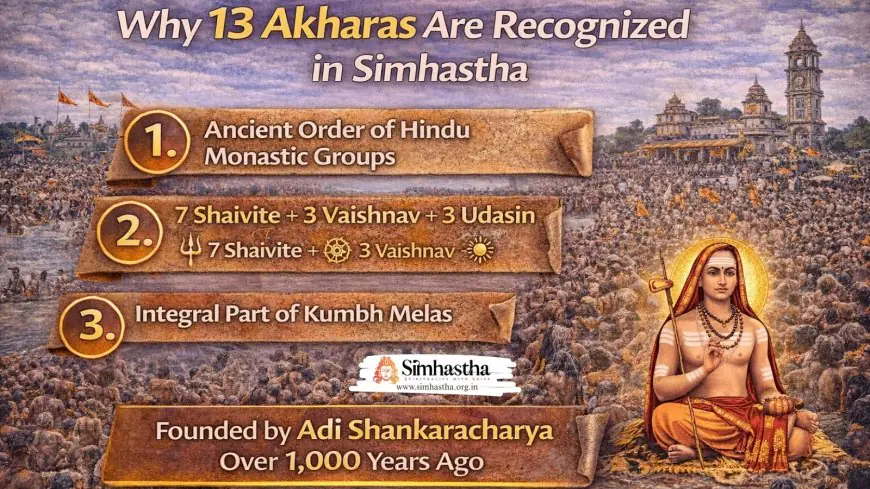


Why 13 Akharas Are Recognised in Simhastha
Thirteen akharas are recognised in Simhastha because they represent the complete, historically continuous, and institutionally verified ascetic orders of Sanatan Dharma.
Only these 13 akharas meet the combined criteria of lineage continuity, doctrinal legitimacy, organizational discipline, and ritual responsibility required to govern Simhastha.
Also Read | Ujjain Simhastha - Meaning, History & Why It Matters
Recognition in Simhastha Is Institutional, Not Numerical
A common misconception is that the number 13 has symbolic or mystical significance. It does not.
The recognition of 13 akharas in Simhastha is not based on numerology, belief, or modern consensus. It is the result of a centuries-long institutional filtration process.
Trending Guides Now

How Naga Sadhus Begin Their Day: Ancient Discipline and Yogic Power

Who Are the Naga Sadhus of Simhastha 2028? Discipline, Rituals & Mystical Identity Revealed

The Untold Reason Naga Sadhus Lead the First Shahi Snan at Simhastha 2028

How Akharas Manage Thousands of Followers During Kumbh

Ujjain Railway Station to Mahakaleshwar Temple Distance (2026 Guide)

Ujjain Simhastha 2028 Dates Announced: Full Shahi Snan & Event Timeline

Ujjain Simhastha Update: CM Mohan Yadav Reviews 2028 Works

Ujjain Railway Station to Kal Bhairav Temple: Distance, Auto Fare and Best Route
Simhastha is not open to every spiritual group, monastery, or sect. It is governed by recognised ascetic institutions that have proven their authority over time.
This is why questions like why 13 akharas, why only 13 akharas, and akharas recognised in Simhastha carry such high informational intent.
What “Recognition” Actually Means in Simhastha
Recognition in Simhastha does not mean participation alone.
For an akhara, recognition grants the right to:
-
Participate in Shahi Snan
-
Establish camps within Simhastha zones

-
Initiate disciples during Simhastha
-
Take part in ritual governance councils
-
Influence religious discipline and order

Only akharas that fulfill all responsibilities of Simhastha akhara authority are recognised.
This is why Simhastha akhara system is restrictive by design.
Also Read | Simhastha 2028 Dates Officially Announced
The Four Core Criteria for Akhara Recognition
An akhara is recognised in Simhastha only if it satisfies all four conditions below. Failing even one results in exclusion.
1. Unbroken Lineage Continuity
Recognised akharas demonstrate uninterrupted guru-shishya lineage spanning centuries. This continuity proves doctrinal stability and prevents opportunistic formations.
This requirement filters out newly formed groups, regardless of popularity.
2. Doctrinal Clarity and Classification
Each recognised akhara must clearly belong to one of the accepted doctrinal streams:
-
Shaivite
-
Vaishnav
-
Udasi
This is why shaivite vaishnav akharas form the backbone of Simhastha governance.
Ambiguous or syncretic sects without defined doctrinal alignment are not recognised.
3. Institutional Discipline and Structure
Recognition requires:
-
Formal hierarchy
-
Initiation rules
-
Internal governance
-
Code of conduct
This institutional rigor is essential because Simhastha involves millions of pilgrims and high-risk ritual events like Shahi Snan.
4. Historical Participation in Kumbh Tradition
All 13 akharas Simhastha have documented participation across Kumbh cycles.
This historical presence proves that they are not occasional participants but permanent custodians of the tradition.
Why New Akharas Are Not Added
A frequent question is why new akharas are not recognised.
The answer is simple:
Simhastha is not an open membership system.
Adding a new akhara would:
-
Disrupt ritual precedence
-
Break Shahi Snan order
-
Create doctrinal conflict
-
Dilute institutional authority
This is why why only 13 akharas remains a fixed answer across centuries.
The Functional Role of Each Akhara
Each of the akharas recognised in Simhastha serves a specific function:
-
Some uphold extreme asceticism
-
Some preserve devotional discipline
-
Some maintain scriptural transmission
Together, they form a complete spiritual ecosystem. No single akhara can replace another without imbalance.
This functional completeness is why the number has remained unchanged.
Akharas as Governors, Not Participants
One of the most misunderstood aspects of Simhastha is the role of akharas.
Akharas do not attend Simhastha.
They govern Simhastha.
This governance includes:
-
Approving Shahi Snan timing
-
Enforcing ritual discipline
-
Resolving doctrinal disputes
-
Coordinating with administration
Only akharas with proven capacity for governance are recognised.
Also Read | How Akhara Allocation Happens In Simhastha
Why Recognition Is Stricter in Simhastha Than Other Kumbhs
Simhastha in Ujjain is uniquely tied to Mahakal, the Lord of Time.
Because Simhastha is governed by time authority, its ritual discipline is stricter than other Kumbh gatherings. This is why ujjain simhastha akharas follow the most rigid recognition framework.
Recognition Protects the Tradition
The purpose of limiting recognition is preservation, not exclusion.
By recognising only 13 akharas, Simhastha ensures:
-
Stability across generations
-
Resistance to commercialization
-
Protection from ideological dilution
-
Clear spiritual authority
This is the foundation of simhastha religious governance.
Also Read | Who Are the Naga Sadhus of Simhastha 2028?
Why This Understanding Matters for Every Simhastha Pilgrim
Understanding why 13 akharas are recognised in Simhastha helps pilgrims realise that Simhastha is not a crowd-driven event but an institutionally governed spiritual system.
Every ritual, restriction, and procession flows from this recognition structure. When pilgrims respect it, Simhastha remains authentic. When they ignore it, confusion follows.
This article is part of a larger Simhastha knowledge framework explaining how authority, discipline, and tradition work together. Explore our detailed guides on akharas, Shahi Snan order, ritual zoning, and Simhastha governance to gain complete clarity.
Related Simhastha 2028 Guides :
- Why Simhastha 2028 Is Being Planned as a City That Exists Only for Pilgrims
- Why Snan Dates Shift According to Planetary Positions in Simhastha
- Simhastha 2028 Dates Officially Announced: Full Event & Shahi Snan Timeline
- Top 10 Routes to Enter Ujjain During Simhastha 2028 Without Traffic Hassles
- How to Travel Inside Ujjain During Simhastha 2028: Routes, Maps and Movement Plans
- How to Travel in Ujjain During Peak Snan Days: Do’s & Don’ts for Simhastha 2028
- Solo Travel Guide for Simhastha 2028: Safety, Budget, Stay & Movement Tips
- Mumbai to Ujjain for Simhastha 2028: Fastest Routes & Budget Tips
- Bengaluru to Ujjain for Simhastha 2028: Night Travel vs Day Travel Comparison
- Delhi to Ujjain for Simhastha 2028: Fastest Same-Day Travel Plan for Pilgrims
Frequently Asked Questions