
































How Ancient Astronomers Used Ujjain as a Time Reference
Discover how ancient astronomers used Ujjain as a time reference. Explore the prime meridian, Surya Siddhanta, Shanku Yantra, and the cosmic clocks that made this city the centre of Hindu astronomy.


The Zero Meridian of Bharat and the Shadow of the Shanku
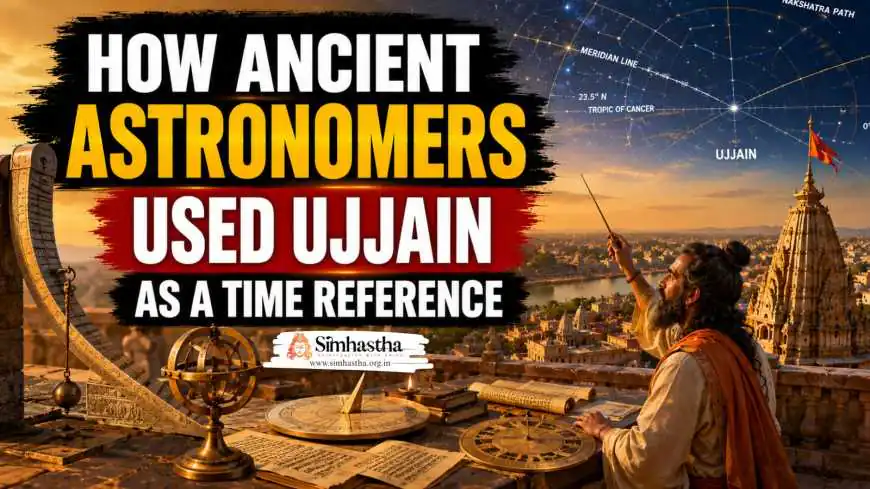
The primary instrument that transformed Ujjain into the cosmic clock was not a complex machine of gears, but a simple, elegant, and brutally precise vertical pillar known as the Shanku Yantra, the gnomon. The Surya Siddhanta, the foundational astronomical treatise that reached its definitive form in the Gupta era, makes an unambiguous declaration: the line of longitude passing through the city of Avanti—Ujjain—is the zero meridian of the earth. This was not a cultural suggestion; it was a mathematically defined baseline. The Shanku was the physical realization of this baseline, planted exactly at the point where the Tropic of Cancer and the zero-degree meridian intersect, a location so precise that on the summer solstice, the pillar cast absolutely no shadow at noon.
The ancient astronomers did not merely admire this phenomenon; they used it to calibrate time itself. The Shanku was a year-long clock. By meticulously measuring the length of its shadow every day at noon, they could mark the slow journey of the sun from the winter solstice, when the shadow was longest, to the summer solstice, when it vanished, and back again. This precise data was the raw material for the Panchangam, the Vedic almanac. It defined the duration of the solar year, the exact moments of the equinoxes, and the ayanamsa, the subtle drift of the equinoxes due to the earth's precession, a phenomenon the Surya Siddhanta acknowledges with remarkable precision. Every subsequent calculation of time—the division of the day, the naming of the months, the setting of festival dates—was ultimately traceable to the silent, shifting shadow of Ujjain's Shanku. 🗿
The Surya Siddhanta and the Division of the Celestial Day
The Surya Siddhanta did not just establish Ujjain’s meridian; it built an entire architecture of time around it. The text describes a day not merely as a period of sunlight, but as a precise celestial unit beginning at midnight at the Ujjain meridian. This concept of a sidereal day, anchored to the fixed stars rather than the sun, was revolutionary. The text calculated the duration of the year with an accuracy that differs from modern values by only a few minutes, and it laid out the complex interlocking cycles of the lunar synodic month, the solar year, and the 27 nakshatras. Because Ujjain was the zero point, all these cycles were measured and synchronized here. The Ujjain meridian was the "handshake" between cosmic and earthly time, the point where the irregular, messy motion of the human world was brought into alignment with the flawless, mathematical dance of the planets. For an astronomer, to know the time was to know Ujjain time. 📜
The Tropic of Cancer and the Solstice That Stops the Sun
Ujjain’s status as a time reference was physically written into the earth by its location on the Tropic of Cancer. This is the northernmost latitude where the sun can appear directly overhead, an event that occurs only once a year at the moment of the summer solstice, known as Karka Sankranti. At Ujjain, this event was not just observed; it was the most significant calibration point of the entire year. On this day, the gnomon cast no shadow at local noon. The sun stood absolutely still at the zenith, a momentary pause in the cosmic drama that ancient cultures understood as the "standing still" of the sun, the literal meaning of the word solstice. This singular, empirically verifiable moment was used to reset the calendar, to correct any accumulated errors in the timekeeping instruments, and to mark the beginning of the sun's southward journey. The city's alignment with the Tropic of Cancer meant that Ujjain was essentially a natural observatory, a place where the earth's own geometry provided the master key for unlocking the structure of the solar year. ☀️
Trending Guides Now
Why Ujjain Was Once Considered India's Prime Meridian
How Ujjain Helped Shape Ancient Indian Astronomy Calculations
Ancient Instruments Used at Jantar Mantar Ujjain Explained

Ujjain Railway Station to Mahakaleshwar Temple Distance (2026 Guide)

Ujjain Simhastha 2028 Dates Announced: Full Shahi Snan & Event Timeline

Mahakaleshwar Sandhya Aarti Online Booking 2026: Fee, Timings, Entry Gate and Step-by-Step Process

Latest Simhastha 2028 Development Projects Every Pilgrim Should Know

Mahakaleshwar Temple Entry Rules 2026: Dress Code, Mobile & Bag Policy
Varahamihira, Brahmagupta, and the Ujjain School of Time
The theoretical precision of the Shanku and the meridian was forged into a practical and powerful system of timekeeping by the galaxy of mathematical geniuses who worked in Ujjain. Varahamihira, the great 6th-century astronomer, compiled the Pancha Siddhantika, a comparative study of five earlier astronomical systems, and in doing so, standardized the methods for calculating time, eclipses, and planetary positions from the Ujjain baseline. His work ensured that the Ujjain meridian was not just a local standard but the standard for the entire subcontinent.
A century later, Brahmagupta, heading the Ujjain observatory, composed the Brahmasphutasiddhanta. Here, he formalized the astronomical concept of the day beginning at midnight on the Ujjain meridian and, in a stroke of genius, introduced the concept of zero and negative numbers to handle time calculations that spanned the zero point. The ability to mathematically cross the Ujjain meridian—to go from east to west longitude—was a conceptual breakthrough. Further refined by Bhaskaracharya II in the 12th century, the Ujjain school produced a continuous chain of precise, empirical timekeeping that was unrivalled in its era. These were not isolated mystics; they were a community of scientists arguing, refining, and building upon each other's work for half a millennium. 🧮
Jai Singh's Samrat Yantra and the Two-Second Timepiece
By the 18th century, the ancient precision had begun to drift, and Maharaja Jai Singh II embarked on a monumental mission to restore the empirical foundation of Indian timekeeping. He built five Jantar Mantars, but the one he raised in Ujjain was the most significant, a physical homage to the city's ancient status as the prime meridian. The centrepiece of this observatory is the Samrat Yantra, the "Supreme Instrument," a giant triangular sundial with a 22-foot-high gnomon. This is not a symbolic sculpture; it is a functional timepiece of breathtaking accuracy.
The two massive quadrants flanking the wall are precisely calibrated so that the shadow of the gnomon moves at the rate of one millimeter per second. This instrument can measure local time to an accuracy of two seconds. Jai Singh’s astronomers would use the Samrat Yantra to correct the existing astronomical tables, re-establishing Ujjain's role as the ultimate verifier of time, not through ancient texts, but through the irrefutable, moving shadow of the sun. To stand before the Samrat Yantra is to witness the Ujjain meridian made monument, a clock so large that you can watch time crawl across its marble face. 🕰️
The Calendar and the King: Vikram Samvat and Ujjain's Temporal Sovereignty
Time is not just a scientific measure; it is a statement of cultural and political identity. Ujjain's role as a time reference is immortalized in the Vikram Samvat, one of the two major calendar systems of India. Legendarily established by the great King Vikramaditya of Ujjain in 57 BCE, this calendar is a lunisolar system whose complex calculations—balancing the solar year with the lunar months—were performed by the astronomers of the city. While the calendar is a political and cultural artefact, its mathematical basis was maintained by the Ujjain observatory. Every new year, every intercalated month (adhika masa), and every festival date was calculated according to the meridian of the king's city. Even today, in vast swathes of North and West India, the turn of the year is a silent recognition of Ujjain’s ancient temporal sovereignty. The Vikram Samvat is a piece of Ujjain’s time that millions still carry in their daily lives. 📅
Simhastha.org.in/difference-between-simhastha-kumbh-mela-and-ardh-kumbh" class="contextual-link" data-post-id="11">Kumbh Mela Timing and the Astrological Clock of the Shipra
The most spectacular and globally recognized expression of Ujjain as a living time reference is the Simhastha Kumbh Mela. This gathering of millions is not scheduled by human convenience; it is triggered by a precise celestial event: the entry of the planet Jupiter (Brihaspati) into Leo (Simha) . The calculation of this exact moment, to the precise day and muhurta, is a direct descendant of the astronomical tradition of the Surya Siddhanta, computed from the meridian of Ujjain.

When the Kumbh astrologers, in consultation with the akharas, announce the Shahi Snan dates, they are reading a cosmic clock that has been ticking for two millennia. The act of the holy dip itself is synchronized to an astrological time standard whose zero point is the Shipra's bank. The great Kumbh is, therefore, a massive, participatory ritual in which millions of souls bathe not just in a river, but in a specific, sacred moment of time, a moment that was defined and is still calculated by the ancient timekeeping methods of the city. The entire Mela is a grand, dramatic proof that for the faithful, Ujjain is still where time itself is sanctified. 🔱
The Living Legacy and the Shadow That Still Moves
The lineage of ancient astronomers using Ujjain as a time reference is not a closed chapter of history; it is a continuous, living tradition that has simply transformed. The modern panchangam makers of India, who publish the almanacs that hang in millions of homes, still refer to the parameters established by the Surya Siddhanta. While modern technology may be used for the calculation, the fundamental data—the geographical coordinates of the zero meridian, the length of the solar year, the precession of the equinoxes as observed from Ujjain—is an inheritance from the Shanku Yantra and the minds of Varahamihira and Brahmagupta. The Jantar Mantar is a protected monument, but it is also still an active, functional observatory. Students, scientists, and curious pilgrims can still watch the shadow of the Samrat Yantra crawl across its marble scale, measuring time exactly as it did three hundred years ago. The city itself, though now surrounded by the noise of the modern world, is still geographically unique, still located on the Tropic of Cancer, still the place where the sun, once a year, stands directly overhead. Ujjain may no longer be the official prime meridian of the world, but it remains, for those who know its story, the meridian of the soul, a place where the ancient, cosmic clock has never stopped ticking. 🔭
Frequently Asked Questions