



















Ancient Instruments Used at Jantar Mantar Ujjain Explained
Explore the ancient instruments used at Jantar Mantar Ujjain. From the Samrat Yantra’s two-second sundial to the Nadi Valaya Yantra's equinox tracker, discover the stunning masonry marvels that made Ujjain the prime meridian of ancient India.


The Samrat Yantra and the Two-Second Sundial
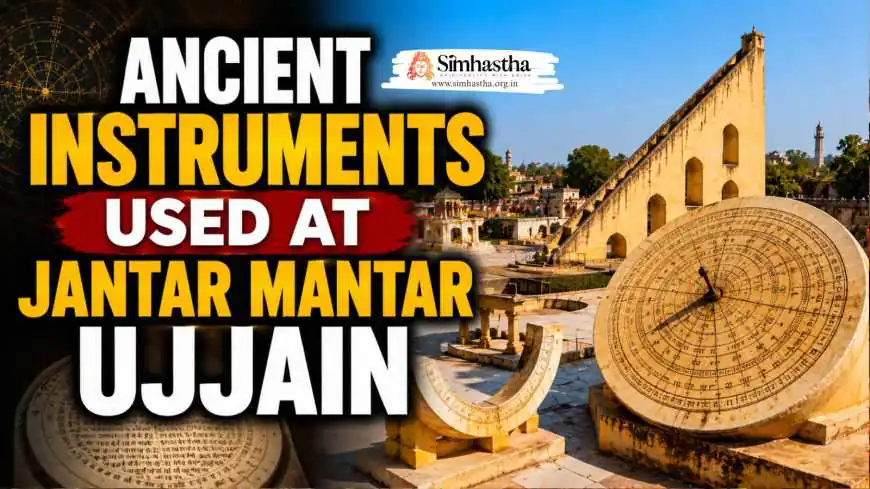
The undisputed king of the Jantar Mantar’s instrument collection is the Samrat Yantra, which translates to the “Supreme Instrument.” At first glance, it appears as a colossal, triangular wall, rising to a height of 22 feet, its sharp, straight hypotenuse slicing into the Ujjain sky. This is the gnomon, the shadow-caster, and it is the heart of what is arguably the world’s largest and most precise stone sundial. The two massive, curved quadrants that flank the wall, each adorned with meticulously engraved marble scales, are the dials upon which the shadow falls. The engineering is breathtaking in its simplicity and accuracy. As the sun moves across the sky, the shadow of the great triangular wall travels along the curved marble quadrants at a steady, measurable rate. The scales are so precisely calibrated that the movement of the shadow can be measured to an astonishing accuracy of two seconds. This means that, even today, you can stand before the Samrat Yantra, watch the silent, creeping shadow, and read the local solar time with a precision that rivals a modern quartz watch. The instrument is not merely a time-telling device; it is also used to determine the declination of the sun and other celestial coordinates, making it a multi-functional astronomical powerhouse. The sheer scale of the Samrat Yantra was a deliberate choice by its creator, Maharaja Jai Singh II. By building an instrument of such immense size, he effectively eliminated the tiny errors of measurement that plagued smaller brass and metal instruments. The larger the quadrant, the finer the gradations of the scale could be, and the more accurately a position could be read. The Samrat Yantra is a monument to the belief that the pursuit of truth, whether spiritual or scientific, required tools of uncompromising grandeur and precision. 🕰️
How to Read the Shadow of the Supreme Instrument
The principle of the Samrat Yantra is elegantly simple. The triangular wall is aligned perfectly with the earth’s axis, pointing directly to the celestial north pole. The two quadrants on either side lie in a plane that is precisely parallel to the equator. As the earth rotates, the sun appears to move at a constant angular speed, and the shadow of the wall, therefore, travels across the equatorial quadrants at a uniform rate. One side of the quadrant is scaled to tell the time from the winter solstice to the summer solstice, and the other side is scaled for the second half of the year. The scales are not simple linear markings; they are sine-curve scales, ingeniously corrected for the sun’s declination, which is the reason the instrument can deliver such astonishing precision. The moment of local noon, when the shadow is at its shortest and the sun is perfectly aligned with the meridian, is the most dramatic and accurate reading of the day, and it was the moment upon which all other astronomical calculations of the Ujjain observatory were calibrated. ☀️
The Nadi Valaya Yantra and the Path of the Celestial Equator
Flanking the Samrat Yantra, or in the Ujjain observatory, designed as distinct, standalone structures, are the Nadi Valaya Yantras, instruments specifically crafted to measure the sun’s position relative to the celestial equator. These consist of two circular, hemispherical dials, one facing north and the other facing south, each graduated with the hours, minutes, and degrees of declination. The dial lies exactly in the plane of the celestial equator, and a thin, perpendicular rod, called the shanku, casts a shadow onto the graduated surface. The primary function of the Nadi Valaya Yantra is to determine the moment of the equinox. On the two days of the year when the sun crosses the celestial equator—the spring and autumnal equinoxes—the sun’s rays strike the dial face-on, and the shadow of the rod falls exactly along a specific, marked line. For the rest of the year, the shadow falls either to the north or south of this line, allowing the astronomer to measure the sun’s precise declination, the angle that defines the seasons. This instrument was essential for determining the length of the day, the entry of the sun into various zodiacal signs, and, crucially, for the accurate fixing of the solstitial points that form the foundation of any solar calendar. The Nadi Valaya Yantra is a testament to the Indian astronomical tradition’s deep understanding of the earth’s axial tilt and its geometric relationship to the sun. 🌐
The Digansha Yantra and the Pillar That Maps the Horizon
A deceptively simple but profoundly useful instrument in the Jantar Mantar’s collection is the Digansha Yantra, or the "Direction Instrument." At its core, it consists of a low, circular masonry pillar, often surrounded by a ring of small, radial walls or a graduated circle, with a series of sighting bars and cross-wires. The purpose of this instrument is to measure the azimuth of any celestial body—that is, its precise position along the 360-degree horizontal circle, measured from true north. To use the Digansha Yantra, the astronomer would align the sighting device with a specific star, planet, or even the sun’s rising or setting point on the horizon. The alignment would then be read against the graduated ring, giving the exact angular coordinate. This was critical work. Knowing the precise azimuth of the sun at its solstitial rising, for instance, was fundamental to verifying the cardinal directions, which were the foundation of the entire observatory’s alignment. All the other great instruments, including the Samrat Yantra, rely on an absolutely precise knowledge of the north-south meridian line. The Digansha Yantra was the tool that provided this foundational, orienting data, anchoring the entire observatory’s complex geometry to the physical reality of the earth. 🧭
Trending Guides Now

Why Ujjain Was Once Considered India's Prime Meridian
How Ujjain Helped Shape Ancient Indian Astronomy Calculations

How Ancient Astronomers Used Ujjain as a Time Reference

Ujjain Railway Station to Mahakaleshwar Temple Distance (2026 Guide)

Ujjain Simhastha 2028 Dates Announced: Full Shahi Snan & Event Timeline

Ujjain Railway Station to Kal Bhairav Temple: Distance, Auto Fare and Best Route

Ujjain Simhastha Update: CM Mohan Yadav Reviews 2028 Works

Mahakaleshwar Temple Entry Rules 2026: Dress Code, Mobile & Bag Policy
The Shanku Yantra and the Ancient Gnomon of the Prime Meridian
Before the towering Samrat Yantra was conceived, the simplest and most ancient of all astronomical instruments was the Shanku Yantra, the humble, vertical gnomon. At the Ujjain Jantar Mantar, the principle is honoured and made monumental. A perfectly vertical pillar, rising from a precisely levelled and graduated circular platform, the Shanku Yantra is a direct, physical descendant of the very instrument that, according to the Surya Siddhanta, first established Ujjain as the earth’s zero-degree longitude. The function is elemental: to measure the length and direction of the shadow cast by the sun. At local noon, the shadow is shortest and points perfectly due north, thereby establishing the cardinal directions with complete certainty. The length of this noon shadow varies throughout the year, and by measuring it daily, the ancient astronomers could determine the precise dates of the solstices and equinoxes and could calculate the sun’s declination. The most magical moment for the Shanku Yantra at Ujjain, the city that lies directly on the Tropic of Cancer, occurs on the summer solstice. On that day, the sun stands exactly at the zenith, and the pillar casts no shadow at all at noon. This is the ultimate empirical proof of the city’s unique geographical and cosmic alignment, a moment that has been observed and recorded by the astronomers of Ujjain for over two thousand years. 📏
The Vision of Jai Singh II and the Revival of the Ujjain Meridian
The ensemble of instruments at the Jantar Mantar was not built in a vacuum of pure scientific curiosity; it was a deeply motivated, almost desperate, act of cultural and intellectual preservation by a remarkable 18th-century ruler. Maharaja Jai Singh II of Jaipur, himself an accomplished astronomer and mathematician, was acutely aware that the ancient astronomical tables, which were still in use across India and which were based on the Ujjain meridian, had drifted into significant inaccuracy over the centuries. He found the small, portable brass instruments of his day to be mechanically limited and prone to error. His radical, visionary solution was to return to the ancient principles of the Shanku Yantra, but to execute them on a gigantic, immovable scale in stone and mortar, completely eliminating the errors of mechanical play. He built five such observatories across his realm, but the one at Ujjain held a unique, sacred significance. He chose this city deliberately, not for political reasons, but because it was the hallowed, historical zero-longitude Greenwich of the classical Indian world, the place where the Surya Siddhanta had fixed the prime meridian. By placing his greatest instruments on this specific ground, Jai Singh II was not merely building an observatory; he was making a monumental statement, physically re-anchoring the living tradition of Indian astronomy to its most ancient and powerful source. 🏛️
Reading the Heavens for Calendar and Cosmic Rituals
The instruments of the Jantar Mantar were never intended to be abstract, ivory-tower research tools. Their primary, daily function was profoundly practical and deeply interwoven with the religious and cultural life of the community. The precise measurements of the sun’s position, the exact moment of an equinox, and the determination of the lunar phases were all essential raw data for the creation of the Panchangam, the traditional Vedic almanac. Every major festival, from the Mahashivratri to the Simhastha Kumbh Mela, is timed according to an astrological calculation that is ultimately derived from the kind of celestial observations made by instruments like the Nadi Valaya Yantra and the Samrat Yantra. The most powerful example of this living connection is the Simhastha Kumbh Mela itself. The timing of the great pilgrimage is determined by the entry of the planet Jupiter into the zodiac sign of Leo. The precise moment of this celestial transition, down to the specific Muhurta of the sacred Shahi Snan, is a calculation that is a direct, intellectual descendant of the astronomical tradition that Jai Singh II sought to preserve and perfect with these very instruments. The Jantar Mantar, therefore, is not a dead museum; it is the silent, stone engine that, for centuries, has powered the celestial clockwork of Hindu sacred time. 📅
A Visitor's Guide to Witnessing the Instruments in Action
For the modern pilgrim or the curious traveler, a visit to the Jantar Mantar is a journey into the mind of a scientific giant. The instruments are most dramatic and most clearly functional when the sun is shining, as they are, with the exception of certain directional tools, fundamentally solar devices. The ideal time to visit is the early morning or late afternoon, when the low angle of the sun casts long, distinct shadows that are easy to observe moving across the stone scales. Noon is the most sacred and precise moment for the Samrat Yantra, when the shadow aligns perfectly with the meridian line. A knowledgeable guide, available at the site, can explain the function of each instrument and can often demonstrate how the shadow is read. The observatory’s interpretive signage has been significantly improved in recent years, allowing a self-guided visitor to understand the basic principles. The experience is not one of passive observation; it is one of active, intellectual participation. You stand where the greatest astronomers of the age once stood, you watch the same sun that they watched, and you see the same shadow fall upon the same marble, measuring the same, eternal, cosmic rhythm. The Jantar Mantar is a place where the abstract, intimidating mathematics of the cosmos is rendered into a tangible, visible, and deeply beautiful physical reality. ✅
The Living Legacy of Stone Giants That Still Measure the Cosmos
The true wonder of the ancient instruments at Jantar Mantar Ujjain is not just their size, their beauty, or their historical significance; it is the fact that, three centuries after they were built, they still work. The Samrat Yantra still measures time to a precision that can startle a visitor accustomed to digital clocks. The Shanku Yantra still marks the summer solstice with its annual, shadowless noon. They are not roped-off, inert museum pieces; they are active, functional, and profoundly alive. They represent a moment in human history when a brilliant mind realized that the path to ultimate accuracy lay not in complexity, but in a return to first principles, executed on a monumental scale. To stand among them is to feel a deep, unbroken connection to the ancient astronomers of the Surya Siddhanta, to the mathematical geniuses like Varahamihira and Brahmagupta who made Ujjain the scientific heart of a civilization, and to the 18th-century king who, in a final, magnificent gesture, inscribed their legacy onto the very earth of the sacred city. The instruments are silent, but they speak a timeless language of shadow and light, of geometry and faith, that continues to resonate, with quiet, unshakable authority, on the ancient, hallowed ground of the Tropic of Cancer. 🔭🔱

Frequently Asked Questions