











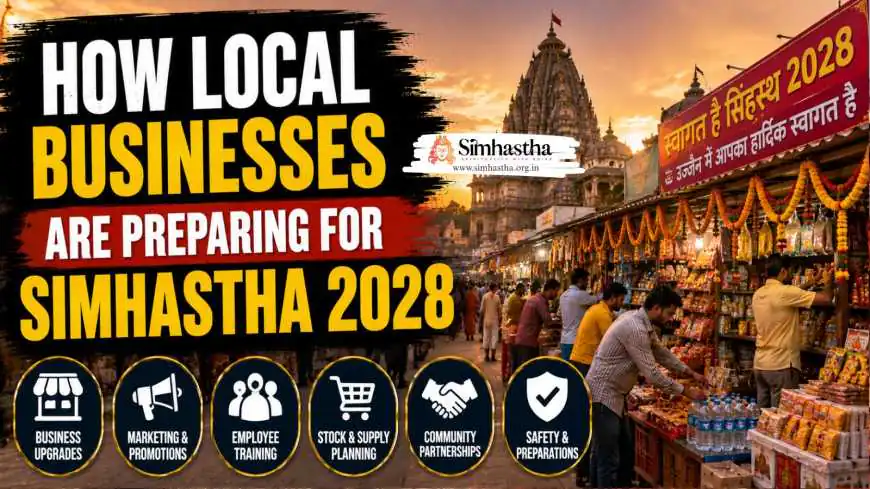
How Local Businesses Are Preparing for Simhastha 2028
Discover how local businesses are preparing for Simhastha 2028 in Ujjain. From homestays and auto drivers to artisans and digital startups, explore the entrepreneurial energy transforming Mahakal's city before the Kumbh.


The Homestay Revolution and the Family Home Turned Sacred Inn
The single most transformative wave of local business preparation is the homestay revolution. The Madhya Pradesh government's aggressive push to register 10,000 to 15,000 homestay rooms before 2028 has ignited a quiet, entrepreneurial fire in the residential neighbourhoods of Ujjain. Families who never imagined themselves in the hospitality business are now attending government-sponsored training workshops on guest management, basic hygiene, food safety, and the operation of the central digital booking portal. The second floor, which was once a dusty storage space for old trunks and winter blankets, is being renovated into a clean, simple, and welcoming guest room with an attached bathroom, a ceiling fan, and a small, private sitting area. The lady of the house is refining her grandmother's recipes for a simple, home-cooked Malwa thali that she will offer to her guests, and the son of the house is learning to manage the booking requests on his smartphone.
This preparation is not just about adding a few extra beds. It is a fundamental shift in the economic self-perception of Ujjain's middle-class families. They are becoming micro-entrepreneurs, direct stakeholders in the great pilgrimage, and the financial return they expect is not a windfall but a dignified, well-earned supplement to the family income. The government's scheme, which provides a small subsidy for essential renovations and a formal certification, has given this movement a structure and a legitimacy that was sorely lacking in the informal, unregulated homestay market of 2016. The families are learning to see their homes not just as private sanctuaries but as sacred inns, temporary abodes for the weary pilgrim, a modern echo of the ancient Indian tradition of atithi devo bhava—the guest is God. The preparation is, in its own way, a spiritual practice, a quiet, domestic consecration of the household to the service of Mahakal's children. 🏡
The Auto-Rickshaw Driver and the Classroom of Polite Pilgrimage
On a hot Tuesday afternoon, in a modest community hall near the Dewas Road, a group of fifty auto-rickshaw drivers, their faces weathered by the sun and the dust of the Malwa roads, sit on plastic chairs and repeat, in a hesitant, murmuring chorus, a simple English phrase: "Welcome to Ujjain, sir. Where would you like to go?" This is a government-organized skill development and pilgrim sensitivity workshop, and it is one of the most visible and moving signs of how Ujjain's vast, informal transport sector is preparing for 2028. The drivers, who are the unacknowledged first ambassadors of the city, are being trained not just in basic English and Hindi phrases, but in the soft skills of polite communication, in the geography of the new ring roads and satellite bus terminals, in the transparent operation of digital fare meters and UPI payment systems, and, crucially, in the gentle art of dealing with a tired, lost, and often anxious pilgrim.
The old culture of haggling, route refusal, and overcharging, which was a constant, low-grade sore in the 2016 Mela, is being systematically dismantled. The drivers are being encouraged to form cooperatives, to adopt a unified, government-approved fare card, and to see themselves not as independent, profit-maximizing operators but as a vital, respected, and regulated feeder service of the grand Mela transport grid. Many drivers are investing their own savings in refurbishing their vehicles—a new seat cover, a cleaner, more efficient engine, a working digital meter, and a small, laminated "Simhastha 2028 Authorised Driver" badge, which they are told will give them access to the dedicated auto-rickshaw stands at the new bus terminals and railway stations. The preparation is an act of professional self-respect, a collective decision to transform the chaotic, informal scrum of the past into a disciplined, welcoming, and trustworthy service that befits the sacred purpose of the pilgrim's journey. 🛺
Trending Guides Now
Why is Ujjain Kumbh Called Simhastha?

How Simhastha 2028 Transport Planning Integrates Rail, Road and Air in One Grid

Why Simhastha Can Only Happen in Ujjain: Scriptural & Astronomical Proof

Why Shahi Snan Is the Most Important Ritual of Simhastha 2028 ?

Ujjain Railway Station to Mahakaleshwar Temple Distance (2026 Guide)

Ujjain Simhastha 2028 Dates Announced: Full Shahi Snan & Event Timeline

Ujjain Simhastha Update: CM Mohan Yadav Reviews 2028 Works

Omkareshwar Trip Budget Guide: Transport, Stay, Food and Local Travel Costs
The Hotelier, the Guesthouse, and the Renovation of Sacred Hospitality
The formal hospitality sector of Ujjain, from the small, family-run lodges in the narrow lanes of the old city to the mid-range hotels on the main arteries, is in the grip of a pre-Mela renovation fever. The lessons of the 2016 Simhastha are being applied with a quiet, practical urgency. The guesthouse owner who received complaints about erratic hot water supply has invested in a new, rooftop solar water heater and a backup electric geyser. The hotel manager whose restaurant was overwhelmed during the morning rush has expanded the dining hall and is training additional kitchen staff, recruited from the local community. A new coat of paint, a more efficient check-in process, a laminated information card in every room detailing the Bhasma Aarti timings and the nearest shuttle stop—these small, incremental improvements are the building blocks of a transformed pilgrim experience. The larger hotels are investing in their own digital booking systems, signing agreements with the official Simhastha portal and with major online travel aggregators, and are working on their online reputation, responding to old reviews and updating their photographs. The preparation is not just about capturing the surge demand of a single month; it is about permanently elevating the standard of Ujjain's hospitality to meet the expectations of a new generation of pilgrims and international visitors, a standard that will continue to bear fruit long after the Mela tents are folded. 🏨
The Temple Food Trail and the Street Vendor's Hygienic Revolution
The thousands of small, family-run food stalls and street vendors that give Ujjain its unique flavour are undergoing a quiet, profound transformation. The poha-jalebi vendor, whose grandfather had served pilgrims from a simple, open cart, is now investing in a glass-enclosed, stainless-steel counter. The kachori seller is switching to biodegradable leaf plates and is proudly displaying a laminated government hygiene certificate. The small chai stall near the Mahakal gate has added a new, water-filtered tap and a hand-washing station for customers. This is the street food hygiene revolution, driven by a combination of gentle government regulation, a deep personal pride, and a shrewd business sense. The vendors understand that the modern pilgrim is more conscious of hygiene than ever before, and that a visible commitment to cleanliness is a powerful competitive advantage. The local administration, through its health department, has conducted a series of free training camps and inspections, offering certification to stalls that meet a basic standard. The vendors are also preparing their supply chains, forging stronger relationships with the local dairy cooperatives for their milk and curd, and with the farmers who supply the fresh coriander and the bright, tart lemons. They are preparing, in their own humble way, to feed the army of the faithful with food that is not just delicious and soul-satisfying but also clean, safe, and offered with a quiet, unspoken blessing. 🍽️
The Artisan, the Weaver, and the Digital Marketplace of Sacred Crafts
For the traditional artisans and craftspeople of the Malwa region—the Bhil painters, the Bagh print masters, the Maheshwari and Chanderi weavers—the Simhastha is a twelve-yearly lifeline, a direct, unmediated market of ten crore potential customers. Their preparation is a blend of the artistic, the logistical, and the digital. The weaver is creating a special, limited-edition Simhastha 2028 collection of stoles, shawls, and sarees, weaving the sacred motifs of the Om, the Shiva lingam, and the Shipra's eternal flow into the fabric. The Bhil artist is producing a series of small, affordable, and exquisitely painted canvases depicting the legends of Mahakaleshwar and the Kumbh. The metalworker is fashioning small, beautiful, and inexpensive copper and brass idols of Lord Shiva, designed to be a sacred souvenir that even the humblest pilgrim can carry home. And the most significant preparation is the digital leap. Many artisans are, for the first time, setting up a simple QR code for UPI payments, a change that opens them up to the cashless economy of the modern pilgrim. The Malyavaan Haat, the permanent 15-acre craft bazaar being built for the Mela, is their great, collective hope, and they are preparing their inventories, their packaging, and their own personal presentation for the day when their stall becomes a direct, sacred bridge between their ancestral art and the world. 🎨
The Language of Welcome and the Rise of the Multilingual Shopkeeper
A quiet, linguistic preparation is taking root in the shops and stalls of Ujjain. The shopkeeper who has, for decades, spoken only the rustic, warm dialect of Malwi is now learning to greet a customer with a simple, respectful "Namaste, how can I help you?" The small bookstore near the temple is investing in a shelf of basic, illustrated guidebooks in Hindi, English, and Marathi. The proprietor of a puja-thali shop has taught his young son, a college student, to handle the occasional foreign pilgrim who wanders in, and the boy, in turn, has created a small, laminated card with the prices of the main offerings written in clear Hindi, English, and simple, phonetic Gujarati. This is not a formal, government-mandated programme; it is an organic, entrepreneurial response to the anticipated diversity of the 2028 pilgrim crowd. The shopkeepers understand that the smallest gesture of linguistic welcome—a smile, a folded hand, a few words in a pilgrim's mother tongue—can transform a transactional encounter into a human connection, and that in the intense, often bewildering experience of the Mela, such a connection is a priceless gift. The city's business community is, in its own quiet, unadvertised way, becoming multilingual, a collective, polyglot welcome mat for the faithful of the entire subcontinent. 🗣️
Digital Ujjain, the UPI QR Code, and the Cashless Pilgrim
The digital payment revolution that has swept across India in the last few years is perhaps the most significant, invisible infrastructure upgrade that Ujjain's small businesses are adopting. The 2016 Simhastha was overwhelmingly a cash economy, with all the attendant problems of change, theft, and the sheer physical weight of currency. In 2028, the local grocer, the chaiwallah, the auto-rickshaw driver, the flower seller, and the prasad vendor are all, with varying degrees of digital literacy, embracing the UPI QR code. The small, laminated square, often stuck to a piece of cardboard and hung from a nail, is the great economic equalizer. The government's push for digital financial inclusion, the widespread availability of cheap smartphones, and the simple, undeniable convenience of a cashless transaction are all driving this shift. The local businesses are not just adopting a technology; they are entering the formal, documented economy. Each UPI transaction leaves a trace, builds a credit history, and opens a door to future loans and government schemes. The preparation of the local business for the Simhastha is, in this sense, a preparation for a permanently modernized, financially integrated future, a transformation that the Mela is catalysing but that will serve the city's economy for decades. 📱
The Practical Guide for the Pilgrim-Supported Local Economy
For the pilgrim who wishes to consciously support Ujjain's local economy, the preparation of these businesses offers a clear, practical map. Choose a government-registered homestay over a chain hotel, and your money will directly enter the household of a local family. Eat at a street stall that displays a hygiene certification, and you are rewarding a vendor who has invested in cleanliness. Hire an auto-rickshaw that displays the official Simhastha driver badge, and you are supporting a professional who has undergone training. Buy a souvenir from an artisan at the Malyavaan Haat rather than a generic, imported trinket from a tourist shop, and you are directly sustaining an ancient lineage of craft. Pay using UPI whenever possible, and you are helping a small business build its formal financial identity. The pilgrim's conscious choices are a powerful force, a silent vote of support for the local, the authentic, and the sustainable. The businesses that are preparing now, with a genuine commitment to quality, service, and respect, are the ones that deserve the pilgrim's patronage, and the pilgrimage itself becomes, in this conscious exchange, a sacred, economic ritual, a circle of grace that flows from the temple to the home, from the prayer to the purchase, and back again. ✅

The Shared Spirit of a City and the Quiet, Determined Preparation
In the end, the preparation of Ujjain's local businesses for Simhastha 2028 is not a frantic, last-minute scramble. It is a slow, steady, and deeply communal process, a city-wide, unspoken agreement that the great Kumbh is not just a burden to be managed but an opportunity to be honoured. The guesthouse owner, the auto driver, the artisan, and the street vendor are not isolated, competing economic units. They are, in their own understanding, part of a single, sacred ecosystem, and their preparation is an act of seva, a service to the pilgrim and, through the pilgrim, to Mahakal himself. The new coat of paint, the learned English phrase, the digital QR code, the hygienic glass counter—these are the tangible, visible signs of a city that is quietly, determinedly, and lovingly making itself ready to receive ten crore guests, to offer them a clean bed, a warm meal, a safe ride, and a beautiful, sacred memory that they will carry home in their hearts. The businesses of Ujjain are preparing not just their shops, but their souls, for the great, divine tide that is on its way. 🔱
Frequently Asked Questions