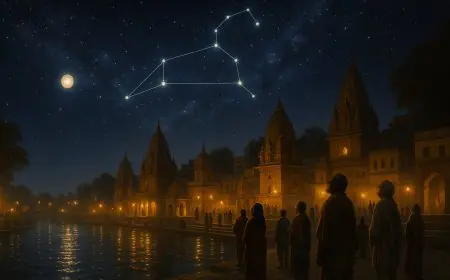



































Ujjain Is Considered a Time Aligned City in Hindu Cosmology
Discover why Ujjain is considered a time-aligned city in Hindu cosmology, where astronomy, astrology, geography, and Sanatan tradition converge.



Why Ujjain Is Considered a Time-Aligned City in Hindu Cosmology








For visitors, knowing the confirmed schedule is essential before planning travel and accommodation.The official dates announced for Ujjain Simhastha 2028 clearly define the start, peak bathing period, and closing timeline of the event, helping pilgrims align their visit with important ritual days.
Time (Kaal) in Hindu Cosmology Is Not Linear
To understand why Ujjain holds this unique position, one must first understand how Hindu cosmology defines time.
In Sanatan Dharma, Kaal is not a straight line progressing from past to future. It is cyclical, layered, and conscious. Time governs not only celestial motion but also:
-
The ripening of karma

-
The effectiveness of rituals
-
The timing of spiritual transformation
-
The rise and dissolution of cosmic phases

Because time itself is sacred and structured, it cannot be approached randomly. Certain locations were identified as more suitable for reading and aligning with cosmic time, just as certain moments were considered more potent than others.
Ujjain is one of the rare cities where these layers of time intersect clearly and consistently.
Why Geography Matters in Sacred Timekeeping
Ancient Indian knowledge systems did not separate astronomy, spirituality, and geography. All three were treated as interdependent.
For accurate time alignment, a city needed:
-
Stable solar paths
-
Predictable lunar visibility
-
Clear horizons for observation
-
Geographic consistency over centuries
Ujjain’s location satisfied these conditions exceptionally well.
Its latitude and longitude allowed astronomers to observe:
-
Solstices and equinoxes
-
Planetary conjunctions
-
Lunar nodes and eclipses
with a degree of consistency that made long-term correction possible.
This is why Ujjain was not merely observed from, but observed through.
If you are attending Ujjain Simhastha for the first time, this complete Simhastha Kumbh Mela first-time visitors guide will help you understand crowds, rituals, walking routes, and physical preparation before you arrive.
Ujjain as the Reference Meridian of Ancient India
Long before modern geography introduced the idea of a global prime meridian, Indian astronomers required a fixed reference point to standardise celestial calculations.
That reference was Ujjain.
Classical astronomical and jyotisha texts repeatedly use Ujjain longitude as the baseline for:
-
Calculating planetary positions
-
Fixing solar ingress (sankranti)
-
Aligning lunar months with solar years
-
Predicting eclipses
In practical terms, this meant that time across India was calculated with Ujjain as its anchor.
A city does not assume such authority through symbolism. It earns it through repeatable accuracy.
Observation (Pratyaksha) Over Belief
A defining strength of Sanatan intellectual tradition is its emphasis on direct observation.
Astronomical knowledge was built through:
-
Continuous naked-eye observation
-
Mathematical correction
-
Generational transmission
-
Verification across regions
For this process to work, the base location had to be reliable over centuries. Ujjain proved to be that location.
This is why even when political capitals shifted, Ujjain retained its cosmological authority. Time does not answer to power. It answers to precision.
The Role of Vedh Shala in Time Alignment
The existence of Vedh Shala in Ujjain is not incidental. It confirms the city’s role as a working center of time observation, not merely a symbolic one.
Vedh Shala functioned as an astronomical observatory, where instruments were designed to:
-
Measure solar declination
-
Track lunar phases
-
Observe planetary motion
-
Fix daily and seasonal time
These observations directly informed:
-
Ritual calendars
-
Festival timings
-
Astrological calculations
In effect, time was not imagined in Ujjain. It was read from the sky.
This practical engagement with cosmic time is a core reason Ujjain is considered time-aligned rather than time-referenced.
Also Read | Key Details About Vedh Shala (Jantar Mantar) Ujjain
Time in Hindu Thought Is Qualitative
Modern systems treat time as purely quantitative.
Hindu cosmology treats time as qualitative.
Certain periods are:
-
Spiritually charged
-
Transformative
-
Neutral
-
Obstructive
For such a system to function, cosmic timing must be accurate and trusted.
Because astronomical readings from Ujjain remained consistent, rituals performed according to Ujjain-based calendars were believed to align human action with cosmic order.
Over centuries, this trust became tradition.
Why Other Ancient Cities Did Not Become Time Anchors
India has many ancient cities, but only a few attained cosmological authority.
Most failed one or more of these criteria:
-
Astronomical consistency
-
Geographic suitability
-
Institutional continuity
Ujjain succeeded in all three.
It maintained:
-
Schools of astronomy and astrology
-
Ritual systems tied to planetary timing
-
Cultural transmission across centuries
This is why Ujjain’s temporal role survived political change, invasions, and social transformation.
Time, Spiritual Authority, and Cultural Continuity
In Sanatan Dharma, spiritual authority often flows from alignment with time, not dominance over space.
Kings ruled territories.
Ujjain ruled calendars.
This distinction explains why Ujjain remained relevant even when it was not politically dominant. Time alignment grants cultural immortality.
How Time Alignment Shaped Ujjain’s Identity
Because of its relationship with Kaal, Ujjain developed unique characteristics:
-
Rituals governed by planetary positions
-
Festivals tied strictly to cosmic timing
-
Temples emphasising time over territory
-
Spiritual practices focused on cycles, not milestones
Over time, the city itself became a living expression of temporal consciousness.
This identity would later find its most powerful expressions in:
-
Mahakaleshwar, the lord of time
-
Simhastha, the ritual of planetary convergence
-
Kshipra, the river of temporal flow
But before reaching those, one truth becomes clear:
Ujjain was not made sacred by belief.
Belief followed alignment.
Why This Understanding Still Matters
Calling Ujjain a time-aligned city is not a poetic label. It explains:
-
Why Simhastha depends on planetary positions, not dates
-
Why Mahakal governs time, not just death
-
Why astrology here emphasises correction, not fear
-
Why rituals feel time-sensitive rather than repetitive
Without this foundation, Ujjain appears ancient.
With it, Ujjain appears intentionally eternal.
How Ujjain’s Time Alignment Becomes Lived Spiritual Reality
The idea of Ujjain as a time-aligned city would remain incomplete if it were confined only to astronomy and theory. What makes Ujjain exceptional in Hindu cosmology is that its relationship with Kaal is not abstract. It is lived, ritualised, and experienced through daily worship, mass pilgrimages, rivers, temples, and astrological practice.
This is where cosmic time becomes human experience.
Mahakaleshwar: Time as a Deity, Not a Concept
At the centre of Ujjain’s temporal identity stands Mahakaleshwar Temple, one of the twelve Jyotirlingas of Lord Shiva.
Unlike other Jyotirlingas, Mahakaleshwar is not primarily worshipped as a destroyer or ascetic. Here, Shiva is Mahakal, the Lord of Time itself.
This distinction is crucial.
In Sanatan Dharma, death is only one function of time. Mahakal represents mastery over time, not submission to it. The deity here is not bound by cycles; he governs them.
This is why:
-
Mahakaleshwar faces south, symbolising authority over Yama, the god of death
-
Rituals here emphasise time of day, not only form
-
Worship is structured around when, not just how
The temple itself becomes a ritual clock, where each aarti marks a different phase of cosmic and human time.
Also Read | Key Details About Simhastha and Mahakaleshwar
Daily Ritual Time at Mahakaleshwar
One of the most overlooked aspects of Mahakaleshwar worship is its strict adherence to temporal discipline.
Each ritual corresponds to a specific state of time:
-
Pre-dawn rituals address unmanifest time
-
Morning aartis align with creation and awakening
-
Midday rituals stabilise sustaining time
-
Evening rituals acknowledge withdrawal
-
Night worship dissolves into timelessness
This is not convenience-based scheduling. It reflects a worldview where time itself is sacred and structured.
For devotees, worship at Mahakaleshwar is not about requesting outcomes. It is about placing oneself correctly within time.
Why Ujjain Is the City of Kaal, Not Just Shiva
Many cities worship Shiva.
Only Ujjain worships Kaal through Shiva.
This difference explains why:
-
Rituals here feel intense but grounding
-
Pilgrims often report altered perception of time
-
The city emphasises cycles over milestones
In Ujjain, time is not something to escape. It is something to understand, endure, and transcend.
The Kshipra River: Flowing Time Made Visible
The Kshipra River is not merely a geographical feature. In Hindu cosmology, rivers often represent time in motion.
The Kshipra is unique because:
-
It flows through a city aligned to time
-
Its rituals are governed strictly by planetary conditions
-
Mass bathing here occurs only when cosmic timing opens
Bathing in the Kshipra River is therefore not symbolic cleansing alone. It is an act of temporal alignment, synchronising individual karma with cosmic rhythm.
This is why snan in Ujjain is never arbitrary. It is always timed.
Also Read | Key Aspects of Kshipra in Simhastha
Simhastha: When Cosmic Time Opens a Window
The clearest expression of Ujjain’s time alignment is Ujjain Simhastha.
Unlike other pilgrimages fixed to calendar dates, Simhastha occurs only when:
-
Jupiter enters Leo
-
Specific solar and lunar conditions coincide
-
Ritual authority confirms cosmic readiness
This makes Simhastha a cosmic appointment, not a festival.
For twelve years, time remains closed.
Then, briefly, alignment occurs.
Millions gather not because of social tradition alone, but because time itself is believed to become accessible.
Why Simhastha Can Only Happen in Ujjain
Many cities are sacred.
Only Ujjain hosts Simhastha under these conditions.
This is because:
-
Jupiter’s movement is interpreted through Ujjain-based calculations
-
The presence of Mahakal anchors time spiritually
-
The Kshipra River provides ritual continuity
Without this triad, Simhastha loses cosmological legitimacy.
This is why Ujjain is not interchangeable with other Kumbh locations. Its role is specific and non-transferable.
Astrology in Ujjain: Time as Guidance, Not Fear
Astrology in Ujjain differs subtly but profoundly from popular astrology.
Here, planetary movements are treated as:
-
Indicators of timing
-
Opportunities for correction
-
Signals of alignment
Rather than predicting doom, Ujjain astrology focuses on when to act, pause, or realign.
Many classical astrological calculations reference Ujjain longitude, reinforcing its role as a temporal calibration point.
This is why remedies in Ujjain emphasise:
-
Correct timing of rituals
-
Alignment with planetary phases
-
Patience over panic
Time is not an enemy here. It is a teacher.
Also Read | Key Astrological Aspects of Simhastha
Liberation and Freedom From Time
In Sanatan Dharma, liberation is not escape from the world. It is freedom from bondage to time.
Because Ujjain is aligned with Kaal, practices performed here are believed to:
-
Accelerate karmic resolution
-
Clarify life cycles
-
Reduce temporal anxiety
This is why Ujjain is associated with:
-
Moksha-oriented rituals
-
Ancestor rites
-
Kaal-related remedies
The city is not about extending life, but about understanding its rhythm.
Why Pilgrims Experience Time Differently in Ujjain
Many pilgrims report a strange phenomenon in Ujjain:
-
Days feel shorter or longer
-
Waiting feels lighter
-
Urgency dissolves
This is not psychological suggestion alone.
When rituals, environment, and movement are all governed by time discipline, the mind gradually synchronises. Personal time yields to cosmic rhythm.
This is the lived effect of a time-aligned city.
Ujjain Versus Modern Timekeeping
Modern systems measure time mechanically.
Ujjain aligns time experientially.
Clocks tell you what time it is.
Ujjain tells you what time means.
This difference explains why:
-
Modern schedules feel rigid
-
Ujjain rituals feel rhythmic
-
Pilgrimage here demands patience
The city teaches that not all moments are equal, and forcing action against time creates friction.
Why Ujjain’s Time Authority Endures
Empires fell.
Calendars changed.
Yet Ujjain’s temporal relevance survived.
Because:
-
Time alignment is independent of power
-
Astronomical truth outlasts politics
-
Ritual continuity preserves knowledge
As long as Kaal governs existence, a city aligned with it remains relevant.
Ujjain as a Living Instrument of Time
Ujjain is not a relic of ancient cosmology.
It is a functioning instrument.
Every:
-
Ritual timing
-
Planetary festival
-
River snan
-
Temple aarti
reinforces its role as a city where cosmic time becomes visible in daily life.
The Deeper Meaning of Calling Ujjain Time-Aligned
To call Ujjain a time-aligned city is to recognise a worldview where:
-
Time is sacred
-
Human life must synchronise, not dominate
-
Liberation comes through alignment, not escape
In this worldview, Ujjain is not ancient because it is old.
It is eternal because it is aligned.
Final Perspective
Ujjain does not promise miracles.
It offers orientation.
It does not suspend time.
It teaches how to stand within it.
That is why, in Hindu cosmology, Ujjain is remembered not merely as a sacred city, but as the city where time itself becomes intelligible.
Frequently Asked Questions