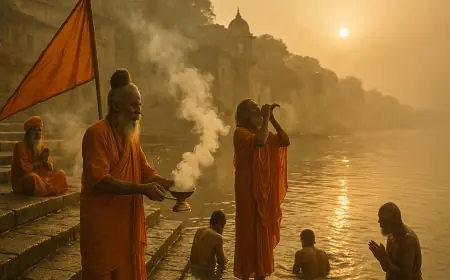



















The Kshipra River Legends: Mythology, Sacred Role & Simhastha 2028
Explore the mythology, sacred importance, and spiritual power of the Kshipra River and why it stands at the heart of Simhastha 2028 in Ujjain.



The Kshipra River Legends: Mythology, Sacred Role & Why It Powers Simhastha 2028
In Sanatan tradition, a river is never just water. It is memory, continuity, and living consciousness. Among India’s sacred rivers, the Kshipra River holds a unique position because it does not merely witness ritual history; it actively sustains it.
Simhastha 2028 in Ujjain exists because of the Kshipra. Without this river, Simhastha is not possible in its authentic form. To understand Simhastha, one must first understand the mythology, sacred role, and spiritual authority of the Kshipra River.
For Every pilgrims, understanding Simhastha 2028 dates and the official Shahi Snan timeline is essential before booking flights or accommodation, as these sacred dates are completely non-negotiable.
What Is the Kshipra River?
The Kshipra River, also known as Shipra, flows through the ancient city of Ujjain in Madhya Pradesh. Though modest in physical length compared to rivers like the Ganga, its spiritual stature is immense.
Trending Guides Now

Ujjain Simhastha
Ujjain Is Considered a Time Aligned City in Hindu Cosmology

Why Ancient Astronomers Considered Ujjain So Important
Was Ujjain the First Scindia Headquarters? Did Ranoji Start Simhastha? Full Spiritual Truth Revealed

Ujjain Railway Station to Mahakaleshwar Temple Distance (2026 Guide)

Ujjain Simhastha 2028 Dates Announced: Full Shahi Snan & Event Timeline

Ujjain Simhastha Update: CM Mohan Yadav Reviews 2028 Works

Karkateshwar Mahadev: 22/84 Mahadev of Ujjain
In Hindu cosmology, spiritual power is not measured by size or volume. It is measured by scriptural presence, ritual continuity, and cosmic alignment. By these measures, the Kshipra stands among the most sacred rivers of Sanatan Dharma.
Mythological Origins of the Kshipra River
According to Puranic traditions, the Kshipra River emerged as a sacred flow connected to Lord Shiva’s cosmic presence in Ujjain.
Ujjain is described in ancient texts as Avantika, one of the seven Moksha-puris. The Kshipra is portrayed as the river that purifies the land surrounding Mahakaleshwar, allowing spiritual rituals to manifest fully.
Legends describe sages performing penance on its banks, celestial beings descending during specific planetary alignments, and the river gaining spiritual potency during astrologically charged periods.
Why the Kshipra Is Central to Simhastha
Simhastha 2028 is not organized around administrative convenience. It is governed by astronomical precision and ritual geography.
When Jupiter enters Leo (Simha Rashi), and the Sun aligns accordingly, Ujjain becomes the designated sacred center. At that moment, the Kshipra River transforms into the ritual axis of Simhastha.

Every sacred bath, procession, and Akhara ritual during Simhastha revolves around the Kshipra. This is why Simhastha Mela in Ujjain cannot be relocated or replicated elsewhere.
Kshipra Snan: Spiritual Meaning and Belief
Bathing in the Kshipra during Simhastha is known as Kshipra Snan.
According to belief:
-
The river absorbs heightened cosmic energy during Simhastha
-
Snan performed during this period carries amplified spiritual merit
-
Ritual bathing is associated with karmic cleansing and ancestral peace
For devotees, Kshipra Snan during Simhastha 2028 is not symbolic. It is an act of direct spiritual participation.
Scriptural References to the Kshipra River
The Kshipra finds mention in multiple ancient sources, including Puranic literature and regional sacred texts associated with Avantika.
These texts consistently describe:
-
The river as self-purifying
-
Its waters as spiritually activating during planetary transitions
-
Its banks as suitable for penance, yajna, and mass rituals
This continuous textual presence establishes the scriptural legitimacy of Simhastha at the Kshipra.
Relationship Between Kshipra River and Mahakaleshwar
The spiritual bond between the Kshipra River and Mahakaleshwar Jyotirlinga defines Ujjain’s sacred geography.
Mahakaleshwar represents timeless consciousness. The Kshipra represents flowing continuity. Together, they create the conditions necessary for Simhastha.
Rituals performed during Simhastha are incomplete without acknowledging this sacred relationship. This is why Simhastha rituals always reference both river and temple traditions.
Why Simhastha 2028 Depends on the Kshipra
Unlike other Kumbh locations that rely on river confluences, Simhastha 2028 depends entirely on the Kshipra River.
This dependence is not logistical. It is spiritual.
The Kshipra:
-
Anchors the ritual geography of Simhastha
-
Enables Shahi Snan and Akhara processions
-
Maintains the continuity of Ujjain’s Sanatan role
Without the Kshipra, Simhastha would lose its scriptural foundation.
Modern Relevance of the Kshipra in Simhastha 2028
In recent decades, the Kshipra has also become a focus of conservation and revival efforts. These efforts are not merely environmental; they are civilizational responsibilities.
Simhastha 2028 brings renewed attention to:
-
River cleanliness
-
Sustainable ritual practices
-
Preservation of sacred river ecosystems
Protecting the Kshipra ensures the continuity of Simhastha for future generations.
Why the Kshipra River Makes Simhastha Unique
Among all Kumbh-related events in India, Simhastha stands apart because of the Kshipra.
This river:
-
Is locally rooted yet cosmically significant
-
Combines Shaiva tradition with planetary science
-
Sustains one of the oldest recurring spiritual congregations
That is why Simhastha is not simply a festival in Ujjain. It is a river-centered spiritual phenomenon.
Frequently Asked Questions