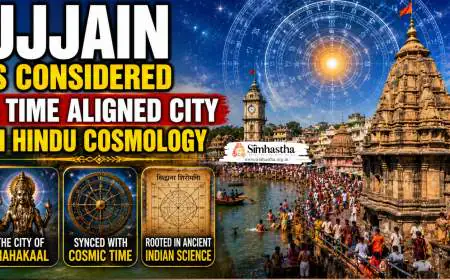



















Mahakaleshwar and Simhastha: The Jyotirlinga That Anchors the Mela
Discover how Mahakaleshwar Jyotirlinga spiritually anchors Simhastha, shaping rituals, sacred bathing, and Ujjain’s unmatched cosmic authority.



Mahakaleshwar and Simhastha: The Jyotirlinga That Anchors the Mela
In the vast spiritual geography of India, some places attract pilgrims, while a few command time itself. Mahakaleshwar Temple in Ujjain belongs to the latter. Simhastha does not merely happen near Mahakal; it unfolds because Mahakal exists. Without this Jyotirlinga of Lord Shiva, the Simhastha Kumbh Mela would lose its spiritual axis, its cosmic legitimacy, and its scriptural authority.
This is why saints, scholars, and scriptures speak in one voice: Simhastha is anchored by Mahakaleshwar.
Why Mahakaleshwar Is Not Just Another Jyotirlinga
Also Read | Mahakaleshwar Temple history and spiritual significance
Among the twelve sacred Jyotirlingas of Lord Shiva, Mahakaleshwar Jyotirlinga is singular. It is the only Jyotirlinga believed to be Swayambhu, self-manifested, and uniquely Dakshinamukhi, facing south. In Shaiva tradition, south-facing Shiva symbolizes Kala, time, and Mahakal, the ruler beyond death.
Trending Guides Now

Ujjain Simhastha
Why Ancient Astronomers Considered Ujjain So Important
The First Ever Kumbh Mela: Complete History, Rituals & Legacy That Continue Today

Why Jupiter Plays the Most Important Role in Ujjain Simhastha

Ujjain Railway Station to Mahakaleshwar Temple Distance (2026 Guide)

Ujjain Simhastha 2028 Dates Announced: Full Shahi Snan & Event Timeline

Ujjain Simhastha Update: CM Mohan Yadav Reviews 2028 Works

Ujjain Railway Station to Kal Bhairav Temple: Distance, Auto Fare and Best Route
This cosmic identity makes Mahakaleshwar Temple the spiritual heart of Ujjain pilgrimage, elevating the city from a sacred town to a time-governing tirtha.
It is here that Shiva is worshipped not as a destroyer, but as the protector of cosmic balance, the force that keeps cycles aligned, including the cycle that gives birth to Simhastha Ujjain.
The Scriptural Bond Between Mahakal and Simhastha
Ancient texts such as the Skanda Purana, Matsya Purana, and Brahma Purana do not describe Simhastha as a standalone fair. They describe it as a Shiva-centered spiritual convergence, taking place when specific planetary alignments sanctify Ujjain, the city of Mahakal.
Also Read | Ancient scriptures that explain Simhastha
When Jupiter enters Leo, and the Sun aligns with Aries, the energy of Mahakal Jyotirlinga is believed to intensify. This celestial moment activates Simhastha, transforming the Shipra River into a living channel of spiritual purification.
Without Mahakaleshwar and Simhastha connection, these alignments hold no ritual meaning.

How Mahakaleshwar Spiritually Anchors Simhastha
During Simhastha, millions arrive for sacred bathing rituals, but their journey does not begin at the ghats. It begins at Mahakaleshwar Temple.
Also Read | Why Shahi Snan Is the Most Important Ritual of Simhastha 2028 ?
Also Read | Simhastha 2028 Ujjain: Next Dates, Shahi Snan Schedule & Complete Spiritual Guide
Pilgrims believe that bathing in Shipra without the darshan of Mahakal is incomplete. Saints affirm that Mahakal’s presence sanctifies the water, the land, and even the passage of time during Simhastha.
This is why:
-
Akharas seek Mahakal’s blessings before Shahi Snan
-
Ascetics meditate facing Mahakal before leading processions
-
Ritual calendars align temple worship with Simhastha bathing dates
In essence, Mahakal anchors Simhastha spiritually, ritually, and cosmically.
Mahakal Bhasma Aarti and Simhastha Energy
The world-famous Mahakal Bhasma Aarti holds special significance during Simhastha. Performed before dawn, this ritual symbolizes the truth that all creation dissolves into Shiva.
During Simhastha, the Bhasma Aarti is believed to:
-
Multiply spiritual merit
-
Prepare devotees for sacred bathing
-
Align individual consciousness with collective spiritual energy
This ritual reinforces why Shiva worship Ujjain is inseparable from Simhastha spiritual importance.
Ujjain: The Only City Where Simhastha Can Exist
Many cities host Kumbh Melas, but only Ujjain Mahakal temple history grants Simhastha its unique authority. Ujjain is not chosen; it is ordained.
As an ancient astronomical capital, Ujjain was India’s prime meridian. Timekeeping, calendars, and planetary calculations emerged here under the spiritual gaze of Mahakal.
Thus, Kumbh Mela Ujjain is not a replication of other Kumbhs. It is a Shiva-governed convergence, rooted in time, tantra, and tradition.
Also Read | Ujjain as India’s ancient astronomical capital
Mahakaleshwar and the Soul of Hindu Pilgrimage
For seekers of Hindu pilgrimage India, Mahakaleshwar represents liberation through awareness of time. Simhastha amplifies this teaching on a mass scale.
Together, they create:
-
Spiritual renewal for householders
-
Ascetic validation for monks
-
Scriptural continuity for Sanatan Dharma
-
Cultural identity for spiritual tourism Ujjain
This is why devotees say: Simhastha cleanses the body, Mahakal transforms the soul.
Simhastha 2028: Mahakal at the Center Once Again
As Simhastha 2028 approaches, infrastructure, ghats, and roads will evolve, but the core will remain unchanged. The axis will still be Mahakal Jyotirlinga.
Also Read | Simhastha 2028 dates and mega development plan
No matter how modern the arrangements become, Simhastha will always revolve around:
-
Mahakaleshwar Temple
-
Shipra River
-
Planetary alignment
-
Shiva consciousness
That is the unbroken chain of faith.
Frequently Asked Questions