































Why Siddhavat Is Compared With Prayagraj's Akshayavat
Explore why Siddhavat in Ujjain is compared with Prayagraj's Akshayavat. From their shared myth of surviving pralaya to pind daan and moksha, uncover the cosmic bond between these two eternal banyan trees.



The Puranic Anchor and the Tree That Sees the End of Time
The primary reason Siddhavat is compared with Akshayavat is their shared, extraordinary status in the Puranas as survivors of the pralaya, the cyclical dissolution of the cosmos. The Skanda Purana, in its Avanti Khanda, describes Siddhavat as the eternal tree on whose leaves the infant Vishnu rests as Vat Patra Shayee during the great deluge. The same text, in its Prayaga Mahatmya, extols Akshayavat in remarkably similar language, calling it the Akshay Vat, the imperishable banyan, which will remain standing when the three worlds are submerged. This is not a coincidence or a regional variation of a folk tale; it is a deliberate, scripturally sanctioned parallelism. The two trees serve the identical cosmic function in the sacred geography of Hinduism: they are the fixed points in a universe of flux, the botanical axis mundi that guarantees the continuity of creation. For the pilgrim, to stand before either tree is to stand before a living entity that has, according to faith, witnessed the birth and death of infinite universes. The comparison is not that one is a copy of the other; it is that both are two visible, terrestrial manifestations of the same single, cosmic banyan that is the spine of the Hindu universe. 🌳
The Ritual Mirror and the Ancestral Rites of Pind Daan
The most immediate, practical reason a pilgrim would compare the two trees is their shared, profound association with pind daan, the ritual offering to the souls of ancestors. Both Siddhavat and Akshayavat are considered among the most powerful locations in India for performing the shraddh ceremony. At Siddhavat, on the banks of the Shipra, families gather under the sprawling canopy to offer rice balls and sesame seeds, the tree's eternal presence serving as a guarantee that the offering will reach the ancestors regardless of which realm they currently inhabit. At Akshayavat, within the confines of the Allahabad Fort, the ritual has been performed for centuries, the roots of the tree considered a direct channel to the world of the pitrus.
The theological logic is identical and is the bedrock of the comparison. Both trees are akshay, imperishable. An offering made at something that never dies is believed to generate a merit that never decays. The river beside each tree—the Shipra for Siddhavat and the Sangam for Akshayavat—adds the element of flowing purity, creating the perfect ritual combination of stability and fluidity. For a grieving son performing the last rites of a parent, the choice between Siddhavat and Akshayavat is often a matter of geography and family tradition, but the underlying spiritual belief is the same: this is where the barrier between the living and the dead is at its thinnest. The tears that fall on the roots of Siddhavat and the tears that fall on the roots of Akshayavat are part of the same, unending river of filial devotion. 🪔
The Skanda Purana and the Scriptural Echoes
The Skanda Purana is the textual thread that explicitly stitches these two trees into a single theological fabric. In the Avanti Khanda, which glorifies Ujjain, Siddhavat is described as the vanaspati tirtha, the plant-life pilgrimage site, and its eternal nature is linked to the presence of the 84 Siddhas who meditated beneath it. In the Prayaga Mahatmya, which glorifies Prayagraj, Akshayavat is described in almost identical terms of eternity and liberation. The Puranic seers did not see these two trees as rivals or separate entities; they saw them as the two great pillars of the Sapta Puri mandala, the sacred geography of the seven holy cities. Ujjain, the city of Mahakal, and Prayagraj, the king of all tirthas, each required an imperishable tree to serve as their cosmic anchor, and the Puranas provided. The comparison, therefore, is not a modern academic observation; it is embedded in the very scripture that sanctified both cities. A scholar who reads the Avanti Khanda and the Prayaga Mahatmya in succession will hear the same divine melody played on two different instruments. 📜
Trending Guides Now
What Makes Siddhavat Sacred for Generations of Pilgrims
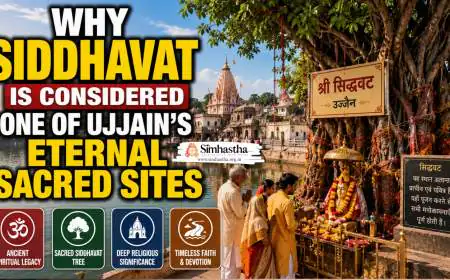
Why Siddhavat Is Considered One of Ujjain's Eternal Sacred Sites
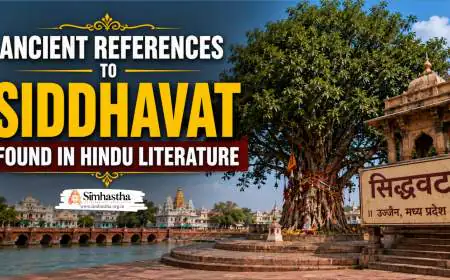
Ancient References to Siddhavat Found in Hindu Literature

Ujjain Railway Station to Mahakaleshwar Temple Distance (2026 Guide)

Ujjain Simhastha 2028 Dates Announced: Full Shahi Snan & Event Timeline

Mahakaleshwar Sandhya Aarti Online Booking 2026: Fee, Timings, Entry Gate and Step-by-Step Process

Latest Simhastha 2028 Development Projects Every Pilgrim Should Know

Mahakaleshwar Temple Entry Rules 2026: Dress Code, Mobile & Bag Policy
The Riverbank Setting and the Liquid Mirror
The physical setting of both trees amplifies their comparison. Siddhavat grows on the southern bank of the Shipra River, a river that, though modest, is mythologically potent, sanctified by the drops of amrit that fell during the celestial Kumbh. Akshayavat stands near the Triveni Sangam, the confluence of the Ganga, Yamuna, and the invisible Saraswati, arguably the most powerful aquatic tirtha in India. In both cases, the tree is not inland; it is precisely on the riverbank, where the element of water, symbolizing impermanence and flow, meets the element of the tree, symbolizing eternal, rooted stillness. This is a deliberate piece of sacred landscape architecture. The pilgrim who performs pind daan at either location is positioned between the two great metaphors of the universe: the river, which represents the flow of time and the cycle of birth and death, and the tree, which represents the timeless, the unchanging, the moksha that lies beyond the cycle. The comparison between Siddhavat and Akshayavat is, in this sense, a comparison of two perfectly constructed spiritual stages, each built by nature and myth to host the most intimate drama of human salvation. 🌊
The Accessibility and the Hiddenness
A fascinating point of comparison, and also a point of difference, is the accessibility of the two trees. Siddhavat is openly and freely accessible to any pilgrim who walks down the stone steps to the Shipra's southern bank. There are no barricades, no tickets, and no armed guards. The tree is a public, civic shrine, woven into the daily life of Ujjain. Akshayavat, in contrast, stands within the high walls of the Allahabad Fort, which is under the jurisdiction of the Indian Army. For centuries, the tree was largely inaccessible to the public. Today, it can be visited, but only through a controlled entry process, and the experience is one of a curated pilgrimage within a military installation. This difference makes Siddhavat, for many pilgrims, the more intimate and personal of the two, while Akshayavat carries an aura of a sacred, protected relic. Yet this very contrast reinforces the comparison: the same eternal tree, the same liberation, the same ancestral rituals, offered in two different modes—one in the open, democratic air of Ujjain, the other in the guarded, ancient fortress of Prayagraj. The theology is identical; the sociology of access is distinct. This makes the comparison all the richer, for it demonstrates that the eternal banyan can thrive both in the public square and in the secret garden of the state. 🚶
The Yoga of Trees and the Siddhas Who Sit Beneath
Both trees are associated with a specific circle of enlightened beings, and this is a key strand in the rope of comparison. Siddhavat derives its name from the 84 Siddhas, the perfected yogic masters who are said to have meditated beneath its canopy. The tree is a living mandala of the Nath and Tantric lineages, its aerial roots encoding the wisdom of Gorakhnath and his disciples. Akshayavat, while not as explicitly linked to the Nath Siddhas in popular narrative, shares the same archetype: it is the tree under which the great sages and rishis have sat, and its name itself—Akshay—implies the presence of the indestructible, the siddha state of consciousness that has transcended death. In the yoga tradition, the banyan tree is the symbol of the sahasrara chakra, the crown of the head, and its descending aerial roots are the channels through which divine grace flows into the material world. Both Siddhavat and Akshayavat, therefore, are not just trees but spatial embodiments of the highest state of spiritual attainment. To sit beneath either is to sit in the energetic field of the siddhas, the perfected ones, whether they are named or unnamed. 🧘
The Experience of the Pilgrim and the Unifying Silence
Ultimately, why Siddhavat is compared with Prayagraj's Akshayavat is best understood not through texts but through the experience of the pilgrim who has sat beneath both. The quality of the silence is the same. The feeling of being sheltered by a living antiquity is the same. The way the light filters through the broad, leathery leaves and dapples the ground is the same. The river beside them flows with the same quiet murmur of eternity. A pilgrim who has performed pind daan at Siddhavat and then, years later, at Akshayavat, will report a profound sense of continuity, as if they had been praying to the same deity in two different temples. The comparison is, in the end, a recognition of oneness: the one eternal banyan that the Skanda Purana places at Ujjain and at Prayagraj is a single spiritual reality, a single promise of liberation, a single imperishable witness to the journey of every soul. The two trees, in their sacred duality, teach the pilgrim that the universe is not fragmented but whole, that the Shipra and the Sangam are the same water, and that the roots that drink from both rivers are the same roots, reaching down into the same deep, dark, eternal earth. 🔱
Frequently Asked Questions