


































Understanding the Astronomical Importance of Mangalnath
Understanding the astronomical importance of Mangalnath—from the birthplace of Mars to India's Greenwich. Explore Ujjain's celestial temple at the Tropic of Cancer.
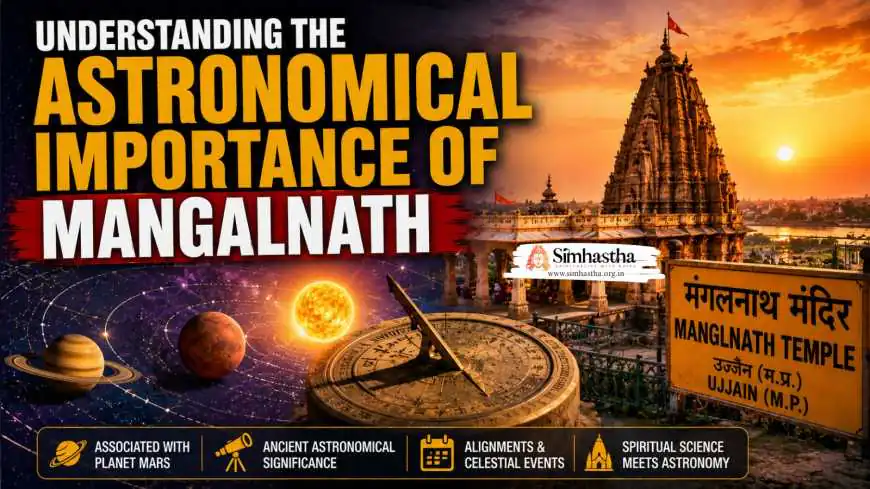


Understanding the Astronomical Importance of Mangalnath
Have you ever stood at a place where the sky meets the earth in a cosmic embrace? Where the Tropic of Cancer runs through the temple grounds, where direct rays of Mars are believed to fall upon the sacred soil, and where ancient astronomers once gazed at the heavens with unparalleled clarity? 🌌🔭
Welcome to Mangalnath in Ujjain—a temple that is not just a place of worship, but a celestial observatory frozen in time.
Understanding the astronomical importance of Mangalnath requires us to look beyond the stone walls and into the cosmos itself. This is not merely a temple dedicated to Lord Shiva. This is the birthplace of the planet Mars according to Hindu mythology. This is a site that was famous for its clear view of the planet and was once a center for astronomical studies in ancient India.
Located on the eastern banks of the Shipra River, away from the bustle of the city, Mangalnath offers a tranquil setting for spiritual reflection. The temple overlooks a vast expanse of the Shipra waters, filling the onlooker with an indescribable sense of peace. But beneath this serene exterior lies a profound cosmic significance that has fascinated astronomers, astrologers, and researchers for millennia.
Trending Guides Now

Why Mangalnath Temple Is Linked to Planet Mars

How Mangalnath Temple Became Associated With Astrology

What Makes Mangalnath Temple Different From Other Shiva Temples

Mangalnath Temple Visit Guide for First-Time Pilgrims

Ujjain Railway Station to Mahakaleshwar Temple Distance (2026 Guide)

Ujjain Simhastha 2028 Dates Announced: Full Shahi Snan & Event Timeline

How ISKCON Ujjain Engages Young Devotees Through Programs

Benefits of Becoming a Simhastha Volunteer
Let me take you on a journey through the celestial wonders of Mangalnath—from the mythology of Mars to the science of the stars, from the Tropic of Cancer to the Greenwich of India. 🌠🔱
🌌 The Celestial Geography: Where Mars Was Born
The Matsya Purana's Cosmic Claim
According to the Matsya Purana, one of the most important ancient Hindu scriptures, Mangalnath is regarded as the birthplace of the planet Mars (known as Mangal in Hindi). This is not a metaphorical claim—it is a literal assertion that this specific spot on Earth is where the red planet was born.
The mythology behind this claim is as poetic as it is profound. It is believed that a drop of sweat from Lord Shiva fell here, and from that divine droplet, the planet Mars was created. Some traditions also say that Mars was born to Lord Shiva and Goddess Parvati. The temple also houses a shrine for Dharati Mata, who is considered the mother of Mars.
The Navel of India
Mangalnath is often referred to as the "navel of India" due to its significant geographical location. According to the Matsya Purana, it is believed to be situated at the center of the Earth. This is not just a spiritual claim—it speaks to the profound astronomical significance of this location.
The Temple's Unique Identity
Mangalnath Temple is dedicated to Mahadeva (Lord Shiva), who is the guardian deity of Ujjain. However, what makes this temple truly unique is its dual identity—it is both a Shiva temple AND the temple of the planet Mars.
This makes Mangalnath the only temple in India dedicated to Lord Mangala (Mars). Devotees from across the country and even from abroad visit this temple to seek relief from Mangal Dosh—the malefic influence of Mars in one's horoscope.

🔭 The Ancient Observatory: A Window to the Heavens
"Famous for a Clear View"
The Matsya Purana itself records that Mangalnath was "famous for a clear view of the planet and hence suitable for astronomical studies". This single sentence reveals the profound astronomical importance of this site.
In ancient times, before the invention of telescopes, astronomers relied on naked-eye observations. They needed locations with unobstructed horizons, clear skies, and minimal light pollution. Mangalnath, situated on the banks of the Shipra River away from the city's bustle, provided exactly that.
Ujjain: The Greenwich of India
To fully understand the astronomical importance of Mangalnath, we must place it in the broader context of Ujjain's celestial heritage.
Ujjain enjoyed the reputation of being India's Greenwich. The first meridian of longitude in Hindu astronomy—equivalent to the Prime Meridian—passed through Ujjain at 75° 47′ E. This is why Ujjain earned the epithet "Greenwich of India".
The Vedh Shala or Jantar Mantar in Ujjain, built by Maharaja Sawai Jai Singh II of Jaipur in 1719, is one of the five astronomical observatories in India. It was designed for precise astronomical measurements and consists of 13 architectural astronomy instruments.
The Surya Siddhanta Connection
The Surya Siddhanta—one of the earliest known descriptions of standard time in India—was developed in Ujjain. The PanchSiddhanta and other significant astronomical works were also written here. The mean motions of the Sanskrit astronomical canons are normally postulated to refer to the central meridian of Ujjain.
The Aryabhata Connection
It is believed that the first astronomical meridian in Hindu India was established during Aryabhata's lifetime, most probably due to his initiative. This meridian ran through Ujjain, which is located just shy of the Tropic of Cancer at 23°10' North latitude.
Mangalnath, as a key site for astronomical observation, was an integral part of this celestial legacy.
🌍 The Tropic of Cancer: Where the Sun Aligns
The Celestial Line
One of the most fascinating aspects of Mangalnath's astronomical importance is its geographical location. The Tropic of Cancer passes through the temple.
The Tropic of Cancer is the northernmost circle of latitude on Earth where the Sun can appear directly overhead. This occurs during the June solstice, when the Sun's rays hit the Earth at a 90-degree angle along this line.
Direct Rays of Mars
According to belief, direct rays of Mars fall at this place. The Tropic of Cancer passing through the temple is considered a cosmic alignment that amplifies the temple's spiritual and astrological power.
The Center of the Earth
Some traditions hold that Mangalnath is the center of the Earth. While this is a mythological claim, it underscores the cosmic centrality of this location in the ancient worldview.
A Unique Geographical Intersection
Some sources suggest that Mangalnath is located at the intersection of the prime meridian and the Tropic of Cancer. This would make it a truly unique geographical point—a place where two of Earth's most significant celestial reference lines intersect.
🪐 Mars in Vedic Astrology: The Warrior Planet
The Nine Planets (Navagrahas)
In Vedic astrology, Mars is one of the nine planets (Navagrahas) associated with Hindu astronomy and astrology. Mars represents:
-
Energy and vigor
-
Courage and confidence
-
Strength and discipline
-
Valor and righteousness
The Mangal Dosh Challenge
When Mars is unfavorably placed in a person's horoscope—particularly in the first, fourth, seventh, eighth, or twelfth house—it is believed to create a Mangal Dosh. This can manifest as:
-
Marriage delays and relationship challenges
-
Anger and conflict issues
-
Career obstacles
-
Financial difficulties and health problems
The Mangalnath Solution
Devotees visit Mangalnath Temple to perform Mangal Dosh Nivaran Pooja—a special ritual designed to pacify the malefic effects of Mars. The temple is considered the most important place in the country for pujas to bring peace to Lord Mangal.
Bhat Puja: The Sacred Rice Offering
The temple is especially famous for Bhat Puja—a ritual involving the offering of rice (bhat) to the deity. This is performed as a remedy for Mangal Dosh and for planetary peace. Many devotees plan their Ujjain trip specifically for this ritual.
🏛️ The Temple: A Celestial Sanctuary
The Architecture
The Mangalnath Temple features a white marble structure that gleams in the sunlight. Its serene ambiance and spiritual aura draw hundreds of devotees daily.
The Unique Idol
Instead of Nandi (the bull)—Lord Shiva's traditional vehicle—the temple features a sheep (goat) facing the Shivalinga. This is a rare and unique iconographic feature that symbolizes the vehicle of Mangal (the planet Mars).
The Lord Shiva Connection
The main deity of the temple is Lord Shiva, worshipped here in the form of Mangalnath Mahadev. Devotees offer prayers seeking blessings, protection, and positive planetary influence.
The Shrine of Dharati Mata
The temple also houses a shrine for Dharati Mata (Mother Earth), who is considered the mother of Mars. This adds another layer to the temple's celestial significance.
🌊 The Shipra River: A Sacred Setting
Overlooking the Vast Expanse
The Mangalnath Temple overlooks a vast expanse of the Shipra River. The temple is situated on the eastern banks of the Shipra, which is believed to be Mokshadayani—one that grants liberation.
The River in Literature
The Shipra River is mentioned by the great Sanskrit poet Kalidasa in his classic work Megadhootam. Kalidasa, who lived in Ujjain, immortalized the river's beauty in his poetry.
The Ganga of Malwa
The Shipra River occupies a prominent place in Hindu religion and is considered the "Ganga of Malwa" . It has the honor of hosting the Simhastha Kumbh Mela on its banks every twelve years.
A Peaceful Setting
The temple is situated away from the bustle of the city and can be reached through a winding road. The temple looks upon the Shipra waters and fills the onlooker with an indescribable sense of peace.
🔬 The Scientific Legacy: What Researchers Are Discovering
Clear View of the Planet
The Matsya Purana's claim that Mangalnath was "famous for a clear view of the planet" is not just mythology—it reflects the practical astronomical significance of the site.
The Importance of Location
Several factors made Mangalnath ideal for astronomical observation:
-
Unobstructed horizon: The temple's location on the riverbank provided a clear view of the sky
-
Minimal light pollution: Away from the city's bustle
-
Geographical position: Located near the Tropic of Cancer at 23°10' North latitude
-
Clear skies: The region's climate favored astronomical observation
The Ujjain Meridian
The first astronomical meridian in Hindu India was established at Ujjain. This meridian served as the reference point for astronomical calculations across ancient India.
The Surya Siddhanta Legacy
The Surya Siddhanta—a foundational text of Indian astronomy—was developed in Ujjain. This text provided one of the earliest known descriptions of standard time in India.
Continuing Research
Understanding the astronomical importance of Mangalnath continues to fascinate researchers today. Scholars study:
-
The astronomical references in the Matsya Purana
-
The geographical significance of the Tropic of Cancer intersection
-
The connection between Mangalnath and Ujjain's broader astronomical heritage
-
The accuracy of ancient Indian astronomical observations
🕯️ The Spiritual Practices: Celestial Rituals
Daily Darshan
The temple opens at 4:00 AM and closes at 8:00 PM. The best time to visit is in the early morning for calm darshan and to attend special poojas.
Morning Aarti
The morning aarti takes place from approximately 5:30 AM to 6:00 AM. This is considered an especially auspicious time for worship.
Evening Aarti
The evening aarti takes place from 7:00 PM to 7:30 PM. The sunset views over the Shipra River are picturesque.
Special Pujas
The temple offers several special pujas:
-
Mangal Dosh Nivaran Pooja
-
Bhat Puja
-
Navgraha Shanti
-
Arka Vivaha and Kumbha Vivaha
The Auspicious Tuesday
Tuesday is considered the most auspicious day for worshipping at Mangalnath Temple. Devotees believe that one who prays on this day gets his or her wish fulfilled.
🗺️ How to Experience Mangalnath
Location
Mangalnath Temple is located on Ankpat Marg, Mangalnath Mandir, Agar Rd, Khilachipur, Ujjain, Madhya Pradesh 456010.
How to Reach
By Air: The nearest airport is Devi Ahilyabai Holkar Airport, Indore, which is about 53 kilometers away. There are regular flights from Delhi, Mumbai, Pune, Jaipur, Hyderabad, and Bhopal.
By Train: Ujjain Junction (UJN) is well-connected to major cities across India. The temple is about 6 kilometers from the railway station.
By Road: Regular bus services connect Ujjain with Indore, Bhopal, Ratlam, Gwalior, and other cities.
Local Transport
From Ujjain Junction, the temple is about 6 kilometers away, taking approximately 15 minutes by auto or taxi.
Best Time to Visit
-
Early morning for peaceful darshan and to attend special poojas
-
Tuesdays are most auspicious
-
Sawan month (July–August) for special celebrations
-
Before marriage for Manglik Dosha remedies
What to Bring
-
Traditional and modest attire
-
Birth details for astrology-related pujas
-
Offerings for the deity
💫 The Cosmic Connection: Why Mangalnath Matters
A Bridge Between Earth and Sky
Mangalnath serves as a bridge between the earthly and the celestial. It is a place where:
-
Mythology meets astronomy
-
Spirituality meets science
-
The Tropic of Cancer runs through the temple grounds
-
Direct rays of Mars are believed to fall
-
Ancient astronomers once studied the heavens
A Living Tradition
Unlike many ancient observatories that have become museums, Mangalnath remains a living tradition. Thousands of devotees continue to:
-
Perform pujas for planetary peace
-
Seek remedies for Mangal Dosh
-
Offer prayers to Lord Shiva and Lord Mangal
-
Connect with the cosmos through ancient rituals
A Unique Heritage
Mangalnath represents a unique heritage that is:
-
Ancient in origin (6000 years of tradition)
-
Astronomical in significance (clear view of Mars)
-
Astrological in practice (Mangal Dosh remedies)
-
Geographical in importance (Tropic of Cancer intersection)
-
Spiritual in essence (birthplace of Mars)
🙏 Final Thoughts: The Eternal Dance of Earth and Sky
Understanding the astronomical importance of Mangalnath is ultimately about understanding the eternal dance between earth and sky. It is about recognizing that the cosmos is not separate from us—it is woven into the very fabric of our existence.
When you stand at Mangalnath, you are standing at a place where:
-
The planet Mars was born, according to ancient mythology
-
The Tropic of Cancer passes through the temple grounds
-
Ancient astronomers gazed at the heavens with wonder
-
Direct rays of Mars are believed to fall upon the sacred soil
-
Devotees continue to seek celestial blessings
Mangalnath is not just a temple—it is a cosmic portal, a celestial observatory, and a living link to India's glorious astronomical heritage.
Whether you approach it as a devotee seeking relief from Mangal Dosh, a history enthusiast exploring ancient astronomy, a spiritual seeker connecting with the cosmos, or simply a curious traveler—Mangalnath offers something profound: the experience of standing at the intersection of earth and sky, of mythology and science, of the ancient and the eternal.
And that is the true astronomical importance of Mangalnath. 🌌🙏🔱
Frequently Asked Questions