



















How Mangalnath Temple Became Associated With Astrology
Discover how Mangalnath Temple became associated with astrology. From its Puranic origin as Mars' birthplace to Ujjain's prime meridian and the Mangal Dosh Nivaran puja, explore the cosmic and astrological legacy of this sacred Shipra shrine.



The Cosmic Sweat and the Birth of the Red Planet on Earth
The foundational reason why Mangalnath is a temple of astrology rather than just another Shiva shrine lies in a remarkable and dramatic Puranic narrative. According to the Skanda Purana and the Matsya Purana, the planet Mars did not simply take his place in the celestial firmament as a distant, indifferent sphere of rock. He was born, in a moment of intense, divine passion, right here on the banks of the Shipra. The story tells that during Lord Shiva's ferocious and world-dissolving Tandava dance, a single, burning drop of his divine sweat fell from his brow onto the earth. From that fiery, potent seed, a child of extraordinary energy and a striking, blood-red complexion was born. This was Mangal, the personification of the planet Mars, a being of immense courage, aggression, and martial power.
The earth goddess, Bhumi, raised the child, and the spot where he first touched the terrestrial plane became eternally sanctified. A swayambhu (self-manifested) lingam appeared at this location, imbued with the very planetary energy of the red planet. Lord Shiva himself then blessed the site, declaring that worship offered here would pacify the malefic effects of Mars in a devotee's horoscope and that this would forever be the supreme abode of Mangal on earth. This is the irreducible, theological core of the temple's astrological power. Mangalnath is not a temple to which an astrological specialty was later added; it is, according to its own foundational scripture, the literal, physical birthplace of the planet, the point on the map where the cosmic energy of Mars first entered the earthly realm. Every Mangal Shanti puja performed here is a ritual that re-enacts this cosmic birth and seeks to harmonize the devotee's personal energy with the fiery, uncontrollable, and ultimately purifying energy of the red planet. 🔥
The Prime Meridian City and the Science Behind the Stars
The Puranic legend provides the sacred narrative, but the profound, enduring, and systematic astrological power of Mangalnath is anchored just as firmly in Ujjain's identity as the ancient prime meridian of India. The Surya Siddhanta, a foundational astronomical text of staggering mathematical precision, explicitly declares that the city of Avanti, modern Ujjain, is situated at the zero-degree longitude, the navel of the earth, the central reference point from which all celestial longitudes are to be measured. The city lies exactly on the Tropic of Cancer, where the sun appears directly overhead on the summer solstice. This was not mythology; it was a coordinate, a verifiable, geographical, and astronomical fact that made Ujjain the natural, unavoidable centre of the ancient Indian scientific world.
The greatest mathematicians and astronomers of the classical age—Varahamihira in the 6th century, Brahmagupta in the 7th, and Bhaskaracharya II in the 12th—all headed the observatory at Ujjain. Their meticulous, centuries-long calculations of planetary motion, eclipses, and the precise length of the solar year were all computed from this meridian. The Mangalnath Temple, dedicated to one of the nine celestial bodies, was thus not an isolated shrine. It was a vital, functioning node in a vast, interconnected scientific and spiritual network. The temple's priests, many of whom were also scholars of the Panchangam (Vedic almanac), understood the rituals not as superstitious practices but as precise, spiritual technologies designed to operate in harmony with the mathematically mapped movements of the planets. The astrology practiced at Mangalnath was, and remains, a descendant of this glorious, unbroken intellectual tradition, a unique synthesis of the Puranic heart and the Siddhantic mind. 📐
Trending Guides Now

Mangalnath Temple Visit Guide for First-Time Pilgrims

Why Mangalnath Temple Is Linked to Planet Mars

Mangalnath Temple Trip Budget: Puja, Local Transport, Food and Stay Planning
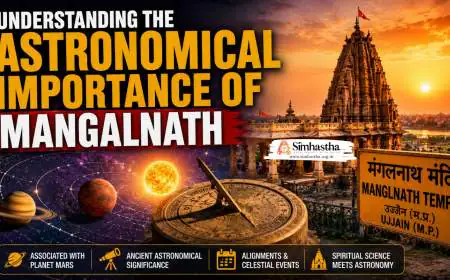
Understanding the Astronomical Importance of Mangalnath

Ujjain Railway Station to Mahakaleshwar Temple Distance (2026 Guide)

Ujjain Simhastha 2028 Dates Announced: Full Shahi Snan & Event Timeline

Ujjain Railway Station to Kal Bhairav Temple: Distance, Auto Fare and Best Route

Ujjain Simhastha Update: CM Mohan Yadav Reviews 2028 Works
The Astrological Specialty and the Fear of Mangal Dosh
The entire, vast, and complex edifice of Vedic astrology is built upon the understanding that the nine planets (Navagrahas) are not merely physical celestial bodies but conscious, powerful deities whose ever-shifting positions and relationships directly and continuously influence the course of every human life. Among the nine, Mars (Mangal) holds a particularly feared and respected position. He is the commander of the celestial armies, a planet of raw, unrefined energy, passion, courage, aggression, and conflict. He governs the blood, the muscles, ambition, and the drive to conquer. A powerfully placed Mars can bestow immense courage, leadership, and success. But a malefically placed Mars, particularly the astrological condition known as Mangal Dosh (or Kuja Dosha), is one of the most dreaded and widely discussed afflictions in Hindu astrology.
Mangal Dosh occurs when Mars is placed in specific houses of a person's birth chart—typically the 1st, 2nd, 4th, 7th, 8th, or 12th house. The most common and socially significant manifestation of this condition is its alleged obstruction of marriage, causing endless delays, conflicts, and even the breakdown of the marital bond. Countless young men and women, and their anxious parents, have been told by their family astrologers that their charts show a pronounced Mangal Dosh. And the single most powerful, time-tested, and geographically specific remedy prescribed in the ancient texts for this condition is a pilgrimage to the Mangalnath Temple in Ujjain. The temple, as the literal birthplace of the planet, is believed to hold a unique, unrivalled power to pacify the angry, malefic energies of Mars, to cool his fiery, destructive gaze, and to transform the obstacles he places in the devotee's path into stepping stones of courage and growth. The fear of Mangal Dosh is a profound, existential driver that has brought millions of pilgrims through the temple's gates, seeking not just a blessing but a cosmic, karmic recalibration. 😟🔴
The Mangal Shanti Puja and the Rituals of Planetary Pacification
The most important ritual performed at the temple, and the reason for its enduring fame, is the Mangal Dosh Nivaran Puja or Mangal Shanti Puja. This is not a simple, five-minute offering. It is a prolonged, meticulously structured, and deeply symbolic tantric ceremony that can last for one to two hours, performed by the temple's hereditary priests under the open sky on the banks of the Shipra. The ritual is a multi-sensory immersion into the cosmic energy of Mars. The devotee, who has typically been fasting, makes a formal sankalpa, a sacred declaration of their name, their gotra, and their specific astrological affliction, invoking the blessings of the planet. The priest then chants the powerful Mangal Beej Mantra, a sonic seed syllable that is the vibrational essence of the planet, designed to resonate directly with its energy.
The offerings made during this puja are a study in the esoteric language of colour and substance. Everything connected with the ritual is red, the sacred colour of Mangal. Red flowers, particularly the fiery hibiscus, are offered in abundance. Red sandalwood paste, red cloth, and red fruits like pomegranates are presented. A specific type of lentil, the red masoor dal, is a signature offering, symbolically absorbing the malefic energy. The ritual reaches its apex with a Homa, a sacred fire ceremony conducted in a small, specially prepared pit on the riverbank. Ghee, sesame seeds, and specific herbs are poured into the fire while the priest chants the ancient Vedic and tantric hymns that are the spiritual antidotes to the planet's malefic influence. The fire is the messenger, carrying the devotee's prayers and the planet's pacified energy from the earthly plane to the celestial realms. After the Homa, the devotee is often advised to perform a ritual bath in the Shipra, to feed the Brahmins, and to make a simple offering of food to a cow, a cycle of sacred acts that completes the holistic remedy, integrating the physical, the spiritual, and the karmic. 🪔
A Gateway to the Navagraha and the Holistic Cosmic Circuit
While Mangalnath is a supremely powerful, standalone planetary shrine, its full spiritual and astrological significance is most clearly understood when it is seen within the context of Ujjain's larger Navagraha (nine planets) circuit. The ancient city is a living, working map of the heavens, and the Mangalnath Temple is the designated, non-negotiable anchor for the planet Mars. A devotee who is undergoing a comprehensive, all-planet pacification ritual (Navagraha Shanti) must include a visit to Mangalnath for the Mars component of the ceremony to be considered complete and efficacious. The temple does not exist in isolation; it is part of an interlocking, sacred, and scientific mandala that includes specific shrines for the Sun, the Moon, Jupiter, Saturn, and the other celestial deities, each located at its own geomantically potent point within the city's boundaries.
This holistic, integrated vision is the hallmark of mature Vedic astrology. A wise astrologer does not simply prescribe a remedy for a single, feared planet; they understand that the entire chart is a complex, interconnected web of relationships. Pacifying an angry Mars without simultaneously honouring the benefic Jupiter or the illuminating Sun is seen as an incomplete, and potentially counterproductive, half-measure. The pilgrim who visits Mangalnath is thus being initiated, whether they consciously realize it or not, into a complete, cosmic worldview. They are being taught, through the physical geography of the sacred city, that their personal, individual karma is inextricably woven into the vast, magnificent, and perfectly ordered dance of the entire solar system. Mangalnath is the fiery, red, and intensely powerful gateway that invites the devotee into this deeper, more holistic, and ultimately liberating understanding of their place in the universe. 🌌

The Tuesday Surge and the Weekly Rhythm of the Red Planet
The astrological energy of the Mangalnath Temple is not a static, constant force; it pulses in a distinct, predictable rhythm that is intimately tied to the ancient Vedic calendar. While every day is sacred, Tuesday (Mangalvar) is the day that is ruled by the planet Mars, and it is on this day that the temple undergoes a profound, visible, and sonic transformation. From the early hours of the morning, a steady, vibrant stream of devotees, many of whom are observing a rigorous Mangalvar Vrat (a day-long fast), begins to flow towards the Shipra. They come dressed in red, the colour of the planet, their hands carrying thalis laden with the specific, prescribed offerings. The queues lengthen, the air thickens with the smoke of the Homas, and the chant of the Mangal Beej Mantra rolls out from the riverbank in a continuous, hypnotic wave.
For the pilgrim seeking the most potent, concentrated dose of the planet's grace, a Tuesday at Mangalnath is an unmissable, intensely charged experience. The collective, focused devotion of thousands of souls, all directing their individual prayers towards the same planetary deity, creates an atmosphere of immense, crackling spiritual power. The priests, who are at their busiest, perform one Mangal Shanti puja after another with a swift, practiced, and deeply reverent efficiency. The red temple walls seem to glow with a deeper, more saturated hue, and the energy of the planet, normally a subtle, distant force, feels immediate, palpable, and overwhelmingly present. It is on Tuesdays that the ancient, astrological identity of the temple is most fully and dramatically expressed, a weekly, cosmic festival that reaffirms the unbreakable bond between the red planet, the sacred river, and the devoted souls who seek his fiery, transformative grace. 🔴
Practical Guidance for the Astrological Pilgrim
For the pilgrim who is planning a visit to the Mangalnath Temple, specifically for astrological reasons, a few pieces of practical guidance will ensure a smooth, powerful, and deeply meaningful experience. The most important logistical advice is to plan for a Tuesday if you seek the most potent, collective energy, but be prepared for significantly larger crowds. If you prefer a quieter, more personal, and contemplative darshan, a non-Tuesday weekday morning is ideal. The Mangal Dosh Nivaran Puja is a formal ritual that requires the assistance of a temple priest. It is always advisable to book this in advance, especially if you are visiting on a Tuesday or during a festival, by contacting the temple directly or through a reliable local source. The priests are experienced, approachable, and will guide you through the necessary preparations.
The dress code follows the standard, modest Ujjain temple protocol. Wearing the colour red is considered highly auspicious and deeply aligning with the planet's energy, but it is not mandatory. A simple, clean kurta-pajama for men and a salwar kameez or saree for women is perfect. The offerings you will need—the masoor dal, the red flowers, the red cloth, and the coconut—can be easily and affordably purchased from the small stalls that line the narrow approach road to the temple. Carry a small bag with a water bottle, as the ritual can be lengthy and the sun can be intense. The most important preparation, however, is to arrive with a clear, honest, and humble intention. The temple is a sacred, cosmic chamber, and the planet's energy responds not to the price of your offering, but to the sincerity, purity, and depth of your heart's prayer. 🙏
The Eternal Dance of the Red Planet and the Sacred City
The Mangalnath Temple, with its red walls, its riverside Homas, and its ancient, unbroken tradition of astrological healing, stands as a silent, powerful, and eternal witness to the profound and beautiful marriage of science and faith that defines the spiritual genius of Ujjain. The same city whose astronomers mapped the precise orbit of the red planet is the city whose pilgrims offer red lentils to pacify its celestial anger. The same meridian that was the zero-degree reference point for the ancient world is the line that connects the fiery, cosmic energy of Mars to the cool, purifying waters of the Shipra. The temple's association with astrology is not a later, accidental addition; it is its very DNA, its foundational reason for being, a truth whispered in the Puranas, measured by the Siddhantas, and lived out, every single Tuesday, in the passionate, hopeful prayers of the thousands who bow their heads before the son of Shiva's sweat. The red planet continues its eternal, silent dance in the night sky, and on a quiet, serene bend of the Shipra, the ancient city of Ujjain continues to listen, to measure, and to bless. 🔱
Frequently Asked Questions