


















Exploring the Connection Between the Ghat and the Cave
Uncover the profound spiritual connection between the ghat and the cave in Ujjain. Explore how Bhartrihari's riverside steps and rock-cut monastery form a complete pilgrimage circuit of renunciation, ancestral healing, and ultimate liberation.
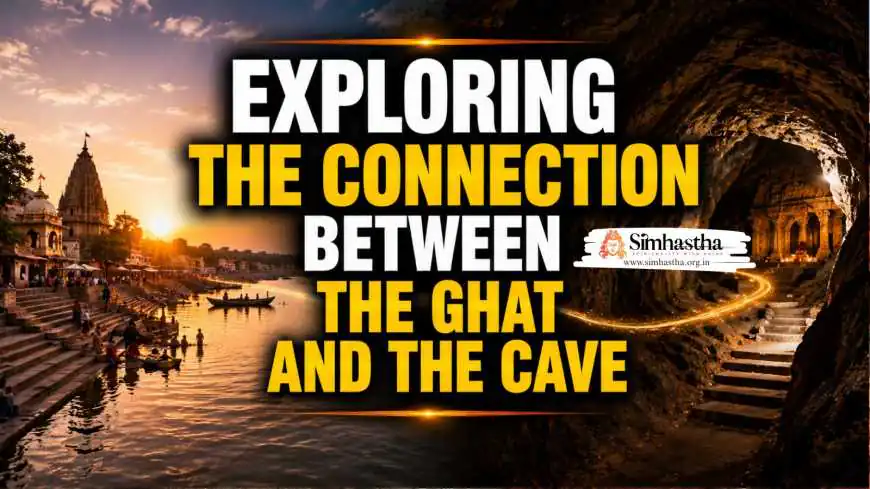


The Sacred Union of Riverbank and Rock-Cut Sanctuary
The Bhartrihari Ghat and the Bhartrihari Caves are, for the discerning pilgrim, a complete and self-contained spiritual circuit. The ghat, with its wide stone steps worn smooth by centuries of bare feet, is the realm of karma—of action, of ritual, of the sacred duty to honour one's ancestors through the offering of pind daan. It is a place of tears, of whispered mantras, and of the tangible, physical release of grief into the flowing water. The cave, carved deep into the riverbank's rock, is the realm of jnana and dhyana—of knowledge, of meditation, and of the solitary, inward-turning journey of the soul. It was here, according to an unbroken tradition, that King Bhartrihari, the stepbrother of the legendary Vikramaditya, shed his royal robes and his worldly attachments to become a Nath yogi, composing his immortal verses of renunciation, the Vairagya Shatakam, in the profound, womb-like silence of the stone.
The connection is not accidental. The same river that receives the offerings of pind daan at the ghat is the river that the king-turned-poet would have heard as he sat in his dark meditation chamber, a constant, liquid reminder of impermanence. The physical proximity is a theological statement. The journey from the bright, open, communal grief of the ghat to the dark, solitary, introspective silence of the cave is a journey that every human soul, eventually, must make: from the external, ritualized acknowledgment of death and loss, to the internal, meditative realization of the eternal, unchanging Self that is beyond both birth and death. The ghat and the cave together teach the pilgrim that the full spiritual life requires both—the open, weeping heart that honours the past and the silent, still mind that seeks the timeless. 🕯️
King Bhartrihari's Renunciation and the Birth of a Cave Monastery
The story that binds the ghat to the cave is one of the most dramatic and spiritually profound narratives in India's vast library of sacred legend. King Bhartrihari, the powerful 5th-century ruler of Ujjain, was a man who possessed everything the material world could offer: a vast kingdom, immense wealth, and a beautiful queen, Pingala, whom he loved with a consuming passion. The legend, told in multiple variations, pivots on a single, devastating moment of disillusionment. In the most famous version, the king received false news of his queen's death and was plunged into an abyss of grief, only to later discover that the report was a cruel deception. In another version, a fruit that was meant to grant immortality was passed through a chain of deceitful hands, revealing the fragile, illusory nature of all worldly love and loyalty. Whatever the precise trigger, the result was a cataclysmic, irreversible, and liberating shift in the king's consciousness. He saw, with a sudden, blinding clarity, the utter emptiness of the pursuits that had consumed his life. He renounced his throne, installed his stepbrother Vikramaditya as king, and walked away from the palace, descending the very steps of this ghat to seek refuge in the dark, silent cave that overlooked the Shipra.
It was within this cave that the former king, now a wandering yogi of the Nath Sampradaya, is said to have composed the Vairagya Shatakam, the "Hundred Verses on Renunciation," a text of such searing, honest, and psychologically acute insight into the nature of desire, attachment, and the human condition that it remains a cornerstone of Indian spiritual literature. The cave, therefore, is not just a geological feature; it is a sacred crucible, the very birth chamber of a timeless spiritual text. And the ghat below is the physical path the king walked, the literal threshold between the world of illusion he left behind and the world of liberation he entered. Every pilgrim who walks up from the ghat and into the cave is, in a subtle, symbolic sense, retracing the footsteps of the king who traded a golden throne for a stone floor. 👑
Trending Guides Now

Ujjain Railway Station to Mahakaleshwar Temple Distance (2026 Guide)

Ujjain Simhastha 2028 Dates Announced: Full Shahi Snan & Event Timeline

Ujjain Railway Station to Kal Bhairav Temple: Distance, Auto Fare and Best Route

Ujjain Simhastha Update: CM Mohan Yadav Reviews 2028 Works

Mahakaleshwar Temple Entry Rules 2026: Dress Code, Mobile & Bag Policy

Bhasma Aarti at Mahakaleshwar Temple – Complete Pilgrim Guide

Why Ujjain Is One of the Four Kumbh Cities in India

Best Time to Visit Mahakaleshwar Temple Crowd And Weather Guide
The Ghat: Where Ancestral Waters Meet the Penitent Soul
The Bhartrihari Ghat, spread out at the foot of the cave, is one of the most serene and spiritually potent sites on the entire Shipra for the performance of pind daan, the ritual offering to the ancestors. The logic of this practice is deeply intertwined with the legend of the cave above. Bhartrihari's own journey was a radical act of dying to his former identity, a complete severance from his past life as a king, a husband, and a possessor of worldly power. The ghat, therefore, is imbued with the energy of that profound, symbolic death. When a family gathers on these steps, the priest chanting the ancient mantras, and the pind—the small, round balls of cooked rice mixed with black sesame seeds—are offered into the flowing Shipra, they are participating in a ritual that resonates with the very atmosphere of renunciation that Bhartrihari created.
The connection is clear: just as Bhartrihari released his attachment to his own mortal identity, the devotee at the ghat prays for the release of their ancestors' souls from the bonds of their past karmas. The flowing water of the Shipra, the same river that witnessed the king's great descent from power to penance, is believed to carry these offerings directly to the realm of the pitrus. The ghat is often quiet, the atmosphere tender and un-rushed, a stark and welcome contrast to the more crowded and commercially busy ghats in the city centre. Here, a family can sit for an hour, the father crying quietly as he performs the rites for his own father, the sound of the river providing a gentle, constant, and deeply comforting backdrop. The ghat is the place of the heart's unburdening, the first, essential step in the complete spiritual circuit. 🪔
The Cave: The Dark Womb of Rebirth and the Poetry of Vairagya
Leaving the sunlit, open expanse of the ghat, the pilgrim ascends a few worn stone steps and stoops to enter the low, dark entrance of the Bhartrihari Caves. The transition is immediate, total, and deeply symbolic. The bright, external world of ritual, sound, and communal activity vanishes, replaced by a profound, enveloping silence, a cool, earthy darkness, and the simple, austere architecture of the rock-cut chambers. This is the realm of the inner journey, the domain of the solitary yogi. The main chamber houses a small shrine with an image of Bhartrihari seated in a meditative posture, dressed in the ochre robes of a renunciate. Smaller, subsidiary chambers, some with Shiva lingams, served as meditation cells for the Nath yogis who followed their illustrious predecessor. The air is heavy with the scent of incense and the weight of centuries of silent, concentrated prayer.
The profound spiritual connection between the ghat and the cave is most powerfully felt in this moment of entry. The pilgrim who has just, on the ghat, offered the pind for their deceased father, symbolically completing their external duty to the past, now enters the cave to confront the one ancestor they must ultimately liberate: their own self. The cave is a living metaphor for the garbhagriha, the dark, inner sanctum of the heart, where the true Self, the Atman, resides in eternal, silent witness. Bhartrihari's own verses, the Vairagya Shatakam, which echo in the mind of the literate pilgrim, are a ruthless and compassionate guide through this inner territory. They speak of the body as a temporary vessel, of beauty as a fleeting illusion, and of the mind's endless, exhausting pursuit of objects that can never bring lasting satisfaction. To sit in this cave, even for a few minutes, is to feel the world's noisy demands begin to recede, replaced by a quiet, steady, and unnerving clarity. The cave is the birthplace of wisdom, and its gift is the silent, penetrating question that Bhartrihari himself asked: "If all of this is not the source of lasting peace, then what is?" 🧘
The Shipra as Witness: The Eternal Dialogue Between Water and Stone
The unseen but ever-present third element in the sacred connection between the ghat and the cave is the Shipra River itself. The river is the continuous, flowing thread that stitches the two spaces together into a single, sacred fabric. The ghat is, fundamentally, the physical interface with the river, the place where the liquid grace of the Goddess is accessed for ritual purification. The cave, set just above the bank, is a constant listener to the river's soft, ceaseless murmur. For the yogi meditating in the dark, stone chamber, the Shipra's gentle sound is not a distraction but a powerful, natural aid to concentration, a liquid, ever-present metronome of impermanence. The river's water evaporates, forms clouds, falls as rain, and flows again, a perfect, visible cycle of death and rebirth. The stone of the cave stands silent, still, and seemingly eternal. The dialogue between the two—the flowing water that never stops and the rooted stone that never moves—is the ultimate teaching of the entire sacred site. The pilgrim is invited to find the still, silent, witnessing cave within their own heart, even as their outer life flows, constantly and uncontrollably, like the river. To understand this dialogue is to grasp the essence of the yoga that was practiced here: not a denial of the world's flow, but the cultivation of an inner, unshakable stillness that can observe the flow without being swept away by it. 🌊
A Pilgrimage Circuit of Stillness and Surrender
For the contemporary pilgrim, the Bhartrihari Ghat and Caves offer a complete, self-contained, and deeply healing pilgrimage circuit that can be walked in a single, unhurried morning. The journey begins at the ghat, ideally in the early hours when the sun is gentle and the air is cool. One can sit on the ancient steps, perform a simple ablution, offer a silent prayer for one's ancestors, or simply watch the river flow, allowing the mind to settle. This is the phase of external ritual and emotional release. From the ghat, the pilgrim then ascends the short path to the cave entrance. There is an immediate, conscious shift in intention. The outer, communal work is complete. Now, the inner, solitary work begins. Entering the cave, one finds a quiet corner to sit, closing the eyes and allowing the profound, meditative silence of the stone to envelop the senses. For those who wish, reading a few verses of the Vairagya Shatakam aloud, letting the ancient words of renunciation fill the dark chamber, is a powerful and transformative practice. The circuit is complete when the pilgrim emerges from the cave, blinking in the sunlight, and walks back down to the ghat, not to perform another ritual, but simply to sit in a new, quieter, more integrated state of being. The ghat and the cave, visited in this conscious, sequential way, become not two places but two phases of a single, profound inner alchemy. 🚶

Practical Guide to Experiencing the Ghat-Cave Connection
Reaching the Bhartrihari Ghat and Caves requires a short, pleasant auto-rickshaw ride from the main Ujjain city centre. The location is near the Gadkalika Temple, another significant shrine, and the two can be easily combined. The ideal time to visit is the early morning, between 6:00 AM and 8:00 AM, when the ghat is at its most peaceful, the light is beautiful, and the cave is at its quietest. The late afternoon also offers a serene atmosphere. There are no entry fees for either the ghat or the cave. The ghat has no facilities, so carrying a small water bottle is advisable. The cave is an active, living shrine; the priests are welcoming, and a small, voluntary dakshina for the maintenance of the temple is appropriate. The dress code is the standard, modest Ujjain temple attire: a kurta-pajama for men, a salwar kameez or saree for women. Footwear must be removed before entering the cave. A small mat or a piece of cloth to sit on can make the cave meditation more comfortable, as the stone floor can be cold. The most important preparation is an inner one: to arrive with the intention not just to see two tourist spots, but to walk a sacred, sequential path from outer ritual to inner silence, from the mourning of the past to the awakening of the eternal present. ✅
The Inner Map: What the Ghat and Cave Teach the Modern Seeker
The Bhartrihari Ghat and Caves, in their silent, unpretentious, and deeply powerful symbiosis, offer the modern seeker a complete, timeless map of the spiritual path. They are a living, three-dimensional teaching that the spiritual life is not a choice between the outer and the inner, between action and contemplation, or between the communal and the solitary. It is a rhythmic, conscious, and balanced movement between these two essential poles. The ghat, representing the world of karma, duty, ritual, and ancestral connection, is not to be rejected. It is to be fully honoured, experienced with a full and open heart, and then consciously, mindfully, left behind as one ascends into the cave of inner silence. The cave, representing the world of meditation, self-inquiry, and the solitary pursuit of liberation, is not an escape from the world's responsibilities. It is the necessary, inner engine room where the clarity and the non-attachment are cultivated that allow one to return to the ghat—to the world—with a wiser, more compassionate, and more peaceful heart.
The legendary king who walked this very path, from the glittering palace to the dark stone cell, is the archetypal guide. His life story assures us that the most profound wisdom is not born from a life of ease and comfort, but from the ashes of disillusionment, from the honest, painful, and courageous confrontation with the transient nature of all worldly things. The ghat receives the tears of grief; the cave transforms that grief into the luminous, diamond-sharp clarity of the Vairagya Shatakam. To walk from the ghat into the cave, with awareness, is to participate, for a brief, sacred moment, in that very alchemy. It is to touch the eternal, silent centre of one's own being, the place that no river of tears can wash away and no darkness of loss can ever extinguish. 🔱
Frequently Asked Questions