
















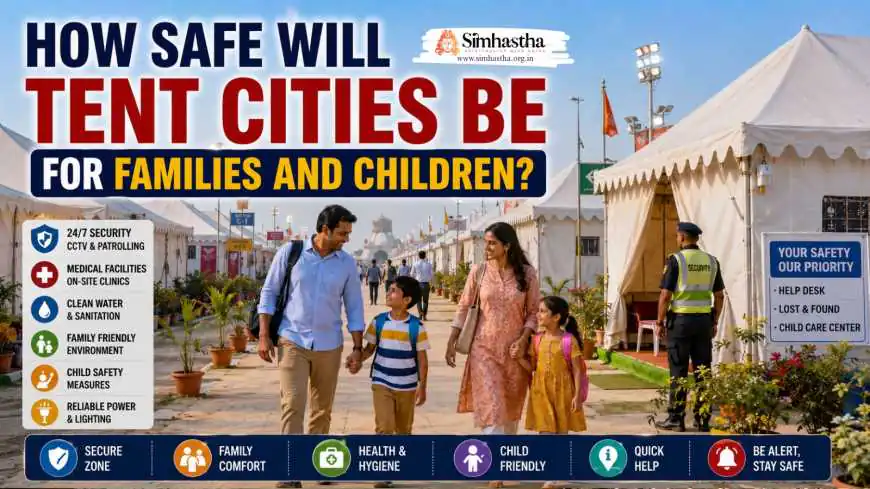
How Safe Will Tent Cities Be for Families and Children?
Concerned about safety? Discover how safe tent cities will be for families and children at Simhastha 2028, with AI surveillance, fire safety, and dedicated security forces.

The Question Every Family Asks Before the Pilgrimage
Let me ask you something that's probably been on your mind. 🌟 You've heard about the spiritual power of Simhastha 2028 in Ujjain. You've seen the breathtaking images of the Mahakal Lok Corridor. Your heart yearns to be part of this once-in-a-lifetime event. But then comes the nagging question that keeps you up at night: how safe will tent cities be for families and children? 👨👩👧👦
I get it. As a parent, your child's safety isn't just a priority—it's the only thing that matters. 🛡️ The idea of staying in a temporary tent city with millions of strangers can feel overwhelming. You wonder about hygiene, security, fire risks, privacy, and medical emergencies.
Here's the truth: The authorities planning Simhastha 2028 have learned from every major gathering in history—from the Maha Kumbh 2025 in Prayagraj to the challenges of previous Simhastha events. They're deploying technologies that sound like science fiction: underwater drones, AI-powered surveillance, articulating water towers for fire safety, and a seven-tier security framework. 🚁
In this article, I'll walk you through exactly how the tent cities are being designed, what safety measures are in place, and what you can do as a family to ensure your pilgrimage is spiritually fulfilling and practically safe. No sugar-coating, no fear-mongering—just honest, practical guidance. Let's dive in. 🙏
Trending Guides Now

Top Rated Hotels Near Mahakal Temple Ujjain
Affordable Hotels Near Ujjain Railway Station

Ultimate Hotel Booking Guide for Ujjain Visitors

Couple Friendly Hotels Near Mahakal Temple Ujjain: Latest Update for 2026

Ujjain Railway Station to Mahakaleshwar Temple Distance (2026 Guide)

Ujjain Simhastha 2028 Dates Announced: Full Shahi Snan & Event Timeline
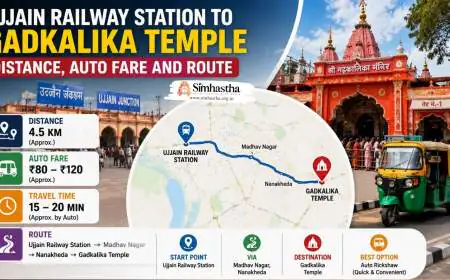
Ujjain Railway Station to Gadkalika Temple: Distance, Auto Fare and Route
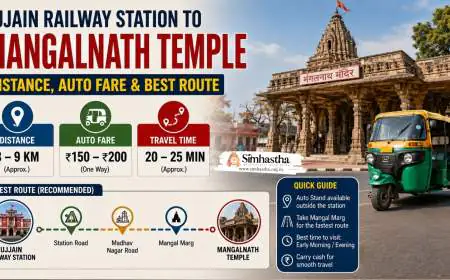
Ujjain Railway Station to Mangalnath Temple: Distance, Auto Fare and Best Route
The Nightmare Scenario: What Happens When Tent Cities Go Wrong
Before we look at the solutions, let's be honest about the risks. Because understanding the dangers is the first step to preventing them.
The Privacy and Dignity Crisis
Imagine sharing a four-by-six-meter tent with your spouse and teenage children. No walls. No privacy. No space to be a couple or have a quiet moment. 😰
This isn't a hypothetical. In Nyabira, Zimbabwe, over a thousand displaced families live in exactly these conditions—tents measuring roughly four by six metres where parents are forced to share space with their children . The result? Couples "seek privacy at inappropriate and sometimes unsafe times or places," according to residents . Parents told reporters they "do things at odd times and places, not because we want to, but because the living set-up leaves us with no choice" .
The Sanitation and Health Crisis
Now think about sanitation. In Gaza's tent cities, described as "a hygienic nightmare," displaced families have to dig their own latrines. Foul smells drift among packed tents, and pools of sewage collect from leaking cesspits. There is "not a single proper toilet across the vast tent cities" .
The Fire and Safety Crisis
And let's talk about fire. In England, temporary accommodation has been a "contributing factor to the deaths of at least 74 children" in the last five years, 58 of whom were under one year old . In Gaza, makeshift tents with open flames for cooking, packed closely together, create a fire hazard that's almost unimaginable.
The Safeguarding Crisis
There's also the issue of safeguarding. When families share communal facilities with strangers—including those with histories of domestic abuse—the risk to children escalates dramatically . In Guwahati, India, residential homestays have been accused of becoming hubs for "illicit activities, sex rackets, drug peddling, and late-night parties, flourishing under the guise of temporary rentals" . A resident of one apartment complex described the situation as "like living above a bar," with "young girls entering the premises wearing skimpy clothes and boys entering the homestay with girls with them" .
Here's the point: These are not the tent cities being planned for Simhastha 2028. But they serve as a stark warning of what can happen when temporary accommodations are mismanaged. The planners of Simhastha have studied these failures and are building a system designed to prevent every one of these scenarios.
The Simhastha 2028 Solution: A Fortress of Safety
The Three-Tier Holding System: Managing Crowds Before They Arrive
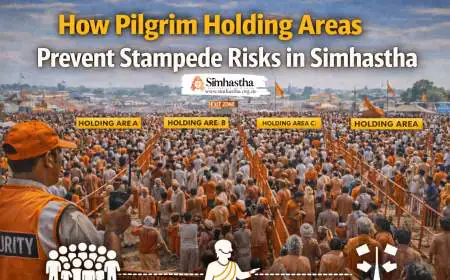
Let me explain the brilliance of this approach. With an estimated 30 crore pilgrims expected, the Madhya Pradesh government isn't waiting for everyone to show up in Ujjain and then scrambling to manage them . Instead, they're creating a network of integrated holding areas across nearly 10 districts—including Indore, Khandwa, Sehore, Bhopal, Narmadapuram, Jhabua, Ratlam, Agar Malwa, Shajapur, Neemuch, and Mandsaur .
What are these holding areas? They're essentially temporary transit townships with parking facilities, food courts, rest zones, medical units, sanitation infrastructure, drinking-water stations, bathing facilities, fuel stations, bio-toilets, mobile toilets, cafeterias, helpdesks, and public address systems .
Why does this matter for families? Because when a child needs a bathroom, medical attention, or a quiet place to rest, these facilities will be available before you even reach Ujjain. The three-tier holding system enables authorities to regulate the flow of pilgrims based on crowd levels and traffic conditions . If Ujjain is at capacity, you'll be held comfortably in a satellite town—not stranded on the roadside or crammed into an overcrowded tent.
As Asheesh Singh, Commissioner of Ujjain Division, said: "With an estimated footfall of crores of devotees, Simhastha 2028 requires planning at a regional scale. The holding-area network is designed to provide essential services, regulate traffic flow and ensure a safer and more comfortable experience for pilgrims while reducing pressure on Ujjain" .
The 3,000 Hectare Parking Infrastructure
Now think about this: 3,000 hectares of parking—that's roughly the size of 4,200 football fields . This isn't just about parking cars; it's about managing the flow of millions of pilgrims and ensuring that families aren't stuck in traffic with hungry, tired children.
ADG Rakesh Gupta of Ujjain Range explained that the biggest challenge will be the "smooth parking management of vehicles belonging to lakhs of devotees." The 3,000 hectares of parking will be developed across 30 sectors, with facilities extending to neighbouring districts .
AI-Powered Surveillance and Crowd Management
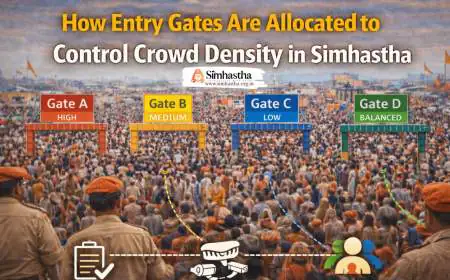
Here's where it gets really high-tech. Artificial intelligence is being deployed to monitor every aspect of the tent cities and mela grounds .
What this means for families:

-
AI-powered cameras and drones will provide 24/7 surveillance across the tent city.
-
The Integrated Command and Control Centre (ICCC) will use AI tools to monitor the situation continuously, providing real-time alerts and ensuring any potential issue is resolved immediately .
-
Anti-drone systems have been activated, and experienced experts are engaged to operate them .
-
Tethered drones (drones connected by cable for extended flight times) will ensure round-the-clock surveillance and real-time updates of all sectors, capturing every detail of the crowd with just a single click .
Think of it as a virtual guardian angel watching over you and your family. 👼
Fire Safety: The Articulating Water Towers
Fire is one of the biggest risks in a tent city. But look at what's being done for Simhastha, learning from the Maha Kumbh 2025 in Prayagraj :
-
Articulating Water Towers (AWT): These modern firefighting vehicles are specifically designed to tackle fires in multi-stored structures and large tents. They can operate at heights up to 35 meters and horizontal distances of 30 meters. They're equipped with advanced video and thermal imaging cameras .
-
Massive Investment: ₹131.48 crore allocated for fire safety .
-
351 firefighting vehicles deployed .
-
50+ fire stations established .
-
More than 2,000 trained fire personnel on duty .

-
Fire equipment fitted in every tent .
-
20 fire posts spread across the mela area .

This is fire protection on a military scale.
Security: The Seven-Tier Framework
Here's how the security is being structured. At the Maha Kumbh 2025, a seven-tier security system was implemented :
-
Outer cordon (the outermost perimeter)
-
Inner cordon (tighter security closer to the tent city and temples)
-
Isolation cordon (for emergency isolation of areas)
-
District checking (security at the district level)
-
Neighbouring/buffer district security
-
Interstate checking (security checks at state borders)
-
Security at city's prominent public places, including religious spots
The numbers you need to know:
-
60,000 police personnel will be deployed during Simhastha, with additional support from other states .
-
117 officers are being trained as "master trainers" in a 21-day specialized programme covering crowd management, disaster response, extreme weather handling, and communication with devotees .
-
400 police personnel will be deployed specifically for traffic management across 8 zones in Ujjain .
-
250 additional personnel have been allotted to Ujjain for Simhastha-related training and traffic management .
Cybersecurity: Protecting Your Digital Information
In the "Digital Maha Kumbh," your data is also protected. A robust cybersecurity team has been established to safeguard devotees from around the world . The Integrated Command and Control Centre will provide all minute inputs that are helpful for crowd control and traffic management .
What Tent Cities for Families Will Actually Look Like
Now let's shift from the abstract to the concrete. Based on the planning for Simhastha and the proven systems from Maha Kumbh 2025, here's what the tent cities for families will include:
For Privacy and Dignity
Unlike the cramped conditions in disaster camps, Simhastha's tent cities are being designed with organized sectors and allocated spaces for families. The tent cities will be zoned and organized to ensure families can stay together and have access to proper sanitation and privacy. The organization into 25 sectors with dedicated facilities ensures that no family is left without services or forced into degrading living arrangements.
For Sanitation and Hygiene
The holding hubs feature bio-toilets, mobile toilets, drinking-water stations, and bathing facilities . The scale of planning—with 3,000 hectares of parking and holding areas across 10 districts—means that sanitation is a priority, not an afterthought. In every sector, fair price shops and essential services are being established to ensure access to supplies.
For Medical Emergencies
Medical units are integrated into the holding areas and tent cities . With 60,000 police personnel and dedicated emergency response teams, medical help will be available 24/7.
For Children Specifically
While no specific "children-only" zones are mentioned in the plans, the overall safety framework—AI surveillance, fire safety, medical units, and sanitation—creates a protective environment. Master trainers are being equipped with skills for "handling extreme weather conditions" and "communication with devotees," which is crucial when families with children need help .
What YOU Can Do to Stay Safe
The authorities are doing their part. But as a parent, you also have a responsibility to plan for your family's safety. Here's a practical checklist based on insights from travel experts :
Before You Go
-
Book accommodation in advance, especially if you want a hotel or specific tent city location .
-
Check your ID: Carry a government ID (passport for foreigners; Aadhaar/driver's license/PAN/Passport for Indian visitors) for hotel check-in and temple queues .
-
Plan your transportation: With 3,000 hectares of parking, traffic management will be strict. Know where you're supposed to park and how you'll get to your accommodation.
-
Pack conservatively: Ujjain is a deeply religious city. Dress with shoulders and knees covered when visiting temples and ghats .
On Arrival
-
Follow the signs: The tent cities will be divided into sectors (25 at Maha Kumbh). Know your sector and location .
-
Keep your phone charged: With AI-based forecasting and real-time alerts, you'll receive important updates via mobile messages, LED screens, and public announcement systems .
-
Emergency numbers: India-wide police 100, ambulance 102. Keep local hotel contact and embassy numbers handy .
At the Tent City
-
Avoid raw street salads and street food unless from a trusted vendor. Drink bottled water .
-
Be aware of your surroundings: With AI surveillance, you're being watched for your own safety, but don't rely on it completely.
-
Respect the rules: The camp prohibits smoking, noise especially toward the midnight, among other regulations .
-
Watch your belongings in crowded ghats and markets .
For Women and Children
-
Women traveling solo: Exercise usual precautions—avoid poorly lit lanes at night, prefer daytime temple visits, use trusted transport .
-
Children: Keep them close, especially during the holy dips and crowded temple visits.
-
Senior citizens: With ramps and accessible facilities being planned for Simhastha, you should find easier access than in previous events.
The Bottom Line: Safer Than You Think, But Not Risk-Free
Let me be completely honest with you. No large gathering is 100% safe. When you have 30 crore people in one region, there will be challenges. But the planning for Simhastha 2028 is orders of magnitude more sophisticated than any previous Kumbh Mela.
Here's the key:
-
The three-tier holding system means you won't be forced into an overcrowded tent city if Ujjain is at capacity .
-
The AI-powered surveillance and seven-tier security mean that threats are detected and neutralized before they reach you .
-
The ₹131.48 crore fire safety budget with 351 vehicles, 50+ fire stations, and 2,000 personnel means that fire risks are minimized .
-
The 40,000+ security personnel mean that help is never far away .
For families and children specifically, the risks are being managed at a scale and with a level of technology that's unprecedented. You won't face the privacy crisis of Zimbabwe's tent cities, the sanitation nightmare of Gaza, or the fire hazards of England's temporary accommodation .
So, should you bring your family to Simhastha 2028? Yes—if you plan ahead, stay informed, and follow the safety guidelines. The spiritual experience of a lifetime awaits. And the authorities have made sure that the tent cities will be a sanctuary, not a source of stress. 🕉️👨👩👧👦✨
Frequently Asked Questions