




















How Tent Cities Handle Water, Power and Daily Operations
Discover how tent cities handle water, power and daily operations during Simhastha 2028. From the Narmada pipeline and smart grids to housekeeping and AI-powered command centres, explore the hidden machinery that turns a canvas camp into a seamless pilgrim sanctuary.


The Liquid Lifeline and the Tent City Water Supply Grid
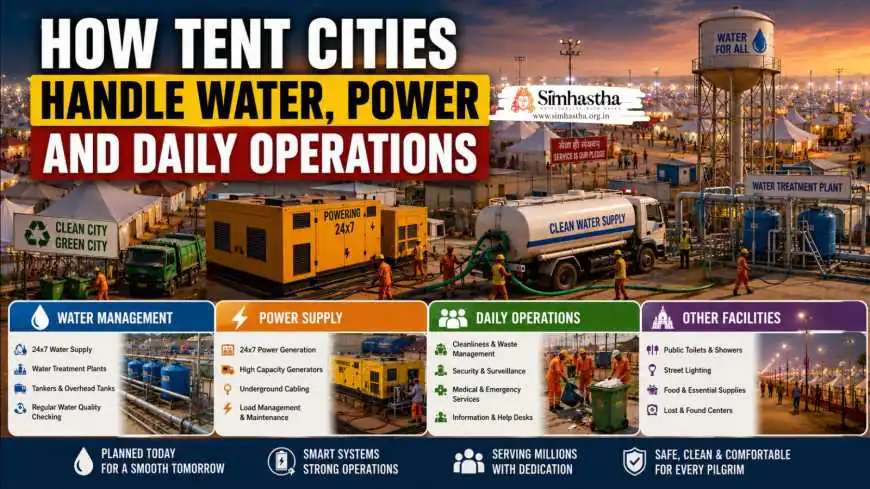
The single most critical, non-negotiable, and life-sustaining operational element of any tent city is water, and for the Simhastha 2028, the supply is not left to the mercy of local borewells or the unpredictable monsoon. The entire tent city complex is fed by a dedicated, high-capacity water supply grid that draws its primary source from the great, perennial Narmada River, delivered through a specially augmented spur of the existing Narmada Pipeline Project. This raw, untreated water is then channelled to a colossal, state-of-the-art 200 MLD water treatment plant, built on the city’s outskirts, where it undergoes a rigorous, multi-stage purification process—coagulation, flocculation, rapid sand filtration, and a final, sterilizing blast of ultraviolet and chlorine disinfection—that ensures it meets or exceeds the World Health Organization’s standards for safe drinking water. The treated, crystal-clear water is then pumped into a network of massive, reinforced concrete Master Balancing Reservoirs, positioned at strategic high points around the Mela zone. From these elevated reservoirs, the water flows, with a steady, reliable, gravity-assisted pressure, through a web of dedicated, high-density polyethylene pipes that snake beneath the canvas streets of the tent city, delivering a continuous, uninterrupted supply directly to every washbasin, every shower, and every kitchen tap.
For the pilgrim, this immense, complex, and meticulously engineered industrial operation manifests as a simple, quiet, and deeply reassuring miracle: the tap, when turned, always yields water. But the operational team, led by the Public Health Engineering Department (PHED) , never rests. A dedicated team of engineers and technicians monitors the entire grid, 24/7, from a digital dashboard within the Integrated Command and Control Centre (ICCC) . Sensors at every reservoir, every main junction, and every critical node continuously measure the flow rate, the pressure, and the residual chlorine levels. Any anomaly, any sudden drop in pressure that might indicate a burst pipe or an unexpected surge in demand, triggers an immediate, silent alert, and a mobile repair team is dispatched to the precise, geo-tagged location. The water is also distributed through a network of 2,000 Water ATMs and 5,000 tap points, each dispensing chilled or ambient, filtered water, free of charge, at the press of a button. The water grid is the silent, underground circulatory system of the tent city, a liquid, life-giving force that is managed with the precision of a hospital’s intensive care unit, ensuring that the pilgrim, exhausted after a long day of sacred bathing and temple darshan, can always wash away the dust, the sweat, and the fatigue in a stream of clean, warm, and deeply restorative water. 💧
The Power Grid and Keeping the Lights On and the Phones Charged
The immense, sprawling canvas city of the Simhastha consumes a colossal, continuous, and non-negotiable amount of electrical power. The air-conditioners that cool the premium tents, the lights that illuminate the pathways, the pumps that drive the water supply, the massive refrigerators in the central kitchens, and the millions of mobile phones that pilgrims need to keep charged are all part of a voracious, round-the-clock energy demand. To meet this demand, the Madhya Pradesh Power Management Company, in coordination with the Simhastha Special Purpose Vehicle (SPV), has constructed a dedicated Mela power grid. Two massive, new 220 KV substations have been built on the city’s periphery, and a network of high-tension transmission lines feeds a series of compact, weatherproof distribution transformers that are strategically located throughout the tent city sectors. Crucially, within the high-density tent city zone itself, the entire electrical distribution network has been undergrounded. The thick, insulated cables are laid in deep, protected trenches, eliminating the dangerous, unsightly, and chaotic tangle of overhead wires that is the bane of most Indian cities, and ensuring complete safety and an unobstructed, aesthetically clean environment for the pilgrims.
The operational heart of the power grid is a dedicated Energy Management Cell within the ICCC. Engineers monitor the real-time load on every transformer, every feeder line, and every sector, using a sophisticated SCADA (Supervisory Control and Data Acquisition) system. The grid is designed with multiple layers of intelligent redundancy. The primary power supply is backed by a fleet of silent, industrial-grade diesel generator sets, which are configured for automatic failover. In the event of a grid failure, the generators start and assume the full load of their designated sector within seconds, ensuring that the lights in the medical posts, the ICCC, and the kitchens never even flicker. A significant and pioneering portion of the Mela’s energy demand is being met by a massive, 50 MW solar power plant, its acres of photovoltaic panels soaking up the abundant Malwa sunshine and feeding clean, green energy directly into the grid. The entire power infrastructure is being built as a permanent, transformative legacy for Ujjain, and the operational team that manages it during the Mela is trained to the highest standards of industrial safety and emergency response. The pilgrim, resting in their air-conditioned tent, their phone quietly charging on the bedside table, remains blissfully unaware of the immense, silent, and deeply complex electrical symphony that is being orchestrated, in real-time, to ensure their comfort. ⚡
Trending Guides Now
Affordable Hotels Near Ujjain Railway Station

Ultimate Hotel Booking Guide for Ujjain Visitors

15 Budget Hotels Near Mahakal Temple Ujjain Under ₹1500

Luxury Hotels Near Mahakaleshwar Temple Ujjain: Big Hospitality Boom Underway

Ujjain Railway Station to Mahakaleshwar Temple Distance (2026 Guide)

Ujjain Simhastha 2028 Dates Announced: Full Shahi Snan & Event Timeline

Ujjain to Mahakaleshwar Temple Distance & Taxi Fare (2026)
Ujjain Railway Station to Mangalnath Temple: Distance, Auto Fare and Best Route
The Daily Rhythm of Hospitality and Check-In, Housekeeping, and the Laundry of the Gods
The power and water grids are the silent, underground skeleton of the tent city, but the warm, living, breathing flesh of the daily pilgrim experience is the hospitality operations, the continuous, twenty-four-hour cycle of check-in, housekeeping, and laundry that transforms a tent from a simple shelter into a true, welcoming sanctuary. The arrival experience at a premium tent city is designed to be a seamless, calming ritual, a gentle decompression chamber after the chaotic, sensory-overloaded journey to Ujjain. At the elegantly appointed, air-conditioned reception pavilion, a guest is greeted not with a queue and a form, but with a chilled, aromatic towel, a glass of infused water, and a swift, paperless, digital check-in process. A dedicated personal butler then escorts the pilgrim to their tent, explains the amenities and the safety features, and becomes their personal, single-point contact for the duration of their stay, a quiet, efficient, and deeply knowledgeable guardian angel who can arrange everything from a pre-dawn auto-rickshaw for the Bhasma Aarti to a private, guided tour of the akhara camps.
The housekeeping operation is a silent, relentless, and meticulously supervised ballet. Teams of trained attendants, dressed in clean, colour-coded uniforms, service each tent on a pre-determined, high-frequency schedule, their work tracked and verified through a geotagged, digital task-management system. The bathrooms are scrubbed and sanitized with hospital-grade disinfectants, the linen is changed daily, the floors are mopped, and the amenities are replenished. The immense, continuous volume of linen—the bedsheets, the pillowcases, the towels, and the staff uniforms—is processed by a large, industrial-scale, on-site laundry facility, equipped with high-capacity washing machines, powerful dryers, and steam presses, ensuring a constant, reliable supply of fresh, clean, and beautifully pressed fabric. The entire housekeeping and laundry operation is run, like the sanitation system, on a performance-linked contract model, with independent quality auditors conducting unannounced inspections and the operator’s payment being directly tied to the consistently high, independently verified quality of their service. The pilgrim, returning from the dust and the sweat of the Mela, finds their tent transformed into a cool, clean, and deeply peaceful haven, a small, daily miracle of invisible, attentive care. 🛏️
The Sacred Kitchen and the Operations of Mass Sattvic Dining
The central dining pavilion of a tent city is not merely a restaurant; it is a massive, high-volume, and profoundly sacred operation, a continuous, humming engine of sattvic nourishment that feeds thousands of pilgrims, multiple times a day. The operation begins long before dawn, in the vast, stainless-steel, industrial-scale kitchen, where a dedicated team of trained chefs, many of whom have been recruited from the finest vegetarian hotel kitchens in India, prepare the day’s meals according to a strictly prescribed, spiritually pure menu. The food is prepared without any onion, garlic, or any tamasic ingredients, using the freshest seasonal produce, much of it sourced directly from the local Malwa farming communities with whom the tent city operators have established direct, pre-arranged supply chains. The kitchen itself is a marvel of hygienic, high-volume food production, with clearly demarcated, colour-coded zones for the preparation of raw vegetables, the cooking of grains, the baking of breads, and the final, careful plating of the meals.
The dining service is a precisely timed, multi-wave operation. The meals are served in a spacious, elegantly appointed, and air-conditioned dining pavilion, where pilgrims are seated in orderly, comfortable settings. The buffet counters are continuously replenished by a team of silent, efficient, and warmly smiling servers, dressed in clean, pressed uniforms and wearing disposable gloves and hairnets. The menu changes daily, offering a wide, rotating variety of pure vegetarian Indian, Malwa regional, and mild Continental dishes, all clearly labelled. For the pilgrim who requires a specific, simple meal for a child, or who is observing a particular fast, the butler service can arrange a custom, private meal in the comfort of their tent. The entire kitchen operation is supervised by a dedicated Food Safety Officer, who conducts regular, rigorous inspections of the storage, the preparation, and the serving areas, ensuring that the highest standards of hygiene and food safety are maintained without compromise. The dining pavilion is a quiet, peaceful, and deeply satisfying space, a place where the pilgrim’s physical hunger is sated with food that is not just delicious but sanctified, a tangible, daily blessing that nourishes the body for the sacred work of the pilgrimage. 🍽️
The Digital Skeleton and Real-Time Monitoring and the ICCC at Work
Behind the seamless, visible operations of the tent city—the running water, the constant power, the clean rooms, and the hot meals—a silent, digital, and all-seeing intelligence is at work. The entire tent city complex, along with every other element of the Mela’s vast infrastructure, is tethered to the Integrated Command and Control Centre (ICCC) , the technological brain of the Simhastha. Within the ICCC, a dedicated cluster of screens and a team of operators are assigned specifically to the tent city operations. They monitor, in real-time, the water pressure in every sector, the electrical load on every transformer, the status of every generator, and the location and performance of every housekeeping and sanitation team. The geotagged, digital task-management system that governs the cleaning of the toilets and the servicing of the tents feeds its data directly into this central dashboard. If a particular toilet block has not been serviced within its designated time window, an automatic alert is triggered, and a supervisor is dispatched. If a water pressure sensor detects a developing leak, a maintenance team is routed to the precise location before the pilgrim ever notices a drop in pressure. The ICCC also serves as the central communication hub for the tent city’s security force, its medical post, and its shuttle bus fleet. The digital skeleton is the invisible, integrating intelligence that transforms a collection of separate, complex systems into a single, harmonious, and deeply responsive living organism, an organism that breathes, adapts, and cares for its inhabitants with a silent, algorithmic grace. 📡
The Unseen Army and Staff Training, Welfare, and the Spirit of Seva
The most sophisticated technology and the most advanced infrastructure are, in the end, only as good as the human beings who operate them. The tent city’s daily operations are powered by a massive, dedicated, and rigorously trained workforce, many of them recruited locally from the Ujjain and Malwa region, who are being offered not just a job but a profound, dignified profession. The staff, from the front-desk receptionists and the personal butlers to the housekeeping attendants and the kitchen helpers, undergo an intensive, multi-week training programme that covers not just the specific technical skills of their roles but the essential, softer skills of pilgrim hospitality: the art of the gentle, reassuring smile, the quiet, patient response to a distressed or confused guest, and the deep, internalized understanding that they are performing a sacred seva, a selfless service, to the pilgrims of the Lord of Time. The staff are provided with clean, comfortable uniforms, nutritious meals in a dedicated staff canteen, clean, safe, and secure dormitory accommodation near the tent city, and a fair, transparent, and timely wage. The welfare of the workers is seen not as a cost but as a foundational investment in the quality of the pilgrim experience. A worker who is well-rested, well-fed, and treated with genuine dignity and respect is a worker who will serve the pilgrim with a genuine, heartfelt warmth, a warmth that no amount of technology can ever replicate. This unseen army of dedicated, humble, and deeply committed individuals is the true, beating, human heart of the tent city’s daily operations. 🧑🍳

The Circle of Comfort and the Grace of a Well-Run Sanctuary
The tent city, in its profound and deeply intelligent design, is not merely a functional accommodation block. It is a complete, self-contained, and deeply dignified sanctuary, a place where the immense, often overwhelming, spiritual energy of the Kumbh can be processed, absorbed, and integrated in a state of physical comfort, safety, and peace. The water that flows from the tap, the light that illuminates the path, the clean, soft bed, the nourishing, sanctified meal, and the quiet, reassuring presence of the watchful security guard are not luxuries. They are the essential, physical foundation upon which the pilgrim’s entire spiritual journey is built. The body that is well-rested, well-nourished, and free from the constant, draining anxiety of basic survival is a body that can pray with a focused, laser-like intensity, that can stand for hours in the long, sacred queue with a patient, loving smile, and that can surrender, completely and ecstatically, to the transformative, ash-smeared grace of the Lord of Time. The daily operations of the tent city, that silent, relentless, and deeply compassionate ballet of water, power, food, and care, are, in the final, beautiful analysis, a profound, secular form of worship, a quiet, invisible, and deeply loving offering to the divine that resides, temporarily and eternally, within every pilgrim who has come to the banks of the sacred Shipra. 🔱
Frequently Asked Questions