


















Best Tent City Zones for Simhastha 2028 (Price & Location)
Complete guide to Simhastha 2028 tent cities. Best zones, price ranges, bathing ghat proximity, and booking tips for a comfortable Kumbh stay.


The Smart Pilgrim’s Alternative to Sold-Out Hotels
You’ve searched every booking app. Called a dozen hotels. Been told “full” more times than you can count. The desperation is creeping in. But here’s what thousands of pilgrims discover during every Simhastha: the best rooms aren’t in hotels at all. They’re in tent cities.
When Ujjain’s 10,000 to 13,000 hotel rooms vanish months before the peak bathing dates, a parallel accommodation universe emerges. Government tent cities, private tent camps, and luxury tent resorts spring up along the Kshipra riverbanks, on vacant grounds, and in dedicated mela zones. Combined, they add 16,000 to 28,000 beds to the city’s capacity.
But not all tent cities are created equal. Some are steps from the bathing ghats. Others require a 20-minute walk. Some cost ₹500 per night with basic cots. Others charge ₹5,000 for air-conditioned tents with attached bathrooms and room service.
This guide maps out the best tent city zones for Simhastha 2028—their locations, price ranges, amenities, and which type of pilgrim each zone suits best. Because when hotels fail, tents don’t just save you. They can give you an experience that hotels never could. Sleeping on the Kshipra’s banks, with the sound of temple bells and the smell of incense—that’s not a compromise. That’s pilgrimage. 🏕️
Trending Guides Now
Ujjain Travel Budget 2026: Complete Cost Breakdown for Pilgrims
Ahmedabad to Ujjain Travel Guide: Fastest Route, Distance, Train & Bus Options

Kota to Ujjain Travel Guide: Routes, Distance and Travel Time

Ujjain Temple Tour by Auto, Taxi or Walking: Best Choice

Ujjain Railway Station to Mahakaleshwar Temple Distance (2026 Guide)

Ujjain Simhastha 2028 Dates Announced: Full Shahi Snan & Event Timeline

Triveni Ghat Ujjain – Simhastha 2028 Complete Guide

Ujjain to Mahakaleshwar Temple Distance & Taxi Fare (2026)
Understanding the Tent City Landscape
Before diving into specific zones, let me explain how Simhastha tent accommodation works.
Who runs the tent cities? Two groups: the Madhya Pradesh government (through the Simhastha Mela Authority) and private operators (travel companies, spiritual organizations, and local entrepreneurs).
Government tent cities are basic, affordable, and organized. They focus on function over form. You get a cot, a blanket, shared toilets, drinking water, first aid, and security. The price is fixed. The location is usually close to bathing ghats. Booking is through the official Simhastha website.
Private tent camps range from budget to luxury. Some are identical to government tents but slightly more expensive. Others offer premium experiences—air conditioning, attached bathrooms, proper beds, meals included, and even concierge services. Booking is through private websites, travel agents, or direct contact.
Temporary vs permanent: These tent cities are seasonal. They appear 2-3 months before Simhastha and disappear 1-2 months after. The infrastructure is designed to be assembled quickly and removed without permanent impact on the riverbanks or grounds.
Capacity varies by zone. The largest tent zones hold 2,000 to 5,000 people. Smaller zones hold 200 to 500. In total, all tent zones combined add 16,000 to 28,000 beds.

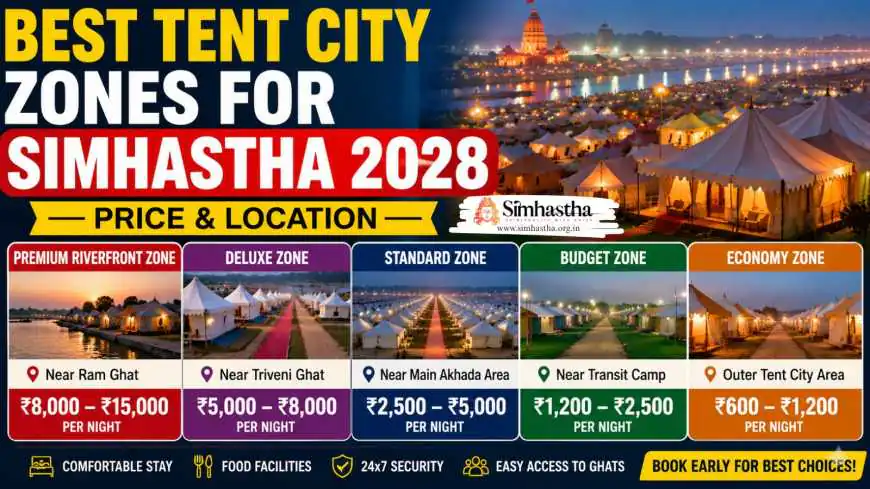
Zone 1: Ram Ghat Riverside Tents (Closest to Action)
Let me start with the most sought-after tent location. Ram Ghat is the main bathing ghat on the Kshipra River. During Simhastha, this is where millions gather for the holy dip. Tent zones directly adjacent to Ram Ghat are the closest you can sleep to the water.
Location: Within 100 to 300 meters of Ram Ghat. Walk to the bathing steps in 2 to 5 minutes.
Who runs them: Mostly government, with some private operators in adjacent areas.
Price range: ₹800 to ₹2,000 per person per night (government). ₹2,000 to ₹5,000 (private basic).
Amenities (government): Cot, mattress, blanket, pillow. Shared toilets (separate for men and women). Shared bathing area with bucket and mug. Drinking water station. First aid. Security. Charging points in common areas.
Amenities (private basic): Same as government but slightly better maintained. Some have cots with thicker mattresses. Slightly cleaner toilets.
Walking distance to Mahakal Temple: 800 meters (10-12 minutes from Ram Ghat).
Best for: Pilgrims prioritizing bathing ghat proximity above all else. Those wanting the most authentic Kumbh experience. Early morning bathers who want to roll out of bed and into the river.
Not ideal for: Those needing privacy or quiet. Ram Ghat is the epicenter of noise and crowds, even at night.
Booking advice: Government tents here book up first—3 to 4 months in advance. Private tents may have availability 1 to 2 months before, at higher prices.
Real pilgrim experience: “I woke up at 4 AM, walked 3 minutes to the ghat, and was in the water before the crowd built. By 6 AM, I was back in my tent having chai. Staying at Ram Ghat changed everything.”
Zone 2: Kshipra Riverbank Extension (Quiet Riverside)
Just south of Ram Ghat, the riverbank extends for another 1 to 2 kilometers. Tent zones here are still on the water but away from the main crowd concentration.
Location: 500 meters to 1.5 kilometers from Ram Ghat. Walk to main bathing area in 10 to 20 minutes. Some zones have their own smaller ghats for bathing.
Who runs them: Mix of government and private. More private operators here than at Ram Ghat.
Price range: ₹600 to ₹1,500 per person (government). ₹1,500 to ₹4,000 (private). ₹4,000 to ₹8,000 (private luxury with AC and attached bathroom).
Amenities (private luxury): Air-conditioned tents (some). Attached bathroom with geyser. Proper beds with linens. Meals included (breakfast and dinner). Power backup. Private seating area. Sometimes even a small veranda.
Walking distance to Mahakal Temple: 1.2 to 2 kilometers (15-25 minutes walk, or 5-10 minutes by auto).
Best for: Pilgrims who want river proximity without Ram Ghat chaos. Families willing to walk a bit more for better amenities and lower prices. Those wanting AC or attached bathrooms.
Not ideal for: Pilgrims with mobility issues (the walk to main ghats is longer). Those who want to be in the absolute center of action.
Booking advice: Government tents here book 2 to 3 months in advance. Private luxury tents have more availability but book 1 to 2 months ahead for peak dates.
Real pilgrim experience: “We stayed in a private AC tent about 1 km from Ram Ghat. It was quiet at night. We had our own bathroom. We walked 15 minutes to the main ghat for the dip. Perfect balance for our family.”
Zone 3: Rudrasagar Lake Area (Near Mahakal Lok)
Rudrasagar Lake is the water body connected to the new Mahakal Lok corridor. Tent zones here are close to the temple and the corridor, making them excellent for pilgrims focused on Mahakal darshan rather than river bathing.
Location: 200 to 500 meters from Mahakal Lok corridor. 500 to 800 meters from Mahakal Temple. Not directly on the Kshipra River (you’ll walk 10-15 minutes to Ram Ghat for bathing).
Who runs them: Mix of government and private. This is a newer zone for Simhastha 2028, so expect more organized infrastructure.
Price range: ₹700 to ₹1,500 (government). ₹1,500 to ₹4,000 (private basic). ₹4,000 to ₹10,000 (private luxury).
Amenities (luxury): AC tents, attached bathrooms, proper beds, meals, power backup. Some have views of the Mahakal Lok corridor.
Walking distance to Mahakal Temple: 500 to 800 meters (7-12 minutes). This is the closest tent zone to the temple.
Best for: Pilgrims prioritizing Mahakal darshan over river bathing. Those who want easy access to the temple and the new corridor. Nighttime aarti attendees who don’t want long walks back.
Not ideal for: Pilgrims who want to be on the riverbank for their bath. You’ll need to walk 10-15 minutes to Ram Ghat.
Booking advice: This zone is expected to be popular in 2028 due to the Mahakal Lok corridor. Book 3 to 4 months in advance for government tents, 2 to 3 months for private.
Real pilgrim experience (predicted): “Waking up and seeing the lit pillars of Mahakal Lok from my tent was surreal. The walk to the temple was beautiful. For the bath, we walked to Ram Ghat—it was fine.”
Zone 4: Nanakheda Grounds (Budget Land Zone)
Not all tent cities are on the river. Nanakheda grounds (near Nanakheda Stadium) is a large open area that becomes a tent city during Simhastha. It’s not on the water, but it’s well-connected and close to Freeganj’s restaurants and amenities.
Location: Nanakheda neighborhood, 2.5 to 3 kilometers from Ram Ghat. 3 to 3.5 kilometers from Mahakal Temple.
Who runs them: Primarily government, with some private budget operators.
Price range: ₹400 to ₹1,000 per person (government). ₹1,000 to ₹2,500 (private basic).
Amenities: Cot, mattress, blanket. Shared toilets. Drinking water. Security. Basic first aid. No AC. No attached bathrooms. This is functional, not fancy.
Walking distance to Mahakal Temple: 3 kilometers (15 minutes by auto, ₹60-₹80). Shuttle buses available during Simhastha.
Best for: Extreme budget pilgrims. Those who don’t mind taking autos to the river and temple. Groups willing to trade proximity for low prices.
Not ideal for: Pilgrims who want to walk to the ghats. Those needing AC or attached bathrooms. Anyone with mobility issues (distance to temple requires transport).
Booking advice: Government tents here have the most availability and book last (1 to 2 months before peak dates). This is your “I didn’t plan ahead” option.
Real pilgrim experience: “We paid ₹500 per night. It was basic—cot, blanket, shared toilet. But it was safe, and we saved money. We took autos to the temple. For the price, it was fine.”
Zone 5: Madhav Nagar Bypass (Premium Tent Resorts)
For pilgrims who want the tent experience without sacrificing comfort, Madhav Nagar bypass road offers premium tent resorts. These are not basic mela tents—they’re organized camps with proper infrastructure.
Location: Madhav Nagar area, 4 to 5 kilometers from Ram Ghat. 3.5 to 4.5 kilometers from Mahakal Temple. You will need transport.
Who runs them: Private operators specializing in luxury camping.
Price range: ₹5,000 to ₹15,000 per person per night (depending on tent size, amenities, and meal inclusions).
Amenities: Large tents with proper beds, AC, attached bathroom with geyser, sitting area, power backup, meals included (breakfast, lunch, dinner), evening tea service, sometimes even a small fridge. Some resorts have common dining tents, meditation areas, and travel desks.
Walking distance to Mahakal Temple: Not walkable (4+ km). The resort will arrange transport or you’ll need your own vehicle.
Best for: International pilgrims. Families with significant budgets. Those with health conditions requiring AC and attached bathrooms. Anyone wanting comfort and service.
Not ideal for: Budget pilgrims. Those wanting to be close to the action. Anyone who doesn’t want to rely on transport for every temple visit.
Booking advice: Book 4 to 6 months in advance. These premium resorts have fewer tents (often 20-50 per property) and fill with international and NRI pilgrims.
Real pilgrim experience: “We flew from the US for Simhastha. The tent resort was incredible—AC, attached bathroom, amazing food. They arranged a car for us to the temple every morning. Yes, it was expensive. But for us, it was worth every dollar.”
Zone 6: Private Ashram Campgrounds (Spiritual Atmosphere)
Some ashrams and spiritual organizations set up tent accommodations on their campuses. These offer a devotional atmosphere that commercial tent cities lack.
Location: Various locations—some near the river, some in the old city, some on the outskirts.
Who runs them: Religious trusts, ashrams, spiritual organizations (e.g., Ramakrishna Mission, Geeta Bhawan, various akharas).
Price range: ₹300 to ₹800 per person (often donation-based or nominal fee). Some include meals (simple vegetarian).
Amenities: Basic tents or simple rooms (not always tents—sometimes dormitories). Shared toilets. Simple meals. Daily bhajans and satsangs. Spiritual environment.
Walking distance to Mahakal Temple: Varies by location. Some are very close (old city ashrams). Others are farther.
Best for: Pilgrims seeking a spiritual atmosphere over physical comfort. Those who want to be part of an ashram community during Simhastha. Extreme budget travelers.
Not ideal for: Those wanting privacy, AC, or attached bathrooms. Pilgrims uncomfortable with ashram rules (quiet hours, dress codes, vegetarian only, no alcohol/smoking).
Booking advice: Call ashrams directly 3 to 4 months in advance. Most do not have online booking. You may need to send someone to book in person. These fill through word of mouth, not advertising.
Real pilgrim experience: “I stayed at an ashram tent camp for ₹500 per night including meals. The food was simple but made with devotion. Every evening we sang bhajans. I didn’t miss hotels at all.”
Zone 7: Railway Station Grounds (Emergency Overflow)
The area around Ujjain railway station has open grounds that become emergency tent accommodation during peak days. This is not planned—it’s overflow for pilgrims who arrive with nowhere to sleep.
Location: Near Ujjain Junction railway station, 2.5 km from Ram Ghat.
Price range: ₹200 to ₹500 (very basic, often just a mat on the ground).
Amenities: A mat. Maybe a blanket. Shared toilets (railway station facilities). No security. No food. This is shelter, not accommodation.
Best for: Absolute last resort. Pilgrims who arrived without booking and have no other options.
Not ideal for: Anyone with another choice.
Booking advice: No booking. First come, first served on peak days. Bring your own sleeping bag or mat.
Real pilgrim experience: “I missed my train and couldn’t find a room. I slept on the railway station grounds on a mat. It was cold. There were many others doing the same. Not ideal, but I survived.”
Price Comparison Table: Tent Zones at a Glance
| Zone | Proximity to Ghat | Proximity to Temple | Price Range (₹/night) | Amenities | Best For |
|---|---|---|---|---|---|
| Ram Ghat Riverside | 2-5 min walk | 12 min walk | 800-2,000 (govt), 2,000-5,000 (private) | Basic to moderate | Bathing priority |
| Kshipra Extension | 10-20 min walk | 15-25 min walk | 600-1,500 (govt), 1,500-8,000 (private) | Basic to luxury | Riverside without chaos |
| Rudrasagar Lake | 10-15 min walk | 7-12 min walk | 700-1,500 (govt), 1,500-10,000 (private) | Basic to luxury | Temple priority |
| Nanakheda Grounds | 15 min auto | 15 min auto | 400-1,000 (govt), 1,000-2,500 (private) | Basic only | Extreme budget |
| Madhav Nagar Bypass | 15-20 min auto | 15-20 min auto | 5,000-15,000 | Luxury | Comfort & service |
| Ashram Campgrounds | Varies | Varies | 300-800 | Basic, spiritual | Spiritual atmosphere |
| Railway Station | 15 min walk | 20 min walk | 200-500 | Minimal | Emergency only |
How to Book a Tent City for Simhastha 2028
Let me give you a clear booking timeline and process.
Government tent cities:
-
Booking opens: 3 to 4 months before Simhastha (around January-February 2028)
-
Platform: Official Simhastha website (simhasthaujjain2028.mp.gov.in)
-
Payment: Online (credit card, UPI, net banking)
-
Confirmation: Email and SMS. Print your confirmation or save PDF on phone.
-
Documents required: ID proof (Aadhaar, passport, voter ID) for each adult
Private tent camps:
-
Booking opens: 4 to 6 months before Simhastha (some as early as 8 months)
-
Platform: Operator websites, travel agents (MakeMyTrip, Booking.com may list some), direct calling
-
Payment: Varies (online, bank transfer, cash for walk-ins)
-
Confirmation: Varies. Get written confirmation via email or WhatsApp.
-
Documents required: Usually same as government.
Ashram campgrounds:
-
Booking opens: 3 to 4 months before Simhastha
-
Platform: Phone or in-person only. No online booking.
-
Payment: Cash or bank transfer. Some accept donations only.
-
Confirmation: Verbal or handwritten receipt. Get a name and phone number.
Pro tip for government tents: Book the moment booking opens. The best zones (Ram Ghat, Rudrasagar) sell out within days. Have your ID proofs ready. Create an account on the website in advance (do this 1-2 months before booking opens).
What to Pack for a Tent City Stay
Tent accommodation requires different packing than hotels. Here’s your checklist.
Essential:
-
Sleeping bag or extra blanket (tents provide blankets, but they may be thin)
-
Pillow (tents provide, but quality varies)
-
Torch or headlamp (essential for nighttime walks to toilets or the river)
-
Power bank (charging points are in common areas, not in tents)
-
Flip-flops (for shared bathrooms)
-
Towel and basic toiletries
-
Wet wipes and hand sanitizer
-
Reusable water bottle
-
Earplugs (tent cities can be noisy)
-
Light cotton clothing for the day, warm layer for early morning
Nice to have:
-
Small lock for your bag (tents have no lockers)
-
Travel sheet (for extra hygiene)
-
Portable fan (non-AC tents get hot in afternoon)
-
Snacks (tent cities have limited food options, though meals may be included)
Leave at home:
-
Large suitcases (tents are small; space is limited)
-
Valuables (no secure storage)
-
Multiple pairs of shoes (one pair sturdy sandals, one pair walking shoes)
Pros and Cons of Tent City Stays
Let me be honest about what you’re signing up for.
Pros:
-
✅ Availability. When hotels are sold out, tents are often still available.
-
✅ Price. Much cheaper than hotels during Simhastha (₹500 vs ₹8,000).
-
✅ Proximity. Many tent zones are closer to the river than any hotel.
-
✅ Atmosphere. Sleeping on the Kshipra’s banks is unforgettable.
-
✅ Community. You’ll meet pilgrims from across India and the world.
-
✅ Flexibility. Tent cities are designed for Simhastha’s unique rhythm.
Cons:
-
❌ Privacy. You’re in a large tent with dozens of others (government) or a small tent with thin walls (private). No real privacy.
-
❌ Noise. Pilgrims come and go at all hours. Snoring. Children crying. Discussions. It’s rarely silent.
-
❌ Shared bathrooms. Government tents have shared toilets and bathing areas. Hygiene varies.
-
❌ No AC in budget tents. Summer days (April-June) can be brutally hot.
-
❌ Limited power. Charging points are in common areas, not in tents.
-
❌ Basic food. If meals are included, they’re simple (dal, roti, sabzi). If not included, you’ll walk to nearby eateries.
The trade-off is clear: Tents give you proximity and price. Hotels give you privacy and comfort. Choose based on your priorities.
The Emotional Gift of Sleeping in a Tent
I’ve slept in a Ram Ghat tent during Simhastha. And I’ve slept in a Freeganj hotel. Both were fine. But the tent stayed with me.
There’s something about lying on a cot, with canvas above you and the river nearby, hearing the distant bells of Mahakal Temple. You feel the pilgrimage in your bones. You’re not a tourist in a hotel. You’re a pilgrim on the Kshipra’s banks.
At 4 AM, you don’t wait for an auto. You don’t negotiate a fare. You just walk. Your feet find the path. The river calls. And by the time you’re waist-deep in the holy water, you know—you made the right choice.
Hotels are comfortable. Tents are memorable.
For Simhastha 2028, consider the tent. Not because you couldn’t find a hotel. But because sleeping under canvas, on sacred ground, with the sound of a million prayers in the air—that’s not a fallback. That’s the real thing. 🙏
Frequently Asked Questions