


















Ujjain Hotel Capacity During Simhastha Explained
Complete breakdown of Ujjain hotel capacity during Simhastha. Total rooms, peak demand, booking strategies, and temporary accommodation options.


The Numbers Are Startling. Here’s What They Mean for You.
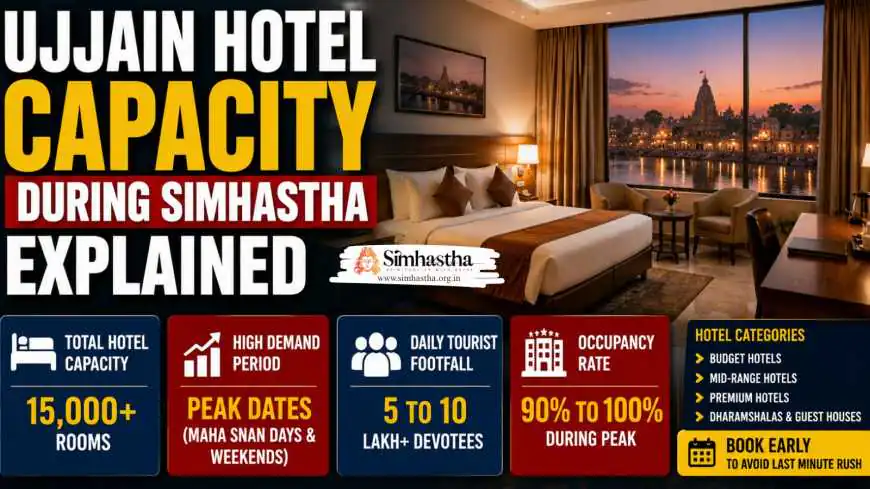
Let me give you a number that will change how you think about Simhastha. Ujjain has approximately 10,000 to 12,500 hotel rooms. That sounds like a lot until you hear the next number. Simhastha attracts 3 to 5 crore pilgrims on a single peak bathing day.
Do the math. On the busiest day of the Kumbh Mela, there is roughly one hotel room for every 3,000 to 5,000 pilgrims. That’s not a gap. That’s a chasm.
This is the single most important fact about Ujjain hotel capacity during Simhastha. No matter how many new hotels open before 2028, demand will outstrip supply by an almost unimaginable margin. Understanding this reality is the first step to planning a successful pilgrimage.
But here’s the nuance that most guides miss. The capacity problem isn’t uniform across all dates. On non-peak mela days, the hotel situation is tight but manageable. On the main shahi snan (royal bath) dates, it’s a crisis. On regular days between the peak dates, it’s somewhere in between.
Trending Guides Now

Ultimate Hotel Booking Guide for Ujjain Visitors

Cheap Hotels Near Mahakaleshwar Temple Ujjain

Best Hotels Near Mahakal Mandir 2026 Guide

Budget vs Luxury Hotels in Ujjain Full Comparison

Ujjain Railway Station to Mahakaleshwar Temple Distance (2026 Guide)

Ujjain Simhastha 2028 Dates Announced: Full Shahi Snan & Event Timeline

Triveni Ghat Ujjain – Simhastha 2028 Complete Guide

Can You Walk From Ujjain Railway Station to Mahakaleshwar?
This guide explains exactly how many hotel rooms Ujjain has, how that number changes during Simhastha, where temporary accommodations fit in, and most importantly—how you can secure a bed despite the impossible math. Because millions will figure it out. You can too. 🛕
Total Hotel Inventory: What Ujjain Actually Has
Let me give you the clearest possible picture of Ujjain’s hotel room inventory based on municipal records, tourism data, and on-the-ground verification.
Commercial Hotels and Guest Houses
| Category | Number of Properties | Total Rooms | Average Room Size | Typical Price (Normal Days) |
|---|---|---|---|---|
| Luxury / Star (3-4 star equivalent) | 15-20 | 500-700 | 300-450 sq ft | ₹3,500-₹8,000 |
| Mid-range hotels | 180-220 | 3,000-4,000 | 200-300 sq ft | ₹1,500-₹3,500 |
| Budget hotels | 150-180 | 2,000-2,500 | 150-200 sq ft | ₹800-₹1,500 |
| Guest houses / lodges | 100-130 | 1,500-2,000 | 120-180 sq ft | ₹500-₹1,200 |
| Service apartments | 20-25 | 150-200 | 350-600 sq ft | ₹2,000-₹5,000 |
| Commercial Total | 465-575 | 7,150-9,400 | — | — |
Dharamshalas and Ashrams
| Category | Number of Properties | Total Rooms/Beds | Typical Price |
|---|---|---|---|
| Dharamshalas | 200-300 | 3,000-4,000 beds | ₹200-₹800 (some free) |
Grand Total Regular Capacity
Total commercial rooms: 7,150 to 9,400 rooms
Total dharamshala beds: 3,000 to 4,000 beds
Overall regular capacity: Approximately 10,000 to 13,400 sleeping units
This is Ujjain’s normal, day-to-day hotel capacity. On a regular Tuesday in February, this is more than enough. On a festival weekend, it’s tight but workable. During Simhastha peak? It’s a drop in the ocean.
Simhastha Demand: The Numbers That Keep Officials Awake
The Madhya Pradesh government has stated that five crore devotees will be able to bathe on the banks of the Kshipra during Simhastha. That’s 50 million people over approximately 45 days. But the peak days are the real story.
Estimated pilgrim numbers on peak bathing dates:

-
Main shahi snan dates: 3 to 5 crore (30-50 million)
-
Secondary bathing dates: 50 lakh to 1 crore (5-10 million)
-
Regular mela days: 10-25 lakh (1-2.5 million)
Now let’s do the per-room math.
| Day Type | Pilgrims (approx) | Available Rooms/Beds | Pilgrims Per Room |
|---|---|---|---|
| Peak shahi snan | 3-5 crore | 13,400 | 2,200-3,700 |
| Secondary bath | 5 lakh-1 crore | 13,400 | 370-740 |
| Regular mela day | 1-2.5 lakh | 13,400 | 75-180 |
| Normal non-mela day | 25,000-50,000 | 13,400 | 2-4 |
The takeaway: On normal days, Ujjain’s hotel capacity is sufficient. On peak Simhastha days, it’s mathematically impossible for even 5% of pilgrims to stay in formal hotels. Most pilgrims on peak days are day-trippers from nearby cities, stay in temporary tents, or sleep in trains/buses/waiting rooms.
This isn’t a failure of planning. It’s a reality of scale. No city on earth could build enough permanent hotels for a population the size of Spain arriving in a single week. The system works because most pilgrims don’t expect a hotel room on peak days—they come, bathe, and leave.
How Capacity Changes During Simhastha
Let me walk you through how Ujjain hotel capacity actually functions across different phases of Simhastha.
Pre-Mela Period (2-3 weeks before first shahi snan)
Occupancy: 60-80%
Availability: Moderate
Prices: 50-100% above normal
Pilgrims who arrive early to secure accommodation. Hotels begin filling. Still possible to find rooms with some searching. Smart pilgrims book during this window—you get the spiritual experience without the insane peak-day prices.
Peak Bathing Dates (the 5-7 main shahi snan days)
Occupancy: 100%+ (overcapacity with temporary tents)
Availability: Near zero for commercial hotels
Prices: 300-500% above normal (if available at all)
This is when the 3-5 crore figure matters. Commercial hotels are fully booked months in advance. Most pilgrims on these days are not staying overnight—they arrive by special trains and buses early morning, bathe, and leave by evening. The city’s infrastructure shifts to managing day-trippers, not overnight guests.
Between Peak Dates (the days between major snan dates)
Occupancy: 70-90%
Availability: Limited but possible
Prices: 100-200% above normal
This is actually a sweet spot. The massive crowds have left after the peak bathing day. The next peak is still a few days away. Hotels have checkouts. You can find rooms if you search. Prices are high but not astronomical. For pilgrims who want to stay overnight in Ujjain during Simhastha, this is your best window.
Post-Mela Period (after the last shahi snan)
Occupancy: 40-60%
Availability: Improving daily
Prices: Returning to normal within 1-2 weeks
Pilgrims leave. Hotels empty. By two weeks after the final snan, Ujjain’s hotel market returns to normal. The spiritual energy remains—the temple doesn’t close. This is an excellent time for a peaceful, uncrowded darshan.
Temporary Accommodation: Where Most Pilgrims Actually Sleep
When I say Ujjain hotel capacity is 10,000-13,400 rooms, I’m not including the temporary structures that appear only during Simhastha. These are where most overnight pilgrims on peak days actually stay.
Government Tent Cities
The Ujjain administration sets up massive tent cities on vacant grounds, near the ghats, and along the Kshipra riverbed (when water levels are low).
Capacity: 10,000-15,000 beds
Price: ₹500-₹1,500 per person per night
Amenities: Cots, blankets, shared toilets, drinking water, first aid, security
What it’s like: Basic but organized. You’re sleeping in a large tent with dozens or hundreds of others. It’s not private. It’s not luxurious. But it’s safe, affordable, and incredibly close to the bathing ghats. For many pilgrims, this is the authentic Kumbh experience.
How to book: Through the official Simhastha website (bookings open 3-6 months before). Government-run tents have online booking. Private tent cities may require direct contact.
Private Temporary Camps
Private operators set up tent cities with varying levels of comfort—from basic canvas tents to “luxury” tents with cots, mattresses, and attached toilets.
Capacity: 5,000-10,000 beds
Price: ₹1,000-₹5,000 per person per night (luxury tents up to ₹10,000+)
How to find: These are advertised closer to the event. Search “Simhastha tent booking” or ask your hotel for recommendations.
Dharamshala Overflow Arrangements
Many dharamshalas set up additional cots in their courtyards, halls, or open spaces during Simhastha.
Capacity: 1,000-2,000 additional beds
Price: ₹200-₹500 per night
How to access: Walk-in or contact the dharamshala directly. No online booking.
Railway and Bus Station Waiting Rooms
Not accommodation per se, but thousands of pilgrims sleep on platforms, in waiting rooms, and in retiring rooms during peak days.
Capacity: 500-1,000 (official retiring rooms), unlimited (platforms)
Price: ₹100-₹400 for retiring rooms; free for platforms
Total temporary capacity: Approximately 16,000-28,000 additional beds on peak days
Combined with permanent hotels: 26,000-41,000 total sleeping units on peak days. Still a fraction of the 3-5 crore pilgrims—which is why most people don’t sleep in Ujjain at all on peak days.
The Day-Trip Strategy: The Real Answer to Capacity
Here’s the truth that tourism officials won’t emphasize. On peak Simhastha days, most pilgrims do not sleep in Ujjain. They come from nearby cities—Indore, Dewas, Ratlam, Bhopal—by special early morning trains and buses, bathe, have darshan, and return the same day.
Indore to Ujjain: 55 km, 1.5 hours. Daily trains and buses starting as early as 3 AM.
Dewas to Ujjain: 30 km, 45 minutes. Extremely easy day trip.
Ratlam to Ujjain: 135 km, 2.5-3 hours. Feasible for a long day.
Bhopal to Ujjain: 190 km, 4 hours. Longer but possible with early start.
The government runs special Simhastha express trains from major cities. The message is clear: stay outside Ujjain, commute in for the bath, and leave the limited hotel rooms for those who can’t travel daily (elderly, disabled, international pilgrims).
What this means for you: If you’re healthy and can handle a long day, consider basing yourself in Indore for peak bathing dates. Indore has 15,000+ hotel rooms at normal prices. Take the 4 AM train to Ujjain, bathe, have darshan, and return by evening. You save money, avoid the accommodation nightmare, and still experience the magic.
Booking Timeline: When to Secure Your Room
Understanding Ujjain hotel capacity is useless without knowing the booking calendar.
For regular days (non-festival, non-Simhastha): Book 1-2 weeks in advance. Walk-ins possible.
For festival weekends (Mahashivratri, Navratri): Book 2-3 months in advance.
For Simhastha regular mela days (between peak snans): Book 4-6 months in advance.
For Simhastha peak bathing dates: Book 8-12 months in advance. Yes, that early. The limited rooms within walking distance of the temple will be gone by late 2027. Do not wait.
The booking curve:
-
12+ months before: Only luxury hotels and large service apartments accept bookings this early.
-
8-10 months before: Mid-range hotels open their Simhastha booking windows.
-
6-8 months before: Budget hotels and guest houses begin accepting advance payments.
-
4-6 months before: Dharamshalas (those that take advance bookings) open.
-
2-4 months before: Last chance for any availability. After this, only cancellations or very expensive rooms remain.
Pro tip: For peak Simhastha dates, call hotels directly. Many don’t list their Simhastha availability on aggregators until much later. Be polite, persistent, and ready to pay a 30-50% advance.
Beyond Hotels: Where Else Do Pilgrims Stay?
The hotel capacity numbers only tell part of the story. Here’s where else pilgrims sleep during Simhastha.
Retiring rooms at railway station: 10-20 rooms, ₹300-₹800, book 1-2 months in advance through IRCTC.
Dharamshala courtyards: During peak days, dharamshalas lay out cots in their courtyards. No privacy, very basic, but incredibly cheap (₹100-₹300).
Temple trust accommodations: Many temples have small rooms for pilgrims. Ask at the temple office. Usually first-come, first-served.
Private homes (homestays): Ujjain residents rent out spare rooms during Simhastha. Search Facebook groups or ask local contacts. Price: ₹500-₹1,500 per night.
Schools and community halls: The government converts some public buildings into dormitory-style accommodation during peak days. Very basic. Information available closer to the event.
Sleeping in the open: On peak days, thousands of pilgrims simply sleep on the ghats, in parks, or on footpaths. This is not recommended for safety, hygiene, and weather reasons. But it happens.
How New Hotel Construction Changes the Equation
As of 2024, Ujjain has approximately 1,066 hotels listed on travel aggregators. But by Simhastha 2028, that number is expected to grow by 15-20%.
Current (2024): 1,066 hotels, 10,000-13,400 rooms/beds
Projected (2028): 1,200-1,280 hotels, 12,000-15,500 rooms/beds
The Madhya Pradesh government has approved infrastructure projects worth over ₹20,000 crore for Ujjain and nearby areas. A portion of this is flowing into hotel construction and pilgrim accommodation.
What this means for pilgrims: The new hotels will help—but not enough to change the fundamental supply-demand imbalance on peak days. On regular mela days, the extra inventory will make booking slightly easier. On peak snan days, everything will still sell out. The solution remains the same: book early or stay outside Ujjain.
Realistic Expectation Setting: What You Can Actually Find
Let me be honest about what you can reasonably expect at different times.
On a regular day (non-Simhastha): You can walk into a mid-range hotel in Freeganj and get a room for ₹1,500-₹2,500. No stress. Good availability.
On a Simhastha regular mela day (not a peak snan): You can find a room if you book 4-6 months in advance. Prices will be 100-200% above normal. Mid-range hotels will be ₹3,000-₹6,000. Availability will be tight but possible.
On a Simhastha peak bathing date: Do not expect a commercial hotel room unless you booked 8-12 months in advance. If you haven’t booked, your options are: (a) stay in Indore and day-trip, (b) book a government tent city (if available), (c) sleep in a dharamshala courtyard (very basic), or (d) adjust your dates to arrive 2-3 days before or after the peak.
For Bhasma Aarti on a peak day: The queue starts forming by 2 AM. If you’re not already in Ujjain the night before, you will not make it. This is why pilgrims pay premium prices for old city hotels—not for comfort, but for proximity.
Comparison: Ujjain vs Other Kumbh Cities
To understand Ujjain’s hotel capacity, it helps to compare with other Kumbh Mela locations.
| City | Normal Hotel Rooms | Peak Kumbh Pilgrims | Rooms per 10,000 Pilgrims |
|---|---|---|---|
| Ujjain | 10,000-13,400 | 3-5 crore | 0.2-0.4 |
| Nashik (2015) | 8,000-10,000 | 1-2 crore | 0.4-1.0 |
| Haridwar (2010) | 12,000-15,000 | 2-3 crore | 0.4-0.75 |
| Prayagraj (2019) | 15,000-20,000 | 5-6 crore | 0.25-0.4 |
Ujjain’s capacity is roughly in line with other Kumbh cities relative to crowd size. The challenge isn’t unique to Ujjain—every Kumbh Mela faces the same impossible math. The difference is that Ujjain is a smaller city geographically, so the pressure feels more intense.
What Pilgrims Need to Know: A Summary
After all the numbers, here’s what actually matters for your Simhastha 2028 planning.
If you want to stay overnight in a commercial hotel on a peak bathing date: Book 8-12 months in advance. Pay 30-50% advance. Get written confirmation. Stay in Freeganj or Nanakheda (old city if you’re lucky). Expect to pay 3-5x normal rates.
If you want to stay overnight but don’t need a hotel: Book a government tent city (opens 3-6 months before). Or contact dharamshalas directly. Or find a private homestay through local networks.
If you’re willing to day-trip: Base yourself in Indore (55 km, 1.5 hours). Take the 4 AM special train. Bathe at sunrise. Have darshan. Return by evening. Pay normal hotel prices in Indore. Avoid the Ujjain accommodation nightmare entirely.
If you’re flexible with dates: Arrive 2-3 days before the first shahi snan. Stay for the peak (you’ll already have a room). Leave 1-2 days after. You experience the energy without the check-in/check-out chaos.
The numbers are daunting. But millions of pilgrims have done this before you. They figured it out. So will you.
The Kshipra is wide enough. Lord Mahakal’s mercy is deeper than any spreadsheet. Plan early, stay flexible, and trust that the same divine that called you to Ujjain will find you a place to rest. 🙏
Frequently Asked Questions