




















Hotel Demand vs Supply in Ujjain Travel Analysis
Deep-dive analysis of hotel demand vs supply in Ujjain. Understanding seasonal peaks, festival pressure, and smart booking strategies.
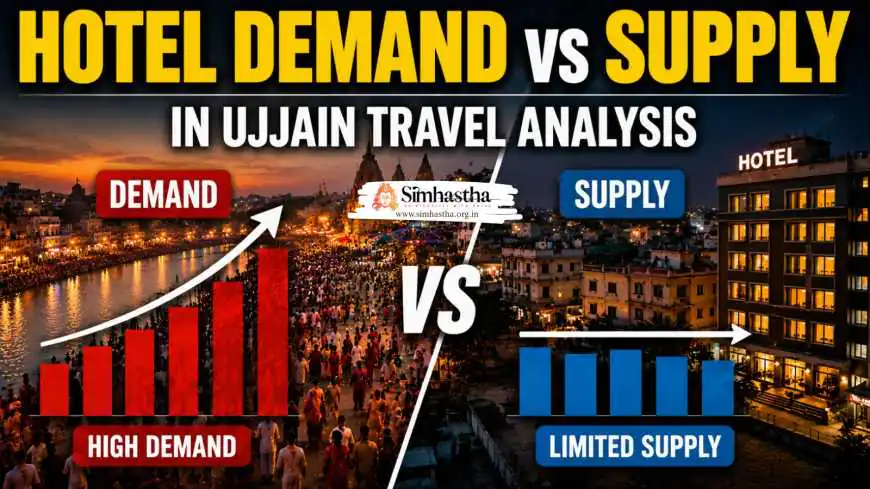


The Equation That Defines Every Ujjain Trip
Ask any pilgrim who has visited Ujjain during a festival week about their experience, and you will hear a similar story. The struggle to find a room. The shock of the prices. The relief when someone finally secures a bed. Behind every such story lies a simple, relentless equation: far more people wanting rooms than rooms available.
Understanding this hotel demand vs supply in Ujjain is not an academic exercise. It is the single most practical thing you can do to ensure your pilgrimage is focused on the divine rather than on desperate hotel hunting.
On a quiet Tuesday in February, Ujjain has more than enough hotel rooms. The market is balanced. Prices are reasonable. You can walk into a hotel and negotiate. On a weekend during Navratri or Mahashivratri, demand begins to strain supply. Prices rise. Advance booking becomes necessary. On the peak bathing days of Simhastha, the equation breaks entirely. Demand exceeds supply by a factor of thousands. The market ceases to function normally.
This analysis walks you through the numbers, the patterns, and the forces that shape Ujjain's hotel market. More importantly, it gives you the tools to predict availability and pricing for your travel dates. Because when you understand the equation, you stop being a victim of the market and start being a smart participant. 📊
Trending Guides Now

Affordable Hotels Near Ujjain Railway Station

Ultimate Hotel Booking Guide for Ujjain Visitors

15 Budget Hotels Near Mahakal Temple Ujjain Under ₹1500

Luxury Hotels Near Mahakaleshwar Temple Ujjain: Big Hospitality Boom Underway

Ujjain Railway Station to Mahakaleshwar Temple Distance (2026 Guide)

Ujjain Simhastha 2028 Dates Announced: Full Shahi Snan & Event Timeline

Triveni Ghat Ujjain – Simhastha 2028 Complete Guide

Ujjain to Mahakaleshwar Temple Distance & Taxi Fare (2026)
The Supply Side: What Ujjain Actually Has
Let me start with the hard numbers. Ujjain's hotel supply is not a single number. It varies by category, location, and season. But for analysis purposes, here is the permanent inventory.
Commercial hotels and guest houses: 7,150 to 9,400 rooms
Dharamshalas and ashrams: 3,000 to 4,000 beds
Total permanent accommodation: 10,000 to 13,400 sleeping units
These are distributed unevenly across the city. The old city near Mahakal Temple has only 600 to 800 rooms. Freeganj has 1,500 to 2,000 rooms. Nanakheda has 1,200 to 1,600 rooms. Madhav Nagar and the bypass road have 500 to 700 rooms. The railway station area has 1,200 to 1,600 budget rooms. The remaining rooms are scattered across other neighborhoods.
What this distribution means: The rooms that pilgrims most want—those within walking distance of Mahakal Temple—are the rarest. Only 6 to 8 percent of Ujjain's hotel rooms are in the old city. The majority are in Freeganj and Nanakheda, requiring a 10 to 15 minute auto ride. Understanding this geography is essential to understanding the demand-supply mismatch.
Seasonal supply variations: Unlike demand, supply is relatively fixed. New hotels open slowly. Dharamshalas do not expand significantly. During Simhastha, temporary tent cities add 16,000 to 28,000 beds, but these are not comparable to hotel rooms in terms of comfort or privacy. For most practical purposes, Ujjain's hotel supply is inelastic. It does not respond to price signals in the short term.
The Demand Side: Who Wants These Rooms and When
Hotel demand in Ujjain follows a predictable but extreme pattern. Let me break it down by season and pilgrim type.

Daily pilgrims (normal days): 25,000 to 50,000 visitors. This includes daily commuters from Indore and nearby towns, casual tourists, and small pilgrimage groups. Most do not stay overnight. Of those who do, demand is comfortably absorbed by the 10,000 to 13,400 rooms.
Weekend pilgrims (Friday-Sunday): 50,000 to 1,00,000 visitors. Weekend demand is significantly higher. Hotels in Freeganj and Nanakheda see 70 to 90 percent occupancy. Old city hotels are often fully booked. Prices rise 20 to 40 percent above weekday rates.
Festival pilgrims (Mahashivratri, Navratri, other major dates): 2 to 5 lakh visitors over 3 to 5 days. This is where the demand-supply balance tips. Old city hotels sell out 1 to 2 months in advance. Freeganj and Nanakheda see 90 to 100 percent occupancy. Prices double or triple. Pilgrims who have not booked in advance struggle.
Simhastha pilgrims (peak bathing dates): 3 to 5 crore visitors on a single day. The market breaks entirely. Commercial hotels are fully booked 6 to 12 months in advance. Prices increase 300 to 500 percent above normal rates. Most pilgrims on these days do not stay overnight. Those who do rely on tent cities, dharamshala overflow, or staying in Indore.
The demand pattern is not linear. It spikes dramatically on certain dates. Understanding these spikes is more important than understanding average demand.
The Gap: When Demand Exceeds Supply
Let me put numbers to the imbalance.
Normal day: Demand 5,000 to 10,000 overnight pilgrims. Supply 13,400 units. Gap is negative (supply exceeds demand). Market functions well.
Weekend: Demand 15,000 to 25,000 overnight pilgrims. Supply 13,400 units. Gap is 1,600 to 11,600 units short. Old city sells out. Freeganj tight. Prices rise.
Festival (Mahashivratri): Demand 50,000 to 1,00,000 overnight pilgrims. Supply 13,400 units. Gap is 36,600 to 86,600 units short. Widespread sellouts across all areas. Prices double or triple.
Simhastha peak bathing date: Demand 30 to 50 lakh overnight pilgrims (10 percent of 3-5 crore). Supply 13,400 permanent units plus 16,000 to 28,000 temporary beds. Gap is 24 to 47 lakh units short. Commercial hotels booked 6-12 months in advance. Temporary beds fill 1-3 months in advance. Thousands sleep on platforms, in waiting rooms, or in the open.
The gap is not uniform across all dates. On Simhastha peak days, the gap is so enormous that no amount of advance booking can accommodate everyone. The system relies on most pilgrims not needing overnight stays. This is by design, not by failure.
Geographic Imbalance: Where the Shortage Hurts Most
The citywide numbers hide a more important reality. The shortage is not evenly distributed.
Old city (Jaisinghpura, Choti Chaupati): 600 to 800 rooms. Demand from pilgrims who want walking access to Mahakal Temple is 5,000 to 10,000 people on festival days. The gap is immense. These rooms sell out first. They are also the most expensive per square foot.
Freeganj: 1,500 to 2,000 rooms. Demand is high but supply is larger. Freeganj acts as a buffer. When old city sells out, pilgrims move to Freeganj. Freeganj sells out next.
Nanakheda: 1,200 to 1,600 rooms. Slightly farther from the temple. Sells out after Freeganj. Popular with long-stay pilgrims and families using service apartments.
Madhav Nagar and bypass road: 500 to 700 rooms. Newer, more expensive, farther from temple. Sells out last among commercial areas.
Railway station area: 1,200 to 1,600 budget rooms. High turnover. Many overnight halts rather than multi-day stays. Sells out but often has last-minute availability due to cancellations.
What this means for you: If you want a room during high-demand periods, start your search in Freeganj. It has the largest inventory and the best balance of price, comfort, and temple access. Old city is for early birds with higher budgets. Nanakheda is for long stays and families. Madhav Nagar is for luxury seekers with cars.
Price Elasticity: How Demand Shapes Rates
When demand exceeds supply, prices rise. But the relationship is not linear. Let me explain Ujjain's hotel pricing dynamics.
Normal weekday rate (Freeganj mid-range): ₹1,800
Weekend rate: ₹2,200 to ₹2,500 (22 to 39 percent increase)
Festival week rate: ₹3,500 to ₹5,000 (94 to 178 percent increase)
Simhastha regular mela day: ₹4,000 to ₹6,000 (122 to 233 percent increase)
Simhastha peak bathing date: ₹8,000 to ₹15,000 (344 to 733 percent increase)
What drives these increases: Hotel owners know their rooms will sell out. They raise prices to capture the premium that desperate pilgrims are willing to pay. But there is a limit. At ₹15,000 per night, even wealthy pilgrims consider alternatives (staying in Indore, tent cities, adjusting travel dates). The market clears at the price where demand equals supply.
For budget pilgrims (under ₹2,000 per night), effective sellout happens much earlier than for luxury travelers. When prices cross ₹3,000, budget pilgrims exit the market. They move to dharamshalas, tent cities, or day trips from Indore. This is why budget rooms in dharamshalas (₹200-₹800) are the first to fill, despite being the least comfortable.
Temporal Patterns: When Demand Spikes
Let me give you a week-by-week and day-by-day breakdown.
Within a normal week:
-
Monday to Wednesday: Lowest demand. Best prices. Easy walk-ins.
-
Thursday to Friday: Rising demand. Book 1-2 weeks ahead.
-
Saturday: Peak demand. Book 2-4 weeks ahead.
-
Sunday: High demand but lower than Saturday. Afternoon drop-off as pilgrims return home.
Within the festival calendar:
-
Mahashivratri (February-March): 3-5 day peak. Book 2-3 months ahead.
-
Navratri (March-April or September-October): 9-day peak. Book 1-2 months ahead.
-
Shravan (July-August): Month-long elevated demand. Book 2-4 weeks ahead.
-
Kartik Purnima (November): 3-5 day peak. Book 1-2 months ahead.
Within Simhastha (2028):
-
Pre-mela period (2-3 weeks before first snan): Occupancy 60-80 percent. Book 4-6 months ahead.
-
Peak bathing dates (5-7 specific days): Occupancy 100+ percent. Book 8-12 months ahead.
-
Between peaks (days between major snans): Occupancy 70-90 percent. Book 4-6 months ahead.
-
Post-mela (1-2 weeks after last snan): Occupancy declining. Book 2-3 months ahead.
Understanding these temporal patterns allows you to time your trip for lower demand and better prices. If you can avoid weekends, festivals, and Simhastha peaks, you will pay 50 to 70 percent less for the same hotel room.
The Indore Effect: How a Nearby City Reshapes the Equation
No analysis of Ujjain's hotel demand-supply is complete without discussing Indore.
Indore is 55 kilometers away. Travel time is 1.5 hours by road or train. Indore has 15,000 to 20,000 hotel rooms across all categories. During Ujjain's peak demand periods, Indore's hotels absorb significant overflow.
How the math changes with Indore included:
-
Combined Ujjain + Indore permanent rooms: 25,000 to 33,400
-
Plus temporary tents in Ujjain: 16,000 to 28,000
-
Total regional capacity on Simhastha peak days: 41,000 to 61,400
Still far below 3-5 crore pilgrims, but significantly better than Ujjain alone.
Why more pilgrims don't use Indore: Lack of awareness about train schedules. Perception that staying in Ujjain is spiritually superior. Fear of missing early morning darshan. For healthy pilgrims willing to wake up at 3 AM, the Indore day-trip strategy is mathematically superior. You pay less, you sleep better, and you still experience the peak bathing day.
The Indore effect is strongest during Simhastha peaks and weakest during normal weekends. On a regular Saturday, the 15-minute auto ride from Freeganj to the temple is easier than the 1.5 hour train from Indore. But on a Simhastha peak day, when Ujjain hotels cost ₹10,000 and Indore hotels cost ₹2,000, the train ride becomes very attractive.
Capacity Utilization: What Percentage of Rooms Are Actually Filled
Let me give you occupancy rates across different periods.
Normal weekday (February, July-September): 30 to 50 percent occupancy. Ujjain has significant excess capacity. Hotels compete for guests. Prices are low. Walk-ins welcome.
Normal weekend (Friday-Sunday, non-festival): 60 to 80 percent occupancy. Freeganj and Nanakheda see 70-85 percent. Old city sees 90-100 percent. Prices moderate. Advance booking recommended.
Festival weekend (Mahashivratri, Navratri): 90 to 100 percent occupancy citywide. Old city 100 percent weeks in advance. Freeganj 95-100 percent. Nanakheda 90-95 percent. Prices high. Advance booking essential.
Simhastha regular mela day (between peaks): 85 to 95 percent occupancy. Some rooms available in Nanakheda and Madhav Nagar. Freeganj tight. Old city fully booked. Prices very high.
Simhastha peak bathing date: 100+ percent occupancy (counting temporary beds). Commercial hotels 100 percent booked months in advance. Tent cities 90-100 percent full. Dharamshala overflow fully utilized. Effective capacity exceeds 100 percent through cots in corridors and courtyards.
The utilization pattern tells a clear story. Most of the year, Ujjain has excess hotel capacity. During festivals, capacity is stretched. During Simhastha peaks, capacity is overwhelmed. Your booking strategy should mirror these patterns.
Forecasting for 2028: What Will Change
Between now and Simhastha 2028, several factors will shift the demand-supply balance.
New hotel construction: 1,500 to 2,500 new rooms will come online, concentrated in Nanakheda Extension, Madhav Nagar, and the bypass road. This is a 15 to 20 percent increase in permanent inventory. Helpful, but not transformative for peak days.
Improved transport infrastructure: The Ujjain-Indore four-lane highway will reduce travel time to under 1 hour. This makes day-tripping from Indore more attractive, potentially reducing demand for Ujjain overnight stays.
Government tent city expansion: The state plans to increase temporary bed capacity by 20 to 30 percent compared to 2016. This will absorb some overflow demand.
Aggregator penetration: More budget hotels and guest houses will list online, improving transparency. However, this also increases competition for the same limited rooms.
Pilgrim awareness: More pilgrims will understand the Indore day-trip strategy, potentially spreading demand geographically.
The net effect: On regular mela days, finding a room will be slightly easier in 2028 than in 2016. On peak bathing dates, the situation will remain extremely tight. The fundamental imbalance—13,000 permanent rooms for 3-5 crore pilgrims—cannot be fixed with incremental supply increases.
What the Analysis Means for Your Trip
After all these numbers, let me give you practical conclusions.
If you are traveling on a normal weekday: You do not need to book far in advance. You can walk into a Freeganj hotel and negotiate. Prices will be reasonable. Enjoy the flexibility.
If you are traveling on a weekend: Book 2 to 4 weeks in advance for Freeganj hotels. Old city may require 1 to 2 months. Prices will be 20 to 40 percent above weekday rates. Not stressful, but not walk-in friendly.
If you are traveling during a major festival (Mahashivratri, Navratri): Book 2 to 3 months in advance for Freeganj. Old city requires 3 to 4 months. Expect prices to double or triple. Have a backup plan in Indore.
If you are traveling during Simhastha regular mela days: Book 4 to 6 months in advance. Freeganj and Nanakheda are your best bets. Old city will be very difficult. Consider tent cities or Indore as primary options.
If you are traveling during Simhastha peak bathing dates: Book 8 to 12 months in advance for commercial hotels. Accept that you may not find a room. Have a clear primary strategy (tent city, Indore day-trip, or arriving early and staying through the peak). Do not assume you will find a last-minute room.
The Human Side of the Equation
After all the analysis, I want to leave you with something the numbers cannot capture.
The demand-supply gap in Ujjain is not a failure. It is a testament to faith. Millions of people wake up before dawn, travel for hours, stand in queues for longer, and sleep wherever they can find space—all for a few seconds in front of Lord Mahakal.
The hotels sell out because the devotion does not. The prices rise because the pull of the temple is stronger than the pull of a reasonable budget. The math is brutal. But the love behind the math is beautiful.
You will figure out your room. You may pay more than you want. You may stay farther than you hoped. You may sleep in a tent or on a train. And then you will stand in the queue, and you will see Him, and you will forget every number in this analysis.
That is the final equation. Demand for the divine will always exceed supply. And somehow, impossibly, everyone who truly seeks finds a way.
Plan smart. Book early. And then let go. The Kshipra is waiting. 🙏
Frequently Asked Questions