



















How Tent Allocation Is Prioritised During Peak Shahi Snan Days
During peak Shahi Snan days, Simhastha tent allocation follows strict priority frameworks based on safety, ritual hierarchy, crowd pressure, and administrative control.
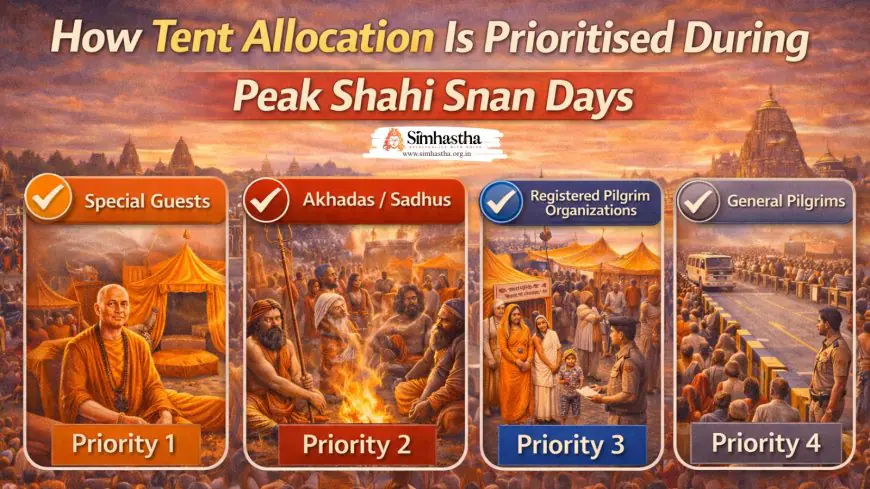


Why Tent Allocation Becomes Critical During Shahi Snan Days
During ordinary days, Simhastha tent allocation is a logistical task. During peak Shahi Snan days, it becomes a safety-critical governance function. These days witness the highest Simhastha footfall, concentrated within narrow ritual windows, placing immense pressure on accommodation, movement corridors, sanitation, and emergency response systems.
Unlike hotels or private lodging, the Simhastha tent city is not allocated on a first-come basis. Especially during Shahi Snan peak days, tent allocation follows a strict prioritisation hierarchy designed to protect ritual order, crowd stability, and administrative control.
This system is not visible to most pilgrims, but it determines whether Simhastha flows or fractures.
For Every pilgrims, understanding Simhastha 2028 dates and the official Shahi Snan timeline is essential before booking flights or accommodation, as these sacred dates are completely non-negotiable.
Trending Guides Now

How to Choose the Right Hotel in Ujjain Near Mahakal

Where Pilgrims Stay During Ujjain Simhastha Event

Family Friendly Hotels Near Mahakal Corridor

Best Hotels in Freeganj Ujjain Near City Center

Ujjain Railway Station to Mahakaleshwar Temple Distance (2026 Guide)

Ujjain Simhastha 2028 Dates Announced: Full Shahi Snan & Event Timeline

Ujjain Simhastha Update: CM Mohan Yadav Reviews 2028 Works

Karkateshwar Mahadev: 22/84 Mahadev of Ujjain
The Core Principle: Safety Overrides Convenience
The first rule of tent allocation during Shahi Snan is simple. Safety overrides convenience.
On peak bathing days, accommodation decisions are made to:
-
Reduce long-distance pedestrian movement
-
Prevent cross-sector congestion
-
Keep vulnerable groups closer to essential services
-
Preserve ritual routes for Akharas


This is why Simhastha accommodation planning during Shahi Snan is inseparable from crowd management strategy.
Priority Category One: Akharas and Ritual Institutions
At the top of the Simhastha tent allocation priority list are Akharas and recognised religious institutions. Their placement is determined months in advance and remains non-negotiable on Shahi Snan days.
This is because:
-
Akharas lead Shahi Snan processions
-
Their movement sets the ritual timetable
-
Any disruption affects the entire bathing sequence
Akhara tent allocation in Simhastha is always located close to designated procession routes and ghats, ensuring uninterrupted ritual flow and minimizing cross-crowd interference.
To deepen your understanding of the spiritual customs and sacred rituals practiced during Ujjain Simhastha, read our complete Simhastha rituals and sacred practices guide that explains their meaning, timing, and significance.
Priority Category Two: Saints, Sadhus, and Religious Orders
Following Akharas, sants, sadhus, and organised religious orders receive high-priority tent allocation. These groups often follow strict schedules tied to pre-dawn rituals.
Allocating their tents within accessible zones:
-
Prevents early-morning surges
-
Reduces nighttime movement pressure
-
Maintains spiritual discipline
This layer of tent city management in Simhastha is as much about spiritual respect as it is about crowd control.
Priority Category Three: Elderly, Divyang, and Medically Dependent Pilgrims
On peak Shahi Snan days, vulnerable pilgrims are prioritised in tent allocation. Elderly devotees, people with disabilities, and those requiring medical support are placed closer to:
-
Medical tents
-
Ambulance routes
-
Low-gradient walking corridors
This prioritisation is central to Simhastha safety planning. Reducing walking distance for vulnerable groups directly reduces medical emergencies during peak crowd hours.
Priority Category Four: Administrative and Emergency Services
Often overlooked, administrative and emergency staff accommodation is a critical priority. On Shahi Snan days, police, sanitation teams, medical staff, and disaster response units must remain operational for extended hours.
Their tents are strategically placed to ensure:
-
Rapid deployment
-
Short response time
-
Continuous shift rotation
Without this layer, Simhastha peak day planning would collapse under fatigue and delay.
first time Simhastha guide is essential because without contextual understanding, pilgrims arrive prepared for devotion but unprepared for logistics, stamina, patience, and adaptability.
Sector-Based Tent Allocation to Prevent Bottlenecks
One of the most important aspects of Simhastha tent allocation during peak days is sector-based distribution. Instead of clustering tents near popular ghats, accommodation is spread across sectors.
This ensures:
-
Balanced footfall across corridors
-
Reduced pressure on single entry points
-
Predictable movement patterns
Sector-based tent allocation converts accommodation into a crowd regulation tool, not just a sleeping arrangement.
Dynamic Allocation Adjustments During Shahi Snan
Unlike normal days, tent allocation during Shahi Snan is dynamic. Authorities may:
-
Temporarily restrict new allotments in high-pressure sectors
-
Redirect late-arriving pilgrims to outer zones
-
Activate buffer tent areas
This flexibility allows Simhastha crowd pressure management to respond to real-time conditions rather than rigid plans.
Also Read | Best Time to Visit Ujjain Simhastha 2028
Why General Pilgrims Are Often Allocated Farther Away
Many pilgrims wonder why they are allocated tents farther from ghats on Shahi Snan days. The reason is not neglect. It is design.
By placing general pilgrims in outer sectors:
-
Inner zones remain fluid for ritual movement
-
Emergency access remains clear
-
Peak-hour density near ghats is controlled
This is a deliberate feature of Simhastha accommodation strategy, not a limitation.
Sanitation and Water Load as Allocation Factors
Tent allocation during Shahi Snan also considers sanitation load and water supply capacity. High-density accommodation zones are matched with enhanced sanitation and water infrastructure.
Ignoring this balance would create hygiene crises within hours. This is why Simhastha infrastructure planning directly influences where tents are allocated.
Also Read | Step-by-Step Guide to Shipra Snan at Ujjain Kumbh Mela
Night-Time Reallocation and Holding Arrangements
During peak days, authorities may use night-time reallocation strategies. Pilgrims arriving late may be directed to temporary holding tents or short-stay shelters until pressure eases.
This ensures that dawn Shahi Snan hours begin with controlled movement rather than overnight congestion.
Why Tent Allocation Is a Crowd-Control Tool, Not a Service
The most important insight is this.
Tent allocation during peak Shahi Snan days is not a hospitality service. It is a crowd-control mechanism.
Every placement decision influences:
-
Walking distance
-
Corridor load
-
Emergency access
-
Ritual timing
This is why Simhastha tent city management operates with strict prioritisation logic, even when it appears inconvenient.
How This Model Scales for Simhastha 2028
With Simhastha 2028 expected to witness even higher footfall, the principles used today are being strengthened, digitised, and expanded.
The prioritisation framework remains unchanged because it works. It protects devotion by preventing disorder.
Also Read | Common Simhastha Mistakes Visitors Must Avoid
Related Simhastha Guides:
- What Happens Inside a Simhastha Tent City After Midnight
- How Tent City Kitchens Serve Millions at Simhastha 2028 ?
- Luxury vs Budget Tent Options for Simhastha 2028: What’s Worth Your Money?
- Inside Ujjain’s Mega Tent City: What Pilgrims Can Expect at Simhastha 2028
- How Sector-Based Movement Will Control Crore-Level Crowds in Simhastha 2028
- How Akhara Camps Are Allocated in Ujjain for Simhastha 2028
- How Crowd Density Is Calculated During Simhastha 2028 ?
- How Sector-Based Crowd Flow Works in Simhastha: A Simple Guide for First-Time Visitors
- Kshipra Riverfront Zones: What Pilgrims Must Know for Simhastha 2028
- Expected Zones & Sectors of Simhastha 2028: A First Look at Ujjain’s Massive Layout
- How Simhastha 2028 Will Transform Ujjain Forever: Dates, Mega Projects & City-Wide Development Plan
- Simhastha 2028 Dates Officially Announced: Full Event & Shahi Snan Timeline
- Simhastha 2028 Ujjain Visiting Guide: Best Dates, Shahi Snan Meaning & Pilgrim Planning
- Big Update: Who Will Handle the Ujjain–Maksi Four-Lane Road and When Does It Start?”
- Indore–Ujjain Six-Lane Highway nearing completion — big step for regional growth!
Frequently Asked Questions