


















How Akhara Camps Are Allocated in Ujjain for Simhastha 2028
Understand how akhara camps are allocated in Ujjain for Simhastha 2028, including sector planning, logistics, safety rules, and administrative process.



How Akhara Camps Are Allocated in Ujjain: Sector Logistics for Simhastha 2028
Akhara camps form the operational and spiritual backbone of Ujjain Simhastha. Their placement is neither symbolic nor improvised. Long before pilgrims arrive and rituals begin, a highly disciplined system determines where each Akhara will live, move, and operate. For Simhastha 2028, Akhara camp allocation in Ujjain follows a sector-based logistical framework designed to preserve ritual hierarchy while ensuring safety, mobility, and administrative control at an unprecedented scale.
Unlike common assumptions, Akhara camps are not simply placed near the river based on status or visibility. Their allocation reflects a complex convergence of Sanatan tradition, administrative law, disaster management principles, and crowd science. This system has evolved across multiple editions of Simhastha Kumbh Mela, learning from past successes and failures, and adapting to rising pilgrim volumes and modern safety requirements.
Understanding how Akhara camps are allocated is essential to understanding how Ujjain Kumbh Mela 2028 functions without collapsing into chaos.
Trending Guides Now

How Sector-Based Crowd Flow Works in Simhastha: A Simple Guide for First-Time Visitors

Why Simhastha Zones Are Reconfigured Between Major Snan Days

How Pilgrim Holding Areas Prevent Stampede Risks in Simhastha

How Crowd Density Is Calculated During Simhastha 2028 ?

Ujjain Railway Station to Mahakaleshwar Temple Distance (2026 Guide)

Ujjain Simhastha 2028 Dates Announced: Full Shahi Snan & Event Timeline

Ujjain Simhastha Update: CM Mohan Yadav Reviews 2028 Works

Karkateshwar Mahadev: 22/84 Mahadev of Ujjain
Pilgrims who need certainty for travel and accommodation planning should always refer to the officially confirmed Simhastha 2028 dates and Shahi Snan schedule published separately.
How Akharas Decide Camp Locations Long Before Simhastha Begins
One of the least understood aspects of Simhastha is timing. Akhara camp locations are not decided during the festival year. They are negotiated, documented, and finalized far in advance through a layered process involving religious councils and state administration.
This early planning is not optional. It is necessary.
Akhara movements affect:
-
Shahi Snan processions
-
Ghat access discipline

-
Pedestrian and emergency corridors
-
Inter-Akhara protocol
-
Security zoning

Because of this, Akharas begin internal planning months, sometimes years, before arriving in Ujjain.
Role of Akhil Bharatiya Akhara Parishad
The Akhil Bharatiya Akhara Parishad acts as the central spiritual authority coordinating Akhara-related matters. While it does not directly allocate land, it plays a decisive role in:
-
Verifying Akhara legitimacy and lineage
-
Establishing inter-Akhara precedence
-
Coordinating ritual order and protocol
-
Acting as the primary interface with state authorities
Before any administrative mapping begins, the Parishad ensures that only recognized Akharas participate under defined norms. This prevents disputes, duplication, and unauthorized claims.
Internal Akhara Planning Before Registration
Each Akhara conducts its own internal assessment before approaching the administration. This includes:
-
Estimating the number of sadhus and disciples
-
Determining tent layouts and internal zoning
-
Identifying proximity needs for ghats or procession routes
-
Assigning internal coordinators and discipline heads
Only after this internal clarity does an Akhara formally enter the registration and allocation process.
To understand the deeper spiritual foundation behind this pilgrimage, readers may explore the complete explanation of Simhastha and its spiritual meaning in Ujjain.
Who Controls Akhara Camp Allocation in Ujjain
Final authority over Akhara camp placement rests with the Simhastha administrative framework, operating under the state government. This centralized control is non-negotiable, regardless of an Akhara’s spiritual stature.
The administration’s role is not to override tradition, but to translate it into a workable spatial system.
Key administrative responsibilities include:
-
Verifying Akhara registration and credentials
-
Assessing projected camp population and infrastructure demand
-
Mapping Akhara needs against available sector capacity
-
Ensuring compliance with safety, sanitation, and access norms
-
Preventing overlap, congestion, or route obstruction
To manage this, a dedicated liaison structure is established, allowing continuous communication between Akhara representatives and administrative officers.
Registration Comes Before Location Allocation
No Akhara receives land by default. Registration is the first and mandatory step.
Each Akhara must submit detailed documentation, including:
-
Official Akhara name and lineage identification
-
Authorization letters from recognized leadership
-
Estimated number of residents and visitors
-
Tent counts, kitchen areas, and utility requirements
-
Internal discipline and security arrangements
Only after verification does spatial planning begin. Incomplete or delayed submissions often result in secondary placement or revised allocations.
This process ensures predictability and prevents last-minute disputes that could destabilize Simhastha Kumbh Mela operations.
Sector-Based Planning: How Ujjain Is Divided
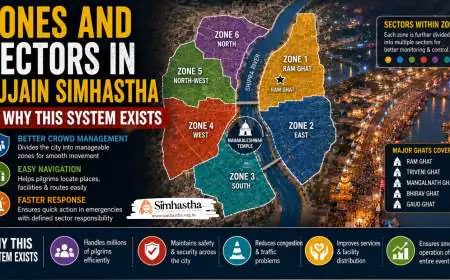
For Simhastha 2028, Ujjain is divided into numbered, functional sectors spanning the Shipra River zone and connected hinterland areas. Each sector operates as a controlled micro-city.
Every sector includes:
-
Clearly demarcated boundaries
-
Dedicated entry and exit routes
-
Emergency access lanes
-
Water, power, and sanitation nodes
-
Medical and fire response points
Akhara camps are placed within these predefined sectors rather than on open or informal land. This ensures uniform infrastructure, predictable movement, and enforceable discipline.
Sector-based planning allows the administration to manage millions of pilgrims while maintaining Akhara autonomy within assigned boundaries.
For ongoing announcements, planning resources, and verified information, pilgrims can always refer to the official Simhastha 2028 guide and updates portal.
How Akhara Priority Is Determined
Priority in camp allocation does not mean privilege. It means sequence and suitability.
Factors influencing placement include:
-
Traditional Shahi Snan precedence
-
Size and scale of the Akhara
-
Ritual proximity requirements
-
Compliance history from previous Simhasthas
-
Ability to maintain internal discipline
Senior Akharas with established precedence are positioned to support ceremonial order, but never at the cost of safety or infrastructure overload.
This balance preserves dignity without destabilizing logistics.
Why All Akharas Are Not Placed Near the Ghats
A common misconception among pilgrims is that every Akhara must be located directly on the riverbank. This is neither practical nor desirable.
In reality:
-
Only select Akharas require immediate ghat adjacency
-
Many camps function efficiently from inland sectors
-
All sectors maintain controlled ghat access corridors
This approach reduces stampede risk, protects river ecology, and improves emergency response time.
At Ujjain Simhastha, proximity is managed, not assumed.
The Temporary City Model of Simhastha
Simhastha 2028 follows a temporary mega-city model. Akhara camps are not permanent settlements. They are modular, reversible, and strictly regulated.
This model ensures:
-
Zero permanent land alteration
-
Post-event ecological restoration
-
Flexible infrastructure scaling
Each Akhara sector includes:
-
Temporary metal or tar roads
-
Bio-toilets and waste management units
-
Drinking water supply and backup systems
-
Controlled electrical connections
Permanent construction is prohibited. Violations invite penalties or relocation.
Also Read | Best Time to Visit Ujjain Simhastha 2028
Arrival, Staging, and Camp Activation
Akhara arrival follows a phased and scheduled protocol.
The process includes:
-
Arrival at designated staging zones outside core areas
-
Identity verification and health screening
-
Movement through fixed corridors
-
Controlled setup windows for tents and kitchens
This sequencing prevents congestion, maintains ceremonial order, and allows authorities to monitor population inflow.
Unscheduled arrivals are restricted.
Security and Discipline Inside Akhara Sectors
Each Akhara sector operates under a micro-security framework.
This includes:
-
Assigned local police units
-
Volunteer marshals and home guards
-
Restricted vehicle access after setup
-
Night patrols and lighting control
Akhara leadership appoints internal coordinators who liaise directly with administration during emergencies or protocol adjustments.
Security is cooperative, not confrontational.
Mobility Planning Around Akhara Camps
Sector placement directly influences pilgrim movement across Ujjain.
Therefore:
-
Akhara sectors align with major pedestrian corridors
-
Shuttle routes avoid camp interiors
-
One-way pedestrian flows are enforced on peak days
-
Emergency evacuation routes remain unobstructed
No Akhara is permitted to modify routes, erect barriers, or divert flow independently.
Movement discipline protects both pilgrims and ascetics.
Environmental and Cultural Discipline
Akhara camps are bound by strict environmental and cultural guidelines.
They must:
-
Avoid damage to riverbanks and vegetation
-
Follow waste segregation protocols
-
Restrict loud activities during early hours
-
Maintain decorum with neighboring camps
Post-Simhastha restoration is mandatory. Land must be returned to original condition.
What Akharas Must Be Prepared For
Before arrival, Akharas are expected to ensure:
-
Compliance with assigned land dimensions
-
Fire safety arrangements
-
Internal sanitation teams
-
Clear identification signage
-
Dedicated coordination staff
Non-compliance can result in relocation or restriction of activities.
Why This System Works
The sector-based Akhara allocation framework ensures:
-
Ritual dignity without disorder
-
Safety without spiritual compromise
-
Equal infrastructure access
-
Predictable crowd behavior
This is why Simhastha can scale to millions without losing discipline.
Akhara camps are not just tents.
They are institutional spiritual spaces.
Their placement reflects centuries of tradition functioning through modern logistical intelligence.
That is how Ujjain Simhastha remains ancient, resilient, and operational.
Also Read | Step-by-Step Guide to Shipra Snan at Ujjain Kumbh Mela
Inter-Akhara Coordination: Preventing Conflict Before It Appears
At Ujjain Simhastha, the absence of visible conflict is not accidental. It is the result of structured inter-Akhara coordination that begins long before camps are erected. Akharas do not operate in isolation. Their proximity, procession order, and movement windows are carefully synchronized to prevent friction.
Coordination mechanisms include:
-
Pre-event consensus meetings facilitated by the Akhil Bharatiya Akhara Parishad
-
Written acknowledgment of sector boundaries and movement corridors
-
Clearly defined Shahi Snan procession sequences
-
Protocol agreements for shared access routes and buffer zones
This framework ensures that disputes are resolved on paper, not on the ground. At the scale of Simhastha Kumbh Mela, even minor misunderstandings can escalate quickly. Preventing ambiguity is therefore a core objective.
Buffer Zones and Why They Matter More Than Visibility
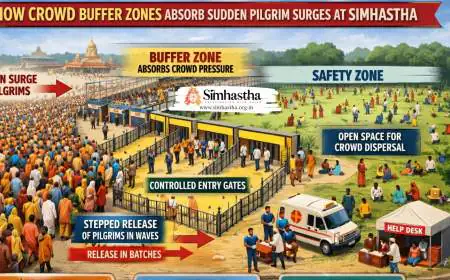
One of the most critical yet invisible elements of Akhara camp planning is the creation of buffer zones. These are deliberately unoccupied strips of land between:
-
Two Akhara sectors
-
Akhara camps and major pedestrian corridors
-
Camps and sensitive infrastructure
Buffer zones serve multiple purposes:
-
Absorb unexpected crowd spillover
-
Allow emergency vehicle maneuvering
-
Prevent sound, movement, or ritual overlap
-
Provide tactical space during peak processions
Pilgrims often mistake these empty spaces as inefficiencies. In reality, they are safety margins designed after decades of learning from Simhastha and other Kumbh gatherings.
How Shahi Snan Logistics Shape Camp Geography
Shahi Snan is not only a ritual event. It is the single largest logistical stress test of Ujjain Simhastha. Akhara camp geography is therefore designed backward from Shahi Snan requirements.
Key considerations include:
-
Distance from camp to assigned ghat
-
Width and gradient of procession routes
-
Holding areas before river access
-
Exit dispersal routes after bathing
Camps of Akharas leading Shahi Snan are placed to minimize cross-flow with general pilgrims. This reduces pressure points and preserves ceremonial dignity. Other Akharas are positioned to join the ritual sequence without intersecting routes.
This choreography allows Simhastha 2028 to conduct Shahi Snan with order despite massive attendance.
Lessons Learned From Past Simhasthas
The current allocation model did not emerge fully formed. It evolved through trial, error, and post-event audits.
Past challenges included:
-
Overcrowded riverbank camps causing choke points
-
Unregulated vehicle movement inside camp zones
-
Informal extensions of camp boundaries
-
Inadequate sanitation near high-density sectors
Each Simhastha generated administrative reports, which directly influenced future planning. Sector standardization, modular infrastructure, and strict boundary enforcement are outcomes of these lessons.
The present framework reflects institutional memory accumulated across generations of Ujjain Simhastha.
Why Informal or “Floating” Camps Are Not Allowed
Occasionally, smaller groups or unregistered ascetic collectives attempt to establish informal camps. These are not permitted.
Reasons include:
-
Lack of accountability
-
Absence of sanitation and safety oversight
-
Disruption of planned pedestrian flows
-
Increased emergency response risk
Only registered Akharas with verified leadership structures are allowed dedicated camps. This protects both pilgrims and ascetics while preserving the integrity of Simhastha Kumbh Mela.
Internal Discipline Within Akhara Camps
Administrative order alone cannot sustain Simhastha. Internal Akhara discipline plays a decisive role.
Each Akhara is responsible for:
-
Managing internal crowd behavior
-
Enforcing silence or restraint during sensitive hours
-
Coordinating volunteer marshals
-
Preventing encroachment beyond assigned boundaries
The administration intervenes only when internal mechanisms fail. This layered responsibility model reduces friction and maintains respect between spiritual and civic authorities.
Also Read | Common Simhastha Mistakes Visitors Must Avoid
Communication Systems During Simhastha
Modern Simhastha 2028 planning integrates traditional discipline with contemporary communication tools.
These include:
-
Dedicated sector control rooms
-
Real-time communication between Akhara coordinators and officials
-
Emergency alert systems
-
Crowd density monitoring inputs
This allows rapid response without visible enforcement, preserving the sanctity of Akhara spaces while ensuring public safety.
Handling Disputes When They Arise
Despite planning, disputes can still occur. When they do, resolution follows a strict escalation protocol.
The sequence is:
-
Internal Akhara resolution
-
Mediation by Akhara Parishad representatives
-
Administrative intervention only if required
Direct enforcement is the last resort. This hierarchy ensures that tradition resolves tradition wherever possible, keeping Ujjain Simhastha spiritually grounded.
Why Akhara Camp Placement Determines Simhastha Stability
At the scale of Simhastha, Akhara camps are not peripheral elements. They are structural anchors.
Their placement influences:
-
Crowd psychology
-
Pilgrim movement patterns
-
Ritual flow
-
Emergency response effectiveness
Well-placed camps create natural order. Poorly placed camps amplify chaos. This is why camp allocation receives attention equal to ghats, bridges, and transport planning.
The Deeper Logic Behind the System
What appears administrative on the surface is deeply philosophical underneath. Simhastha operates on the principle that spiritual intensity must be supported by structural restraint.
Freedom without order collapses.
Order without reverence alienates.
The Akhara allocation system balances both.
Why This Model Will Continue Beyond 2028
As pilgrim numbers grow and expectations rise, this framework is not temporary. It represents the future of large-scale spiritual gatherings in India.
Its strengths lie in:
-
Respect for tradition
-
Predictability for planners
-
Safety for pilgrims
-
Autonomy for Akharas
This is why Ujjain Kumbh Mela 2028 is not reinventing Akhara logistics, but refining them.
The Silent Achievement of Simhastha Planning
When Simhastha functions smoothly, the planning disappears from view. Pilgrims see devotion, not diagrams. Rituals unfold without visible control.
That invisibility is the success.
Akhara camps stand quietly, disciplined and ordered, enabling millions to participate without fear.
This is not accidental.
This is design.
And it is why Simhastha continues to endure as both a spiritual and civilizational institution.
How Ujjain’s Akhara Allocation Differs From Other Kumbh Locations
While Akhara camps exist at every Kumbh, Ujjain Simhastha operates under conditions that are structurally and spiritually distinct. Comparing Ujjain with Prayagraj, Haridwar, and Nashik reveals why its camp allocation system is more controlled, more compact, and more sensitive to spatial discipline.
Unlike Prayagraj, which spreads across a vast floodplain, Ujjain functions within a historically dense city fabric. The Shipra River is narrower, the ghats are closer together, and ancient neighborhoods sit immediately adjacent to ritual zones. This leaves little margin for improvisation.
As a result, Akhara camp placement in Ujjain Simhastha must be more precise. Sector boundaries are tighter. Buffer zones are carefully engineered. Movement corridors are shorter but more strictly regulated. What works in open plains cannot be replicated here.
Why Ujjain Requires Tighter Camp Discipline
At Simhastha Kumbh Mela, discipline is not symbolic. It is spatially enforced.
Ujjain’s challenges include:
-
Limited riverfront width
-
Proximity of residential zones to ritual areas
-
High pedestrian density over short distances
-
Multiple sacred sites operating simultaneously
Because of this, Akhara camps cannot expand organically. Every tent, kitchen, and assembly area must fit within pre-approved limits. This is why enforcement in Ujjain Simhastha appears stricter than at other Kumbh locations.
The city itself demands it.
The Role of Sacred Geography in Camp Placement
Ujjain is not just a host city. It is a living sacred geography anchored by Mahakal and the Shipra River. Camp placement respects this geography.
Certain zones are restricted due to:
-
Temple influence corridors
-
Ancient processional paths
-
Archaeological sensitivity
-
Ritual sightlines
Akhara camps are deliberately positioned to avoid visual, acoustic, or movement interference with these sacred alignments. This is one reason why some camps appear farther from the river despite their importance.
At Ujjain Simhastha, sanctity is protected not by proximity, but by placement.
Why Simhastha Cannot Follow a One-Size-Fits-All Model
Administrative models from other Kumbhs are studied, but not copied wholesale. Simhastha requires customization.
For example:
-
Vehicle exclusion zones are larger relative to area
-
Pedestrian-only corridors dominate movement planning
-
Emergency access must be vertical and lateral within compact zones
-
Camp density must remain lower despite high attendance
This is why Akhara allocation at Ujjain Kumbh Mela 2028 appears conservative. It is designed for resilience, not spectacle.
How Camp Placement Shapes Pilgrim Psychology
A rarely discussed aspect of Akhara logistics is its impact on pilgrim behavior.
Well-spaced camps:
-
Reduce visual congestion
-
Lower perceived crowd pressure
-
Encourage slower movement
-
Create psychological breathing space
When camps are orderly, pilgrims subconsciously follow order. When camps sprawl, anxiety spreads. The discipline of Akhara placement directly influences how pilgrims experience Simhastha emotionally.
This is not incidental. It is intentional design.
Akhara Camps as Institutional Anchors
At Ujjain Simhastha, Akhara camps function as more than residences. They are institutional anchors.
They provide:
-
Points of orientation for pilgrims
-
Stability during peak crowd surges
-
Cultural continuity across generations
-
Moral authority within the temporary city
Their fixed, disciplined placement creates reference points in an otherwise fluid environment. This is why Akhara camps are never treated as temporary inconveniences, but as structural necessities.
Why Akhara Allocation Is Final and Rarely Changed
Once camps are activated, changes are avoided unless absolutely necessary. Relocation disrupts:
-
Procession timing
-
Security zoning
-
Utility networks
-
Crowd routing
For this reason, Simhastha planning prioritizes correctness over flexibility. Adjustments are made early, not during the event.
This stability is why large-scale failure is rare despite enormous attendance.
The Long-Term Impact of Akhara Planning
Although camps are dismantled after Simhastha Kumbh Mela, their planning leaves lasting impact.
Infrastructure decisions influenced by Akhara placement often guide:
-
Permanent road upgrades
-
Future ghat improvements
-
Emergency planning templates
-
City-scale crowd management models
In this way, Akhara logistics quietly shape Ujjain’s urban evolution beyond the festival itself.
Why This System Endures
The Akhara allocation system endures because it balances three forces:
-
Spiritual hierarchy
-
Administrative discipline
-
Human behavior
Remove any one, and the system collapses.
This balance is why Ujjain Simhastha remains functional at a scale that would overwhelm ordinary urban systems.
The Larger Meaning Behind Camp Allocation
At a deeper level, Akhara camp placement reflects the philosophy of Simhastha itself. Spiritual power is acknowledged, but it is never allowed to override collective safety. Authority exists, but it is bounded by responsibility.
This is not compromise. It is wisdom.
When Order Becomes Invisible
When Simhastha works, its most complex systems disappear from notice. Pilgrims see devotion, not diagrams. Movement feels natural, not enforced.
That invisibility is the success of Akhara planning.
Camps stand in quiet discipline. Processions flow without rupture. Millions move without panic.
This is not coincidence.
This is the result of a system refined across centuries, operating with modern intelligence, and anchored in Sanatan order.
This is how Ujjain Simhastha sustains both faith and function at the same time.
Related Simhastha 2028 Guides :
Frequently Asked Questions